

Could chiropractic help a child with ADHD, or are families being asked to treat a complex neurodevelopmental condition as though it were a spinal problem? That question sits underneath most searches for chiropractic for ADHD. Parents are often tired, worried, and looking for a gentle way to ease even one part of a child's daily struggle, not necessarily a miracle cure.
ADHD is a recognized neurodevelopmental condition. Medication, behavioral therapy, parent training, and educational support remain important parts of care for many children. Chiropractic may be considered as a complementary option for specific concerns, such as discomfort or movement-related issues, but families deserve a clear distinction between supportive care and treatment that has been proven to change ADHD itself.
This guide explains the nervous-system theory behind chiropractic, what the research shows, what a pediatric visit may involve, and how to make a careful decision without stopping effective care or accepting exaggerated promises.
What Parents Are Really Asking About Chiropractic for ADHD
The question usually isn't, “Can an adjustment cure ADHD?” Most parents are really asking, “Could this help my child sleep, regulate emotions, tolerate sensory input, or get through the school day with less distress?” Those are meaningful goals, but they aren't all the same as treating the core features of ADHD.
A responsible conversation starts by separating three ideas:
- ADHD treatment: Medication, behavioral interventions, parent training, and school-based support have a central role in established ADHD care.
- Support for associated difficulties: A child may also experience poor sleep, anxiety, sensory sensitivities, muscle tension, headaches, or discomfort. Those concerns may deserve their own assessment.
- Chiropractic claims: Chiropractic care may focus on spinal movement and nervous-system function, but that doesn't establish it as an ADHD treatment.
A useful starting point: Ask what specific, observable problem you want to address. “Better attention” is broad. “Fewer bedtime struggles” or “less discomfort after sitting at school” gives a family and clinician something more practical to monitor.
The evidence matters because children deserve treatments matched to what research can support. The first major systematic review on chiropractic care for pediatric and adolescent ADHD described itself as an “empty review”, meaning it found no high-quality trials that could establish effectiveness. It also characterized claims of improved ADHD symptoms as based on low-level scientific evidence. The historical review and its findings are available through this evidence summary.
That doesn't mean a family can't explore chiropractic for another reason. It means a practitioner should explain what care can and can't reasonably promise, invite questions, and work alongside the child's pediatrician, mental-health professionals, therapists, and school team.
How the Nervous System Theory Connects to ADHD
Chiropractic approaches often begin with the idea that the brain and body communicate continuously through the nervous system. Signals from joints, muscles, skin, and movement travel toward the brain, while the brain sends instructions back to coordinate posture, movement, attention, and regulation.
A simple analogy is a busy airport control tower. Pilots and controllers exchange messages constantly. If radio traffic becomes noisy, the tower may have more difficulty coordinating arrivals and departures. Chiropractors theorize that altered spinal motion or physical tension could add “static” to sensory communication and affect how a child manages movement, attention, or sensory input.
That analogy describes a working hypothesis, not a proven explanation for ADHD. ADHD isn't defined as a spinal misalignment, and chiropractors shouldn't present an adjustment as a way to correct the biological cause of the diagnosis. A plain-language overview of the broader brain-body framework appears in this explanation of chiropractic and the nervous system.
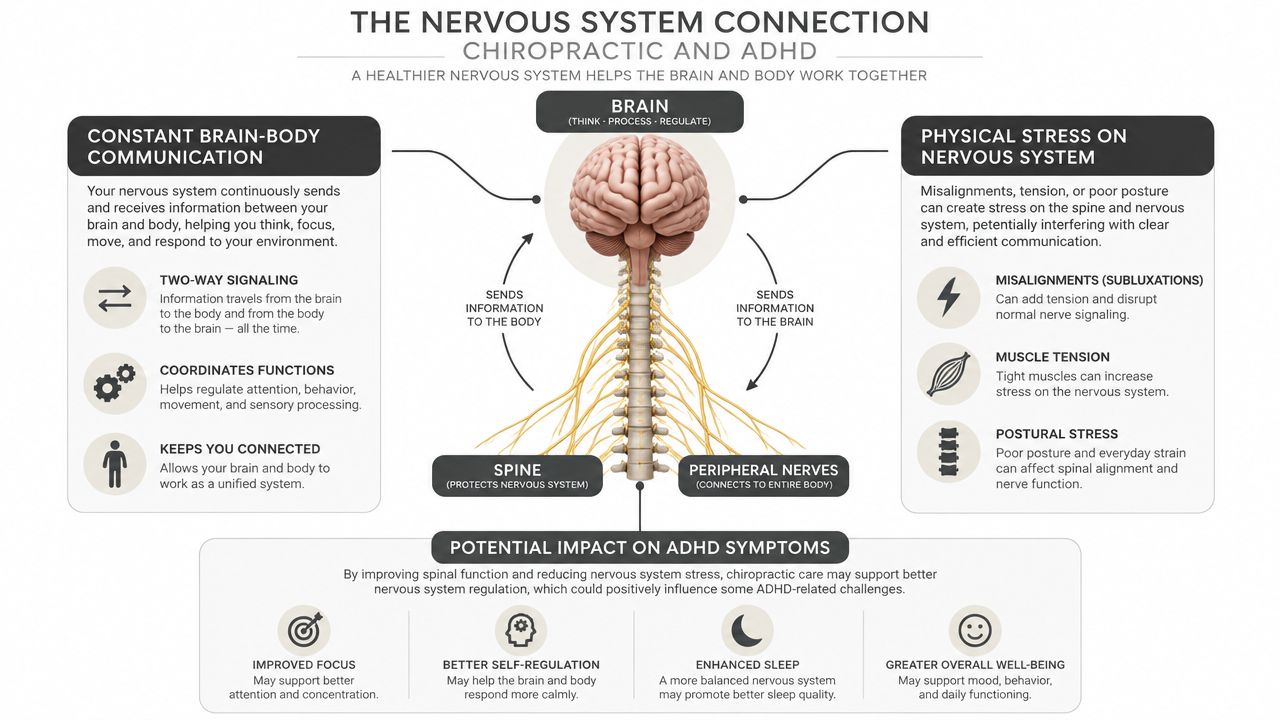
Terms parents may hear
Subluxation is a chiropractic term that can refer to altered function or movement in a spinal segment. Different chiropractic professions use the term differently, and its proposed relationship to ADHD hasn't been established by strong clinical evidence.
Tone generally describes the level of muscle activity or nervous-system readiness. A child who looks tense, restless, or poorly coordinated may have several possible explanations, including stress, sleep problems, medication effects, pain, anxiety, or developmental differences.
Neuroplasticity refers broadly to the nervous system's ability to adapt with experience. That capacity is real, but mentioning neuroplasticity doesn't prove that spinal manipulation will improve ADHD symptoms. A theory becomes clinically persuasive only when well-designed studies show consistent, meaningful benefits.
The safest interpretation is modest: a chiropractor may assess physical function and offer care for an appropriate musculoskeletal concern. That is different from claiming that chiropractic changes the underlying ADHD condition.
What the Research Shows
The evidence remains limited, so conclusions about chiropractic for ADHD should stay cautious. The foundational review discussed earlier found insufficient evidence to assess effectiveness. Later research has not produced a large, replicated set of controlled trials that closes this gap.
A scoping review found that two systematic reviews about ADHD were based on the same single study. It identified no additional research supporting a clear conclusion about spinal manipulation for children with ADHD. A separate pediatric evidence review also found little evidence that chiropractic care improves ADHD specifically. The pediatric evidence review provides that broader assessment.
One pilot study reported a statistically significant reduction in reading time after chiropractic intervention, with a p-value of .034 and a mean reduction of 646.87 milliseconds, compared with 108.35 milliseconds in the control condition. These figures come from the published pilot study. Reading time was a secondary outcome, and the study's pilot design limits what can be concluded. It does not establish that chiropractic treats ADHD or that the result would last.
| Study type | Sample size | Reported findings | Limitations |
|---|---|---|---|
| Systematic review | 22 eligible intervention studies from 58 citations | Insufficient evidence to evaluate effectiveness | No high-quality trials were available to support chiropractic care for ADHD |
| Scoping review of pediatric spinal manipulation | No additional ADHD studies identified beyond the existing evidence base (review) | No significant effect on ADHD outcomes measured with the Connors Scale | Insufficient evidence to draw conclusions |
| Small pilot study | Not reported here beyond the published study | Reading time reduction was reported as a secondary finding | Pilot design does not establish cause, durability, or generalizability |
| Retrospective pediatric research | 180 children in one 2025 retrospective study | Improved quality of life and reduced hyperactivity were reported | No control group, so causation remains uncertain |
A reported improvement is not the same as a proven treatment effect. Attention, sleep, school demands, family routines, and expectations may change when a child begins care. Without suitable controls, researchers cannot confidently attribute the improvement to chiropractic treatment.
Families may still choose complementary care to address discomfort or avoid adding another medication. That decision can be reasonable when expectations are grounded, standard medical care continues, and the chiropractor clearly separates musculoskeletal support from ADHD treatment. A first visit should answer practical questions, not promise a cure.
What a Pediatric Visit Looks Like
A thoughtful first visit should feel like a conversation, not a rushed adjustment. The chiropractor may ask about developmental history, birth details, sleep, sensory triggers, injuries, posture, pain, current diagnoses, medications, and the child's existing ADHD care plan.
The physical examination should be adapted to the child's age and comfort. It may include observation of posture and movement, gentle neurological checks, and an assessment of spinal or joint function. X-rays aren't automatically appropriate for every child. Imaging decisions should depend on clinical need, safety, and referral guidance.
The usual sequence
Consultation: You describe what your child is experiencing and what you hope to improve. A responsible practitioner should ask about conventional care rather than dismiss it.
Examination: The clinician observes movement and checks relevant physical findings. Children may need breaks, a parent's lap, or time to become comfortable.
Report of findings: The chiropractor explains what was found, what it may mean for physical function, and what remains uncertain. You should hear a clear distinction between musculoskeletal support and ADHD treatment.
First adjustment: Some pediatric practices use Torque Release Technique, or TRT. This approach uses light contact at selected points and may involve an instrument such as the Integrator, producing gentle pulses rather than a forceful manual thrust.
Follow-up review: The practitioner may suggest reviewing the child's response after a period of care. Ask what outcome will be assessed and what would lead to changing or stopping the plan.
First Steps Chiropractic describes its consultation and examination process in its overview of the PX approach. The details of any visit vary by practitioner, so ask directly about training, technique, consent, and referral policies.
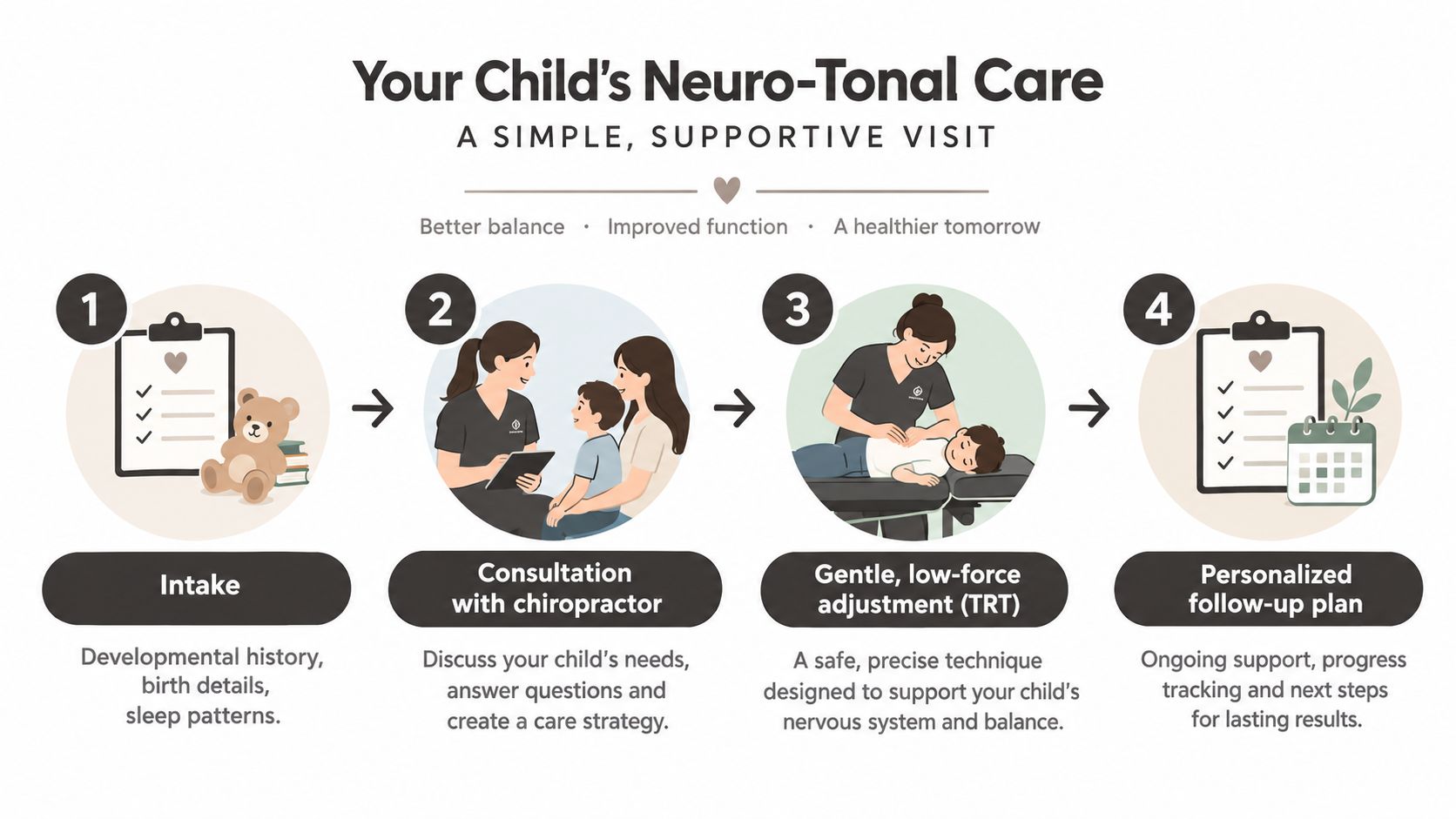
Some offices may recommend frequent early visits and later tapering, but a schedule should be individualized rather than treated as a fixed prescription. A child may seem calm, tired, or energized afterward, yet none of those immediate reactions proves that ADHD has improved.
For another perspective on how a gentle pediatric appointment may be presented, you can watch this short explanation:
The most important practical feature is the child's experience. The practitioner should respect communication differences, sensory needs, movement, and consent instead of forcing stillness or compliance.
Safety, Screening, and When to Be Cautious
Parents often hear that pediatric chiropractic uses very light contact, but “gentle” doesn't mean every child is automatically an appropriate candidate for every technique. Safety depends on the child's medical history, the practitioner's training, the examination, and appropriate referral when a concern falls outside chiropractic scope.
Before care, a responsible practitioner should screen for recent head trauma, suspected fractures, significant neurological changes, severe or unusual pain, and medical conditions that require assessment elsewhere. The clinician should also ask about medications, previous diagnoses, surgeries, and symptoms that may look like an ADHD difficulty but have another explanation.
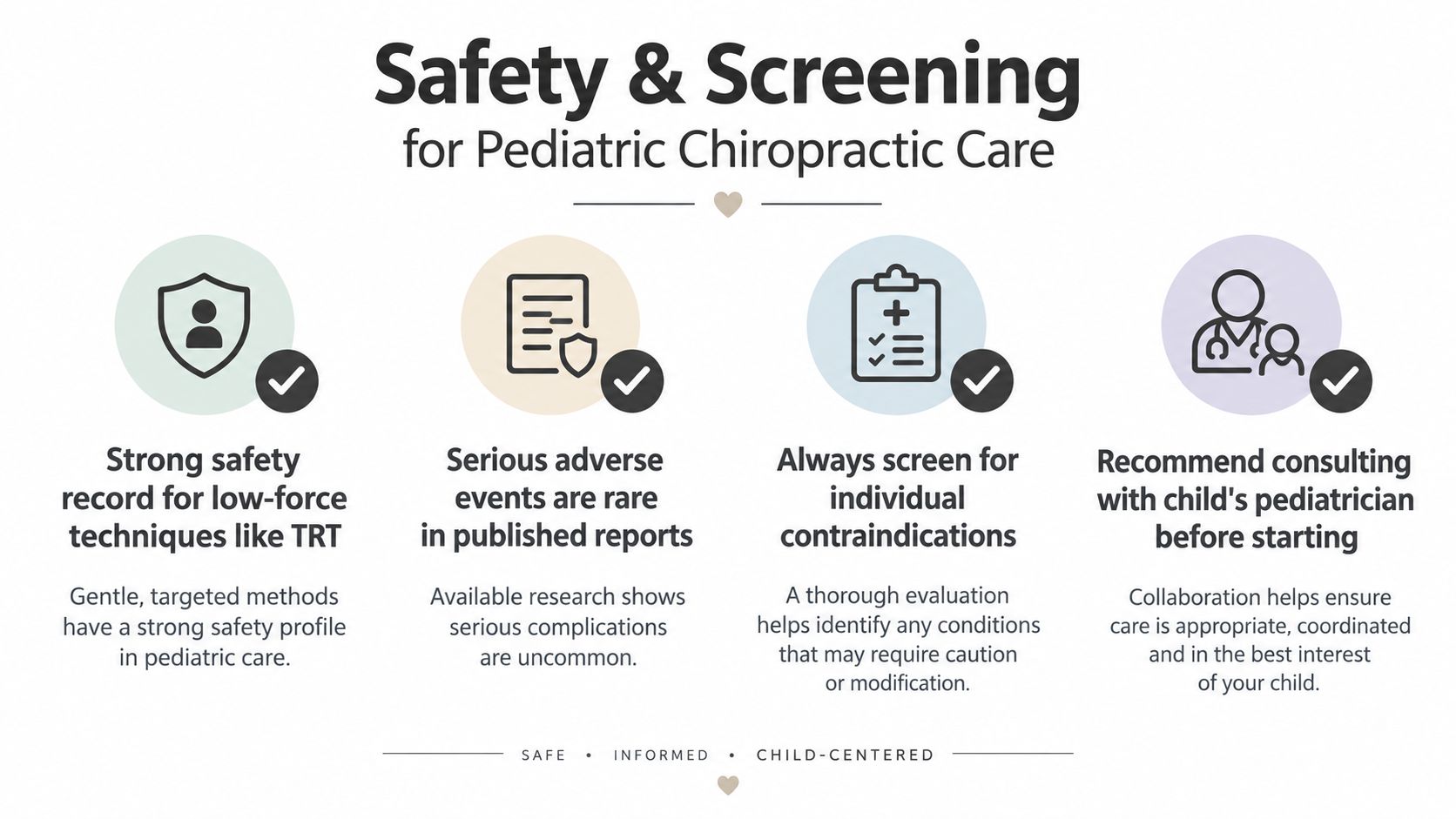
Questions worth asking before an adjustment
- Pediatric experience: What training and experience does the practitioner have with children who have ADHD, sensory sensitivities, or complex medical needs?
- Technique: What does the proposed technique involve, and how is force adapted to the child?
- Evidence: What outcomes does the practitioner believe chiropractic can realistically influence, and what evidence supports that position?
- Coordination: Will the chiropractor communicate with the pediatrician or other clinicians when appropriate?
- Stopping rules: What would make the practitioner pause care, refer the child, or conclude that it isn't helping?
Be especially careful if your child has a complicated neurological diagnosis, takes multiple medications, has recently been injured, or is too young to communicate discomfort clearly. These situations don't automatically rule out care, but they call for medical coordination and a conservative approach.
Stop and seek medical evaluation for worsening headaches, persistent or escalating pain, weakness, changes in walking, new numbness, seizures, unusual confusion, or other new neurological symptoms. Chiropractic should never replace medication, behavioral therapy, educational accommodations, or urgent medical assessment when those supports are needed.
Realistic Outcomes and Combining With Standard Care
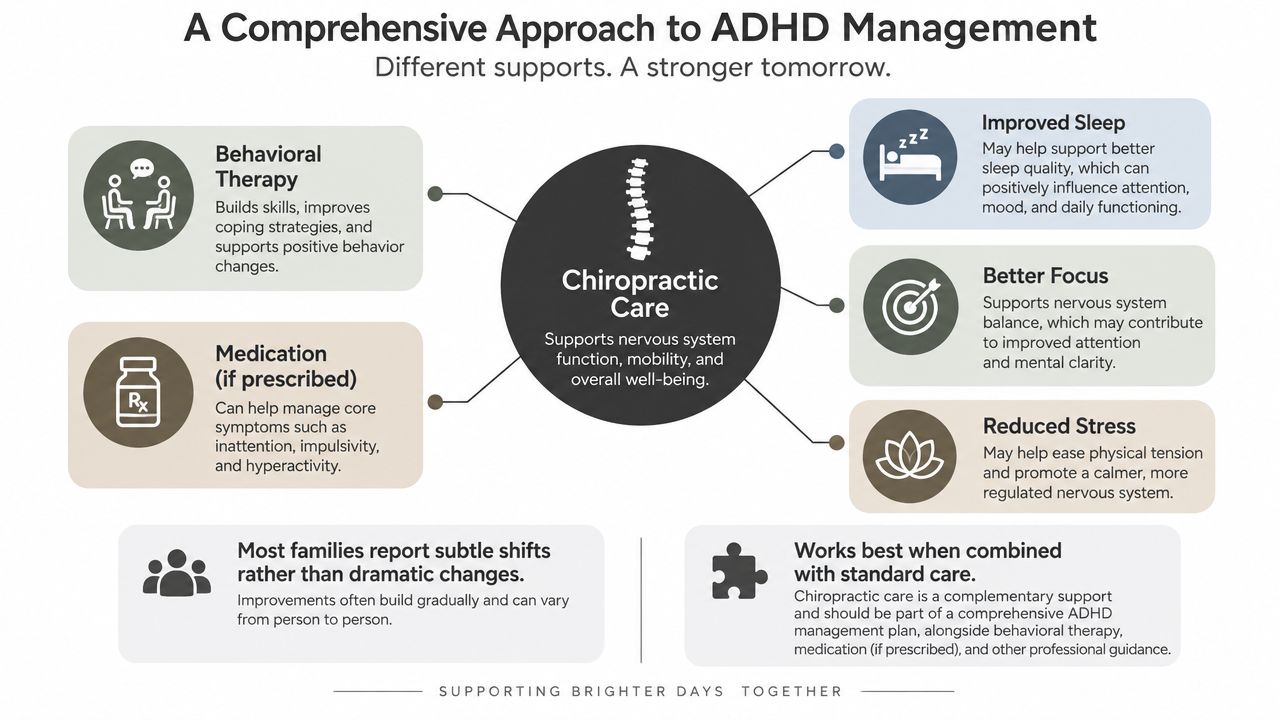
What would count as a useful result for your child? Sleep, comfort, transitions, emotional outbursts, or sensory tolerance may change after care begins. Those changes deserve attention, but they do not show that chiropractic has treated ADHD. A physical problem may have improved, routines may have changed, or another support may be responsible.
ADHD care usually works through several layers. Prescribed medication may target core symptoms. Behavioral parent training can strengthen routines and responses, while school accommodations reduce barriers to learning. Occupational therapy may address sensory or functional concerns. Chiropractic, when appropriate, can sit alongside these services for a clearly defined physical goal.
A practical rule: Keep an effective support in place when complementary care begins. Add one change at a time when possible, so you can better identify what helped.
Choose a few outcomes you can observe. You might record bedtime difficulty, disrupted nights, transition problems, or pain after sitting at school. Use the same simple scale each day. Agree with your healthcare team on how long you will observe before deciding whether care is useful. One good day, or one difficult day, cannot establish a treatment effect.
Families considering non-medication options can read this guide to helping a child with ADHD without medication. “Without medication” should still include professional assessment and appropriate support.
The most grounded question is additive: Does this specific care help my child function a little better within the plan we already trust? If the answer remains unclear, pausing is a valid clinical decision.
Deciding Whether a First Visit Makes Sense for Your Family
Before booking, consider the purpose of the visit. A consultation may make sense if your child has a specific physical or functional concern, you understand that evidence for chiropractic as an ADHD treatment is insufficient, and you're looking for complementary support rather than a replacement for established care.
Use this checklist:
- Diagnosis and care: Has your child received an appropriate ADHD evaluation, and is the current medical, behavioral, or school support being reviewed?
- Specific goal: Can you name the concern you want to monitor, such as discomfort, sleep difficulty, posture, or a transition problem?
- Qualified practitioner: Does the chiropractor have relevant pediatric experience and explain gentle techniques without promising to cure ADHD?
- Open communication: Are questions about evidence welcomed rather than treated as disloyal or negative?
- Medical coordination: Is the practitioner willing to involve your child's pediatrician when the history or symptoms call for it?
- Child-centered care: Does the office respect sensory needs, communication differences, movement, and refusal?
During the consultation, ask what improvement would look like, when you'll review progress, and what would happen if nothing changes. Watch how the practitioner speaks to your child. A calm explanation and respect for boundaries tell you more than a confident promise.
Choosing to try chiropractic isn't a referendum on your parenting, and declining it doesn't mean you've failed to explore every option. With limited evidence for ADHD itself, waiting, seeking another opinion, or choosing not to proceed can all be sensible decisions.
First Steps Chiropractic provides pediatric consultations and neuro-tonal services, including gentle Torque Release Technique, for families exploring nervous-system support alongside their child's broader ADHD care. If you want to discuss your child's specific concerns and expectations, visit First Steps Chiropractic to learn about the practice and request a consultation.