
You may be in that stage right now. Your child covers their ears when the blender turns on, refuses certain clothes, cries in busy stores, and still isn't using many words. Or maybe they say a few words at home, then seem to lose them when the room gets loud or chaotic. That combination can leave parents wondering whether these things are connected, and whether they're missing something important.
The short answer is that sensory differences and speech delay often do show up together. But they don't always mean the same thing, and one doesn't automatically explain the other. That's where many families get stuck. They hear “sensory processing disorder,” “speech delay,” “autism,” “oral-motor,” and “regulation” all in the same week and end up with more confusion than clarity.
Introduction to Sensory Processing and Speech Development
A toddler pushes away a spoon because the texture feels wrong. A preschooler hides under the table during birthday songs. A child who wants something badly points, grunts, or melts down instead of saying the word. These are the moments that often bring families to the same question: what's going on in my child's nervous system, and how is it affecting communication?
Sensory processing is the brain and body's way of receiving information from the world and deciding what to do with it. Sound, touch, movement, body position, visual input, and internal body cues all need to be sorted quickly. For some children, that sorting process seems smooth. For others, everyday input feels too intense, too faint, too fast, or too confusing.
If you'd like a broader overview of the sensory side, this explanation of what sensory processing disorder is can help put a name to what many parents are already seeing at home.
Why speech and sensory concerns often get discussed together
Speech development doesn't happen in a vacuum. A child has to notice language, stay regulated enough to attend to it, understand what they hear, plan how to move their lips and tongue, and then try again and again through practice. If the nervous system is working overtime just to handle noise, touch, or movement, communication can become harder.
That doesn't mean parents caused this. It also doesn't mean one rough grocery trip or one missed milestone tells the whole story. Most children show a mix of strengths and struggles, and those patterns make more sense when we look at the whole child instead of one behavior in isolation.
Many parents feel guilt before they feel clarity. In most cases, what helps most is careful observation, not self-blame.
What worried parents usually need first
Families usually don't need more alarming language. They need a calm map. They need help separating a single hard day from a repeated pattern. They need to know when to watch, when to ask questions, and who should evaluate what.
That's especially true with sensory processing disorder and speech delay, because the overlap is real, but the pathway isn't always simple. Some children primarily need speech support. Some need occupational therapy for regulation and motor planning. Some need a broader developmental evaluation. Some families also want a nervous-system-focused perspective as part of a coordinated care plan.
How Sensory Processing Shapes Early Communication
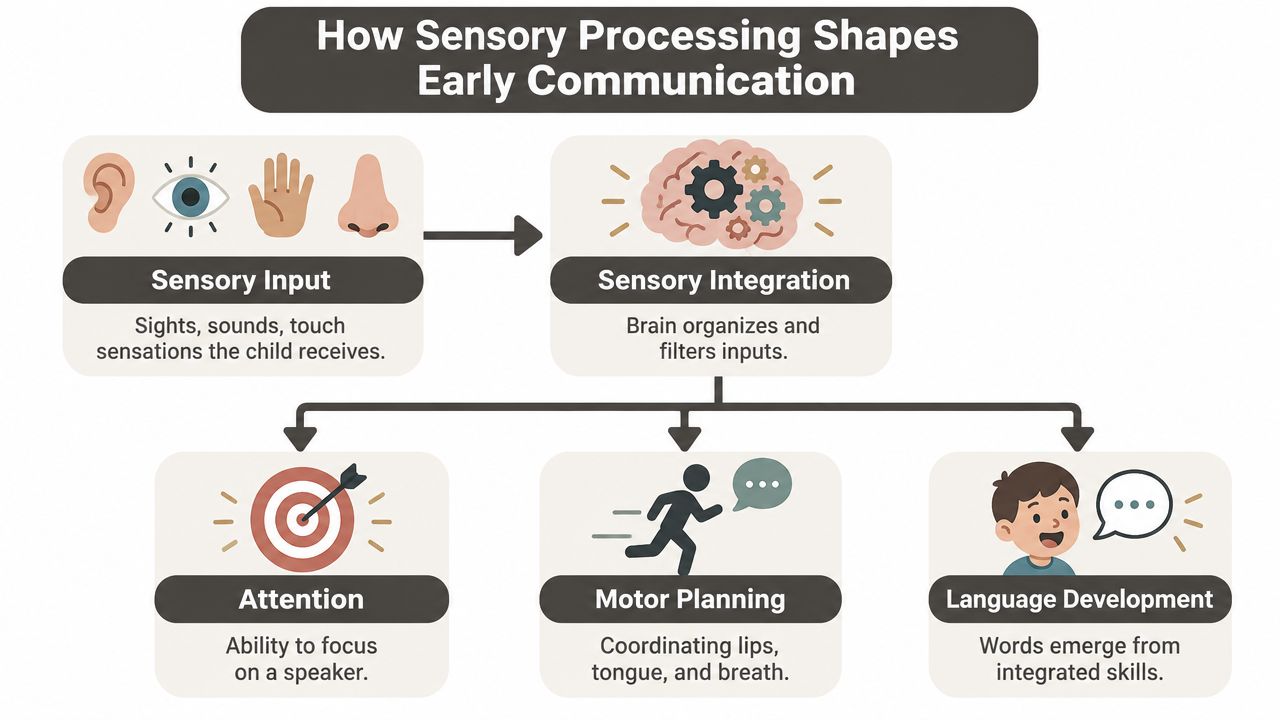
A useful way to think about sensory processing is to picture an air traffic controller. Information is constantly arriving. Sounds, sights, touch, movement, and body signals all come in at once. The brain has to decide what matters, what can wait, and what action to organize next.
When that process is efficient, a child can notice your voice, look toward your face, stay with the interaction, and try to imitate a sound. When that process is strained, the child may seem distracted, flooded, shut down, or driven to seek more input before they can engage.
Parents who are sorting out hearing versus regulation concerns often find this article on sensory and auditory processing disorder helpful, because those terms get mixed together all the time.
From sensation to attention
Children learn language through repeated, meaningful exposure. They hear a word, connect it to an object or action, and store that pattern over time. But attention is the doorway. If a child is distressed by sound, distracted by clothing seams, or constantly seeking movement, they may miss parts of the language coming toward them.
That can look confusing from the outside. A parent may think, “He knows this word at home, so why doesn't he respond at preschool?” Often the issue isn't effort. It's that communication changes when the sensory load changes.
A child who is over-responsive may react strongly to ordinary input. They might cover their ears, avoid crowds, or resist messy play. A child who is under-responsive may seem hard to engage, slow to notice their name, or in need of extra movement or touch input before they “wake up” to interaction.
From sensory integration to motor planning
Speech isn't only about knowing words. It's also a motor task. The jaw, lips, tongue, breath, and timing all have to work together in a very precise sequence. That sequence relies on the brain organizing information clearly enough to build a motor plan.
Research adds an important piece here. In one study of children with delayed language, expression-language scores were correlated with multisensory processing and movement-control domains on a sensory profile, which suggests sensory integration can affect the perceptual and motor support needed for speech production (study details).
What this can look like in daily life
Here are a few ways this shows up in ordinary routines:
- During meals a child may understand what they want but struggle to coordinate chewing, mouth movements, and speech while also managing sensory discomfort.
- During play they may want to join in, but the noise, motion, and shifting attention demands of a group make imitation harder.
- During conversation they may know a word one moment and lose access to it when the room becomes busy.
Practical rule: If communication gets worse as sensory demands rise, that pattern is worth noting and sharing during an evaluation.
Understanding the Link Between Sensory Challenges and Speech Delay
This is the question parents ask most often. Does sensory processing disorder cause speech delay?
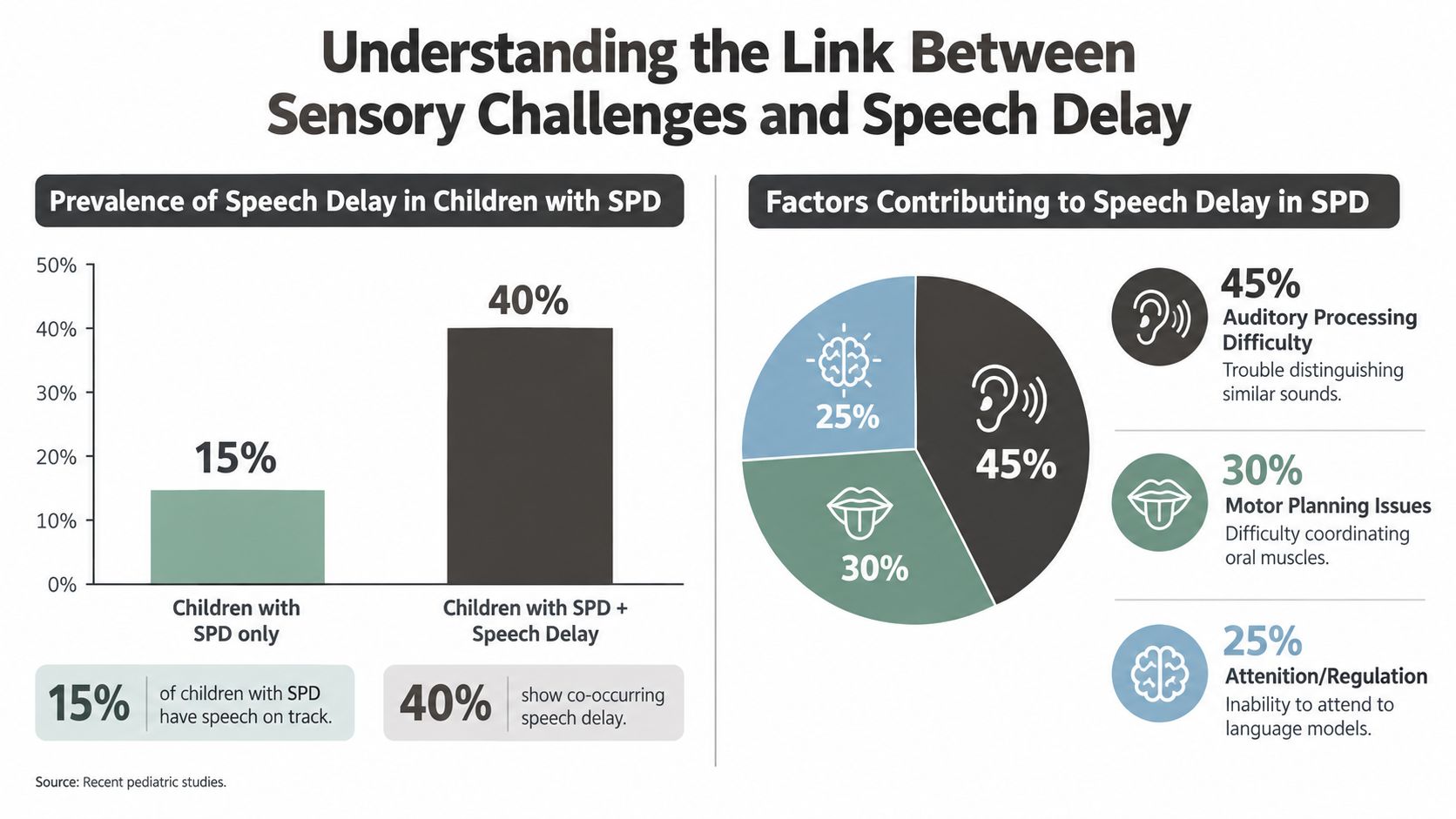
The most accurate answer is not in a simple, proven cause-and-effect way. Current evidence supports an association. In plain language, sensory differences and speech problems often travel together, but that doesn't mean one single sensory issue directly causes a child's language delay.
What the prevalence data actually tell us
Sensory processing disorder has been described in epidemiological studies as affecting roughly 5% to 15% of children, with one population-based study of 703 North American schoolchildren ages 3 to 6 finding 13.7% met criteria, and another U.S. sample of 796 children ages 3 to 10 finding 11.6% prevalence. The same review noted that “pure” idiopathic SPD may be closer to 5%, and that sensory processing differences are reported in about 80% to 90% of autism cases (review summary).
Speech and language delay are also common developmental concerns. In preschool-aged children, published estimates for combined speech and language delay range from 5% to 8%. Language delay alone has been reported from 2.3% to 19%, and a U.S. clinical summary notes that up to 1 in 8 children ages 2 to 5 may have a speech or language delay. One population-based cohort found persistent speech sound disorder in 3.6% of children at age 8 (clinical summary).
Those numbers matter for one reason. They remind parents that these concerns are not rare, and they shouldn't be brushed aside as “just a phase” without taking a closer look.
Here's a brief video that helps many families start thinking about early support in practical terms.
If you're in the stage of deciding whether to wait or act, this guide on speech delay and early intervention can help frame that decision.
Why co-occurrence matters more than simple labels
Children with motor speech disorders and children with language-oriented speech disorders plus oral-motor developmental delay have been reported to show more sensory-processing difficulties than typically developing peers, which supports a clinically important link between speech-motor patterns and broader sensory dysregulation (reviewed article).
A separate review-based perspective makes the bigger clinical point clearly. The evidence is stronger for association than direct causation, and sensory differences may co-occur with speech sound disorders, autism, oral-motor issues, or broader developmental delays rather than serve as a single explanation by themselves (review discussion).
If a child has speech delay and sensory issues, the next best question usually isn't “Which one caused the other?” It's “What full developmental picture do these signs belong to?”
That shift in thinking protects families from oversimplified answers. A child may need assessment for speech sound disorder, childhood apraxia of speech, autism, language delay, regulation challenges, or some combination. One label rarely tells the whole story.
Signs That Sensory Processing and Speech May Need Support
Parents often spot the overlap before anyone else does. Not because they can diagnose it, but because they see the pattern across breakfast, car rides, daycare pickup, bath time, and play.
One hard day after poor sleep doesn't mean there's a disorder. What matters is a repeated pattern across settings or over time.
Sensory patterns parents commonly notice
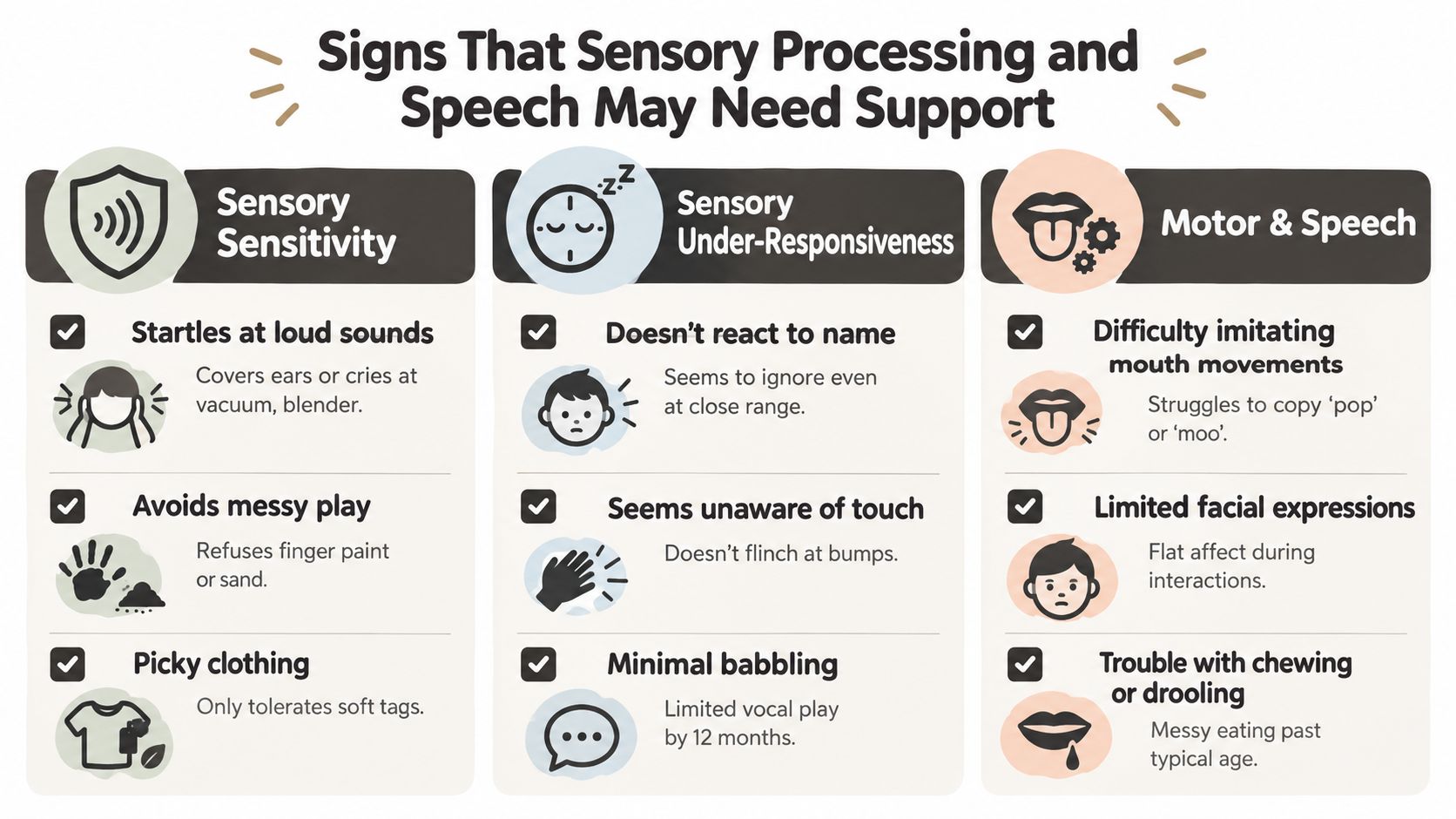
- Sound sensitivity often looks like ear covering, distress with vacuums or hand dryers, or falling apart in busy rooms.
- Touch sensitivity may show up as avoiding sand, glue, finger paint, toothbrushing, hair washing, or certain fabrics.
- Movement needs can look like constant crashing, spinning, pacing, climbing, or trouble settling long enough for back-and-forth interaction.
- Low response to input may show up as not noticing name calls, seeming unusually hard to engage, or needing big input before joining play.
Communication patterns that deserve attention
- Limited vocal play such as reduced babbling, fewer sound experiments, or not trying to imitate simple sounds.
- Few spoken words compared with what you're seeing in everyday interaction.
- Frustration when misunderstood including pulling, crying, throwing, or shutting down instead of communicating needs.
- Trouble following language especially in noisy or visually busy places.
- Speech that seems effortful such as difficulty imitating mouth movements, inconsistent sound production, or avoidance of verbal attempts.
Watch for combinations, not isolated traits. A child who dislikes hair washing but communicates well may need a different kind of support than a child who avoids sound, struggles with imitation, and has very few words.
Signs to write down before an appointment
A simple note on your phone is enough. Try tracking:
- When it happens after daycare, during meals, in crowds, at bedtime
- What came before loud sound, change in routine, touch demand, group activity
- How communication changed fewer words, no response, more frustration, clearer speech in quiet spaces
- What helped movement, deep pressure, dim lights, one-on-one interaction, shorter phrases
Those observations help clinicians far more than a general statement like “he gets overwhelmed sometimes.”
How Assessment Works for Sensory and Speech Concerns
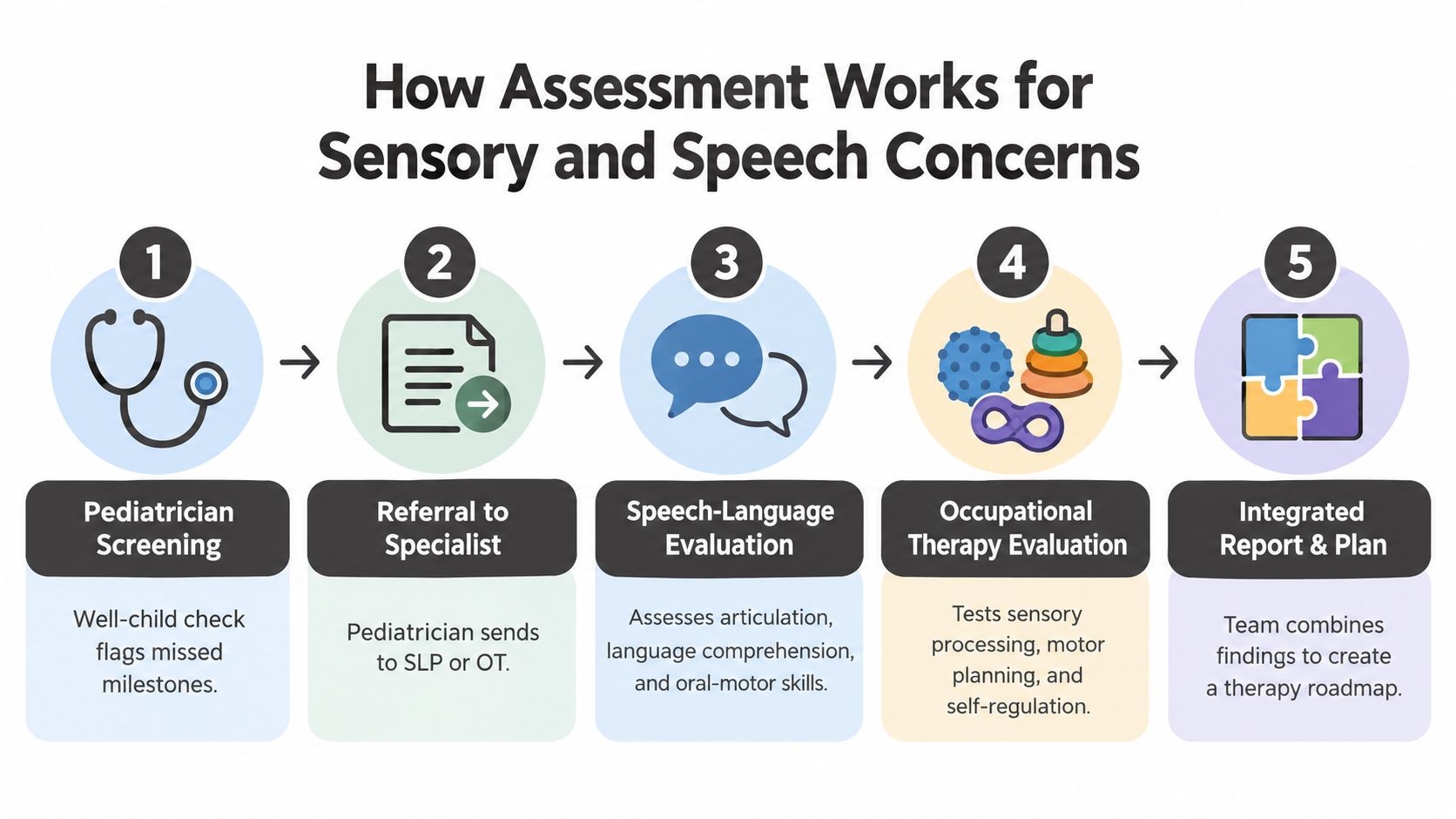
Once concerns are consistent, families usually feel better when they know who evaluates what. Sensory processing disorder and speech delay often need a team view, because communication, regulation, motor planning, and development overlap.
The usual pathway
A pediatrician often starts the process by reviewing milestones, hearing history, medical factors, feeding concerns, social communication, and parent observations. From there, the child may be referred to a speech-language pathologist, an occupational therapist, developmental specialists, or more than one at once.
A speech-language evaluation looks at how a child understands language, uses words, produces sounds, coordinates oral movements, and communicates socially. An occupational therapy evaluation looks at sensory processing patterns, regulation, fine motor function, participation in routines, and in many cases motor planning.
Some families also seek a nervous-system-focused assessment. In a neurologically-focused chiropractic setting such as First Steps Chiropractic, that may include consultation, Insight Scans, and a chiropractic exam to look at stress patterns and nervous system function as one part of a broader care picture. That doesn't replace speech-language or occupational evaluation. It sits alongside them as a complementary perspective.
Why broad assessment matters
A child with speech delay and sensory concerns may fit several possible patterns. The purpose of assessment is to sort them out carefully.
- Speech sound disorder may involve trouble producing certain sounds clearly.
- Childhood apraxia of speech raises concern when planning and sequencing speech movements appear especially difficult.
- Autism evaluation may be appropriate when sensory differences occur alongside social communication differences and repetitive patterns.
- Global developmental review may be needed when delays affect multiple areas, not speech alone.
Who evaluates what in a combined assessment
| Professional | Focus Area | What to Expect |
|---|---|---|
| Pediatrician | Developmental screening, medical history, referrals | Milestone review, hearing and health questions, referral planning |
| Speech-language pathologist | Receptive language, expressive language, speech sounds, oral-motor skills | Play-based tasks, parent interview, observation of sounds, words, and interaction |
| Occupational therapist | Sensory processing, regulation, motor planning, participation in routines | Sensory history, observation in play, responses to touch, movement, transitions, self-care tasks |
| Developmental specialist or psychologist | Broader developmental profile, autism assessment when indicated | Structured observation, caregiver interview, developmental testing |
| Neurologically-focused chiropractor | Nervous system stress patterns, functional regulation perspective | Consultation, scans or exam depending on the office, discussion of how care may complement therapy |
Bring videos if you can. A short clip of mealtime struggle, play frustration, or your child losing words in a noisy setting often gives evaluators information they can't get in a quiet office alone.
What to bring to the first round of appointments
- A short timeline of when you first noticed concerns
- Your notes on patterns, triggers, and what helps
- Prior reports from daycare, preschool, or other providers
- Questions in writing so you don't forget them when you're stressed
Families often leave the first visit relieved because the picture starts to organize itself.
Multidisciplinary Support Options That Work Together
Once families have answers, the next question is practical. What helps?
The most useful approach is usually coordinated, not all-or-nothing. A child doesn't have to fit neatly into one box to benefit from more than one kind of support.
What each support type adds
Speech therapy targets communication directly. That may include expressive language, understanding directions, play-based interaction, articulation, speech sound development, and oral-motor coordination depending on the child's needs.
Occupational therapy addresses regulation, sensory processing patterns, motor planning, and participation in daily routines. For one child, that may mean building tolerance for sound and touch. For another, it may mean helping the body become organized enough for learning and communication.
Caregiver-implemented strategies at home matter more than many parents realize. A systematic review found strong evidence for deep-pressure tactile input and caregiver training, moderate evidence that varied sensory techniques are better than focusing on one system alone, and a lack of evidence for sensory environmental modifications as a broad solution (systematic review summary).
That means the helpful pieces are often simpler than social media suggests. Consistent routines, parent coaching, and well-chosen sensory supports may matter more than buying lots of equipment.
What this can look like in real life
A coordinated plan may include:
- A speech session each week focused on imitation, functional words, and play routines.
- Occupational therapy support for regulation, transitions, body awareness, and sensory modulation.
- Home practice using short language routines during dressing, snack time, bath, and movement play.
- Complementary chiropractic care for families who want a nervous-system-focused lens alongside standard therapies, especially when regulation and stress responses are central concerns.
Not every child needs every service. The point is fit.
The best plan is often the one a family can repeat calmly and consistently, not the one with the most moving parts.
A balanced way to think about sensory strategies
Parents often hear that “sensory integration” will help everything, including speech. Sometimes parts of that are true for an individual child. But it's better to stay specific. If a strategy helps the child regulate enough to attend, imitate, or participate, it may support communication indirectly. That's different from saying the strategy treats speech delay by itself.
A regulated child is more available for learning. Speech still needs speech practice. Language still needs language exposure. And many children do best when those pieces are coordinated rather than separated.
Next Steps for Parents Navigating Sensory and Speech Support
Parents usually feel less overwhelmed when the next step is small and concrete. You don't need to solve the whole picture in one week. You just need to move from worry to observation, and from observation to informed support.
Here's a steady way forward:
- Track patterns for a short period and focus on what happens before, during, and after communication struggles.
- Schedule the right evaluations if concerns are persistent, especially with speech-language and occupational therapy when both communication and sensory regulation seem involved.
- Ask broader questions such as whether the pattern suggests a speech sound disorder, autism, oral-motor issue, or a wider developmental delay.
- Build a calmer home routine with predictable transitions, simpler language, sensory breaks, and repeated opportunities for connection.
- Consider complementary care thoughtfully if you want another view of nervous system regulation alongside traditional therapies.
The most important takeaway is this. Association is not the same as causation. Sensory processing disorder and speech delay can overlap in meaningful ways, but one label shouldn't close the door on fuller assessment.
Early support matters. So does nuance. A child can have sensory challenges, communication difficulties, and real strengths all at the same time. Families don't need to choose a single explanation before getting help.
If you're in the middle of this right now, you're not behind. You're noticing. That's where good care begins.
First Steps Chiropractic offers families in Hayden a neurologically-focused consultation process that looks at nervous system stress and regulation alongside the concerns you may already be addressing in speech or occupational therapy. If you want that complementary perspective as part of a broader plan for sensory processing and speech concerns, you can learn more or schedule a visit at First Steps Chiropractic.