
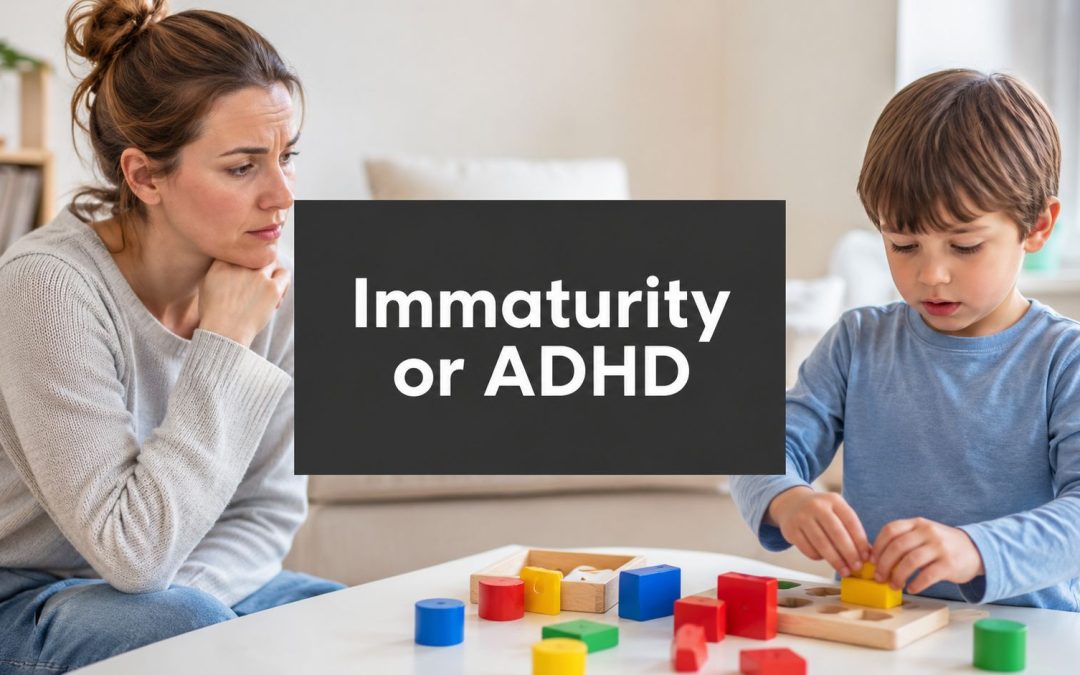
You're in the kitchen, the teacher just emailed again, and your child is melting down over a tiny change in routine. Maybe they blurt out answers, forget directions, or seem younger than classmates in the way they handle frustration. That leaves many parents stuck on the same question, is this just immaturity, or could it be ADHD?
The confusion is understandable. Some children are developing at their own pace, while others are showing a broader pattern that needs clinical attention. The key is learning how to separate developmental immaturity from ADHD-related impairment, then looking at the whole picture, home, school, history, and daily functioning, before deciding what to do next.
Introduction to Immaturity and ADHD
A child can look “behind” without being disordered. A younger student in a class with older peers may still be learning how to wait, listen, and manage big feelings, especially when school expectations jump quickly. That's one reason relative age matters so much in early childhood, and why the same behavior can mean very different things depending on the child's developmental stage.
ADHD is different because it tends to show up as a consistent pattern that affects attention, impulse control, and regulation across settings. It's also common, and often persistent, with a 2022 U.S. report estimating that 11.4% of children ages 3 to 17, about 7.1 million, had ever received an ADHD diagnosis, while 10.5%, about 6.5 million, were currently diagnosed (CDC report). That's why parents shouldn't shrug off symptoms just because a child is young for the grade.
A helpful lens is to ask whether the child seems merely less mature than classmates, or whether the behavior is reaching beyond age expectations and interfering with everyday life. A broader developmental view can prevent both overreaction and delay. For families who want to learn more about developmental delay patterns alongside behavior concerns, this guide on developmental delays offers a useful companion read.
Developmental Immaturity Versus ADHD Explained
What normal immaturity looks like
Developmental immaturity usually tracks with age, and it often softens as a child grows. A young child may need reminders to share, may cry quickly when plans change, or may have trouble sitting still for long stretches, especially in a classroom that asks for more self-control than home routines do.
That pattern does not automatically point to ADHD. An immature child may seem more capable in one setting than another, and the gap often narrows as the child matures. The behavior can still be frustrating, but it usually follows a recognizable developmental course.
What makes ADHD different
ADHD is a neurodevelopmental condition, not just a lag in social polish. The core issue is not that the child “won't” behave. The child often can't sustain regulation the way same-age peers can, especially when tasks are boring, long, or emotionally loaded. That is why a child with ADHD may struggle at school, at home, in sports, and during transitions, not just in one setting.
The scope of ADHD also matters. The CDC report notes that symptoms can persist into adolescence in many children. In practical terms, this is rarely a brief phase that disappears the moment a child gets older.
Practical rule: immaturity is usually age-linked and temporary, while ADHD tends to be broader, more persistent, and more disruptive across daily life.
Why parents get stuck
A child can be bright, affectionate, and funny, yet still struggle with follow-through, emotional control, or listening. That mix confuses families because it does not fit a simple label. ADHD can also coexist with age-related immaturity, so the goal is not to choose one story too early. The better approach is to look for the pattern that best fits the child.
For parents who want a broader picture of developmental concerns alongside behavior, this guide on developmental delays offers a helpful companion read.
Symptoms Patterns and Age Trajectories
The same behavior means different things at different ages. Toddlers are supposed to be impulsive. Preschoolers are still learning rules. Early elementary children should slowly gain more control over attention and emotions, and older children should show increasing consistency across school and home.
A Swedish nationwide study showed why age relative to classmates matters. Children born in November and December were up to 1.8 times more likely to receive an ADHD diagnosis at age 6 than children born in January or February, with the strongest association at ages 6 and 7 (Swedish study). That doesn't prove a child doesn't have ADHD, but it does show how relative immaturity can muddy the picture.
Behavior by Age: Immaturity vs ADHD
| Age Group | Typical Immaturity | ADHD Indicators |
|---|---|---|
| Toddler | Short attention, tantrums, impulsive grabbing | Extreme difficulty settling, frequent unsafe impulsivity, struggles in more than one setting |
| Preschool | Big feelings, inconsistent rule-following, frequent redirection | Daily inattention, impulsivity that disrupts play and routines, difficulty following even familiar directions |
| Early elementary | Needs reminders, forgets sometimes, restless during long tasks | Ongoing trouble across home and school, frequent task abandonment, emotional reactions that outpace the situation |
| Older child | More self-control over time, occasional setbacks | Symptoms persist or worsen, interfere with learning, friendships, or family life |
The important question isn't whether a child acts immature once in a while. It's whether the pattern is daily, cross-setting, and out of step with what you'd expect for age. When that happens, a formal evaluation becomes more useful than more guesswork.
Clinician Methods for Differentiation
Clinicians don't rely on one behavior or one conversation. They look at the child's history, ask how the child behaves in more than one setting, and weigh whether the concerns are steady enough to suggest ADHD rather than developmental lag. That matters because immaturity and ADHD symptoms can overlap, and a child may appear more regulated in a preferred setting than in a demanding one.
Family history also matters. A population study found that relative immaturity and ADHD symptoms often reflect shared genetic factors, which means clinicians have to consider both age and inherited risk rather than assuming immaturity is the whole explanation (population study).
Common assessment pieces include:
- Parent and teacher rating scales, which show whether the same pattern appears across environments.
- Developmental history interviews, which reveal when the behaviors started and how they changed over time.
- Observation in multiple settings, because a child who struggles only in one place may need a different explanation.
- Cognitive and learning testing, when school performance and attention questions overlap.
A strong evaluation asks, “What is happening at home, at school, and in the child's wider life?” One setting alone rarely tells the whole story.
That wider view helps separate a child who is less mature from a child whose regulation difficulties are part of a larger neurodevelopmental pattern.
Parent Actions for Observation and Screening
Parents usually know something is off long before the paperwork catches up. The trick is turning that instinct into useful information instead of a worry spiral. Start by watching for the same behavior in different settings, because a meltdown in one room means less than a pattern across mornings, homework, playdates, and class.

A simple parent checklist
- Observe in more than one setting. Home, school, sports, and playdates can show different sides of the same problem.
- Record frequency and intensity. Write down what happened, what came before it, and how long it lasted.
- Use a screening questionnaire. Tools such as the Conners' Rating Scales can help organize what you're seeing.
- Talk with teachers. Ask whether the same concerns show up during instruction, transitions, recess, and group work.
The goal is not to diagnose on your own. It's to give a pediatrician or psychologist a clearer map. Clinicians now emphasize cross-setting impairment and multiple informants rather than relying on one environment, especially when emotional regulation problems can mimic immaturity (Child Mind Institute).
A useful question at the pediatric visit is simple, “Do these behaviors fit normal development, or do they look beyond age expectations?” If the answer is unclear, ask what additional information would help and whether school input should be part of the next step.
Interventions Strategies and School Supports
Once the pattern is clearer, the next move is support, not blame. Many families start with structure at home because it's the easiest place to change the rhythm of the day. Predictable routines, shorter instructions, and immediate praise often help a child who gets flooded by long verbal directions or sudden transitions.
At school, the conversation usually shifts to accommodations. Some children do better with seating changes, movement breaks, extra time, or a quieter testing space. Others need a formal IEP or 504 plan so support is written into the school day instead of depending on who happens to notice the problem.
Home and school supports that often help
- Consistent routines. A visual morning and bedtime flow can lower friction.
- Positive reinforcement. Catch the behavior you want, then name it right away.
- Sensory breaks. A short pause can reset a child before dysregulation grows.
- Seating and environment changes. Some children focus better away from doors, noise, or visual clutter.
- Extended test time. This helps when speed, not understanding, is the main barrier.
- Noise reduction. Headphones or quieter work areas can reduce overload.
For families looking for a practical starting point, this parent guide on helping ADHD without medication can be a useful companion to school conversations.
If support needs are broader, therapy, coaching, and teacher collaboration can help the child practice skills in real life, not just talk about them. The best plan usually matches the child's weak spots instead of using one strategy for every problem.

Role of Neuro-Tonal Chiropractic
Some families want a care plan that doesn't stop at behavior charts and school meetings. That's where neuro-tonal chiropractic enters the picture as a complementary, nervous-system-focused approach. First Steps Chiropractic uses a five-step process, including consultation, Insight Scans, a chiropractic exam, a care plan, and adjustments, to look at how a child's body is adapting to stress and how that may connect with regulation, sleep, and day-to-day functioning.
The idea is not that chiropractic replaces diagnosis or school support. It's that a child who feels dysregulated, tense, or overwhelmed may benefit from gentle care as part of a larger plan that includes pediatric evaluation, behavior support, and educational accommodations. The clinic's functional neurology approach is described in more detail in this overview of functional neurology chiropractic, which fits well with families exploring a multidisciplinary roadmap.
How parents can think about it
A child's nervous system is always working in the background, helping with alertness, sleep, posture, and stress response. When that system is under strain, the child may look more scattered, reactive, or exhausted than peers. Gentle care aimed at improving body-based regulation can be one part of support, especially when parents are already doing the work of observation, school communication, and clinical follow-up.
A multidisciplinary view makes sense here. ADHD concerns are rarely solved by a single conversation or a single appointment. Families often do best when they combine medical input, classroom support, and a body-based approach that respects the whole child.
Conclusion and When to Seek Evaluation
Immaturity and ADHD can look similar at first glance, but the difference shows up in pattern, persistence, and impact. A younger child may act behind peers for a while and then catch up. A child with ADHD usually shows more consistent difficulty across settings, and those struggles don't fade just because adults wait it out.
Seek a formal evaluation when the behavior keeps showing up at home and school, interferes with learning or relationships, or feels out of proportion to the child's age. Family history matters too, because inherited risk can shape the picture. If you're still unsure, don't guess alone. Get input from a pediatrician, a school team, and, when it fits your family's plan, a chiropractor who understands nervous-system regulation and works alongside other professionals.
If you're trying to sort out whether your child's behavior is developmental immaturity, ADHD, or a mix of both, First Steps Chiropractic can help you think through the nervous-system side of the picture with a gentle, multidisciplinary approach. Visit First Steps Chiropractic to learn how their care model fits alongside pediatric evaluation, school supports, and family routines.