

A 1996 blinded trial found no significant benefit from chiropractic spinal manipulation for infantile colic, while a later trial of 185 infants found higher odds of short-term improvement, leaving the overall clinical value debatable. Long evenings of unexplained crying and feed, sleep, cry cycles can make any option feel worth trying, but newborn chiropractic adjustment for colic should be considered alongside medical evaluation, soothing strategies, feeding support, and the limits of current research.
The Late-Evening Reality of Life With a Colicky Newborn
At 10 p.m., you may be pacing the hallway with your baby against your shoulder, moving through the same sequence again: feed, burp, swaddle, sway, white noise, then another feed. Your newborn still cries with a high, sharp end-of-day wail that seems disconnected from anything you can see or fix.
Clinicians often describe colic using the Wessel rule of threes: crying for about three hours a day, on at least three days a week, continuing for roughly three weeks. It commonly reaches its most difficult point around six weeks and gradually eases by three to four months. Those timing patterns can reassure you that colic often changes with development, but they don't make the crying easier to hear tonight.
Many parents start questioning everything. Was the latch shallow? Is milk supply too low? Did a formula change make things worse? Conversations with a partner can become tense because both adults are tired, worried, and trying different solutions without knowing which variable matters.
A useful starting point: Treat colic as a pattern that deserves evaluation, not as proof that you've done something wrong.
Newborn chiropractic adjustment for colic is one option families may weigh, not a replacement for pediatric care. A thoughtful decision requires two separate questions: could the treatment help, and is it appropriate and safe for this particular baby?
The answers depend on the research, the baby's health history, and the practitioner's examination. The sections ahead look at what the contact involves, what randomized trials and reviews found, how chiropractic compares with other approaches, what a first appointment may feel like, when care should be delayed, and how to judge whether the plan fits your family.
What a Newborn Chiropractic Adjustment Actually Involves
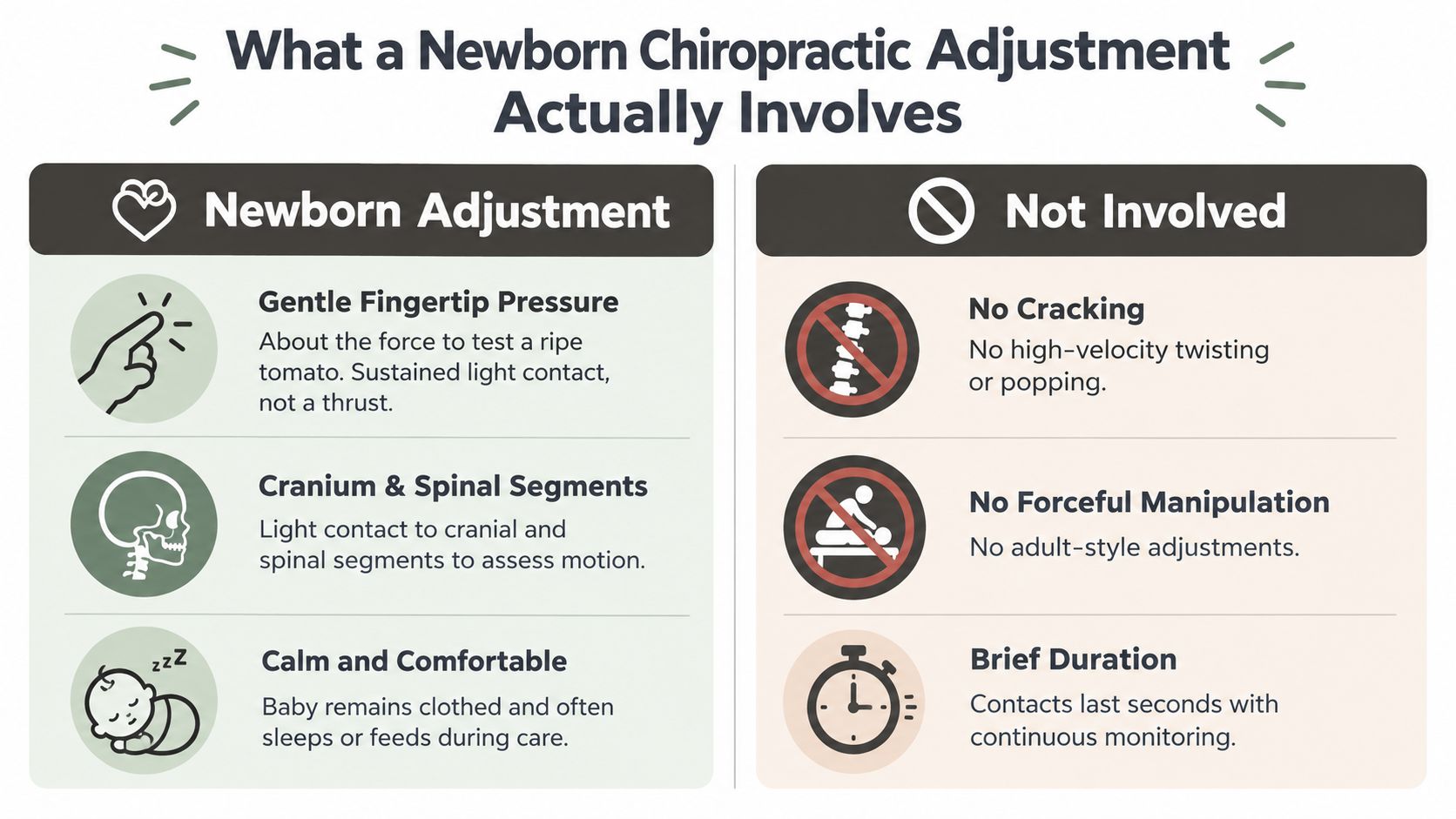
A newborn chiropractic adjustment is generally described as a low-force contact applied to selected areas of the spine or cranium. Pediatric practitioners may use fingertip pressure, sustained light contact, or a technique such as Toggle Recoil Technique, often called TRT. This is different from the high-velocity twisting or thrusting that some adults associate with chiropractic treatment.
The intended contact usually doesn't produce a crack or pop. Practitioners may compare the pressure with testing a ripe tomato, meaning light pressure rather than forceful compression. A baby generally remains clothed, and the practitioner monitors breathing, facial expression, muscle tone, and signs of distress throughout the contact.
What the practitioner may assess
Depending on the clinic and the baby's presentation, the practitioner may examine:
- Cervical movement: How the baby turns the head and whether one direction appears easier.
- Sacral and spinal motion: Whether movement feels symmetrical and comfortable.
- Cranial areas: Some practitioners assess motion around cranial sutures with very light contact.
- Muscle tone and posture: Whether the baby appears unusually tense, favors one side, or arches during handling.
The proposed mechanism varies by practitioner. Some describe the care as reducing irritation associated with spinal subluxation, while others focus on easing musculoskeletal tension after birth and supporting nervous-system regulation. These explanations are theories used in practice, not proof that an adjustment causes colic to resolve.
A contact itself may last only seconds or a few minutes, with much of the visit devoted to history-taking and examination. Parents can review how infant care is approached in this guide to chiropractic care for babies, then ask the clinic to explain exactly what it will and won't do before consenting.
What the Research Says About Adjustment for Colic
The research picture is mixed at first glance but becomes more cautious when investigators account for parent blinding. Parents naturally notice changes in crying, yet their expectations can influence how they interpret a difficult evening, estimate crying time, or describe improvement.
A landmark 1996 randomized, blinded, placebo-controlled trial recruited 100 infants, with 86 completing the study after exclusions and dropouts. Among the infants who completed the study, 69.9% of treated infants, 32 of 46, and 60.0% of controls, 24 of 40, showed some improvement, but the trial found no significant benefit from chiropractic spinal manipulation. The authors concluded that treatment was no more effective than placebo, an important early controlled baseline for this question (the full trial report).
A 2012 Cochrane review pooled six randomized trials involving 325 infants. Five trials reported less crying, but that apparent benefit disappeared when the analysis was limited to studies in which parents were blinded. The review concluded that manipulation hadn't been shown to improve colic beyond placebo or expectation effects, and the evidence base was too small to assess rare harms reliably (the Cochrane review).
Why trial results can point in different directions
A later Danish randomized controlled trial, registered in 2015 and conducted from November 2015 to July 2019, included 185 infants aged 2 to 14 weeks. In analyses involving blinded parents, manual therapy was associated with higher odds of clinically significant improvement by day 8, with an adjusted OR of 8.1, 95% CI 1.4 to 45.0, and by day 10, with an adjusted OR of 11.8, 95% CI 2.1 to 68.3. The investigators also reported that the overall clinical significance remained debatable, while later evidence syntheses didn't find a clear reduction in crying time (the indexed trial record).
A systematic review identified three eligible randomized trials and still concluded that current randomized evidence doesn't show spinal manipulation to be an effective treatment for infantile colic. Short-term reductions in unblinded studies may reflect natural improvement, regression to the mean, or reporting bias rather than a treatment effect (the systematic review).
| Study | Year | Design | Sample size | Key finding |
|---|---|---|---|---|
| Blinded placebo-controlled trial | 1996 | Randomized, blinded, placebo-controlled | 100 recruited, 86 completed | No significant benefit over placebo |
| Cochrane evidence review | 2012 | Review of randomized trials | 325 infants across six trials | Benefit disappeared in blinded-parent analyses |
| Danish randomized trial | 2015 to 2019 | Randomized controlled trial | 185 infants | Higher odds of short-term improvement, with clinical significance still debatable |
| Systematic review | Later review | Review of randomized trials | Three eligible RCTs | Totality of evidence didn't demonstrate effectiveness |
You can read more about how some practices describe their neurological model in this discussion of chiropractic and the nervous system, but the model shouldn't be confused with proof of colic treatment effectiveness. The most honest conclusion is that some families may report improvement, yet randomized evidence hasn't established a reliable benefit beyond expectation and natural symptom resolution.
How Chiropractic Compares to Other Colic Options
Parents don't have to choose between a chiropractic visit and every other form of support. The more useful approach is layered: rule out illness, review feeding, use practical soothing measures, and discuss targeted options with the baby's pediatrician.
A 2023 meta-analysis found that complementary treatments, including chiropractic and osteopathy, failed to significantly reduce crying time or increase sleep compared with no intervention. Broader reviews have described Lactobacillus reuteri, especially for breastfed infants, as having stronger evidence than manual therapy, although probiotic decisions still belong in a feeding and medical context (the 2023 meta-analysis).

How the options differ
- Chiropractic adjustment: Offers hands-on assessment and low-force contact, but the evidence for reducing colic crying remains limited and inconclusive.
- Probiotic discussion: L. reuteri has a comparatively stronger evidence base for some breastfed infants. Ask the pediatrician about the specific product, feeding pattern, and suitability.
- Hypoallergenic formula trial: An extensively hydrolyzed formula may be considered when cow's-milk protein intolerance is suspected. A clinician should guide the trial rather than having a family make repeated changes without a plan.
- Soothing strategies: Swaddling, white noise, rhythmic movement, responsive holding, and careful burping are accessible ways to reduce stimulation and support comfort.
- Supportive reassurance: A feeding review, growth check, and clear safety-net plan can be more valuable than adding another intervention without measuring what changes.
A clinic such as First Steps Chiropractic's colic care resource may describe assessment and low-force techniques, but parents should still ask how outcomes will be tracked and when referral back to the pediatrician is needed. Cost, travel, time, and emotional energy matter too. A treatment that requires repeated visits may not feel reasonable if the expected benefit is uncertain.
What Happens at Your Baby's First Appointment
A good first visit should feel more like a careful pediatric intake than a rushed hands-on session. The practitioner needs to understand what happened during pregnancy and birth, how the baby feeds, when crying starts, how sleep looks, and what changes you've already tried.
The visit in five practical steps
Detailed intake: You'll discuss pregnancy, delivery, birth interventions, feeding, stooling, sleep, crying patterns, and any medical diagnoses. Bring discharge notes or pediatric records if they contain information about prematurity, injury, or feeding concerns.
Non-invasive examination: The practitioner may observe posture, head movement, muscle tone, spinal motion, and primitive reflexes. The baby may stay on your lap or on a padded surface, and you should be able to comfort or feed the baby as needed.
Neurological screening: A neurologically focused clinic may observe movement symmetry, head-turn preference, and responses during handling. Ask what each screening tool measures and whether the result changes the care plan.
Gentle contact if indicated: A TRT-style practitioner may demonstrate the pressure on your finger first. If care proceeds, the contact should be light, brief, and continuously monitored, without adult-style twisting or forceful thrusting.
Parent coaching: The visit may include guidance about holding, positioning, burping, feeding mechanics, and supervised tummy time. A clear plan should state what to watch for, when to follow up, and when to contact the pediatrician instead.

Calm room cues include unhurried handling, a parent holding the baby, and pauses when the baby becomes distressed. Be cautious if the practitioner skips the medical history, promises that colic will resolve, pressures you into a predetermined course of visits, or discourages pediatric care.
When Adjustment Should Be Avoided or Delayed
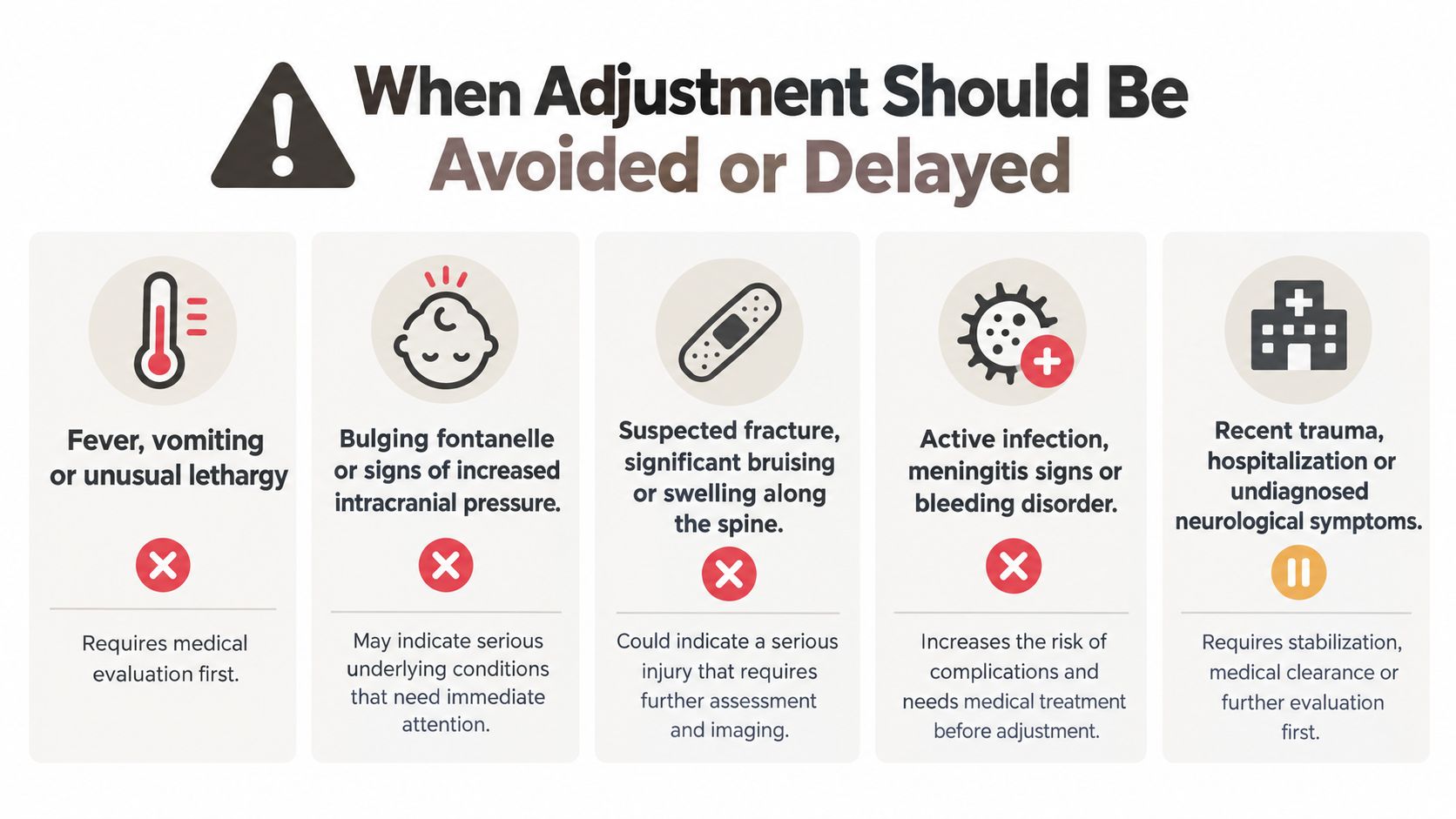
A crying baby shouldn't automatically be treated for colic. Fever, vomiting, unusual lethargy, poor feeding, or a change in responsiveness can signal a medical problem that requires pediatric assessment before any manual therapy.
Care should be delayed or ruled out when there is a suspected fracture, bruising or swelling along the spine, a bulging fontanelle, unexplained weight loss, or signs of failure to thrive. Recent trauma, a diagnosed birth injury, significant forceps marks, or substantial birth bruising also call for medical review before an adjustment.
Red flags need medical attention
- Breathing or color changes: Seek urgent help for breathing difficulty, blue or gray coloring, or unusual pauses.
- Neurological changes: A bulging soft spot, marked limpness, seizure-like activity, or a new movement difference needs prompt evaluation.
- Gastrointestinal symptoms: Projectile vomiting, green or bilious vomiting, or refusal to feed shouldn't be managed as ordinary colic.
- Injury signs: A bruise, swelling, tenderness, or reduced movement near the spine requires assessment.
- Poor growth: Ongoing feeding difficulty, dehydration, or unexplained weight loss needs a pediatric plan.
Mild positional fussiness, a preference for turning the head, or ordinary evening crying may be reasons a clinic offers an assessment. Those symptoms don't prove that an adjustment is needed. Ask your pediatrician to review the history first, particularly if the baby was premature, had a complicated delivery, or has an existing neurological or musculoskeletal concern.
Caring for Your Baby After an Adjustment
For the first day or two, keep the routine simple and observe rather than trying to interpret every small change. A longer nap, a somewhat fussier evening, looser or more frequent stools, or a temporary feeding-pattern change may occur after handling, but parents shouldn't assume that every response is therapeutic or harmless without considering the baby's overall condition.
Feed responsively and pause for burping if the baby appears uncomfortable. Use the sleep position recommended by your pediatrician, and don't add pillows, wedges, or positioning devices to the sleep space. If tummy time seems to irritate a particular area, reduce pressure and ask the practitioner or pediatrician how to modify it safely.
Keep a short observation record
A simple diary can make the next conversation more objective:
- Crying: Note when episodes begin, how long they last, and what reliably settles the baby.
- Feeding: Record unusual refusal, repeated vomiting, or a meaningful change from the normal pattern.
- Sleep: Track whether the baby settles differently, while remembering that one night doesn't establish a treatment effect.
- Stools and movement: Note major changes in stooling, bruising, swelling, or how the baby moves an arm, leg, neck, or back.
Call the pediatrician rather than the chiropractor for a fever above 100.4°F, projectile or bilious vomiting, refusal of multiple feeds, a bulging soft spot, marked lethargy, or any bruise, swelling, or movement change near the adjusted area. These signs need medical evaluation, not a routine follow-up.
Schedule another visit only after you understand the proposed purpose and how progress will be measured. If crying, sleep, or feeding doesn't improve in a meaningful way, ask whether continuing makes sense and whether another evaluation is more appropriate.
Deciding Whether This Care Is Right for Your Family
Before booking newborn chiropractic adjustment for colic, answer three questions.
Does your baby need medical clearance first?
Review prematurity, a complicated birth, forceps or vacuum assistance, torticollis, feeding difficulty, poor weight gain, neurological symptoms, or any injury concern with the pediatrician. A baby who appears fussy but otherwise well may be eligible for a conversation, while a baby with red flags needs medical assessment before hands-on care.
Can the practitioner show appropriate preparation?
Ask about verifiable pediatric credentials and experience with newborns. The practitioner should take a full history, perform an examination before touching the baby, explain the technique in plain language, use age-appropriate low-force contact, and welcome questions about evidence, alternatives, and referral.
A responsible clinician won't promise a cure or imply that pediatric care is unnecessary. They should also explain how you'll decide whether the plan is helping, rather than assuming that any calmer period proves the adjustment worked.
Are you comfortable with the evidence?
The randomized evidence is encouraging in some short-term analyses but not conclusive overall. Parents who choose a visit can still pair it with feeding review, responsive holding, soothing routines, safe sleep practices, and a discussion about probiotics or formula changes with the pediatrician.
Colic can exhaust an entire household, and looking for help doesn't make you gullible or desperate. It means you're trying to protect your baby and regain enough rest to function. Choose care that respects both parts of the decision, effectiveness and safety, and walk away from any provider who dismisses either one.
First Steps Chiropractic provides pediatric consultations and low-force neuro-tonal care for families considering support for a colicky newborn, with an intake, examination, and individualized guidance before treatment. Visit First Steps Chiropractic to learn about the clinic's newborn services and request a consultation that keeps your baby's pediatric care at the center.