
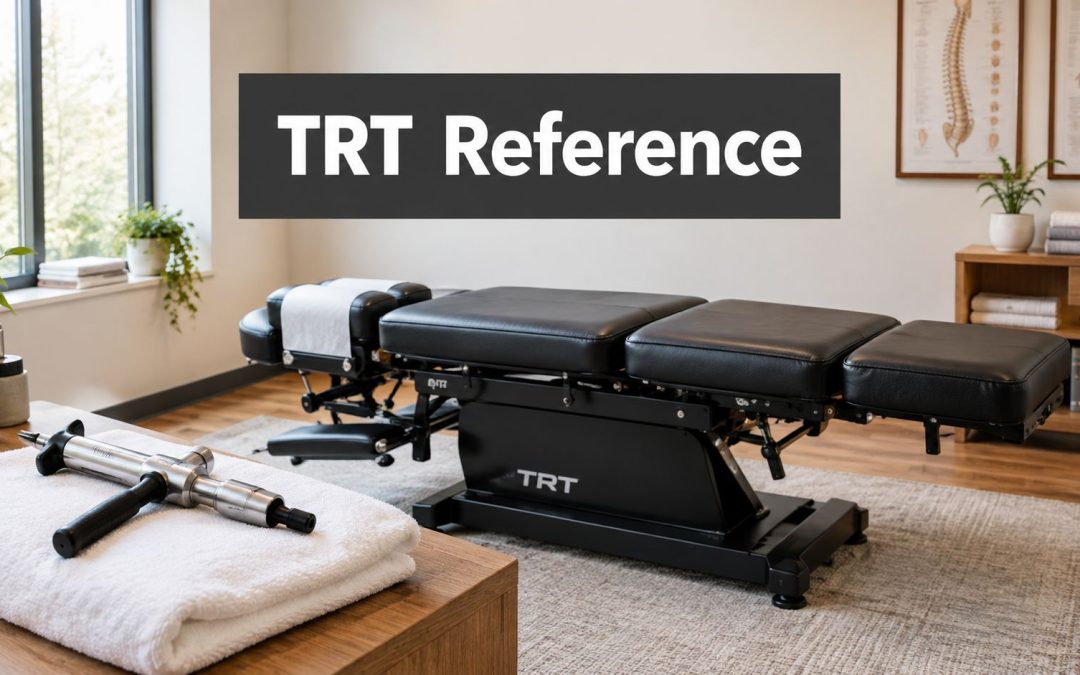
Your child's first chiropractic visit may already feel like a big event. You're wondering whether the table will move, whether there will be cracking or twisting, and what your baby, growing belly, or own back will experience. A Torque Release Technique table visit is usually quieter and more controlled than the traditional picture many people carry of chiropractic care.
TRT uses a stable support surface and the handheld Integrator instrument. The practitioner evaluates specific findings, places the patient in a relaxed position, and applies brief, targeted impulses rather than relying on broad manual movement. The technique's model is specific, but the practical questions are personal: where does the body rest, what does the contact feel like, and how should care change for an infant or prenatal patient?
What Happens on a TRT Table During a First Visit
A first visit usually begins with conversation, not an adjustment. The chiropractor reviews the parent's concern, the child's or adult's health history, previous injuries, medications, pregnancy status when relevant, and any signs that require medical evaluation before contact.
The examination may include posture, comfortable movement, neurological observations, and a lying-down leg check. In TRT practice, the leg check is used as part of the listing process, helping the practitioner decide which contact points and directions fit the examination findings. It isn't a random search for a place to tap.
The on-table sequence
The patient then lies in a relaxed prone position, with the face supported and the spine kept as neutral as possible. A baby may be handled differently from an adult, including remaining close to a parent, while a pregnant patient may need side-lying or additional support rather than pressure through the abdomen.
The Integrator delivers a brief impulse at the selected contact. TRT materials describe upper cervical and sacral contacts within the protocol, but the exact listing depends on the practitioner's examination. Patients commonly notice a light tap, brief pressure, or a small mechanical click from the instrument. The experience shouldn't involve forceful twisting, rolling, or intentional cracking.
Practical rule: A calm explanation matters as much as the tap. Parents should know where contact will occur, what sound the instrument may make, and what the practitioner is checking afterward.
A child may be more aware of the sound than the pressure. An adult may feel a quick localized impulse and little movement elsewhere. Any sharp pain, unusual symptoms, or distress should be reported immediately, because comfort and clinical screening take priority over completing a protocol.
How Torque Release Technique Was Developed
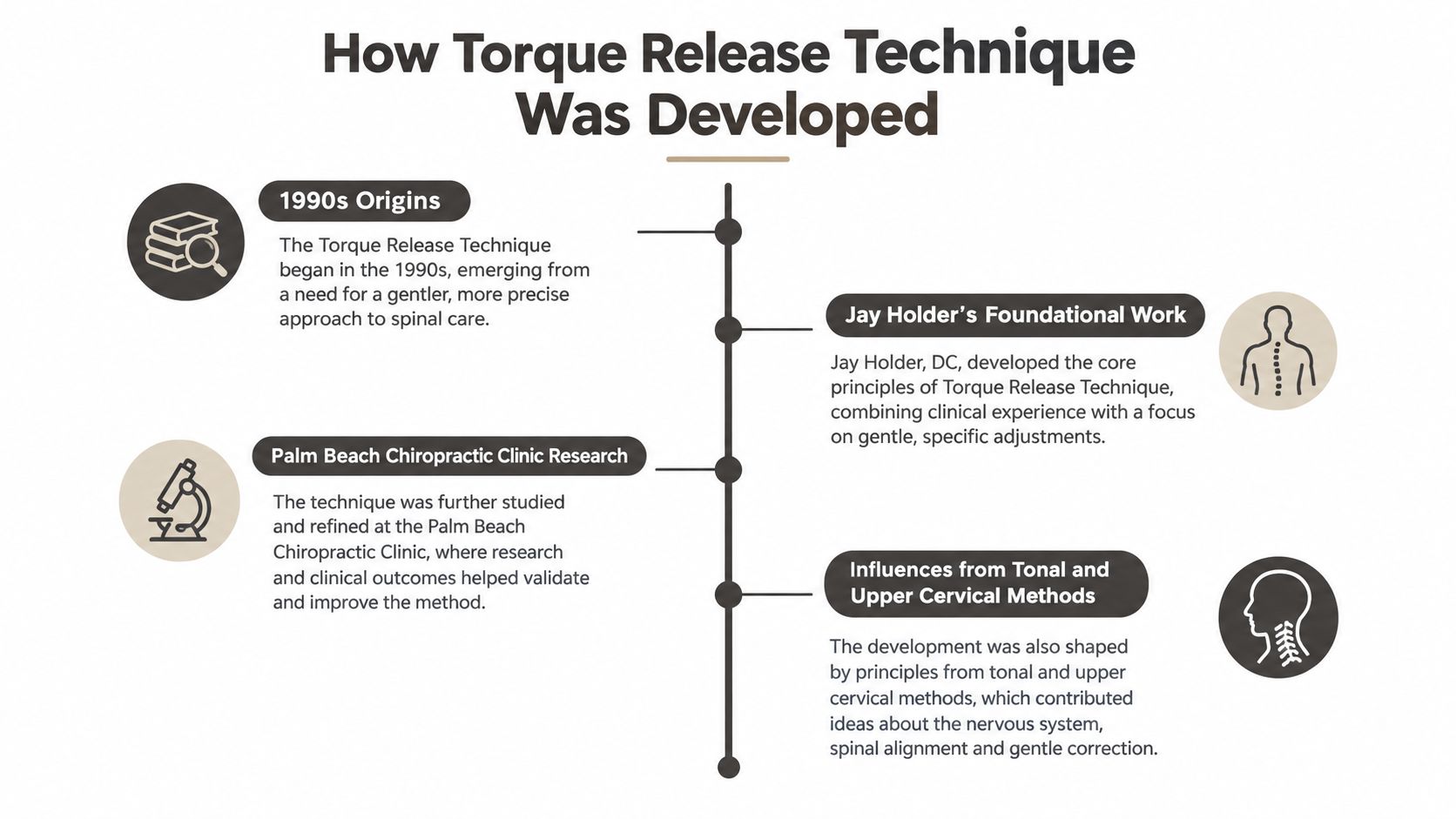
Torque Release Technique emerged during the 1990s through the work of Dr. Jay M. Holder and Dr. Marvin A. Talsky. One historical account states that Holder published the first description in March 1995, while the complete model appeared in 1998. These dates and the technique's early development are documented in the TRT technique model history.
The origin story matters because proponents describe TRT as developing from human population research rather than being created solely as an office procedure. The model is also associated with an early randomized, blinded, placebo-controlled population study in chiropractic, which supporters present as an important research milestone.
What “tonal” means in everyday language
Traditional segmental chiropractic models often focus on how a joint moves, where motion is restricted, and how a mechanical correction may restore movement. TRT uses a different emphasis. Its tonal or neurological framework considers how tension is expressed through the nervous system, dural tissues, and related contact points.
That distinction changes what the practitioner looks for. The purpose isn't necessarily to create a cavitation or push a vertebra through a large range of motion. Instead, the practitioner identifies a specific listing and applies a controlled impulse intended to influence the pattern being assessed.
This framework helps explain why TRT became attractive in family practices. A practitioner can use the same broad listing logic while modifying the patient's position, contact, and instrument settings. Still, the model shouldn't be confused with proof that every neurological, developmental, or prenatal outcome has been established. For a plain-language overview, see what Torque Release Technique involves.
The Integrator Instrument and How It Adjusts
The Integrator is the central tool used with TRT. It's a handheld instrument with a preloaded trigger mechanism and selectable tip characteristics, allowing the practitioner to deliver a controlled impulse to a chosen contact point.
Published TRT material describes the thrust as occurring in about one ten-thousandth of a second and identifies the instrument as a low-force delivery system. Those details come from the official Integrator description, not from a general claim about every instrument-assisted chiropractic device.
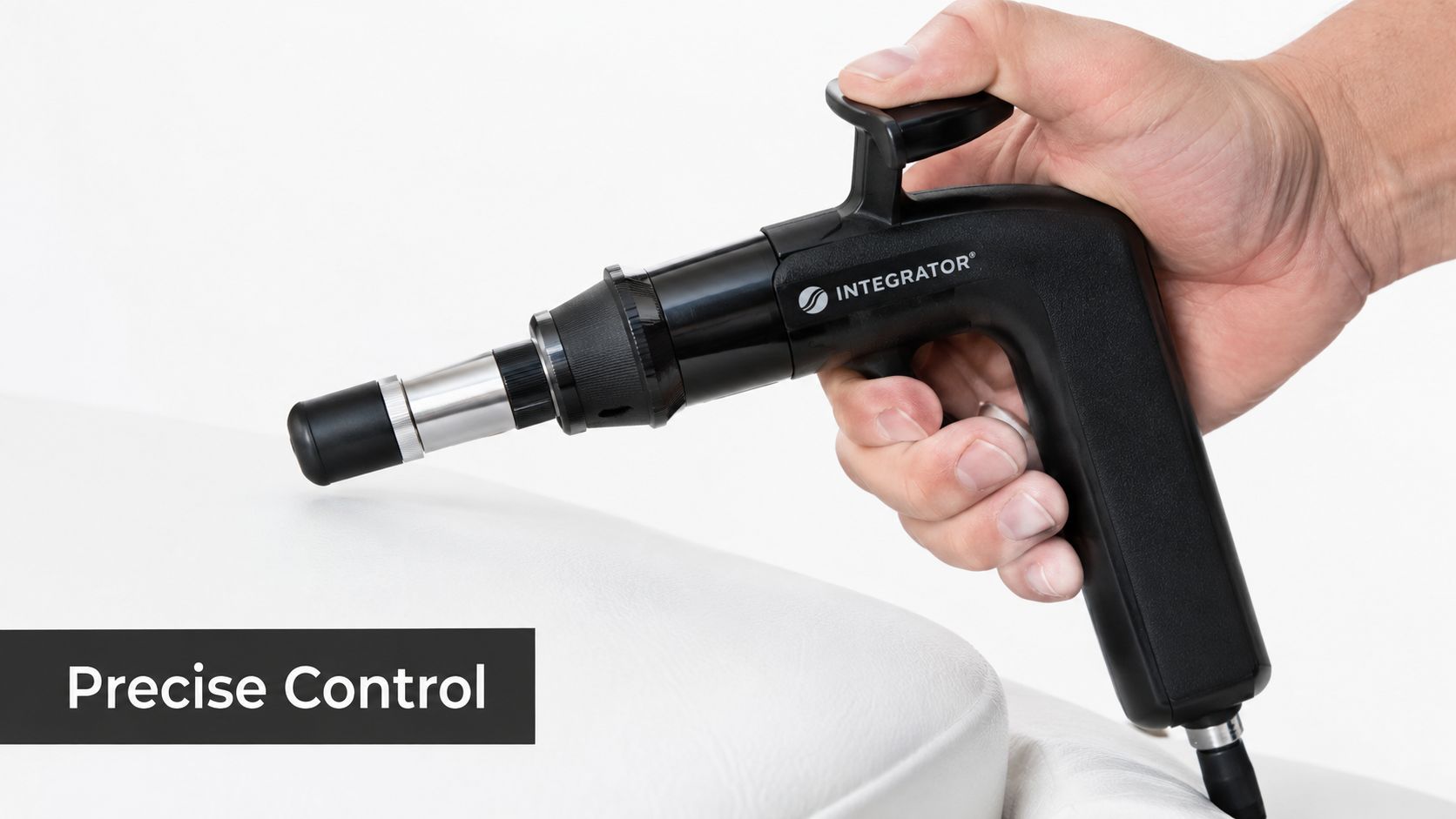
The patient usually feels a short, focused contact rather than a broad movement of the spine. The tool's click may be more noticeable than the force itself. There's no requirement for the practitioner to rotate the neck, twist the trunk, or use body weight to create a manual thrust.
What the practitioner controls
The practitioner selects the contact point, direction, and suitable tip characteristics according to the examination and the patient's age, body size, position, and tolerance. TRT descriptions refer to tip options for different contact needs, but parents shouldn't assume that a particular tip or setting is appropriate without an individual assessment.
An instrument's repeatability can be useful, especially when several clinicians work with one family. It can also create a false sense of certainty if the examination is weak. A consistent impulse doesn't replace diagnosis, screening, informed consent, or reassessment.
Here's a short visual demonstration of the instrument and its use:
The Integrator's design explains the quiet feel of a TRT visit, but it doesn't establish that TRT treats every condition associated with nervous-system language. The tool describes how force is delivered. Clinical outcomes require separate evidence.
Table Setup and Patient Positioning
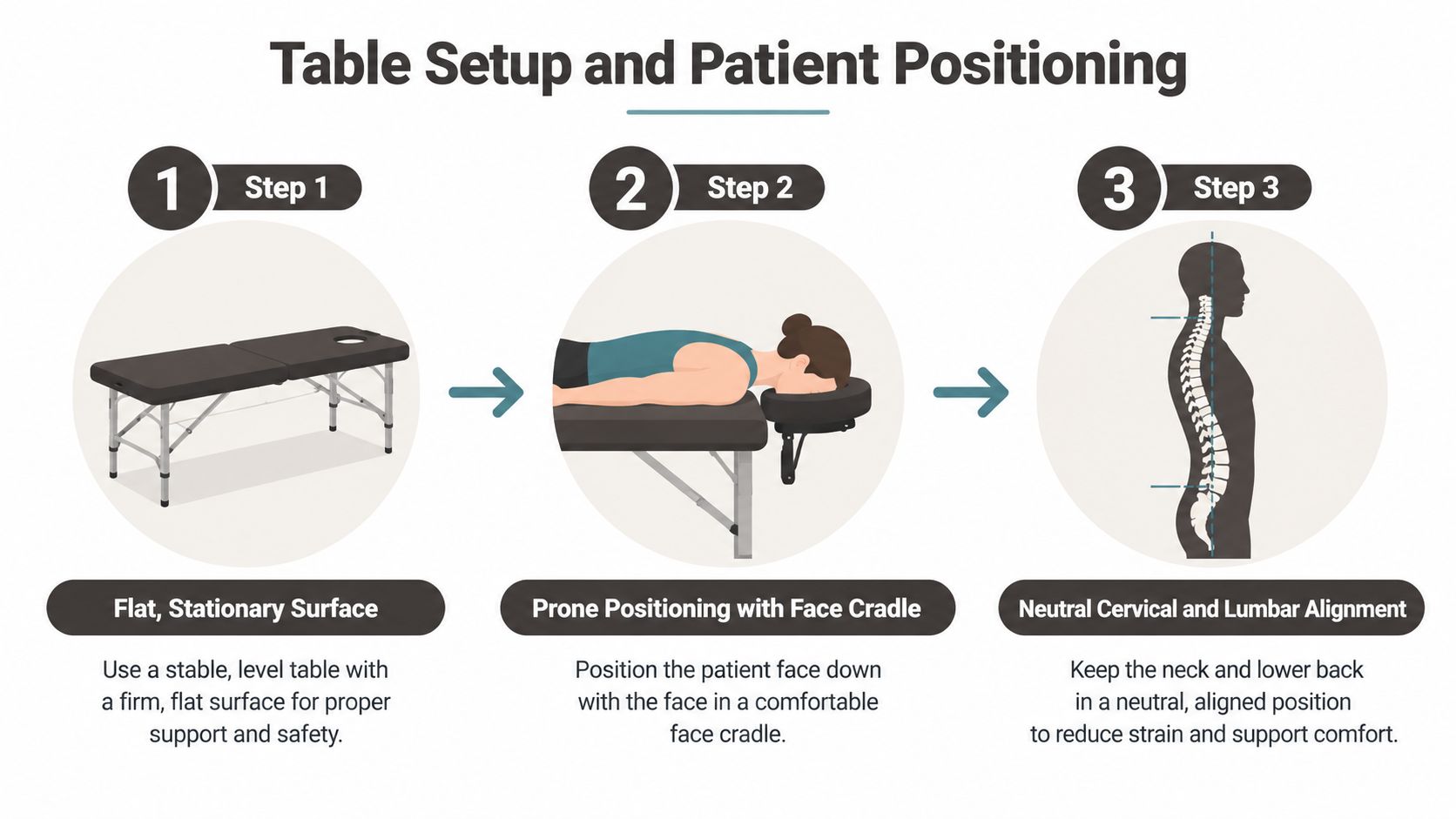
A TRT table is generally a flat or cushioned, stationary treatment surface. The table provides support while the Integrator supplies the brief impulse, so the setup doesn't depend on a drop section, rolling motion, or flexion mechanism.
For an adult, the practitioner may use a face cradle so the neck can rest without turning. The arms stay relaxed, the legs remain supported, and the cervical and lumbar regions are kept as close to neutral as the patient's comfort allows. The point is to reduce guarding. A person who is bracing against the table changes the contact and makes the examination less reliable.
Why clinician mechanics affect comfort
The chiropractor's stance matters too. Shoulders should be aligned over the contact, the contact hand stabilized against the table when appropriate, and the Integrator hand directed along the intended vector. Stable footing can help the practitioner avoid adding unnecessary movement.
Broader chiropractic table guidance emphasizes prone positioning, table height, spring tension, abdominal-piece adjustment, and wedged support as factors in line-of-drive accuracy and unwanted rotation. The classic adjustment setup reference describes how support and table height influence biomechanics.
In a family setting, positioning is adapted rather than forced:
- Adults: A face cradle and neutral support usually allow the patient to relax without active participation.
- Infants: The baby may remain on a parent's chest or receive close support so the position feels secure.
- Prenatal patients: Bolsters and side-lying arrangements can reduce abdominal pressure and accommodate changing body shape.
Soft lighting and a comfortable room temperature can help children settle, but those details don't substitute for proper support. The table should feel stable, the instructions should be clear, and the patient should be able to stop the process at any time.
Primary TRT Listing Points and Adjustment Vectors
TRT listing language uses specific contact points and directional vectors. Common abbreviations include P, posterior; A, anterior; AS, anterior superior; PS, posterior superior; PI, posterior inferior; and AI, anterior inferior. These directions belong to the TRT model, so they shouldn't be interpreted as a universal map for every chiropractic technique.
A practitioner may assess the sacrum, ilium, cervical spine, cranial landmarks, and dural attachment areas. The table below presents the protocol categories in a concise reference format. The “typical finding” column describes the type of leg-length or postural change a practitioner may document, not a guaranteed response or diagnostic test for disease.
| Listing | Contact Point | Vector | Typical Finding |
|---|---|---|---|
| Sacral apex | Sacral apex | P or A | Leg-length or pelvic change during the check |
| Sacral base | Sacral base | P or A | Altered pelvic balance on reassessment |
| Sacral torsion listing | Sacral landmark | AS or PI | Apparent leg-length asymmetry |
| Sacral dural attachment | Sacral apex or base | P | Change associated with the tonal check |
| Ilium listing | Posterior ilium | PI or AI | Pelvic postural variation |
| Ilium superior listing | Iliac landmark | AS or PS | Apparent change in pelvic height |
| Lower lumbar listing | Lumbar spinous process | P | Change in postural or leg check |
| Upper lumbar listing | Lumbar contact | P or A | Altered tension pattern on examination |
| Lower thoracic listing | Spinous or transverse process | P | Localized postural finding |
| Upper thoracic listing | Spinous or transverse process | P or A | Change in upper-body tone |
| Lower cervical listing | Cervical contact | P | Upper cervical or leg-check change |
| Mid-cervical listing | Cervical contact | P or A | Altered cervical finding |
| Upper cervical listing | Upper cervical contact | P | Change in the neurological or postural check |
| Occipital listing | Occipital landmark | P or A | Cranial and cervical tension finding |
| Cranial suture listing | Selected cranial suture | Direction-specific | Change in the practitioner's cranial check |
These entries shouldn't encourage self-assessment or tell a parent that a visible leg-length difference proves a spinal problem. Leg checks can be influenced by positioning, muscle tone, and examiner technique.
Clinical distinction: TRT vectors follow a tonal model of reducing tension along a meningeal and neural chain. They aren't the same as a mechanical instruction to rotate or cavitate a joint.
The most useful question isn't whether a practitioner can recite every listing. Ask how the listing was identified, what contact will be used, why that vector was selected, and how the response will be reassessed.
Adapting Listings for Prenatal, Infant, and Pediatric Patients
The listing logic may remain recognizable across a family, but the table experience shouldn't be identical for everyone. Age, body size, pregnancy, tissue tolerance, communication ability, and medical history all change how a practitioner positions the patient and selects contact.
Prenatal care
A pregnant patient may be positioned side-lying or supported in a modified prone arrangement, depending on comfort and the clinician's training. Bolsters can support the abdomen and pelvis without pressing directly into the belly. The practitioner may focus on sacral or pelvic listings, but the exact contact and force should follow the examination rather than a fixed pregnancy script.
The pregnancy chiropractic care guide offers a broader explanation of prenatal positioning and care considerations. It's still important to distinguish clinical practice from strong evidence. TRT-focused summaries acknowledge limited peer-reviewed data on fetal development, infant spinal alignment after birth, and prenatal pelvic biomechanics.
Infants and children
An infant may stay on a parent's chest or receive close, supported handling. The contact may involve a fingertip or a carefully selected instrument tip, with a brief single impulse rather than repeated pressure. Sacral, upper cervical, and cranial listings are often discussed in TRT practice, but newborn care requires especially careful screening and communication.
Older children can gradually tolerate more of the adult examination structure. The practitioner may reduce contact intensity, use a different tip, shorten the examination, or allow the child to watch the instrument first. A child's ability to consent through cooperation matters. Crying, withdrawal, or fear isn't a technical obstacle to overcome.
For parents: “Gentle” describes the delivery, not a blanket guarantee of safety or effectiveness. The clinician still needs to review birth history, illness, injury, medication, and current symptoms.
The evidence gap is particularly important here. Adult or mixed-age findings can't automatically establish safety or benefit for newborns, pregnant patients, or children with complex medical needs. A careful practice will explain what is documented, what is inferred, and when another provider should be involved.
What the Research Actually Shows
TRT's evidence narrative includes historical population research and published outcome reports, but the strength of evidence varies by population and outcome. The material most often cited by TRT discussions includes adult outcomes, pediatric work, and addiction-recovery research, yet those categories shouldn't be treated as interchangeable.
TRT literature summarizes a pediatric ADHD study with average improvements of 17% in ADHD symptoms, 23% in functional status, and 21% in general wellbeing. Those figures are reported in the TRT research summary. They describe the reported study outcomes, not proof that TRT should replace pediatric or psychiatric evaluation.
Evidence in context
A randomized controlled study in addiction recovery is also cited in TRT literature as reporting unusually high retention and fewer nursing-station visits than typical program averages. The supplied material doesn't provide numerical values for those comparisons, so they should remain qualitative.
Claims about infant colic, prenatal care, breastfeeding, developmental conditions, and newborn alignment require more caution. Some findings may come from small studies, clinical reports, broader instrument-assisted chiropractic research, or practice experience rather than TRT-specific trials. A result from a different instrument or a different chiropractic method can't be presented as direct evidence for TRT.
| Study | Population | Outcome Measured | Evidence Strength |
|---|---|---|---|
| Early TRT population research | Human population | Foundational technique and population outcomes | Historically important, but not a universal treatment proof |
| Pediatric ADHD study | Children with ADHD | Symptoms, function, and wellbeing | Quantitative report, but limited for broader claims |
| Addiction-recovery controlled study | People in recovery | Retention and nursing-station visits | Controlled research described in TRT literature |
| Prenatal and newborn claims | Pregnant patients and infants | Comfort, alignment, pelvic or developmental outcomes | Evidence remains thin and requires careful interpretation |
A fair conclusion is narrower than marketing language. TRT has documented research claims and measurable reported outcomes, but pediatric, prenatal, and newborn applications need stronger, directly relevant trials before practitioners can make broad promises.
Common Indications and Cautions for TRT
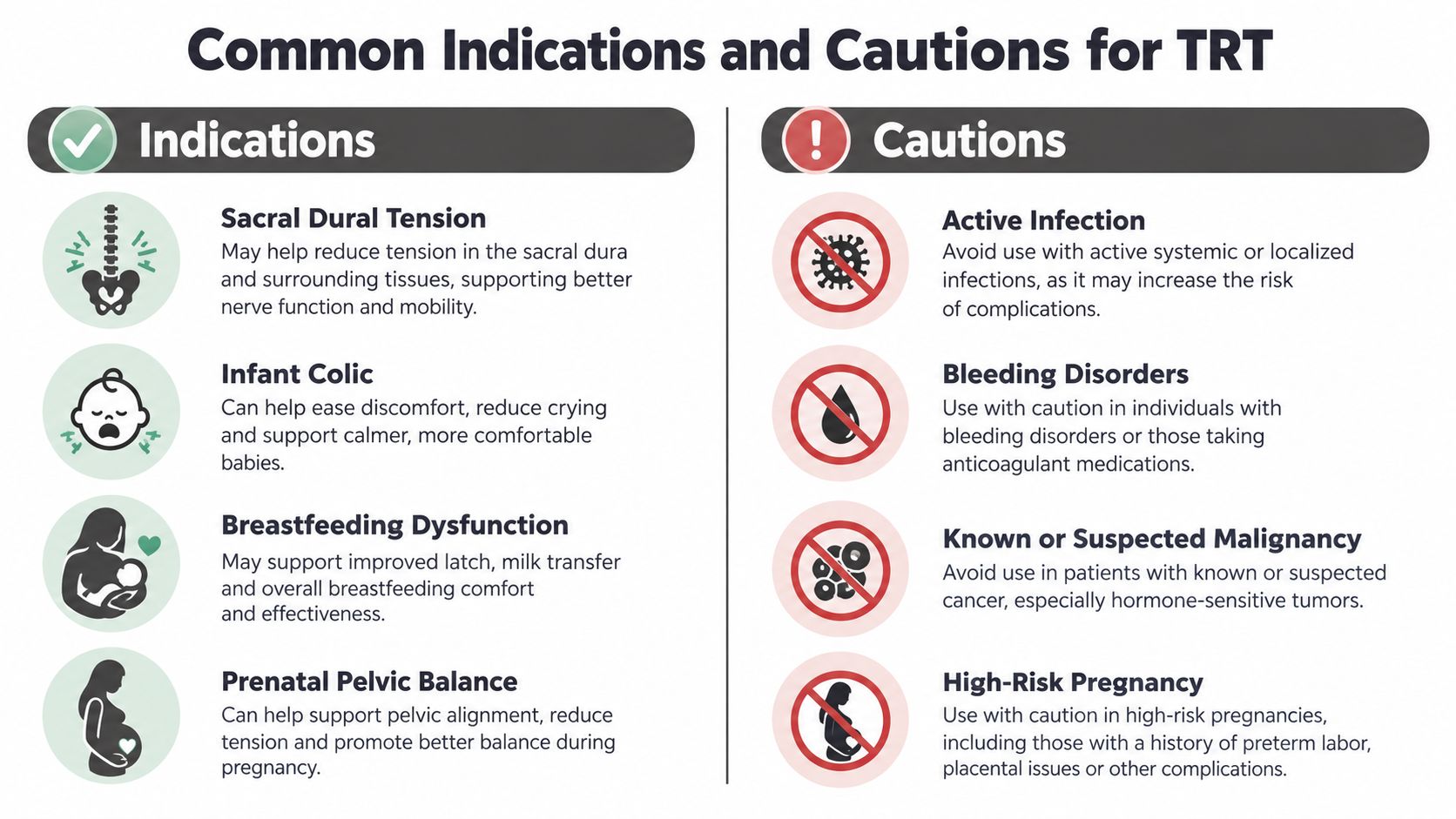
Practitioners may discuss TRT when an examination identifies a pattern they interpret through the technique's tonal framework. Common clinical conversations can include sacral or occipital dural tension, infant feeding concerns, colic, prenatal pelvic balance, and adult stress-related muscular tension.
The adjustment focus depends on the finding. A sacral contact may be selected for a pelvic or lower-chain listing, while an upper cervical or cranial contact may be chosen when the examination points higher in the chain. These are clinical decisions, not diagnoses that a parent can confirm from symptoms alone.
Situations that need caution
A low-force instrument doesn't make every case appropriate for contact. Screening and referral deserve priority when a patient has:
- Possible fracture: Contact should wait until the injury has been medically assessed.
- Acute disc symptoms with radiculopathy: Progressive weakness, significant numbness, or severe radiating pain may require medical evaluation.
- Unstable joints: Instability changes the risk calculation and may make another approach more suitable.
- Bleeding disorders or relevant medication: The practitioner needs a complete history before deciding whether contact is appropriate.
- Recent spinal surgery: Surgical records, healing status, and the operating clinician's guidance may be necessary.
- Symptoms requiring imaging: Imaging or medical evaluation should come before an adjustment when the history or examination indicates it.
A gentle technique still needs a safety screen. Force level is only one part of clinical risk.
TRT should sit inside a broader care plan when appropriate. A pediatrician, midwife, obstetric provider, lactation consultant, physical therapist, or medical specialist may have an important role. At First Steps Chiropractic, the practice describes TRT as one gentle, specific adjustment option within pediatric, prenatal, and family care. Families should compare that approach with other qualified providers and choose care based on examination quality, communication, and appropriate referral.
Comparing TRT With Other Chiropractic Table Setups
The table often tells you more about the expected experience than the word “chiropractic” does. TRT generally uses a stable flat or cushioned surface because the Integrator delivers the impulse. The table doesn't need to drop, flex, or create rotational movement.
A drop-piece table has a section that moves downward when the practitioner applies a manual thrust. That can create a distinct mechanical sound and sensation, even when the movement is controlled. Some patients tolerate it well, while others prefer not to feel a moving surface beneath them.
A stationary flat bench gives the clinician a stable base for manual or instrument-assisted contact. A flexion-distraction table, by contrast, is designed to move in a guided pattern and is commonly used when the practitioner wants to combine positioning with rhythmic table motion.
| Setup | Patient experience | Clinician hand position | Common trade-off |
|---|---|---|---|
| TRT table | Brief tap, stable surface, little body movement | Focused contact with the Integrator | Less table motion, but technique depends heavily on accurate listing |
| Drop-piece table | A controlled drop and possible audible table response | Manual contact with a moving section | Some patients like the movement, others find it startling |
| Flat bench | Hands-on or instrument contact on a fixed surface | Broader manual or focused instrument contact | Stable and simple, but comfort depends on the chosen technique |
| Flexion-distraction table | Guided movement and repeated table motion | Contact coordinated with table movement | More movement, which may not suit every patient |
A practitioner may change setups when a care plan calls for technique diversity or when patient preference changes. Parents can ask whether the table is stationary, whether any section will drop, and whether they'll need to turn or hold a position.
Quick Reference for Parents and Practitioners
Use this card to set expectations before the first appointment. The exact schedule varies with the examination and the patient's response.
| Element | Typical TRT Experience |
|---|---|
| Visit timing | A first visit may take around 45 to 60 minutes, including history and examination. The adjustment itself may take only a few minutes. |
| Audible cue | The Integrator may produce a characteristic click when it fires. |
| Perceived pressure | Most patients describe a brief, low-force tap without popping or forceful twisting. |
| Follow-up cadence | A practitioner may review findings after 2 to 4 weeks and taper visits as the clinical picture changes. |
The figures in this card are the supplied TRT practice guidance, not a guarantee for every office or patient. A longer first visit may be appropriate when a child has a complex history, a prenatal patient needs careful positioning, or records and referrals must be reviewed.
Parents should also know what reassessment means. It is not just asking whether the patient “feels better.” A responsible clinician compares the original findings with current symptoms, function, comfort, and any relevant medical information.
For families considering infant care, the guide to chiropractic care for babies can help frame questions about handling, communication, and the limits of gentle care. Bring those questions to the practitioner before the first contact.
TRT Questions Parents Ask Most
Is TRT safe for a newborn with open fontanelles?
Open fontanelles are a reason for careful assessment, not a reason to assume that any instrument contact is safe. Published TRT-specific evidence for newborns remains limited, and decisions should depend on the infant's health history, examination, birth circumstances, symptoms, and the practitioner's training. Ask exactly where contact will occur and whether the infant's pediatric provider should be consulted.
How many visits might a child need?
Some practices describe an initial arc of 6 to 8 visits during the first month for a new finding, followed by tapering. That's a practice pattern, not a universal clinical requirement, and it should never override reassessment. If the plan remains unchanged despite no meaningful response, ask what the practitioner is measuring and whether referral is appropriate.
What counts as progress?
Meaningful progress should involve a change relevant to the original concern, such as more comfortable movement, improved feeding function as assessed with the right professionals, or a documented change in the examination. A brief post-adjustment response isn't automatically improvement, and a temporary change shouldn't be presented as proof of correction.
Can the Integrator be used over hardware or a recent fracture?
Not without case-specific screening. Surgical hardware, healing bone, acute injury, unstable joints, and neurological symptoms may require records, imaging, medical clearance, modification, or referral. A low-force impulse doesn't remove those considerations.
Can TRT be used alongside pediatric or birth care?
Yes, coordination may be appropriate, but TRT shouldn't replace a pediatrician, obstetric provider, midwife, lactation consultant, or other clinician. Share the care plan, report new symptoms, and make sure each provider knows what treatment the patient is receiving.
Parents deserve a calm explanation, not a promise that one table or instrument can solve every concern. Ask what is known, what is uncertain, and how the practitioner will decide whether to continue, modify, or stop care.
First Steps Chiropractic offers pediatric, prenatal, and family chiropractic evaluations that may include Torque Release Technique and individualized positioning for the patient's age and needs. Visit First Steps Chiropractic to review the practice's approach and arrange a consultation where you can ask about the Integrator, table setup, safety screening, and coordination with your child's or pregnancy care team.