
At snack time, your child flings the peas across the kitchen and refuses the yogurt. At bath time, water on their face triggers screaming. In the grocery store, the blender near the deli counter starts, and they clamp both hands over their ears. You may be wondering whether you're seeing ordinary childhood preferences, a phase, anxiety, or something more.
These reactions can feel confusing because adults experience the same setting without the same distress. A shirt tag feels minor to you, but painful or impossible for your child. A birthday party may seem fun, while the noise, movement, smells, and crowded room fill their nervous system faster than they can manage.
Understanding your child's sensory signals starts with observation rather than judgment. Sensory-processing differences are common enough to matter in everyday family life. A JAMA Pediatrics review stated that about one in six children have sensory processing difficulties, with higher estimates in some groups of children with neurodevelopmental or medical conditions.
Snack time, bath time, and the grocery store often reveal patterns because they combine several kinds of input with demands, transitions, and tiredness. We'll look at what your child may be communicating, how to respond in the moment, how to track patterns, and where a professional evaluation may fit.
When Everyday Reactions Feel Bigger Than They Should
You've planned a simple morning. Your child needs to get dressed, eat breakfast, and leave for school. Then the shirt comes out, the tag touches their neck, and the entire routine stops. They pull at the fabric, cry, push your hands away, and insist they can't wear it.
Later, they fling peas at dinner. At first, it looks like defiance. Then you notice they're also avoiding the mashed potatoes, turning away from the smell of the chicken, and becoming upset when food touches the sides of the plate. The behavior may be communicating discomfort before your child has the words to explain it.
A useful question: “What might this sensation feel like in my child's body?”
Parents often hear that a reaction is “just a phase.” Sometimes it is a short-lived preference. But when the same pattern repeatedly disrupts dressing, meals, sleep, school, or family outings, that explanation may no longer feel sufficient. Sensory signals can be misread as poor behavior, shyness, stubbornness, or anxiety when the child is trying to manage input.
The grocery store shows this clearly. Bright lights, cart movement, announcements, conversations, food smells, and unexpected sounds arrive together. A child who covers their ears or drops to the floor may not be trying to control the shopping trip. Their system may have reached its limit.
The same idea applies to bath time. Water temperature, slippery surfaces, shampoo near the eyes, the sound of water, and the feeling of a washcloth can combine into an overwhelming experience. At a birthday party, music, cheering, hugs, sugar, unfamiliar people, and fast movement may create a similar response.
You don't need to decide what a behavior means immediately. Start by treating it as information. That shift helps you respond with curiosity, reduce shame, and notice which kinds of input make daily routines easier or harder.
Sensory Seeking vs Sensory Avoiding Explained
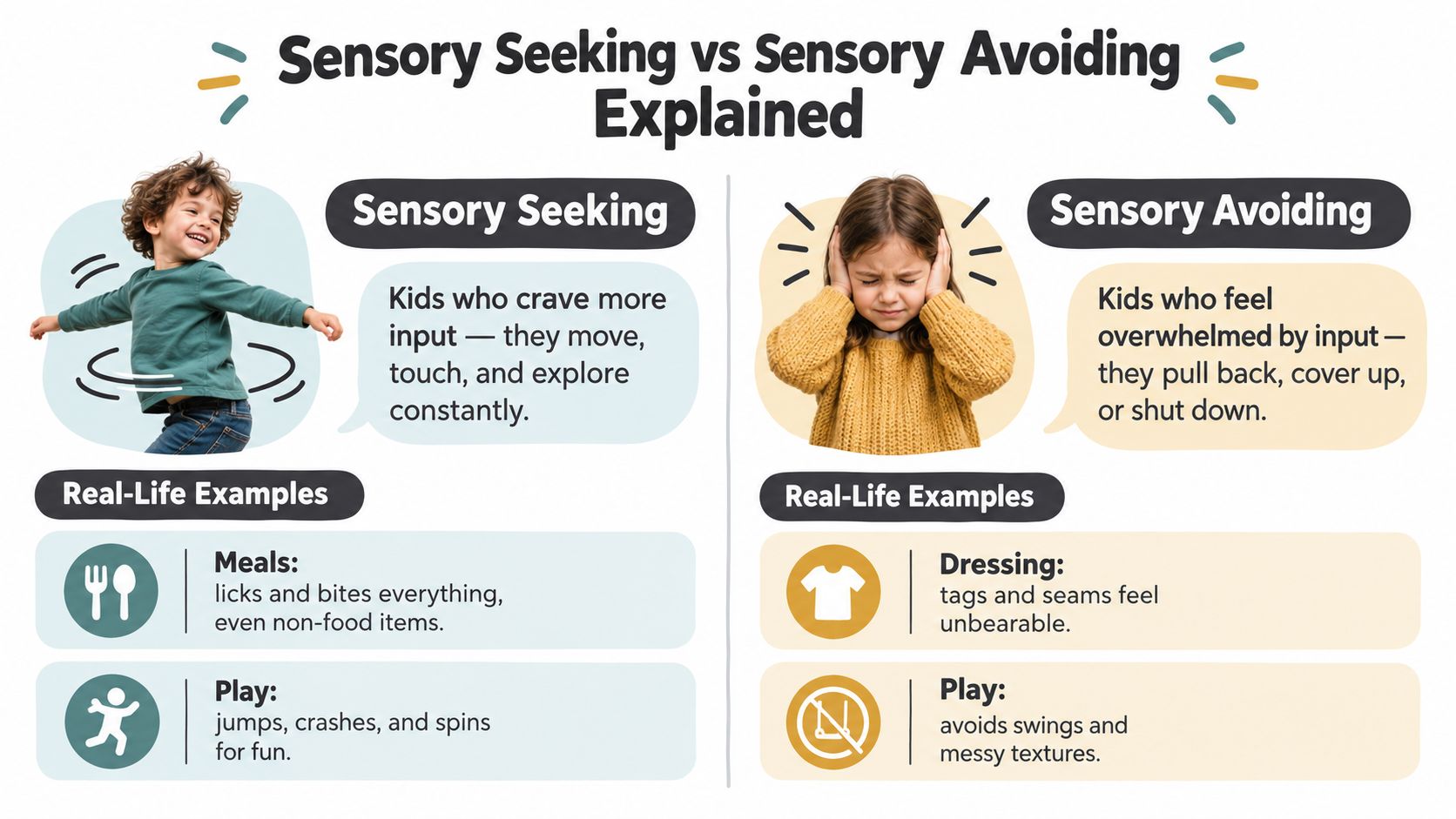
Some children seem to need more sensory input to feel organized. They jump from the sofa, crash into cushions, spin in circles, lick objects, chew clothing, or seek loud and fast play. This pattern is commonly called sensory seeking, but the plain-language meaning is simple: the child's body keeps looking for movement, pressure, sound, touch, or taste.
At meals, a seeking child may lick utensils, bite non-food objects, or prefer crunchy foods. During play, they may jump, wrestle, run into pillows, or repeatedly ask to spin. While getting dressed, they may pull hard on sleeves, press against furniture, or choose tight clothing because the added pressure feels grounding.
Other children experience ordinary input as too intense. They pull away from hugs, refuse finger paint, cover their ears in the store, reject certain food textures, or become distressed by tags and seams. This pattern is often called sensory avoiding, meaning the child tries to reduce or escape sensations that overwhelm their system.
The two patterns aren't moral categories. A child who avoids messy play isn't necessarily shy, and a child who crashes into furniture isn't necessarily naughty. Both children are attempting to regulate.
Notice the conditions around the behavior
A child may seek movement after sitting through a long school day but avoid spinning when tired. They may eat crunchy foods in the afternoon and reject them when their mouth is sore. They may tolerate a busy store on a quiet morning but cover their ears during a crowded weekend trip.
Fatigue, hunger, illness, unfamiliar settings, and the number of demands placed on the child can all change the response. Some children also move between seeking and avoiding, depending on the sensory channel and the situation.
A practical guide to sensory-seeking behavior can help you identify patterns, but observation still matters more than a checklist. Write down what happened, what came before it, and what helped.
Movement, pressure, and chewing may help one child settle while making another child more activated. Your child's response is the guide. Once you know whether they're seeking or avoiding, look at the individual sensory channels rather than treating every reaction as the same problem.
The Seven Senses and What Each Signal Looks Like
Children receive information through more than the familiar five senses. Touch, sound, sight, taste, smell, movement, and body awareness each send messages that the nervous system must organize.
A child may seek input through one channel and avoid it through another. The table below offers starting points, not a diagnosis.
| Sense | Seeking signals | Avoiding signals |
|---|---|---|
| Touch | Rubs fabrics, touches surfaces, seeks rough play or firm pressure | Rejects tags, seams, finger paint, hair brushing, or unexpected contact |
| Sound | Hums, makes repeated noises, turns music up, seeks noisy play | Covers ears, leaves when the blender runs, or becomes distressed in crowded rooms |
| Sight | Watches spinning fans, moving objects, reflections, or bright visual patterns | Avoids fluorescent aisles, busy rooms, glare, or visually cluttered spaces |
| Taste | Craves strong flavors, crunchy foods, or frequent oral input | Gags at textures, rejects mixed foods, or eats from a narrow comfort range |
| Smell | Seeks scented objects, strong foods, or noticeable odors | Reacts strongly to perfume, cleaning products, food smells, or bathrooms |
| Vestibular movement | Swings, spins, jumps, runs, and seeks fast changes in position | Avoids swings, slides, climbing, uneven ground, or having feet leave the floor |
| Proprioception and body awareness | Crashes into pillows, pushes furniture, chews, or uses force during play | Seems floppy, misjudges force, bumps into objects, or appears unsure of body position |
The familiar five
Touch can show up when a toddler rubs every fabric in a shop or when a school-age child refuses a shirt because the seam feels unbearable. Sound may look like constant humming on the seeking side, or leaving the room when a vacuum starts on the avoiding side.
Visual input matters in places adults may not notice. A child fascinated by a ceiling fan may be seeking predictable movement. Another child may struggle under bright lights or in a crowded aisle where visual information arrives from every direction.
Taste and smell often meet at the dinner table. A child who wants spicy, sour, crunchy, or intensely flavored foods may be seeking stronger input. A child who gags at mixed textures or rejects food because of its smell may be protecting themselves from input that feels too powerful.
Movement and body awareness
The vestibular system helps the brain process balance and movement. A child who never seems finished swinging may be seeking that input, while a child who keeps both feet on the ground may feel safer with less movement.
Proprioception helps the brain understand body position, pressure, and force. Crashing into cushions can provide strong information about where the body is. A child who appears clumsy or uses too much force may need help noticing body feedback.
Interoception, the awareness of internal signals such as hunger, fatigue, or arousal, adds another layer. Research on measuring interoception from infancy to childhood is still emerging, but it supports structured attention to how children notice and respond to body cues.
Every visible behavior offers a clue about what the nervous system is trying to take in, find, or block.
Why the Nervous System Drives These Behaviors
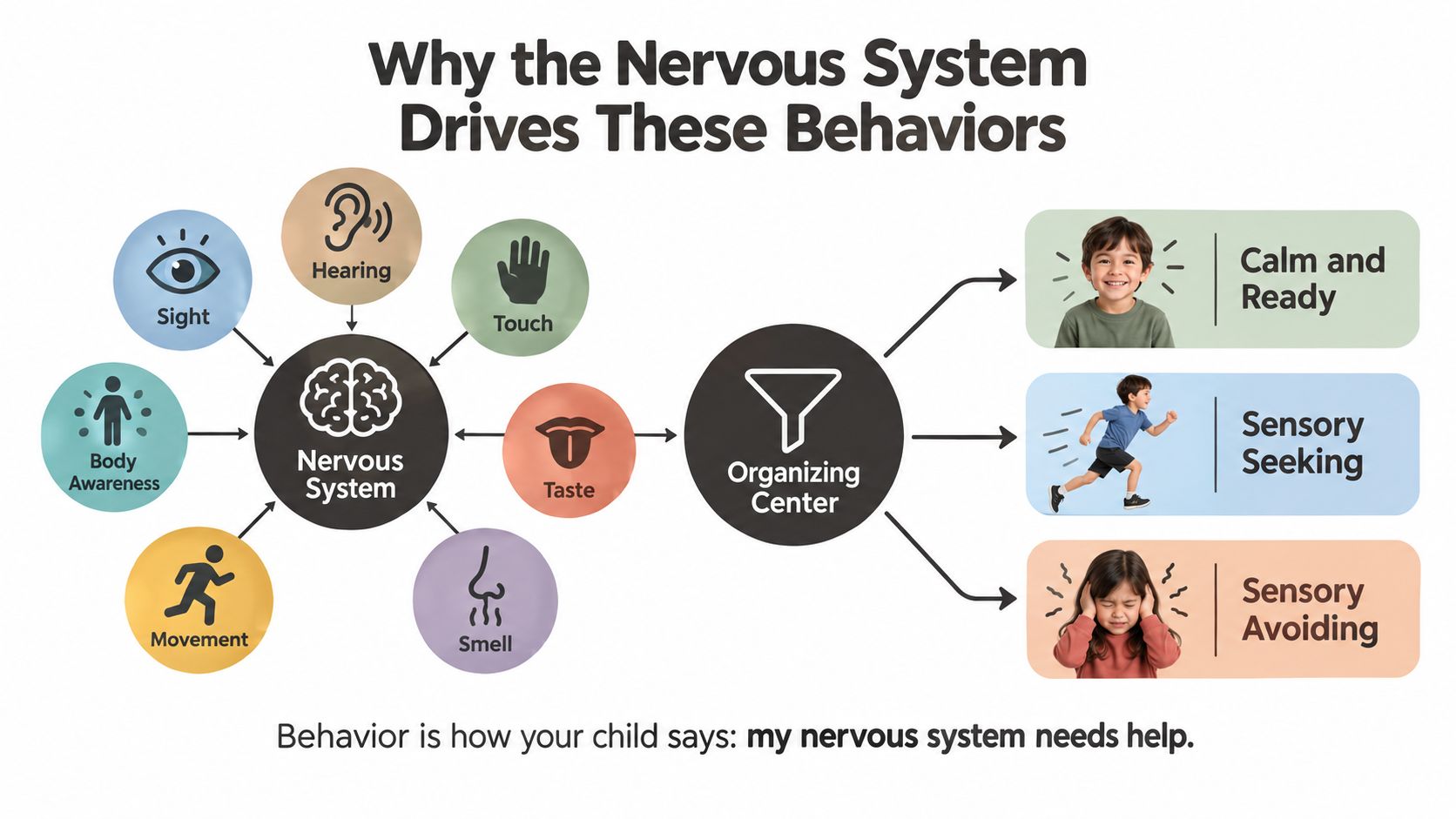
Your child's brain receives sensory information, sorts it, and helps produce a response. The autonomic nervous system influences whether the body is prepared to engage calmly, move toward input, or protect itself by escaping, resisting, freezing, or shutting down.
A grocery-store meltdown may reflect sympathetic activation, the body's mobilized fight-or-flight state. Covering the ears, refusing to move, pushing away a hand, or crying can be protective responses when sound, light, movement, and demands arrive too quickly.
A child who crashes into pillows may be responding from a different need. Strong pressure and movement can provide body information that helps them feel more present and organized. That same activity may become too stimulating if the child is already tired or highly activated.
Think of a changing sensory threshold
One helpful image is a bucket. Every sound, touch, smell, movement, demand, and transition adds something to the bucket. Some children's buckets fill quickly, while other children actively seek input because their bucket doesn't feel full enough.
Bath time may be manageable when the child is rested, then become impossible after a demanding day. A birthday party may begin well and end with a sudden collapse. The change doesn't mean the child is manipulating you. Their available capacity has changed.
Parasympathetic regulation supports calmer engagement. When a child feels organized enough, they may focus, make eye contact, play flexibly, and accept help. Regulation isn't constant, and no child stays calm through every demand. The important clue is how quickly the system becomes overloaded and how much support it takes to return.
Behavior is information about nervous-system state, not a complete explanation of character.
Research in pediatric sensory regulation uses measures such as pre-ejection period and electrodermal activity to examine sympathetic activation during sensory stress tests. A systematic review of physiological regulation and sensory responses found that the connection between observed behavior and physiological regulation remains inconclusive overall. That's why a careful interpretation combines behavior, context, developmental history, and, when appropriate, objective assessment.
A neurologically focused pediatric chiropractic perspective may be one part of a broader support plan. Functional neurology chiropractic focuses on nervous-system function, but it shouldn't replace medical evaluation, occupational therapy, developmental assessment, or other appropriate care.
A Simple Way to Observe and Track Your Child's Signals
You don't need to diagnose your child at home. You need a clearer picture of what happens before, during, and after difficult moments.
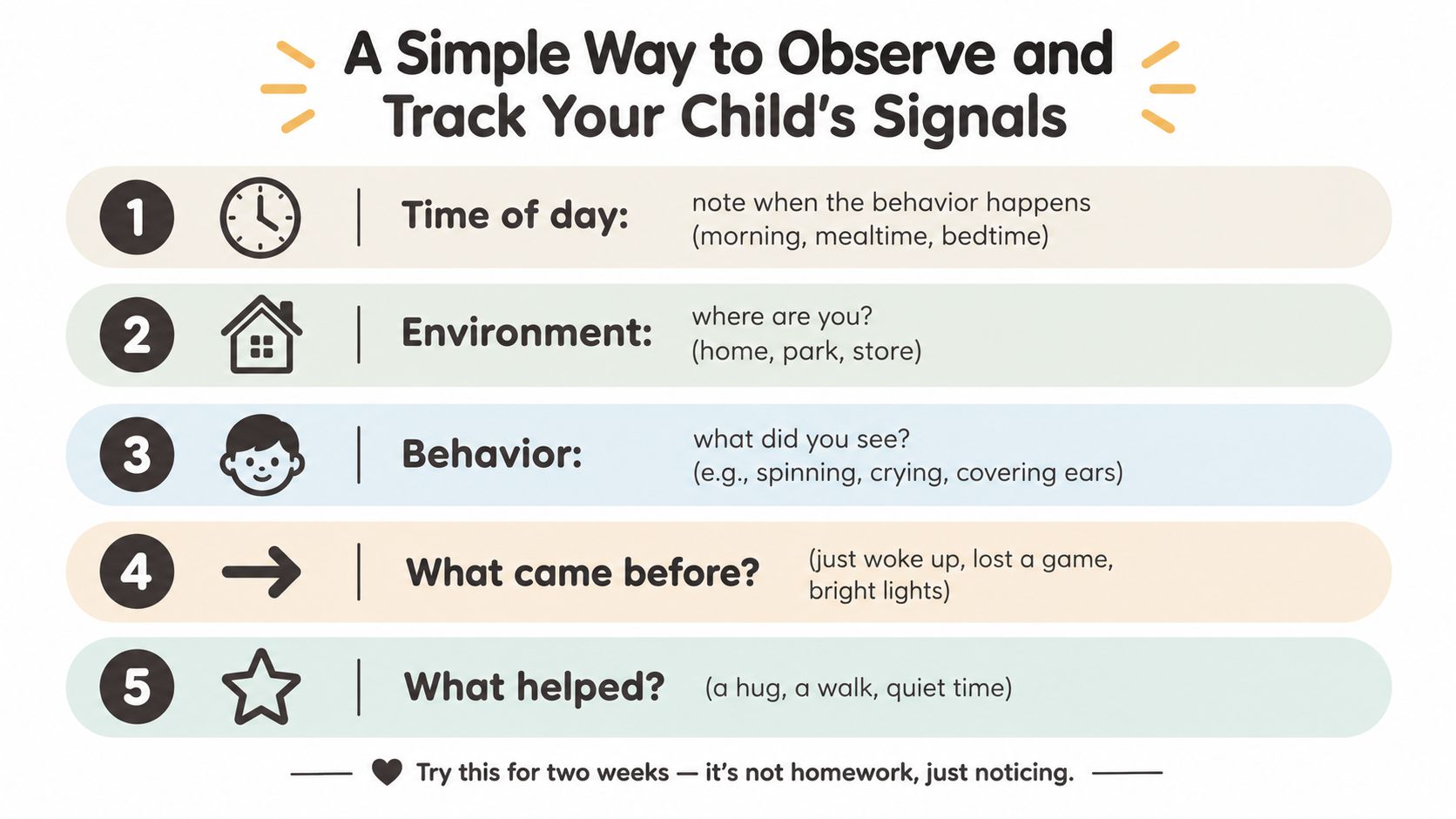
Use a notebook or notes app for about two weeks. Keep the entries short. A few accurate details are more useful than a long description written after everyone is exhausted.
Record the setting, not just the reaction
Focus on three predictable windows: morning routines, meals, and transitions. These moments often reveal how your child responds when the body is tired, hungry, rushed, or asked to shift from one activity to another.
For each event, note:
- Time of day: Was it morning, mealtime, after school, or bedtime?
- Environment: Were you at home, in a store, at school, or outdoors?
- Visible behavior: Did your child spin, cry, cover their ears, chew, flee, freeze, or push away?
- What came before: Had they just woken up, lost a game, entered bright lighting, heard a sudden noise, or changed clothes?
- What helped: Did quiet time, a snack, a walk, a firm hug, a softer shirt, or a clear choice make a difference?
At breakfast, ask whether the texture, temperature, smell, or arrangement of food mattered. During waiting, watch for movement-seeking, chewing, tapping, or repeated questions. During transitions, notice whether a warning, visual cue, familiar object, or slower pace changes the response.
Look for frequency, intensity, and impact. A child who occasionally dislikes a sock is different from a child who cannot get dressed for school because clothing distress repeatedly stops the morning. Your notes give a pediatrician or therapist something concrete to discuss without turning your home into a diagnostic clinic.
Practical Strategies for Responding at Home
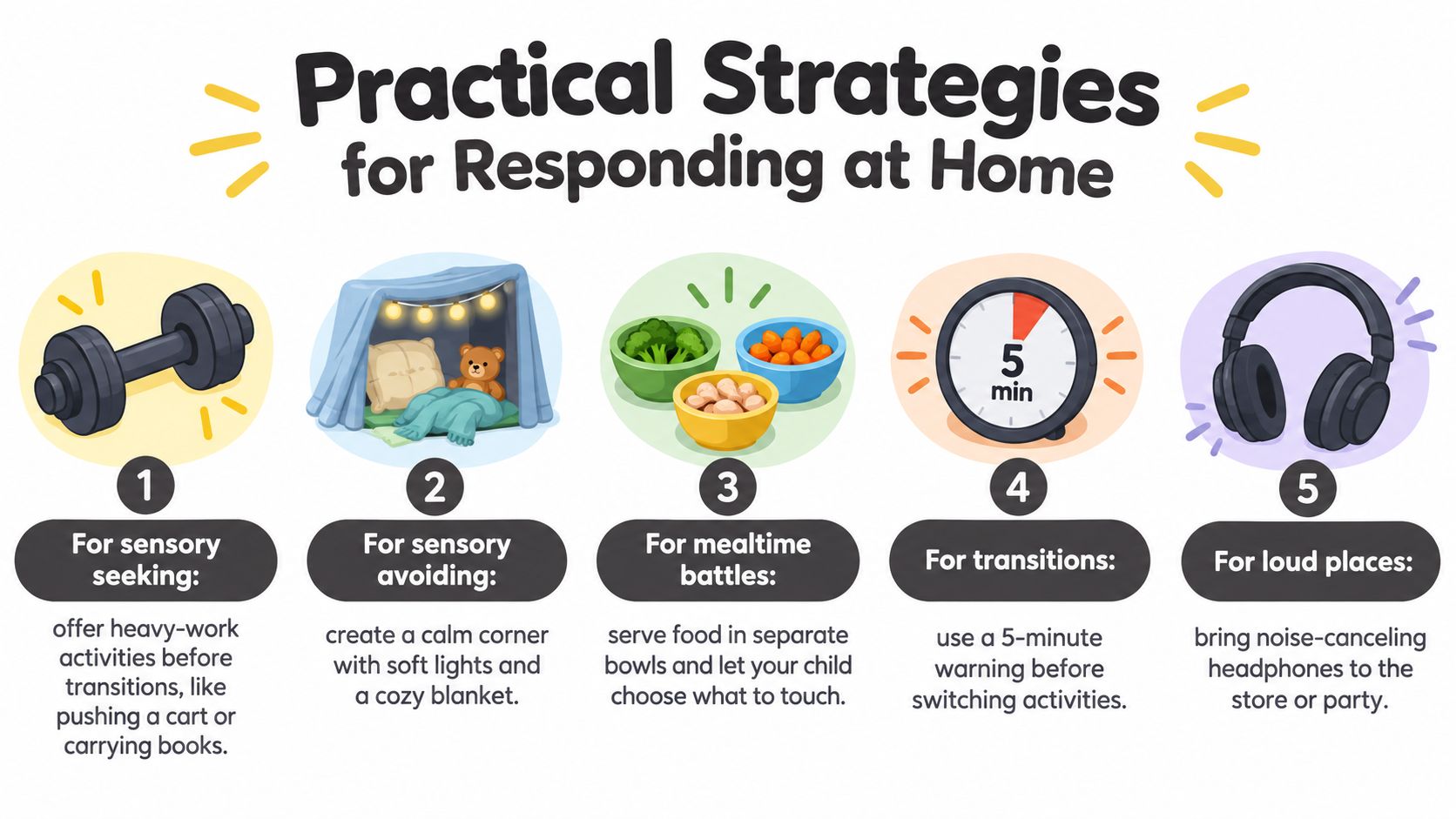
Your response can begin before the difficult moment. If your child seeks movement before leaving the house, invite them to push a laundry basket, carry books, or do wall pushes before putting on shoes. If homework becomes restless, offer brief movement breaks instead of waiting until the body is already overloaded.
Food can provide useful input, but keep safety and developmental readiness in mind. A child who seeks oral input may prefer an appropriate crunchy or chewy snack. A child who avoids mixed textures may manage better when foods are served separately and they can decide what touches their plate.
Match the support to the signal
For avoiding patterns, reduce surprise. Give a warning before hair washing, let your child choose between two soft shirts, and bring noise-reducing headphones to the grocery store or a party. Respecting that a tag hurts doesn't mean giving in to every demand. It means removing an unnecessary barrier so your child can participate.
At bath time, try a predictable sequence. Let your child know what will happen first, next, and last. Offer a dry towel nearby, reduce splashing, and let them hold the washcloth if that gives them more control.
For bedtime resistance, lower stimulation before asking for cooperation. Dim the lights, use the same short routine, and offer a quiet corner with a familiar blanket. A breathing game, slow rocking, or reading side by side may work better than repeated instructions while the child is already activated.
Use calm as an active support
At a birthday party, you might say, “The music is loud. We can stand in the hallway or stay near the door.” At the store, try, “Your ears are working hard. Headphones or a quiet break?” These statements name the experience without labeling the child.
Stay close, lower your voice, and solve the sensory problem before discussing behavior.
A small home toolkit can include a quiet corner, soft lighting, a favorite blanket, headphones, a water bottle, and one or two familiar calming activities. Don't introduce every tool at once. Offer a simple choice and watch what your child's body does next.
Your calm presence matters because children often need support from an adult before they can use a strategy independently. You don't have to be perfectly calm. Pause, soften your tone, and repair if you become frustrated.
Knowing When It's Time to Seek Professional Support
A sensory preference alone doesn't establish a disorder. Many children dislike a particular fabric, avoid a strong smell, or need movement after sitting. The more important question is whether the pattern is persistent, intense, and limiting your child's participation.
Consider professional support when sensory reactions repeatedly affect:
- Daily care: dressing, bathing, brushing teeth, or toileting
- Feeding: accepting enough variety or managing textures and smells
- Sleep: settling, staying asleep, or tolerating the bedtime routine
- School: entering the classroom, focusing, joining activities, or coping with noise
- Family life: leaving home, attending events, shopping, or maintaining safe relationships
The sensory processing overview for parents can help you gather questions, but online information can't determine what's happening for your child.
Choose the right starting point
A pediatrician can review medical history, development, sleep, feeding, hearing, vision, and broader concerns. They may recommend an occupational therapist, developmental specialist, psychologist, or another clinician. An occupational therapist can assess sensory processing and functional participation, then design strategies for home and school.
A neurologically focused pediatric chiropractor may offer an evaluation centered on nervous-system regulation and musculoskeletal findings, including patterns the practice believes may contribute to stress responses. Families should ask what the evaluation measures, how findings are explained, and how the provider coordinates with the child's pediatrician and therapy team.
Reviews indicate that sensory difficulties occur across pediatric populations and are especially common alongside neurodevelopmental conditions. A peer-reviewed review of sensory processing prevalence describes estimates ranging from 60% to 90% among children with autism spectrum disorder, while general-population findings are lower and vary by study. Sensory differences can also appear in ADHD, anxiety, and other developmental profiles. A review of sensory abnormalities in ADHD and ASD supports using a nuanced assessment rather than assuming one explanation.
When you call, describe the pattern plainly: “My child covers their ears in stores, refuses certain clothing, and needs a long time to recover. It happens most often after school and is affecting dressing and family outings.” That language keeps the conversation focused on function, context, and support.
Bringing It All Together as a Parent
Start with four commitments:
- Observe without diagnosing. Notice the setting, sensory channel, body cues, and what came before.
- Support the signal instead of suppressing the behavior. Change the noise, texture, lighting, movement, or demand when you can.
- Partner with the right provider. Share your notes with the pediatrician, occupational therapist, developmental specialist, or other qualified clinician.
- Revisit the pattern as your child grows. A support that works during toddlerhood may need adjusting at school age.
Your child's sensory signals are communication from a nervous system that's still learning how to organize the world. They aren't proof of defiance, and they don't automatically establish a disorder. The same child may need movement at one moment, quiet at another, and connection throughout both.
Take five minutes each week to ask: What helped? What escalated the situation? What signal did I notice earlier than before? Which small change should we try next?
You don't need to solve every reaction at once. Understanding the signal is the first intervention, and a calmer, more responsive environment can help your child feel safer before any formal label is considered.
First Steps Chiropractic offers pediatric consultations and neurologically focused evaluations that consider how a child's nervous system may be responding to sensory input, alongside appropriate medical and therapy support. Visit First Steps Chiropractic to learn about the practice's consultation process and discuss your child's sensory patterns with the team.