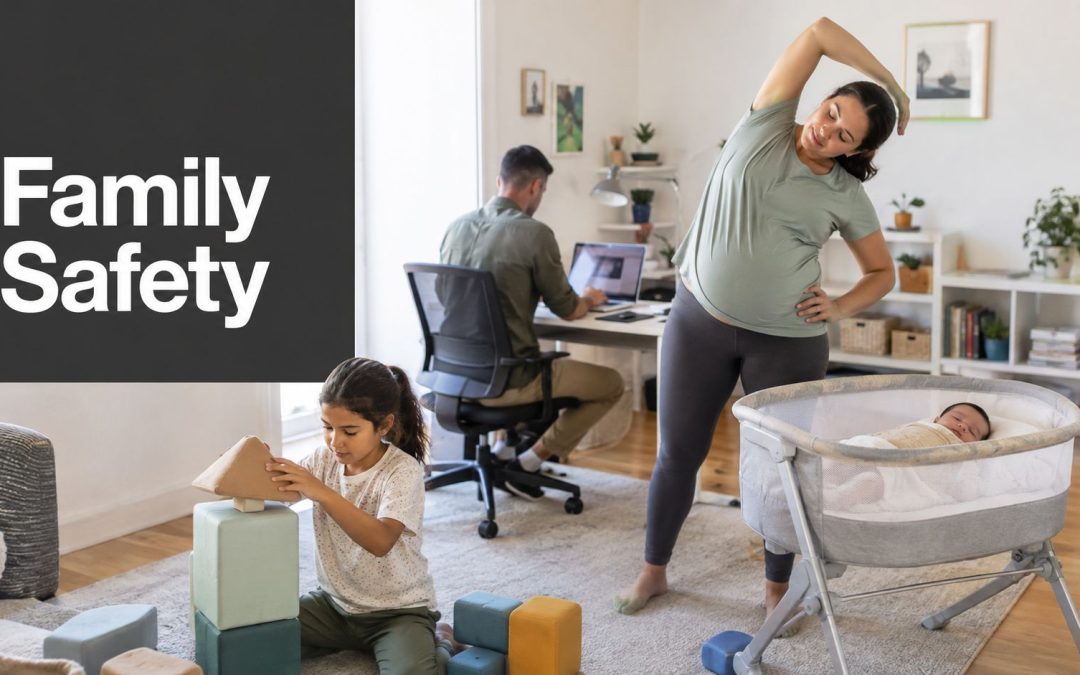
A family home rarely has just one kind of body in it. One person may be pregnant and moving more carefully, another may be carrying a newborn from room to room, a school-aged child may be climbing, running, and testing limits, an athlete may be training after practice, and an adult may spend most of the day at a desk. Each of those routines creates a different injury risk, which is why the strongest injury prevention strategies aren't one-size-fits-all, they combine age-appropriate movement, safer equipment and environments, body awareness, monitoring, and timely professional evaluation.
That matters because injury isn't a small issue. The World Health Organization reports that injuries and violence caused about 4.4 million deaths in 2019, which was 8% of all deaths worldwide, and roughly 90% of injury-related deaths occur in low- and middle-income countries (WHO injuries and violence fact sheet). In the United States, CDC materials also describe injury as the leading cause of death and hospitalization for people ages 1 to 44, which is one reason prevention has become a core public-health goal rather than a niche topic (CDC WISQARS).
The good news is that prevention can start early and stay practical. Use the 10 strategies below as a family guide, and remember that urgent symptoms, suspected concussion, significant trauma, breathing problems, or concerning infant or pregnancy symptoms need prompt medical care, not home guessing.
1. Neurologically Focused Chiropractic Care
A nervous system that's working smoothly helps the body register position, balance, and movement more clearly. In everyday life, that means a child who notices when they're slouching, an athlete who senses a risky landing sooner, or a baby who isn't compensating for discomfort in awkward ways. For families who want a preventive lens, this approach is about checking function before patterns become habits.
Why body awareness matters
The practical value here is simple. When people move with better proprioception, they tend to make cleaner decisions with less unnecessary strain. That's one reason some families look for gentle, neurologically focused care from a pediatric-certified practitioner, especially when they want support that starts early instead of waiting for repeated falls, poor coordination, or ongoing discomfort.
Practical rule: prevention works best when it starts with observation, not just reaction. If a child, teen, or parent keeps repeating the same movement mistake, the pattern deserves attention.
For families interested in this style of care, a helpful starting point is First Steps Chiropractic's overview of functional neurology chiropractic, which explains the general idea in more detail. It's still important to separate prevention from treatment. Chiropractic care can be part of a broader plan, but it doesn't replace emergency care, medical diagnosis, or rehabilitation when an injury is serious.
A useful home example is a child who trips often during play or a teen who feels “clumsy” during sports. Those aren't diagnoses by themselves, but they are reasons to notice movement quality, track patterns, and ask a qualified professional whether further evaluation makes sense.
2. Prenatal Chiropractic Care and Webster Technique
Pregnancy changes how the pelvis, spine, and ribs share load. That shifting mechanics can affect comfort, posture, sleep, and day-to-day movement, especially in the later months when getting in and out of bed, walking, or turning in the car starts to feel different. A preventive mindset during pregnancy focuses on keeping movement as efficient and comfortable as possible while staying in close communication with the care team.
If you're looking for a family-centered example, First Steps Chiropractic's page on chiropractic benefits during pregnancy is one place to learn how prenatal visits are commonly framed. The Webster Technique is often discussed in prenatal chiropractic settings as part of pelvic assessment and gentle care, but it should be used alongside standard obstetric guidance, not as a substitute for it.
Pregnancy also calls for a different kind of body awareness. A parent-to-be may notice sciatica, hip tightness, or a feeling that one side is doing more work than the other. Those signs are useful prompts to ask questions, adjust sleep positions, and review safe movement with a prenatal provider.
Simple ways to support the body at home
- Use positioning support: A pregnancy pillow or side-lying support from the care team can reduce unnecessary strain while sleeping.
- Keep communication open: New pelvic pain, numbness, severe headache, bleeding, contractions, or reduced fetal movement need medical evaluation.
- Match movement to the day: Gentle walking, posture breaks, and prescribed exercises usually work better than pushing through discomfort.
A prenatal plan should feel calming, not complicated. The goal is to help the parent move with more confidence and fewer compensations while pregnancy is changing the body week by week.
3. Early Infant and Newborn Alignment Screening
A newborn can't say where they feel stuck, uncomfortable, or limited, so parents have to read the signs. Feeding difficulty, one-sided head turning, or a strong preference for one position may reflect a need for closer assessment, especially after a difficult birth or a fast transition into feeding and sleep routines. Early screening is about noticing these patterns while the body is still highly adaptable.

A family that acts early often has more options. The younger the baby, the more gently clinicians can observe neck motion, comfort with holding positions, feeding mechanics, and developmental symmetry. That doesn't mean every preference is a problem, but it does mean persistent tightness, flattening, or difficulty latching shouldn't be brushed off as “just how babies are.”
For a deeper parent-friendly explanation, First Steps Chiropractic's page on chiropractic care for babies is a useful resource. Bring birth records, feeding notes, and any photos or videos that show repeated positioning patterns, because those details make the initial conversation more concrete.
A newborn doesn't need forceful intervention to benefit from careful observation. Gentle handling, clear documentation, and timely follow-up are often the most useful first steps.
Parents should also know when to escalate. Poor feeding with weight concerns, fever, extreme sleepiness, breathing trouble, or signs of dehydration need prompt medical attention. Screening is preventive, but red flags still belong in medical hands first.
4. Posture Correction and Ergonomic Assessment
Posture problems usually don't start as pain. They start as habits, a laptop placed too low, a child leaning over homework, a desk chair that doesn't fit, or a parent always carrying a baby on the same side. Over time, those patterns can create neck strain, back discomfort, and fatigue that feel “normal” until they don't.
A good ergonomic check is specific. The screen should be at eye level, the keyboard should let elbows rest in a comfortable position, and the feet should have stable support. For children, the same logic applies to desks, tablets, and backpacks, because small bodies often fit adult furniture poorly and compensate by craning forward or twisting.
A home reset that helps the whole family
- Check the screen height: Raise monitors or laptops so the neck isn't bent down for long stretches.
- Match the chair to the task: Hips and knees should feel supported, not pinched or dangling.
- Notice when posture collapses: If a child leans closer every day during screen time, the setup probably needs adjustment.
- Build in breaks: Static positions are part of the problem, so short resets matter.
The key is awareness. A person can't improve what they never notice, and families often get used to poor ergonomics because the discomfort creeps in slowly. That's why posture correction works best when it's practical, repeated, and tied to daily routines like homework, reading, gaming, driving, or feeding a baby.
Sometimes a simple change makes the biggest difference, but persistent pain, numbness, or weakness still deserves professional evaluation. Ergonomics can reduce strain, yet it shouldn't be used to explain away symptoms that are worsening or unusual.
5. Movement Pattern Analysis and Corrective Exercise
Some injuries start with how a person moves, not how much they move. A knee that caves inward during landing, a shoulder that hikes up during lifting, or a toddler who always favors one side while crawling can all point to a pattern that deserves attention before it becomes painful. Movement analysis looks for those patterns and then uses corrective exercise to retrain them.
That approach is especially useful because it focuses on quality first. If the body keeps cheating through the same compensation, adding more exercise of the same kind can reinforce the problem. A better plan starts with assessment, then builds up gradually so the movement becomes cleaner and more automatic.
Here's a practical example. A teen athlete who keeps getting sore after practice may not need more volume right away, they may need to learn better hip control, balance, or landing mechanics. A child with coordination challenges may need simpler, guided movement practice that helps the nervous system organize effort more efficiently.
Practical rule: don't chase quantity before form. A few high-quality reps beat many sloppy ones when the goal is prevention.
If you use home exercises, start with professional assessment, practice daily if advised, and film yourself occasionally to check form. Children benefit from short, playful movement drills, while adults often do better with small, repeatable routines that fit before work, after school, or before sports practice.
A short video can help families visualize that process, especially when a coach or clinician is teaching hip, knee, or balance work.
6. Tissue Regeneration and Soft Tissue Therapy
Some bodies need repair support because the same tissue keeps getting overloaded. That might look like a runner with a recurring calf strain, a parent with a stubborn shoulder flare-up, or an active adult who feels like an old injury never fully settled down. In those cases, soft tissue-focused care can be part of a prevention plan if it's paired with better movement and load management.
The prevention angle is important. If a painful area keeps flaring, people often compensate without realizing it, and compensation spreads stress to other joints and muscles. That's how a localized problem can become a broader pattern.
SoftWave therapy is one example of a tissue-focused option offered in some clinics. Families exploring it should ask how the treatment fits into the overall plan, what activity is appropriate during care, and what kind of follow-up helps the tissue keep improving rather than just temporarily calming down.
What to ask before starting
- How does this fit the bigger plan: Make sure the therapy connects to movement correction, sleep, and activity guidance.
- What should change at home: Ask what to do about lifting, sports, work tasks, or training during the recovery window.
- How will progress be checked: Follow-up matters more than a single visit because recurring pain needs tracking.
Soft tissue care can be helpful, but it shouldn't become a stand-alone answer for a problem caused by mechanics, posture, or overload. If pain is severe, swelling is significant, or function is dropping quickly, the family should seek medical evaluation first.
7. Developmental Milestone Monitoring and Early Intervention
Children don't all develop at the same pace, but patterns still matter. Rolling, sitting, crawling, standing, walking, coordination, speech, and feeding all give clues about how the nervous system is organizing growth. When parents track milestones closely, they're better able to spot when a child needs extra help early rather than later.
That early attention can prevent secondary problems. A toddler who walks with an uneven pattern may start overusing certain muscles. A baby with neck tightness may learn to compensate with one side. A preschooler with coordination trouble may avoid play that would otherwise build confidence and balance.
The useful habit here is recordkeeping. Photos, short videos, and brief notes about what a child can and can't do make it easier to share clear information with a pediatric clinician, chiropractor, physical therapist, or developmental specialist. Concerns are easier to evaluate when they're documented over time instead of remembered vaguely.
A delay doesn't automatically mean something serious, but it does mean it's time to look closer.
Parents should bring concerns up promptly rather than waiting for a child to “catch up” on their own. Early intervention may involve chiropractic support, speech therapy, occupational therapy, physical therapy, or medical evaluation, depending on the issue and the child's needs.
If there's one takeaway for families, it's this. Milestone tracking isn't about labeling children, it's about giving them the right help at the right time so small deviations don't harden into larger movement or developmental problems.
8. Stress Management and Nervous System Regulation
Stress changes the body. Muscles tighten, sleep gets lighter, attention narrows, and movement becomes less efficient, which can make everyday tasks clumsier than they should be. That's why nervous system regulation belongs in an injury prevention plan, not just a mental-health conversation.
This matters across the family. An anxious child may hold tension in the shoulders and move more stiffly. A pregnant parent may notice that stress makes pelvic discomfort feel worse. A teen athlete may rush warm-ups because their mind is already overloaded. In each case, the body is less prepared for safe movement.
Simple regulation practices can help. Deep breathing, a consistent bedtime, age-appropriate physical activity, and quiet wind-down time all support recovery. Families don't need elaborate routines to start. They need repeatable ones.
Easy routines that fit real homes
- Use slow breathing: Box breathing or 4-7-8 breathing can help calm the body before bed or after a hard day.
- Protect sleep: A predictable sleep schedule gives the nervous system a better chance to reset.
- Lower evening stimulation: Reducing screen time before bed can make it easier to relax.
- Unclench on purpose: Brief progressive muscle relaxation helps people notice where they hold tension.
These habits don't diagnose or treat injury, but they can reduce the tension and rushed movement that make injuries more likely. Families often notice that when sleep and stress improve, posture, patience, and coordination improve too.
9. Family Education and Health Literacy Programs
Prevention becomes easier to sustain when families understand both the action and its purpose. Education can connect posture, movement, pregnancy biomechanics, infant handling, sports loading, and nervous system awareness with routines people can use at home. It should also clarify the boundary: education supports safer choices, but it does not diagnose or treat an injury.
A short workshop, a clear handout, or one focused conversation may change how a family arranges a desk, carries a newborn, or prepares for a sports season. Effective programs explain the reason behind each step, then let families practise it in familiar settings.
Workplace programs show how shared knowledge can support prevention. The National Safety Council's 2023 to 2024 MSD Solutions Index reported that nearly 89% of participating organizations had a musculoskeletal disorder prevention and ergonomics program, compared with about 83% the prior year (NSC MSD Solutions Index). The report also described attention to leading indicators, frontline participation in safety decisions, and sharing MSD prevention solutions beyond the organization, with figures of 65.1%, 68%, and 76.7%, respectively.
Families can apply the same principle without copying a workplace system. Parents, children, coaches, and caregivers can agree on simple cues: adjust a desk when posture collapses, review safe infant positioning with relatives, and report discomfort early rather than hide it. During pregnancy or recovery, a clinician can help identify which activities need modification and when symptoms warrant assessment.
Use a repeatable, age-aware checklist:
- Explain: match instructions to the child's or adult's understanding.
- Practise: rehearse lifting, carrying, warm-ups, and reporting discomfort.
- Review: revisit the routine after growth, pregnancy changes, new sports, or altered work demands.
The goal is shared confidence, not turning family members into clinicians. When everyone knows what to watch for and when to seek care, safer habits are more likely to last.
10. Comprehensive Diagnostic and Preventive Screening Protocols
Some risk factors don't show up in everyday conversation. A child may move “fine” but have a subtle imbalance. A pregnant parent may feel okay overall but still have a pelvic pattern that deserves closer tracking. An athlete may not be injured yet, but a movement asymmetry may be building toward one.
That's where careful screening helps. A detailed history, exam findings, and objective measures can reveal hidden dysfunction before it turns into a bigger problem. In some injury-prevention settings, clinicians use structured tools such as Insight Scans, then pair the findings with a personalized plan and follow-up checks to see whether the body is changing in the right direction.
The broader public-health case for measurement is strong. The CDC's WISQARS database exists because injury risk can be tracked, compared, and managed at scale, not just guessed at in the moment (CDC WISQARS). That same principle works at the family level, too. When you have a baseline, you can tell whether something is improving, stable, or drifting the wrong way.

What a good screening visit should give you
- Clear findings: The clinician should explain what they found in plain language.
- A baseline: You should leave with a reference point for future comparison.
- A plan: Screening should lead to practical next steps, not just more uncertainty.
- Follow-up: Reassessment helps show whether the plan is helping.
Screening is preventive only when it leads to action. If the results point to a medical problem, the family should get the appropriate referral. If the issue is mechanical, developmental, or movement-related, the plan should match the person's age, symptoms, and daily demands.
10-Point Injury Prevention Strategies Comparison
| Strategy | 🔄 Implementation Complexity | ⚡ Resources & Training | 📊⭐ Expected Outcomes | 💡 Ideal Use Cases |
|---|---|---|---|---|
| Neurologically-Focused Chiropractic Care (Neuro-Tonal Techniques) | High, requires PX/neurologically-focused certification and protocol fidelity | Specialized training, diagnostic tools (e.g., Insight Scan), clinical setting; multiple visits | ⭐⭐⭐ Gradual nervous‑system optimization; reduced compensatory injuries over weeks–months | Infants, children with developmental concerns; families seeking preventive nervous‑system care |
| Prenatal Chiropractic Care & Webster Technique | Moderate, requires prenatal certification and cautious technique adaptation | Practitioner prenatal/webster training; low‑tech clinic setup; repeated visits | ⭐⭐⭐ Improved pelvic alignment, reduced pregnancy pain; may aid fetal positioning over time | Expectant mothers with pelvic/sacroiliac dysfunction or sciatica |
| Early Infant & Newborn Alignment Screening | Moderate, specialized pediatric training; protocolized gentle techniques | Pediatric certification, infant‑safe tools, frequent early visits | ⭐⭐⭐ Early correction of birth misalignments; prevents chronic compensations when done promptly | Newborns (2–4 weeks), infants with birth trauma or feeding/sleep issues |
| Posture Correction & Ergonomic Assessment | Low–Moderate, assessment skills plus coaching; long‑term behavior change | Minimal equipment; ergonomic assessment tools; patient education time | ⭐⭐–⭐⭐⭐ Reduced musculoskeletal strain and fatigue; improvements seen over months with adherence | School‑age children, office workers, athletes, pregnant women needing postural support |
| Movement Pattern Analysis & Corrective Exercise | Moderate, detailed assessment and individualized exercise progression | Trained therapists/coaches, space for practice, possible video analysis | ⭐⭐⭐ Corrects dysfunctional patterns; improves performance and reduces re‑injury risk over weeks–months | Athletes, children with motor delays, rehab patients needing movement retraining |
| Tissue Regeneration & Soft Tissue Therapy | High, requires advanced equipment and trained operators | Specialized devices (e.g., softWave), trained clinicians, multiple sessions | ⭐⭐⭐ Promotes tissue healing and resilience; reduces chronic progression over weeks–months | Chronic musculoskeletal conditions, active individuals seeking regenerative prevention |
| Developmental Milestone Monitoring & Early Intervention | Moderate, systematic tracking and multi‑provider coordination | Screening tools, coordination with therapists, ongoing follow‑up | ⭐⭐⭐ Early detection and intervention; reduces later intensive treatment needs | Children at risk for developmental delays (autism, ADHD, SPD) or missed milestones |
| Stress Management & Nervous System Regulation | Low, behavioral interventions require consistency and follow‑through | Minimal equipment; training in breathing/relaxation; family engagement | ⭐⭐–⭐⭐ Reduced muscle tension and injury risk; improves sleep and resilience with practice | Families with anxiety/ADHD; athletes needing arousal control; prenatal stress reduction |
| Family Education & Health Literacy Programs | Low–Moderate, program development and consistent delivery | Educational materials, workshop facilitators, time commitment from families | ⭐⭐–⭐⭐⭐ Increased compliance and preventive behaviors; indirect reduction in injuries | All families, caregivers, teachers; especially households managing developmental challenges |
| Comprehensive Diagnostic & Preventive Screening Protocols | High, integration of advanced diagnostics and interpretation | Insight Scans/advanced tools, trained interpreters, time‑intensive assessments | ⭐⭐⭐ Objective risk identification and baseline tracking; enables personalized prevention | New patients, high‑risk individuals, families seeking data‑driven preventive plans |
Turn Prevention Into a Family Routine
The easiest way to make injury prevention strategies stick is to tie them to the routines your family already has. Start by identifying the highest-risk setting in your home, maybe the nursery, the car seat area, the homework desk, the sports bag, or the kitchen where lifting and rushing happen. Then review the equipment and ergonomics in that space, check whether the body is being asked to work in awkward positions, and decide where a small change would give the biggest benefit.
After that, build age-appropriate movement practice into the week. That can mean supervised play for young children, posture breaks for students, warm-up and corrective drills for athletes, prenatal positioning and mobility work for expectant parents, and simple recovery habits for adults who sit too long. Keep track of developmental concerns, recurring pain, sleep changes, or repeated movement problems, and don't wait for small issues to become chronic ones before asking for help.
The strongest plans also stay flexible. A newborn's needs are different from a toddler's, a teen athlete's needs are different from a desk worker's, and pregnancy changes what “normal” comfort looks like from month to month. Revisit the plan whenever the family's schedule, equipment, or activity level changes, because prevention works best when it keeps up with real life.
If you're unsure where to start, look for qualified pediatric, prenatal, chiropractic, physical therapy, or medical guidance that fits the problem in front of you. Urgent injuries, neurological changes, breathing problems, severe pain, suspected concussion, or concerning pregnancy and newborn symptoms need prompt medical evaluation first.
For families in northern Idaho, First Steps Chiropractic is one local option for prenatal, pediatric, newborn, and family consultations, along with specialized assessments and personalized care plans. The right support can help you organize prevention around your family's actual routines, not an idealized version of them.
If you're ready to make prevention more practical at home, First Steps Chiropractic offers prenatal, pediatric, newborn, and family-focused care that fits the themes in this guide. You can ask about specialized assessments, age-appropriate guidance, and care planning that supports safer movement, better body awareness, and earlier problem-solving for the whole family.