The most popular advice about regenerative treatments is often the least useful: “It works for everything.” SoftWave tissue regeneration therapy has a more specific and defensible story. It belongs to the broader field of extracorporeal shock wave therapy, or ESWT, where research supports benefit for some soft-tissue conditions but remains cautious about broad claims, treatment comparisons, and diagnoses with limited evidence.
That distinction matters if you're considering SoftWave for chronic pain, a tendon problem, plantar fasciitis, or a slow-healing wound. A responsible clinician should explain what the therapy is cleared to do, which conditions have stronger support, how treatment dose affects results, and whether exercise-based rehabilitation or standard physical therapy may be just as appropriate.
What SoftWave Therapy Actually Is and Is Not
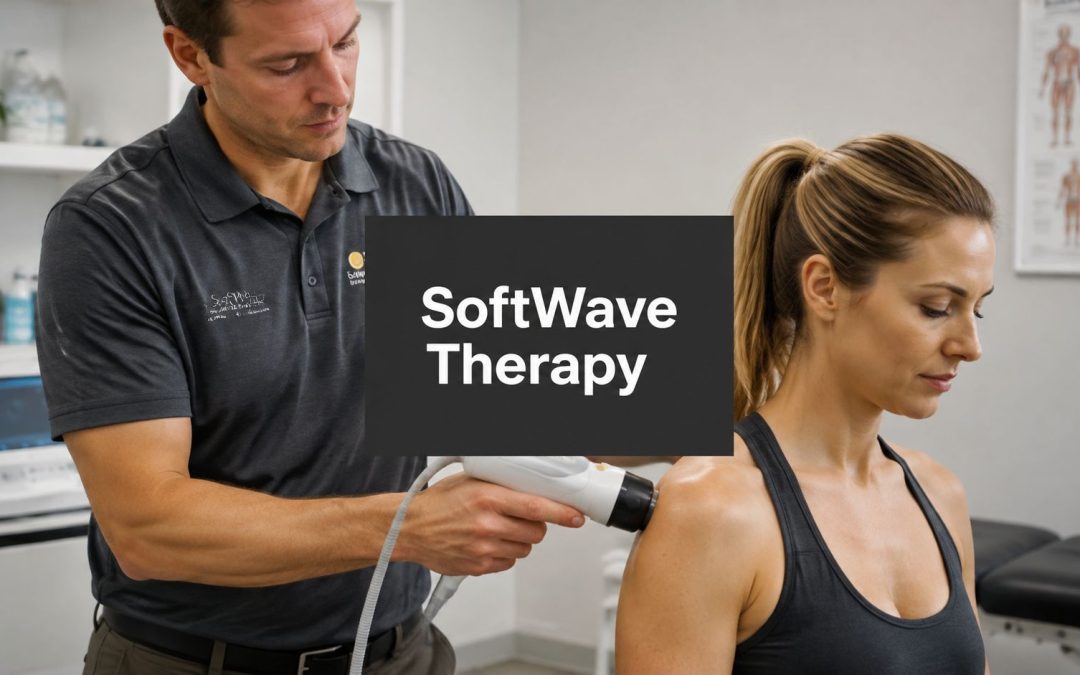
SoftWave tissue regeneration therapy is a form of extracorporeal shockwave therapy, not a stem-cell injection and not a surgical procedure. A handheld applicator delivers acoustic or mechanical pulses through the skin toward a treatment area. The intended effect is to influence local tissue biology, rather than just mask pain with medication.
The broader ESWT evidence base gives SoftWave a clinical lineage. A systematic review identified 23 appropriate studies across soft-tissue musculoskeletal conditions and found evidence of benefit and safety for focused ESWT and radial pressure therapy in several indications, including plantar fasciitis and calcific tendinitis. The review also noted that outcomes were often better with higher-dose regimens, as described in the SoftWave clinical science compendium.
That history supports measured confidence, not unlimited confidence.
Focused and radial approaches
Shockwave devices don't all deliver energy in the same way. Focused shockwaves concentrate energy more intensely around a target, while radial pressure waves disperse energy outward from the applicator. These distinctions can affect how a provider selects a device, identifies a treatment area, and adjusts the protocol.
SoftWave is therefore best understood as part of a wider technology category with different devices, waveforms, energy settings, and clinical protocols. Results from one ESWT device or condition shouldn't automatically be presented as proof for every SoftWave use.
What the treatment doesn't do
SoftWave doesn't repair every damaged structure, replace progressive rehabilitation, or guarantee that pain has a single tissue-based cause. Chronic pain can involve weakness, altered movement, nerve sensitivity, sleep disruption, and protective nervous-system responses. A tissue-focused intervention may be useful, but it shouldn't substitute for diagnosis.
A practical rule: Ask which diagnosis the treatment is targeting, what evidence supports that diagnosis, and how SoftWave fits with loading, mobility, strength, and lifestyle care.
The FDA milestone is also narrower than many advertisements suggest. On May 4, 2021, SoftWave Tissue Regeneration Technologies reported FDA 510(k) clearance for its OrthGold 100 device for a temporary increase in local blood circulation, relief of minor aches and pains, and activation of connective tissue under clearance number K210451. The company also reports separate clearances for superficial partial-thickness second-degree burns in adults and chronic diabetic foot ulcers. A clearance describes specific intended uses. It isn't a promise that every advertised application will work equally well.
How Acoustic Pulses Trigger Cellular Repair
The biological idea behind SoftWave is called mechanotransduction. In plain language, cells can detect physical forces and convert them into chemical signals. Think of a cell as a responsive workshop. Mechanical input changes the tension around its walls and supporting structures, and the cell adjusts its activity in response.
Step one, mechanical input
The applicator sends acoustic or mechanical pulses into the treatment area. These pulses deform cell membranes and parts of the extracellular matrix, the network that supports cells and helps organize tissue. The deformation is brief, but it can act as a signal rather than mere pressure.
Step two, cellular signaling
Cell membranes contain structures that respond to force. When those structures detect mechanical change, they can activate signaling cascades inside the cell. Reviews of ESWT describe links with angiogenesis, fibroblast activation, collagen synthesis, and recruitment of stem or progenitor cells, as outlined in this peer-reviewed review of shockwave biology.
Angiogenesis means the formation of new blood vessels. Fibroblasts help build and remodel connective tissue, including collagen. These processes don't mean that a tendon or ligament instantly becomes normal. They indicate that treatment may influence the environment in which repair takes place.

Step three, tissue-level effects
Downstream effects described in independent reviews include improved tissue perfusion, neoangiogenesis, immunomodulation, and analgesia. Better perfusion may improve delivery of oxygen and nutrients. Immunomodulation refers to changes in inflammatory activity, while analgesia describes a reduction in pain signaling.
These effects help explain why clinicians consider ESWT for chronic conditions where low vascularity, stalled remodeling, or persistent pain may limit progress. They don't prove that every painful area needs acoustic treatment. The mechanism provides a rationale, but clinical outcomes still depend on diagnosis, dose, timing, patient health, and concurrent rehabilitation.
Step four, dose and tissue response
Dose matters because mechanical treatment is not automatically better at higher intensity. A systematic review found better outcomes with higher-dose focused shockwave regimens, while an orthopedic technology review cautioned that energy flux densities above 0.50 mJ/mm² should be avoided, as reported in this review of shockwave technology and regenerative effects.
That creates a balancing act. Too little energy may fail to produce a meaningful biological response in some disorders. Excessive energy may increase irritation or tissue stress. A qualified provider should adjust treatment to the target tissue and the patient's response, rather than applying an identical setting to everyone.
Conditions With Strong Clinical Evidence
The strongest clinical support is concentrated in particular diagnoses, especially plantar fasciitis and calcific tendinitis. These conditions have been included among the indications with evidence of benefit and safety in systematic reviews of ESWT, although the strength of evidence can vary by protocol and study quality.
Plantar fasciitis affects the tissue along the bottom of the foot and often produces pain with standing or walking. Calcific tendinitis involves calcium deposits within a tendon, commonly around the shoulder. Shockwave research has examined both conditions more extensively than many of the broader claims attached to regenerative marketing.

Wound care has a separate evidence story
SoftWave-branded devices have reported FDA clearances that extend into wound-care applications, including superficial partial-thickness second-degree burns in adults and chronic diabetic foot ulcers. The broader ESWT wound-healing literature also includes a systematic review that found adding ESWT increased wound-healing rate by 2.73-fold, improved mean wound-area change by 30.45%, shortened healing time by 3 days for acute wounds and 19 days for chronic wounds, and reduced infection risk by 53% compared with conventional wound treatment alone, according to this wound-healing systematic review.
Those figures apply to the reviewed ESWT wound-treatment evidence. They shouldn't be transferred automatically to every SoftWave protocol, device, or patient. Wounds also require appropriate medical assessment, infection management, pressure relief, blood-sugar management when relevant, and wound-care follow-up.
Dose changes the interpretation
A low-dose protocol and a higher-dose protocol aren't interchangeable. The systematic review evidence suggests that some conditions respond more favorably to higher-dose regimens, while low-dose treatment may provide little or no benefit in certain disorders. Providers should be able to explain the intended dose, the reason for that choice, and how they'll monitor tolerance.
For patients with shoulder symptoms, a focused discussion may be more useful than a generic promise. The clinician should identify whether the problem involves calcification, tendon degeneration, joint restriction, referred pain, or another diagnosis. If the concern is rotator cuff pain, readers can also review this guide to rotator cuff conditions, then ask how the proposed treatment relates to their specific findings.
What to Expect During a SoftWave Session
A typical appointment begins with questions, not with the device. The provider should ask where the pain occurs, what movements aggravate it, how long it has been present, and what care you've already tried. They may examine motion, strength, tenderness, gait, or nearby joints before deciding whether the painful spot is the right treatment target.

The applicator is placed against the skin, usually with coupling gel to help transmit the acoustic pulses. Patients commonly describe tapping, pulsing, or pressure. Sensitivity can change across the treatment area, particularly over a tender tendon or a region with irritated tissue.
Discomfort isn't automatically a sign of effective treatment. Tell the provider if the sensation becomes sharp, intolerable, or meaningfully different from the expected tapping. A clinician can modify the intensity, reposition the applicator, or reassess whether the chosen area is appropriate.
Questions to answer before treatment
Bring information that could change the clinical decision:
- Medication details: Tell the provider about medicines and supplements that may affect bleeding, healing, or pain perception.
- Medical history: Mention diabetes, circulation problems, neuropathy, wounds, recent procedures, or unexplained symptoms.
- Symptom behavior: Explain whether pain changes with activity, rest, position, or pressure.
- Treatment response: Describe what helped, what failed, and whether exercise caused improvement or aggravation.
A session should end with clear instructions, not vague reassurance. Ask what activity is appropriate afterward, which symptoms are expected, when to contact the clinic, and how progress will be measured. Improvement may be gradual, and the plan may include movement or strengthening work rather than relying on SoftWave alone.
The following video can help you understand the general device experience before speaking with a provider.
SoftWave Versus Traditional Rehabilitation Approaches
SoftWave and exercise-based rehabilitation do different jobs. SoftWave aims to deliver a mechanical stimulus that may influence tissue biology and pain signaling. Physical therapy and exercise expose the body to controlled movement and loading, helping a person rebuild strength, coordination, tolerance, and confidence.
The important question isn't whether one sounds more advanced. It's whether adding SoftWave improves the plan for the diagnosis at hand.
A recent systematic review found no clear superiority of radial over focused shockwave therapy for pain or function in tendinopathy, and concluded that both approaches appeared similarly safe while the evidence remained low-certainty, as reported in this systematic review of radial and focused shockwave therapy. That finding doesn't compare SoftWave with every form of rehabilitation, but it reinforces the need for careful claims.
| SoftWave therapy | Traditional rehabilitation |
|---|---|
| Uses acoustic or mechanical pulses | Uses movement, loading, education, and functional practice |
| May influence tissue signaling and pain | Builds capacity through progressive activity |
| Can target a selected painful region | Addresses strength, mobility, coordination, and behavior |
| Requires diagnosis-specific dosing | Requires a structured progression and patient participation |
Where SoftWave may add value
SoftWave may be reasonable when a well-defined condition has evidence supporting ESWT, symptoms have persisted despite appropriate care, or pain is limiting participation in rehabilitation. In that situation, the therapy may serve as an adjunct that helps a patient tolerate movement more effectively.
Where standard rehab may be enough
Exercise-based care may be a sensible first choice when weakness, poor movement control, deconditioning, or fear of activity are central contributors. A passive treatment can't teach a shoulder to manage load, restore balance, or prepare a runner for a return to sport. Those adaptations require practice.
Cost and coverage also matter. Before paying privately for any device-based therapy, ask whether the same clinical objective can be reached through a supervised exercise plan, home program, activity modification, or another established approach. Readers considering noninvasive options for back symptoms can compare approaches in this overview of nonsurgical back-pain treatments.
The strongest plan may combine a targeted tissue intervention with a progressive rehabilitation program, but combination care should have a reason, not just a longer menu of services.
Integrating SoftWave With Chiropractic Care
Chiropractic care and SoftWave address different layers of a musculoskeletal problem. SoftWave focuses on the local tissue environment. Chiropractic assessment may examine joint motion, load distribution, posture, movement patterns, and nervous-system responses that influence how a person experiences and manages pain.
That combination can make clinical sense when each intervention has a defined role. A provider might use a gentle chiropractic technique to address restricted movement while using SoftWave around a persistent soft-tissue problem. The patient may then receive mobility, breathing, strength, or activity guidance to help maintain the change.
The nervous-system perspective
Pain isn't produced only by damaged tissue. The nervous system interprets signals in the context of threat, sensitivity, sleep, stress, prior injury, and movement. A tissue-focused treatment may help reduce local irritation, but lasting progress often depends on restoring safe, confident movement and improving the body's ability to tolerate normal activity.
This is why patients should be cautious about claims that any single treatment “fixes the root cause.” Root causes differ. A tendon problem, spinal joint restriction, nerve-related symptom, and persistent pain syndrome require different assessments. A nervous-system-focused model should expand the examination, not replace sound diagnosis.
For a plain-language discussion of how chiropractic care may relate to nervous-system function, see this overview of chiropractic and the nervous system. Families may also need a plan that accounts for age, pregnancy, developmental needs, work demands, and athletic goals.
A practical care plan should identify the target, the expected response, and the next step. If SoftWave reduces irritability, rehabilitation may become easier. If an adjustment improves movement, tissue loading may become more comfortable. Neither result guarantees a cure, and neither should be used to postpone medical evaluation for red-flag symptoms.
Insurance Coverage and Finding Qualified Providers
Insurance coverage for SoftWave or ESWT can vary by plan, diagnosis, device, and local policy. Don't assume that a clinic's general insurance participation means the therapy itself is covered. Ask the office to verify benefits and request the answer in writing when possible.
Before scheduling, ask:
- Coverage status: Is the specific procedure covered for the diagnosed condition?
- Patient responsibility: Will you owe a copayment, deductible, or self-pay fee?
- Documentation: Does the insurer require a referral, imaging, failed conservative care, or authorization?
- Billing details: What code or description will the office submit?
- Plan limits: Are there visit, diagnosis, or provider restrictions?
A provider's qualifications matter as much as the machine. Look for a clinician who performs a physical examination, explains the diagnosis, distinguishes SoftWave from other ESWT devices, and discusses alternatives. The provider should also explain dose selection, possible discomfort, activity guidance, and how progress will be assessed.
Warning signs to take seriously
Be wary of clinics that promise universal regeneration, guarantee results, use identical settings for every condition, or present marketing graphics as if they were direct evidence for the exact device and diagnosis. A responsible practice won't insist that SoftWave replaces medical care, wound management, rehabilitation, or emergency evaluation.
First Steps Chiropractic offers SoftWave tissue regeneration technology within a broader family chiropractic setting, alongside consultation, Insight Scans, examination, personalized care planning, and adjustments. If you're considering treatment, ask whether the proposed plan includes a clear diagnosis, an appropriate rehabilitation strategy, and a way to decide whether the therapy is helping.
The right decision isn't always “yes” or “no” to SoftWave. It's whether the treatment has a credible role in your specific plan, supported by appropriate evaluation and realistic expectations.
If chronic musculoskeletal pain is limiting your movement, visit First Steps Chiropractic to learn how its SoftWave therapy and nervous-system-focused chiropractic care may fit your needs. Ask about a consultation and benefits check so you can discuss your diagnosis, alternatives, and a personalized next step with the care team.