
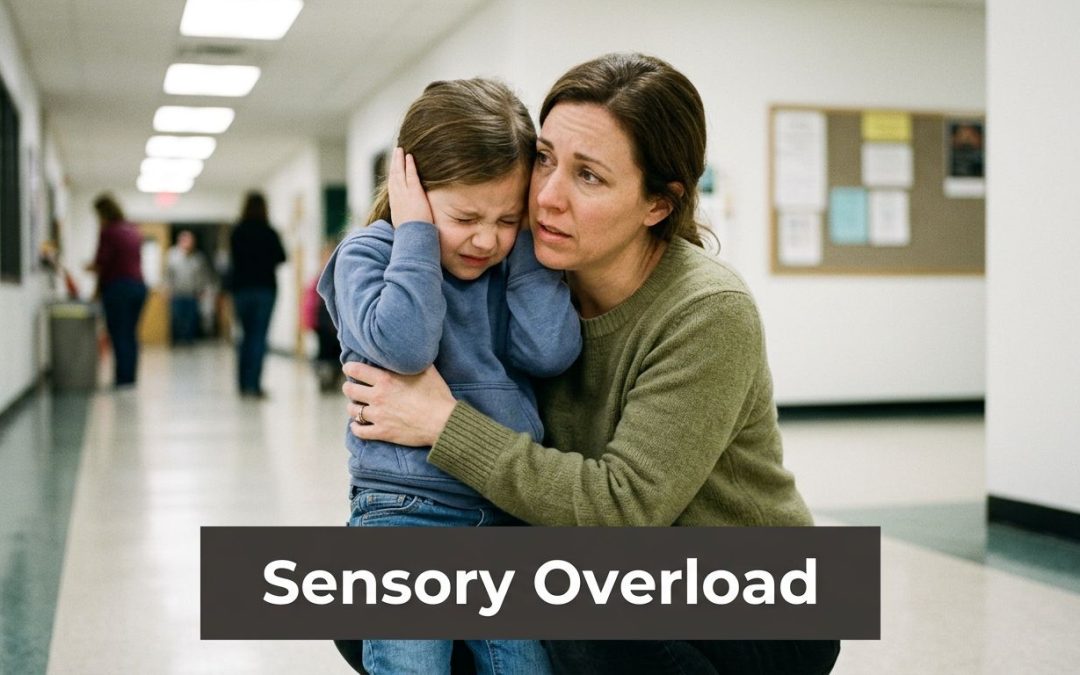
You know the scene. The grocery store lights feel harsh, the freezer aisle hums like it's inside your child's head, and by the time you reach checkout, they're covering their ears, squinting, crying, or asking to leave right now. Sometimes the same child is fine at home, then falls apart after a birthday party, a school assembly, or a windy drive with sunlight flashing through the trees.
That pattern can feel confusing and lonely, but it isn't rare or imaginary. In general-population samples, hypersensitivity to sound shows up often enough that researchers have measured it in about one in ten adults, with estimates varying by how the condition is defined and measured (tandfonline prevalence review). For families, the useful question isn't whether the reaction is “real.” It's why the nervous system is reacting as if ordinary sound or light is a threat, and what you can do next.
What overstimulation can look like in everyday life
When Everyday Light and Sound Feel Too Much
A child can seem fine in the car, then melt down the moment the store doors open. Another child can sit through dinner, but cover their ears when the blender starts or bolt from a room with fluorescent lights. Parents often call this “too sensitive,” but that phrase does not explain what is happening. The body is reacting as if the environment has turned the volume and brightness way up.
The nervous system's filter is not sorting input well
Hypersensitivity to sound and light means the brain is not filtering everyday input in the usual way. A typical brain can set aside the dishwasher as background noise and treat a bright classroom as ordinary. A hypersensitive brain lets those same sounds and lights stay front and center, so they feel urgent, irritating, or even painful.
That shift can show up in small ways before it becomes a major problem. A child may ask for the lights off, avoid the cafeteria, or get “stuck” after a busy day because the sensory load never really settles. Parents sometimes blame behavior, but the more accurate explanation is that the child's system is overwhelmed and has not reset.
A child is not choosing to be difficult when their body acts like the world is too loud or too bright.
A calm home can look manageable one day and impossible the next. The trigger is not always the same. Sleep loss, illness, stress, a growth spurt, or a noisy room can all narrow tolerance.
What sensory processing means in plain language
What parents usually notice first
The first signs are often practical, not dramatic. A child wants the curtains closed, leaves a room quickly, or cries after a school event that other kids seemed to enjoy. Some children become clingy, while others go quiet and avoid eye contact after a noisy outing.
That is the point where everyday observation starts to matter clinically. If a child is avoiding normal routines, losing recovery time after ordinary environments, or struggling at school because of light or sound, the sensitivity is affecting daily life and deserves attention.
What Hypersensitivity to Sound and Light Really Means

A child covers their ears at a hand dryer, asks for the lights to be dimmed in a store, or melts down after a noisy event that other people seemed to handle easily. Those reactions can look puzzling from the outside, but they fit a recognizable clinical pattern. Hyperacusis is the term for sound hypersensitivity. Photophobia is the term for light hypersensitivity. Both describe input that feels too intense, too sharp, or too hard to tolerate.
Why normal input starts feeling wrong
The ears and eyes may be working in the usual way. The harder part happens in how the brain filters what comes in and decides what matters. A child may hear a vacuum cleaner, a bathroom fan, or several voices at once and react as if the sound were far louder than it really is. For sound hypersensitivity, reviews describe central auditory gain, which means the brain can turn up responsiveness when input from the ear is reduced or distorted, so ordinary sounds feel louder than they should (NCBI Bookshelf on hyperacusis).
The same basic principle helps explain light sensitivity. The nervous system starts treating everyday brightness as if it needs immediate attention. Fluorescent lights, bright screens, or sunlight through a window can feel invasive instead of merely noticeable.
That is why “just get used to it” often misses the point. The problem is not stubbornness, and it is not a child choosing to react. The threshold for comfort has shifted, so the usual input lands as too much, too fast, or too close.
Sensory preference, overload, and clinical hypersensitivity
Some children prefer quieter rooms or softer lighting, and that preference by itself is not a disorder. A bedroom lamp can feel nicer than overhead light, and a calm hallway can feel better than a crowded cafeteria. Preference is a choice about comfort.
Sensory overload is different. The child becomes flooded, disorganized, or unable to keep functioning once the input piles up. A noisy room that starts out manageable can become too much after a busy day, poor sleep, or illness.
Clinical hypersensitivity sits one step farther. The reaction is strong enough to change behavior, limit participation, or create real distress. In sensory processing discussions, one child may handle touch well but react strongly to sound or light, which is why the pattern can look uneven from day to day. That variability is part of the condition, not a sign that the child is being inconsistent.
If you need a phrase for school or a pediatric visit, try this: “My child seems to have a very low threshold for sound and light, and it is affecting function.” That gives teachers and clinicians a clear place to start. For a plain-language overview of how sensory processing works, what sensory processing means in plain language can help frame the conversation.
A practical way to describe the problem
Threshold is the useful idea here. A typical brain says, “That is background.” A hypersensitive brain says, “That is too much, too fast, too close.” That difference changes the whole conversation at home and in clinic.
Once families understand that the issue is a low threshold, the next questions become more useful. What lowers the threshold on a given day, and what helps raise tolerance without pushing the nervous system past its limit?
Common Causes and Conditions That Travel Together
A child who covers their ears in the cafeteria and squints in bright rooms may seem like they are reacting to separate problems. Often, the same nervous system pattern is involved. Light and sound sensitivity rarely live alone, and the pattern matters more than the symptom by itself. Migraine is one of the clearest examples. A clinical review reports 80% to 90% of people with migraine experience photophobia and 70% to 80% experience phonophobia, with both symptoms often appearing together. In chronic migraine, those sensitivities persist between attacks in 40% to 60% of patients (lightsensitivity.org conditions overview). A child who shuts down around bright screens, fluorescent rooms, or loud cafeterias may be showing a migraine pattern, even if they never say “my head hurts.”
The patterns that can look similar
Autism is another common overlap. A 2021 meta-analysis found current hyperacusis prevalence of 41.42% and lifetime prevalence of 60.58% in people with ASD, and a separate study of 4,104 people with ASD found 60.1% had current auditory sensory over-responsivity and 71.1% had ever experienced it. Those numbers matter because they show how often auditory sensitivity sits inside a broader neurodevelopmental profile, not as a stand-alone complaint.
Post-concussion patterns deserve special attention. Reviews of sound hypersensitivity after head injury describe a brain-level filtering problem, not just an ear problem, and note common triggers such as acoustic trauma, head injury, Ménière's disease, Bell's palsy, and ototoxic drug exposure. When a child starts reacting to sound after an illness, fall, sports hit, or car accident, that timing matters. A separate look at what can drive sensory integration problems helps families see why the same child may react strongly to more than one sense at once.
Why light and sound show up together
The brain does not process every sense in a separate silo. Migraine and concussion/TBI can disrupt sensory gating in shared brain circuits, including thalamic processing. Clinical sources note that photophobia and phonophobia commonly co-occur in migraine, concussion/TBI, fibromyalgia, and autism, which is why families often see both light and sound intolerance at the same time (Mind Eye on sound and light sensitivity).
If light and sound both became harder at once, think beyond “pickiness.” Think migraine, concussion, autism-related sensory reactivity, or another central nervous system pattern.
That broader view also changes what to ask next. A child with motion sickness, screen-triggered headaches, sleep disruption, or post-activity crashes needs a wider look, not just a quieter room.
Signs to Watch For at Every Age
Infants and toddlers often give the earliest clues. They may startle hard at household noises, struggle to feed in bright rooms, or seem to become more unsettled under fluorescent lighting. If a baby is hard to soothe only in certain settings, or a toddler suddenly hates the bathroom fan, that's worth noticing. If the reaction is tied to a recent illness, injury, or major change in behavior, book a medical visit sooner rather than later.
School-age children
School-age kids usually show the pattern in places adults can't ignore. They may avoid assemblies, the gym, cafeteria, or birthday parties. Some begin asking for headphones all the time, refusing to sit under harsh lights, or crashing hard after school because they've spent all day holding themselves together.
A child in this age group can also look like they've hit a learning plateau. They aren't unable to learn, they're spending too much energy coping with the room. If sleep gets worse because of household noise, or if homework turns into a daily battle after busy days, it's time for a same-month appointment with the pediatrician or a relevant specialist.
Teens and adults
Teens and adults often describe driving anxiety, screen fatigue, or the sense that every full day comes with a crash afterward. They may stop going to social events, avoid stores, or wear sunglasses indoors. Some people don't call it pain, they call it exhaustion, irritability, or needing to disappear after school or work.
The red flags are the same across ages. Sudden onset, one-sided symptoms, or sensitivity paired with severe headache, weakness, or visual loss needs prompt medical evaluation. Those symptoms aren't something to manage only at home. They deserve timely assessment.
When to watch, and when to act
A useful rule is simple. Mild preference for dimmer rooms is one thing. Loss of function is another. If the child is missing school activities, refusing ordinary outings, or taking a long time to recover after noise and light exposure, don't wait for it to pass on its own.

Practical Strategies You Can Start at Home
Start with the easiest wins. A pair of noise-reducing headphones can help in specific settings, but they work better on a schedule than all day. Dimmable bulbs, layered lighting, and screen brightness adjustments often reduce friction quickly, especially in kitchens, bedrooms, and homework spaces. Small changes matter because children usually face several mild triggers at once, not one giant trigger.
Build a home that lowers the daily load
Room by room, look for the sounds families stop noticing. The refrigerator hum, bathroom fan, LED flicker, and television in the background can all chip away at tolerance. The goal isn't a silent house, it's a house with fewer surprise spikes.
A simple routine can help the body recover after overload. Movement, deep pressure, hydration, and a predictable reset period after school or errands give the nervous system a chance to settle. I often tell families to build a short “reset ritual,” for example a drink of water, ten quiet minutes, and a low-demand activity before homework starts.
Practical rule: protection helps most when it's paired with planned re-exposure. Avoiding every sound or bright room all the time can make the threshold narrower, not wider.
That's the avoidance trap. If a child wears ear protection in every ordinary setting or never gets gradual exposure to normal light, their system may stay on high alert. The better approach is to protect when needed, then reintroduce manageable input in small steps.
A weekly rhythm families can actually use
Pick one predictable challenge, not five. For one week, keep one noisy errand short, keep bedtime lighting consistent, and give the child a reset after the hardest part of the day. If that goes well, add one more small exposure.
Parents also ask about products versus behavior. Use both, but don't make the products the whole plan. Sunglasses in a bright store, filtered headphones during a parade, and a quieter corner at home are tools, not the treatment itself. The treatment is teaching the body that safe input can be tolerated again.
For families who want a concrete home reference, the YouTube guide below offers a visual reminder of pacing, light changes, and daily structure.
Clinic-Based Care and Where Neuro-Tonal Chiropractic Fits
Different professionals look at this problem through different doors, and that helps families avoid random care. Occupational therapy is often the right start when the child needs sensory routines, environmental supports, or help with participation at school and home. Audiology is a strong fit when sound itself seems painful, distorted, or hard to tolerate. Neurology matters when the pattern looks like migraine, concussion, seizure concern, or a more complex neurologic issue.
Matching the provider to the pattern
If the child's biggest issue is sound, an audiology evaluation can help sort out hyperacusis and related hearing concerns. If light sensitivity comes with headaches, nausea, or screen intolerance, neurology or a pediatric migraine workup may be the more relevant lane. If the problem is broader sensory overload, OT can build practical coping skills and routines.
Neuro-tonal chiropractic fits differently. In that model, the focus is on nervous system regulation, posture, tone, and patterns that may be amplifying sensory load. Gentle pediatric approaches, including Torque Release Technique, are typically low-force and not the same as a high-velocity adult-style adjustment. Families should expect an evaluation, a clear explanation of findings, and a care plan that matches the child's age and comfort level.
First Steps Chiropractic uses Insight scans and a detailed chiropractic exam as part of its nervous-system-focused process, and for families who are already exploring chiropractic alongside other care options, that can be one starting door among several. It should not replace medical workup when the pattern suggests migraine, concussion, eye disease, or sudden neurologic change.
A simple way to choose a first step
- Sound is the main complaint: Start with audiology, especially if ordinary noise feels painfully sharp.
- Light plus headache or nausea: Start with neurology or pediatrics.
- Broad sensory overload with school trouble: Start with occupational therapy.
- Post-injury or rapid change: Start with the pediatrician, urgent care, or neurology depending on severity.
- Child seems globally dysregulated and family wants a gentle nervous-system-based exam: A neuro-tonal chiropractic assessment can be one part of the picture.
The best plan is usually not either-or. It's the right order.
Common Myths Worth Letting Go
"They'll grow out of it" is a comforting phrase, but it can delay help. Some children do improve with time, yet function is the measure, not hope alone. If the child is avoiding school, refusing outings, or becoming more limited, it deserves attention now.
“They're being dramatic” misses the point completely. A child who covers their ears or begs for dark rooms is usually trying to reduce a real body stress, not stage a performance. “Just avoid all triggers” sounds protective, but overprotection can shrink tolerance over time, so the better question is how to protect and gently reintroduce input.
“Chiropractic is just for back pain” is another oversimplification. Some families use chiropractic care for musculoskeletal issues, while others look for a neurologically focused approach that considers regulation and sensory load. The useful question is not whether a provider uses a label you've heard before, but whether they can explain their role clearly and know when to refer out.
Questions Families Ask Next
Many parents ask how young a child can be evaluated. If the sensory pattern is affecting feeding, sleep, or daily function, evaluation can start early. Others ask about insurance, and the honest answer is that coverage varies, so a benefits check before care is smart. Timelines also vary, so ask each provider what progress should look like in weeks, not just months.
Teachers and relatives usually respond better to function-based language. Try, “My child's nervous system gets overwhelmed by sound and light, so we're working on accommodations and gradual tolerance.” Re-check the plan after illness, growth spurts, injury, or a big school change, because thresholds can shift.
If your child's world feels too loud, too bright, or both, First Steps Chiropractic can help you sort through the pattern with a nervous-system-focused evaluation and a practical care plan. Visit First Steps Chiropractic to learn how their pediatric, family, and neuro-tonal approach can fit alongside the right medical and therapeutic referrals.