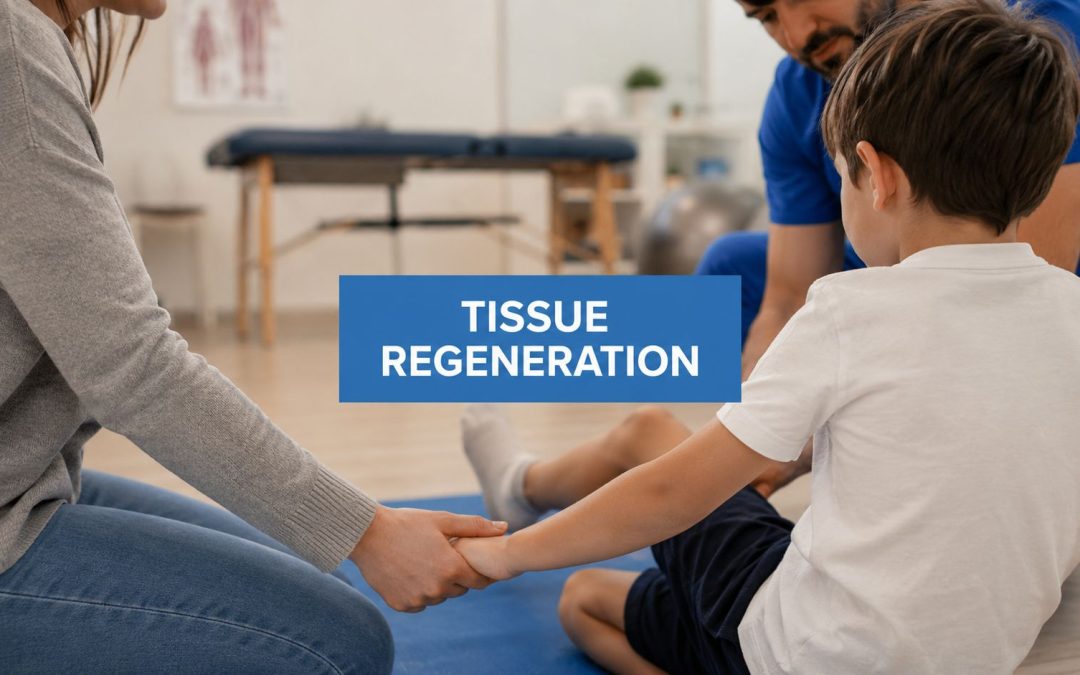
A parent comes in after months of trying to solve the same problem from every angle. Their back still flares up after lifting a toddler, their teenager's sports injury keeps returning after each season, or their child sleeps lightly because their body always seems tense. They've already done the sensible things, rest, medication, stretching, maybe physical therapy, and the results were partial or temporary.
That's where tissue regeneration therapy starts to get interesting. Instead of covering up pain or jumping straight to surgery, it aims to encourage the body's own repair response so damaged tissue can heal more effectively. For families who want gentle, non-invasive options and who care about how pain affects posture, movement, sleep, and nervous system balance, that difference matters.
Discovering Tissue Regeneration Therapy
A mother might say the same thing many parents say after trying a dozen approaches, “We're not looking for a miracle, we just want something that makes sense.” Her child has tight muscles, poor sleep, and a body that never seems to fully settle. Her own pain keeps returning after lifting, carrying, or long days on her feet, and the old routines haven't brought lasting relief.
Tissue regeneration therapy enters the conversation when the goal is to support repair instead of only quieting symptoms for a short time. In a clinic setting, that means paying attention to irritated tissues, the nervous system, and the ways the body has been compensating around the problem. For families used to short-lived fixes, that shift can feel important because it asks a different question, not just “How do we reduce pain today?”, but “Is the body getting the support it needs to heal well?”
A different kind of care
Families often think in two categories, either do nothing and hope it settles, or move toward stronger interventions. Tissue regeneration sits in a more middle ground place. It is non-invasive, it does not require surgery, and it fits with care plans that also support movement, recovery, and nervous system regulation.
Practical rule: if a problem keeps returning, look at whether the body is getting enough repair support, not just enough pain relief.
That matters for parents because pain rarely stays isolated. A strained back can change how someone sleeps, how they breathe, and how they move with their children. A child who is chronically tense may not be “just stiff,” they may be spending extra energy staying braced all day.
A family also deserves an honest view of the evidence. Interest in regenerative care is growing, and market reporting from market overview reflects that attention, but market growth does not prove that every treatment claim is equally supported. It does show the field is moving beyond a fringe idea. The harder question is who benefits, what kind of tissue problem is being treated, and whether the approach fits alongside chiropractic care that focuses on the nervous system rather than trying to replace the body's own healing process.
How Tissue Regeneration Actually Works
Think of damaged tissue like a construction site after a storm. The body sends workers, chemical signals, and materials to the site, but sometimes the signal is weak, the workers arrive late, or the repair crew doesn't stay long enough to finish the job. Tissue regeneration therapy tries to help that process restart more effectively.
The repair signal
In many approaches, including SoftWave, high-energy sound waves are directed at the affected area. The goal is to stimulate the body's own healing cascade, not replace it. Researchers describe the core engineering challenge as getting repair cells to survive, integrate, and function where they're needed, which is why biomaterial scaffolds, delivery systems, and sometimes genetic modification are being explored to support cell retention and therapeutic effect (biomaterials and cell integration research).
The construction crew arrives
The first response is a stronger healing signal. Then comes recruitment, where the body sends cells and repair factors into the area. After that, the tissue begins laying down new structural support. In plain language, that means the site moves from “stuck and irritated” toward “rebuilding and stabilizing.”

The final phase is remodeling. That's when tissue matures and gets stronger, instead of remaining in a fragile, half-healed state. Reviews in regenerative medicine describe 3D bioprinting as a major technical advance because it can place multiple cell types and biomaterials in a controlled architecture, which shows how seriously researchers are taking the problem of structure, not just stimulation (3D bioprinting review).
For families, the takeaway is simple. This therapy isn't about forcing healing. It's about creating better conditions for healing to happen, which fits naturally with a nervous-system-aware approach that values calm, function, and gentle input over aggressive force.
Conditions That Respond Best to Regenerative Therapy
Not every problem belongs in the same lane. Some conditions have more practical promise with tissue regeneration than others, and parents deserve a straight answer about that instead of a blanket promise. The best candidates are usually the problems that involve irritated soft tissue, stubborn pain, or a repair process that seems to have stalled.
| Clinical Conditions and Evidence Levels for Tissue Regeneration Therapy | Condition Category | Evidence Level | Clinical Notes |
|---|---|---|---|
| Clinical Conditions and Evidence Levels for Tissue Regeneration Therapy | Chronic musculoskeletal pain | Moderate and growing | Often considered for back pain, neck pain, and joint irritation when conservative care has helped only partially. |
| Clinical Conditions and Evidence Levels for Tissue Regeneration Therapy | Sports injuries and tendon issues | Moderate and growing | Useful to discuss when tendon or ligament irritation keeps returning with activity. |
| Clinical Conditions and Evidence Levels for Tissue Regeneration Therapy | Prenatal and postnatal discomfort | Limited to supportive use | Can fit alongside gentle care when pregnancy or postpartum strain affects posture and movement. |
| Clinical Conditions and Evidence Levels for Tissue Regeneration Therapy | Pediatric neurological challenges with muscle tension | Preliminary and indirect | The focus is usually secondary musculoskeletal tension, sleep disruption, or bracing patterns rather than a direct cure. |
| Clinical Conditions and Evidence Levels for Tissue Regeneration Therapy | Autism and sensory processing differences | Preliminary and indirect | Tissue work may be discussed as part of broader nervous system support, but it's not a stand-alone answer. |
Families often ask whether this means the therapy “treats” autism or sensory processing disorder. The honest answer is no. In a pediatric chiropractic setting, the more realistic role is supporting the body's tension patterns, comfort, and regulation so the child can function more easily.
A useful local resource on this topic is this overview of regenerative medicine for back pain, especially for parents trying to sort out where non-invasive options fit before they jump to something more aggressive.
Clinical reality: the more mechanical and localized the problem is, the easier it is to talk about regenerative support. The more complex and whole-body the issue is, the more careful the conversation needs to be.
That's especially true for families. A teenager with a stubborn tendon issue, a postpartum parent with low back pain, and a child with chronic tension all need different expectations. The therapy may look similar from the outside, but the reasoning behind it shouldn't be.
The Evidence Gap Most Articles Ignore
A lot of marketing sounds certain where the science is still cautious. That's the biggest thing families need to hear clearly. Regenerative medicine is real and expanding, but outcomes still vary based on the condition, the person, and the setting in which care is delivered.
Who benefits most is still not fully mapped out
Recent reviews say the field still lacks strong patient-stratified evidence because age and sex remain understudied in both preclinical design and clinical implementation (patient stratification review). That means it's harder to predict who responds best, especially for older adults, women, and children. Families often assume a therapy should work the same way for everyone, but biology doesn't cooperate that neatly.
The access problem is just as real. These therapies often need specialized infrastructure and trained personnel, and that creates geographic and socioeconomic barriers. One clinic may offer a treatment that another family across town or across a state line can't easily reach. That's not a minor detail, it changes who gets to try the therapy in the first place.
Marketing often outruns durability data
Independent reviews also stress that regenerative medicine still faces major challenges in routine care, including better standardization and stronger proof that results last across different conditions. That's where readers should slow down and ask better questions.
Good question to ask: what does this help, for whom, and for how long, compared with what I've already tried?
That kind of question is exactly why a careful consult matters. A thoughtful clinician won't promise that every case is a fit. They'll look at the type of tissue involved, the person's health background, how long the issue has been present, and whether nervous system irritation may be part of the pattern.
If you want to see how hype can creep into pain care, the discussion on stem cell therapy for pain is a helpful reality check. It's one thing to describe a technology. It's another to prove a durable benefit for a specific person sitting in front of you.
Tissue Regeneration vs Other Regenerative Options
Families comparing options usually want the same practical facts. Is it invasive, how much recovery is involved, how strong is the evidence, and does it make sense for a child or pregnant patient. Those questions matter more than buzzwords.

Where SoftWave fits
SoftWave therapy is non-invasive, so it appeals to people who want to support healing without needles or surgery. It also fits well inside a nervous-system-focused chiropractic plan, because the goal is not to force the body to heal, but to reduce irritation and support a better environment for recovery.
PRP injections and traditional stem cell injections can be reasonable in selected cases, but they are still procedures. Surgery sits at the far end of the spectrum, where the aim is direct structural repair but the tradeoffs are larger. For children and pregnant patients, that difference in invasiveness often matters a lot.
A simple way to think about the spectrum:
- SoftWave therapy: external, non-invasive, and often discussed for chronic pain or stubborn soft-tissue irritation.
- PRP injections: minimally invasive, but still a needle-based procedure using the patient's own blood components.
- Stem cell injections: more complex, more variable, and usually tied to more specialized settings.
- Surgery: reserved for structural problems that need direct repair or replacement.
SoftWave is often described as a middle-ground option because it does not require an incision or a needle. Families who want to learn more about the approach can also review shock wave therapy for pain, which explains how clinicians use it in pain care.
For parents, the value is not that one approach is always better. It is that a non-invasive regenerative option can sometimes be tried before the family moves into a more aggressive lane, especially when the goal is to support healing while staying gentle with the nervous system.
Your First Treatment Experience at Our Clinic
Most families want to know what happens before they ever book. They want to know whether the visit feels clinical, whether it's painful, and whether they'll leave with a clear plan or just more uncertainty. That's fair.
At First Steps Chiropractic, care is built around an in-depth consultation, Insight Scans, a thorough chiropractic exam, a personalized care plan, and adjustments. When tissue regeneration therapy is part of the conversation, it's not treated as a disconnected add-on. It sits inside a broader plan that looks at motion, posture, nervous system stress, and the body's ability to heal.
What the visit feels like
A SoftWave session is external. Clients lie comfortably while the applicator glides over the skin and delivers gentle pulses. The goal is to target the area without injections or downtime that would disrupt family life.

The clinic has locations in Hayden and Post Falls, accepts most insurance plans, and offers free benefits checks and complementary consultations. That makes it easier for families to ask questions before committing to a care plan, especially if they're trying to compare this with other conservative or regenerative options.
Who should pause and ask more questions
Not every person is an immediate candidate. A good clinician will think through whether the pain pattern is mechanical, whether there are red flags that need medical evaluation, and whether the person's goals fit a regenerative approach at all. That caution is a strength, not a weakness.
Practical rule: if a treatment is being sold as universal, that's a sign to slow down.
Families also want to know whether the approach fits into a nervous-system-centered model. In this clinic, the answer is yes. The goal is to reduce strain and support better function with gentle, neuro-tonal care, not to force the body through aggressive interventions it doesn't need.
Taking the Next Step Toward Healing
The most useful thing to remember is this. Tissue regeneration therapy can be a meaningful option, but it works best when it's part of a careful plan, not a miracle story. For some families, that plan includes gentle chiropractic care, soft tissue support, and a closer look at how stress, posture, and nerve function are affecting recovery.
That's where a patient-centered clinic can matter. Parents don't need more pressure. They need clarity, a respectful explanation of what the data shows, and help deciding whether the problem in front of them is a good fit for a non-invasive regenerative approach.
The philosophy stays the same from prenatal care to newborns to older children and adults, support the nervous system, lower unnecessary strain, and use gentle techniques that match the person sitting in the room. If the body is bracing, overworked, or stuck in a loop of irritation, the goal is to create conditions where healing can happen more naturally.
Families who are considering this path usually don't need another sales pitch. They need a conversation. That can start with a benefits check, a complimentary consultation, or a simple question about whether their current situation is appropriate for regenerative support.
If you're wondering whether tissue regeneration therapy could fit your family's needs, schedule a conversation with First Steps Chiropractic. The team can help you sort through your options, check insurance benefits, and see whether gentle regenerative care belongs in your plan for healing, comfort, and better nervous system balance.