
A major U.S. survey found that in 2021, 36.9% of preschool-aged children played outdoors for 1 hour or less on weekdays, and only 28.8% reached 3 or more hours on weekdays, compared with 49.3% on weekend days source study. That gap is more than a scheduling issue. It's a sign that many young children are getting too little of one of the most basic inputs for healthy development, especially at a stage when their nervous systems are learning how to organize movement, attention, and regulation.
For parents, the hard part isn't understanding that play matters. It's understanding why outdoor play importance goes far beyond “fresh air is nice.” Outdoors gives a child's brain and body the kind of changing, messy, real-world input that indoor spaces rarely match. For children with sensory processing challenges, that difference can be especially meaningful, because the nervous system doesn't just need stimulation, it needs the right kind of stimulation, in the right amount, to settle, adapt, and build confidence.
The Decline of Outdoor Play and Why It Matters Now
The shift is easier to see when you look at the numbers together. Older U.S. survey data from the National Kids Survey reported that 62.5% of children spent at least 2 hours outdoors on weekdays, and 78.2% did so on weekend days USDA report. A separate public-health brief adds that compared with the 1970s, children now spend 50% less time in unstructured outdoor activities. It also notes that children ages 10 to 16 average only 12.6 minutes per day of vigorous physical activity. That is a major change in how childhood unfolds.

What changed in the daily experience of childhood
Outdoor play matters because it does more than fill time. Active outdoor play is associated with higher moderate-to-vigorous physical activity and less sedentary behavior than indoor time, and the 2025 position statement notes that outdoor environments usually create more chances for movement. The setting itself changes what the body does. A hallway, couch, or tablet screen does not ask the same things of a child's muscles, balance system, and attention network.
The same statement also summarizes an umbrella review of 381 published articles showing overall favorable associations between active outdoor play and physical, mental, social, and spiritual health outcomes, with partial support for causality position statement. For parents, that shifts the conversation away from nostalgia. The issue is not whether earlier childhoods looked different. The issue is that children's everyday movement patterns have changed, and the body notices.
Practical rule: if a child's free time keeps moving indoors, the nervous system gets fewer chances to practice balance, effort, spatial awareness, and self-regulation in one setting.
Why a nervous system lens changes the conversation
A developing brain is constantly taking notes from the body. It uses movement, light, sound, texture, distance, and novelty to learn how to sort information and stay organized. Outdoor play gives the brain a full-body workout, not just a workout for the legs. That is why the decline in outdoor time is more than a lifestyle trend. It is a developmental shift with real effects on how children learn to calm down, focus, and adapt.
For families of children with developmental differences, this point carries even more weight. Outdoor play is not a cure-all, but it can be one of the most accessible ways to give the nervous system richer input. That makes it a foundational habit, not an optional extra.
For a clearer sense of how this kind of learning begins, it can help to look at the sensorimotor stage of development, where movement and sensory input work together to shape early brain organization.
How Outdoor Play Shapes Developing Brains and Bodies
Outdoor environments work like a mixed-sensory classroom without walls. A child has to move, notice, react, and regulate all at once. That combination matters because active outdoor play can raise movement levels while lowering sedentary time, which gives the body a stronger signal to organize itself around action instead of passivity position statement. For children who seem “bouncy” indoors or “checked out” on screens, outside time can give the nervous system a more usable range of input.
Physical growth and motor planning
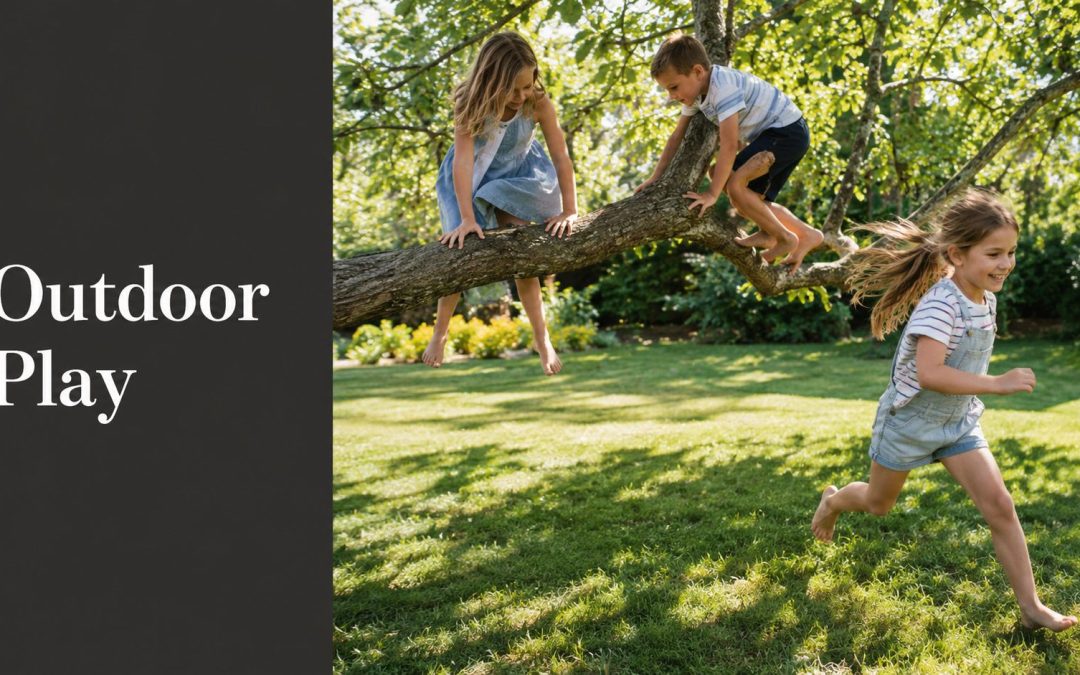
Running across uneven ground, climbing a low structure, or stepping over roots asks the body to coordinate strength, timing, and balance. Those movements build gross motor control, but they also train the brain's planning systems. A child doesn't just learn to move. They learn to predict where the body is in space and adjust when the ground is uneven or the task changes.
Sensory processing and regulation
Outdoor play becomes especially important for children with sensory differences. Indoors, the sensory environment is often simplified and controlled. Outdoors, the nervous system receives changing input from wind, temperature, smell, light, sound, and touch. That variety can help a child learn to tolerate, sort, and integrate sensations instead of getting stuck in overload or under-stimulation.
Outdoor play often works best when the goal isn't perfection, it's regulation. A child who feels frazzled indoors may settle after time with grass, movement, and open space.
Neurological and social development
The 2025 Position Statement reports an umbrella review of 381 published articles with favorable associations between active outdoor play and physical, mental, social, and spiritual health outcomes position statement. That broad pattern makes sense. Outdoors, children negotiate turns, invent rules, recover from frustration, and read social cues in motion. Those experiences are not separate from brain development. They're part of how the brain learns flexibility, inhibition, and creativity.
A gentle note for parents who worry about “just playing”
Play looks simple from the outside, but the nervous system is busy the whole time. Climbing, balancing, chasing, hiding, and pretending are doing more than burning energy. They're giving the brain repeated practice in how to organize the body, manage sensation, and stay engaged with other people.
Read more about the sensorimotor stage
Age-Specific Outdoor Activities That Support Development
The best outdoor activity depends on what a child's nervous system is ready to practice. A toddler doesn't need a “program.” They need safe access to texture, movement, and repetition. A preteen needs more autonomy, challenge, and room to test judgment. Matching the activity to the developmental stage makes the outdoor time feel easier and more rewarding for both child and parent.

Infants and toddlers
For babies and toddlers, the goal is sensory exploration. A blanket on grass, a few safe objects to touch, and time to look at trees or clouds all support early sensory integration. A short walk where they can hear birds, feel a breeze, and notice light and shade helps the brain build maps of the world without demanding too much from them.
Rolling a ball back and forth is another good option. It encourages turn-taking, tracking, and simple motor planning. If your child is sensitive to noise or crowds, start with a quiet corner of a yard or park so the experience feels manageable.
Preschoolers
Preschoolers usually do best with imaginative, open-ended play. Mud kitchens, sticks, leaves, chalk roads, and pretend rescue missions let them combine movement with creativity. These games help with self-direction because the child has to invent the rules and stay with the story long enough to make it work.
A simple yard task can also be powerful. Carrying small sticks, watering plants, or helping collect rocks gives a preschooler a job they can finish. That matters because the brain likes clear action and clear payoff.
School-age children
School-age kids often benefit from outdoor challenges that ask for problem-solving. Natural playgrounds, climbing structures, scavenger hunts, and obstacle courses build coordination and confidence together. This age group usually wants a little risk, not danger. A log to balance on or a path to traverse gives them that healthy dose of effort.
If your child tends to seek intense movement, outdoor games can serve as a useful outlet. If your child avoids movement, begin with low-demand activities like walking, kicking a ball, or looking for insects. Those choices keep the nervous system engaged without overwhelming it.
Preteens
Preteens often need more ownership. Let them help choose the route for a walk, plan a neighborhood loop, or follow a simple trail with you nearby. That kind of freedom supports judgment, body awareness, and independence.
The key is to keep the invitation open, not forced. A child who resists “exercise” may still enjoy exploring, collecting, drawing, or taking photos outside.
Real Barriers to Outdoor Play and How to Address Them
The biggest mistake parents make is assuming outdoor play is hard only because they're not trying hard enough. Many families face real barriers. Safety concerns, screen competition, limited access to green space, and neighborhood isolation all change how easy it is to get outside. Research on play participation shows that children were less likely to spend time outdoors when parents didn't allow unsupervised play beyond home, when screen-based activities crowded out free time, and when families perceived more outdoor danger participation study.
Safety, supervision, and confidence
Some children can play with more freedom than others, and some neighborhoods support that better than others. If you don't feel comfortable with unsupervised play, start smaller. Stay outside with your child, choose enclosed areas, or arrange play with one familiar family. The goal is not to remove caution, it's to lower the activation level enough that outdoor time can happen.
Screens and packed schedules
Screens are powerful competitors because they're immediate and predictable. Outdoor play asks more from the child at first, which means the transition can be bumpy. Keep that transition simple. End screen time before the outing, offer a clear destination, and keep the first outdoor session short enough that your child leaves wanting more.
Access and equity
Outdoor play is often treated like it's equally available to every family, but it isn't. Research notes profound disparities in access to outdoor spaces for children in communities of color, and evidence from the UK and elsewhere shows children from minority ethnic groups spend less time active outdoors than white-majority children, partly because green-space quality and access aren't equal equity research. That matters because the conversation should not stop at family motivation. Communities need safe, nearby places where children can move freely.
Practical rule: if outdoor access is limited, protect what you can control, like daily time on a balcony, a shared courtyard, a schoolyard, or a walk around the block.
What families can do right away
- Use “nearby nature” first. A small patch of grass, a tree-lined sidewalk, or a backyard counts.
- Trade perfection for repetition. Frequent short outings usually work better than rare big outings.
- Build social permission. One more family outside often makes play feel safer and easier.
- Advocate locally. Ask schools, parks, and community leaders for safer, more usable outdoor spaces.
When Outdoor Play Isn't Enough Recognizing Developmental Red Flags
One child runs outside and settles right in. Another refuses grass, panics at noise, or seems lost in play no matter how often they're invited. That difference doesn't always mean something is wrong, but it can mean a child needs more support than outdoor time alone can offer.
A parent might notice a child who avoids swings, won't climb, or becomes upset by ordinary outdoor sensations like wind on the face or dirt on the hands. Another child may love being outside but still struggle with coordination, frequent falls, or difficulty joining peers in simple games. If those patterns persist across settings, it's worth asking whether the nervous system is having trouble organizing sensory input or motor output.
Learn about causes of developmental delays
What to watch for
If your child consistently shows extreme sensitivity to textures, movement, sound, or visual input, that's a clue. If they seem calmer outdoors only briefly, then quickly dysregulated again, the issue may be broader than a lack of fresh air. And if a child has trouble with balance, posture, body awareness, or social play even in low-pressure settings, that pattern deserves attention.
What to ask your pediatrician
Bring specific observations. Describe what happens, when it happens, and what helps. Ask whether occupational therapy, developmental evaluation, or another specialty assessment would fit your child's needs.
A child doesn't need to “fail” at play before a family asks for help. Early support often makes outdoor experiences easier, not harder.
Where chiropractic care may fit
For some families, pediatric chiropractic care is part of a broader support plan, especially when the concern is how the nervous system organizes movement and regulation. It's not a replacement for pediatric, occupational, or developmental care, but it can be one tool in a coordinated approach when a child seems stuck in patterns of tension, overreaction, or poor body control.
The main point is simple. Outdoor play should stretch a child a little, not leave them overwhelmed. If the gap between easy play and distressed play feels too wide, getting help is a reasonable next step.
Building a Sustainable Outdoor Play Routine for Your Family
A routine works best when it feels smaller than the thing you're already trying to do. Parents often fail at outdoor time because they make it sound like a major daily event. It doesn't have to be. A short, repeatable rhythm usually beats a grand plan that collapses by Thursday.
The easiest way to reduce friction is to connect outdoor time to something that already happens. After school, before dinner, or right after breakfast are all useful anchors. If your child resists the transition, give them one clear job, like carrying the snack bag or choosing the route. That keeps the nervous system from getting stuck in negotiation mode.

A workable weekly frame
- Working parents: one short weekday outing, plus one longer weekend play block.
- Homeschooling families: use outdoor time as a reset between lessons, not only as “recess.”
- Families with mixed ages: choose one activity that can scale, like walking, chalk, bubbles, ball games, or collecting leaves.
The phrase yes space helps here. A yes space is a place where you've reduced the number of “no's” needed, so your child can move more freely and you can supervise less intensely. That might be a fenced yard, a safe patio, or a corner of a park where you can relax your shoulders a little.
Transition strategies that help
- Start screen-free before leaving. A predictable pause before outdoor time reduces arguments.
- Keep a nature kit ready. A magnifying glass, sketchbook, or small bucket gives reluctant kids a job.
- Join as a partner, not a director. Follow their lead for part of the time.
- Repeat the same place often. Familiarity lowers the stress of getting started.
See how holistic family wellness connects habits and nervous system support
The best routine is the one you can keep when life is busy. If that means 10 quiet minutes in the yard after dinner, that still counts.
Supporting Your Child's Development Beyond the Playground
Outdoor play gives the nervous system room to settle and sort itself out, but some children need more support before that can happen. When movement, sensory processing, or regulation feels hard every day, parents should not have to piece together the answer alone. A thoughtful plan can include outdoor time, pediatric guidance, and hands-on care that looks at how the body is carrying stress and how your child responds to movement and touch.
The nervous system functions like an internal control center. For some children, especially those with developmental challenges, that control center can remain in a higher-alert state. Outdoor play can help lower that pressure, and coordinated care can provide a clearer picture of what is helping and what still feels difficult.
First Steps Chiropractic in Hayden, Idaho offers pediatric and family-focused chiropractic care with a neurologically focused approach to support nervous system function. If your child needs help with regulation, comfort, or movement patterns, it can be one option to consider alongside pediatric care, developmental screening, and the broader plan you and your child's providers are building together.
If your child struggles to settle, move, or tolerate sensory input, the team at First Steps Chiropractic can help you explore whether nervous system-focused care fits your family's goals. Outdoor play is a strong starting point, and the right support can make it easier for your child to benefit from it in everyday life.