

Your baby turns easily toward one side during feeding but seems uncomfortable looking the other way. During tummy time, the head tilts, and you may notice a small flat area developing on the back or side of the skull. These observations can feel alarming, especially when you're still learning what's normal for a newborn.
The reassuring news is that many infants with congenital muscular torticollis respond well to early, conservative care. The important qualification is that not every head tilt comes from a tight neck muscle, and chiropractic treatment shouldn't replace pediatric assessment or physical therapy. The safest plan begins with careful evaluation, clear red-flag screening, and measurable progress.
Understanding Infant Torticollis and Why Early Detection Matters
A baby may feed comfortably on one side yet fuss when turned the other way. During supervised floor play, the head may repeatedly tilt, with one ear closer to a shoulder and the chin angled away. If the baby also watches voices from mainly one direction or develops a flatter area on the preferred side of the head, the pattern deserves attention.
These signs can fit congenital muscular torticollis, in which a neck muscle, often the sternocleidomastoid, is shortened or tight. The result is a persistent head tilt and reduced rotation. A temporary preference can happen in young babies, especially around light, a caregiver, or a familiar feeding position. Muscular torticollis is more consistent across feeding, carrying, play, and other everyday activities.
The condition may be associated with positioning before birth, birth-related strain, or an early imbalance in neck muscle use. Birth history gives clinicians useful context. One clinical summary reported an incidence of 2% after traumatic deliveries compared with 0.3% after nontraumatic deliveries in the cited populations, as described in the NCBI clinical overview of congenital muscular torticollis. These figures do not diagnose an individual infant. They explain why an evaluation may include questions about labor, delivery, presentation, and early movement.
A recurring early-life condition
Reported occurrence varies by population and study design. Estimates range from about 0.3% to 1.9% of newborns, with some sources citing roughly 1 in 250 births. One review describes reported rates from 0.3% up to 16% in some settings. This variation reflects differences in screening and diagnostic definitions, not a reason to dismiss a caregiver's observation.
The condition is often identified during the first month of life. Early recognition can support timely referral and may reduce the period during which limited neck movement affects head shape or the baby's opportunities to move evenly. A pediatric clinician or physical therapist can determine whether the pattern fits muscular torticollis and set measurable goals, such as more even head turning and a comfortable resting position.
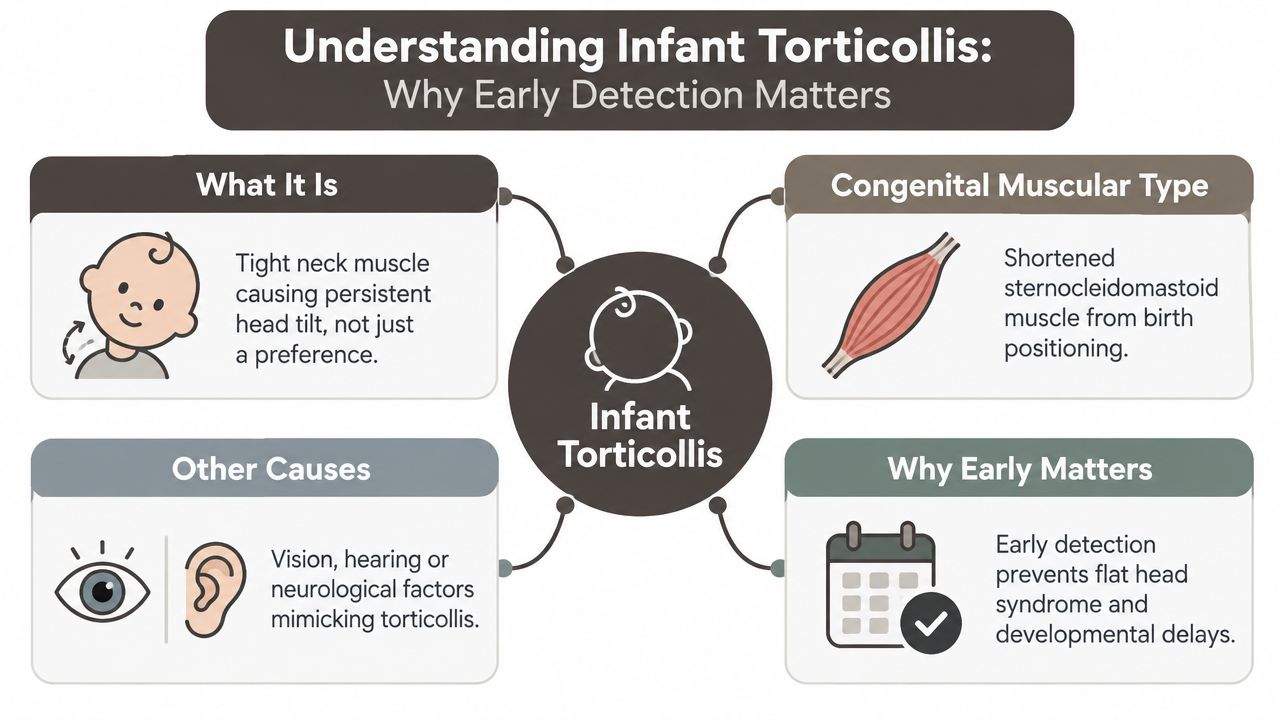
A head tilt can also reflect visual, hearing, neurological, skeletal, or other structural concerns. “Tight muscles” should therefore remain a working possibility, not a conclusion. Chiropractic care, when considered, belongs within conservative care and should not replace pediatric assessment or physical therapy. A responsible provider screens for warning signs, uses gentle methods, tracks change, and refers when the presentation does not resemble uncomplicated muscular torticollis.
Practical rule: Early observation helps, but persistent asymmetry calls for professional evaluation rather than repeated home experimentation.
Spotting the Signs at Home and When to Seek Evaluation
Parents don't need to perform a neck examination. Your role is to observe how your baby moves during ordinary routines and describe the pattern accurately.
Start with feeding. Does your baby latch or settle more easily when facing one direction? Does turning the head toward the other side cause fussiness, pulling away, or repeated repositioning? Note whether the same preference appears with bottle-feeding, not just breastfeeding.
Watch during calm alert time:
- Head position: Look for a repeated tilt toward one shoulder rather than an occasional adjustment.
- Looking direction: Notice whether your baby follows your face or a toy in both directions.
- Turning ability: Observe whether the baby can rotate the head comfortably during play, diaper changes, and carrying.
- Head shape: Check for a developing flat area or facial asymmetry, without pressing on the skull.
- Whole-body movement: See whether the baby uses both arms and turns the trunk similarly on each side.
A short phone video can help. Record ordinary movement from the front and above, and write down when the asymmetry appears. Photos taken during feeding, tummy time, and relaxed carrying can give the pediatrician, physical therapist, or appropriately trained clinician a clearer picture than a single office moment.

When to make the call
Contact your pediatrician or pediatric physical therapist when the tilt is persistent, rotation seems limited, feeding is consistently easier on one side, or head flattening is becoming noticeable. Prompt assessment is especially sensible when the asymmetry was present from birth or became clear during the early weeks.
Don't force the head to turn, press on a neck lump, or copy a stretch from an online video. Babies can have different causes of limited movement, and an exercise that suits muscular torticollis may be inappropriate when the cause is structural or neurological.
Seek urgent medical guidance for a baby with worsening asymmetry, unusual stiffness or weakness, marked changes in alertness, feeding difficulty that concerns you, or other symptoms that don't fit a simple movement preference. A home checklist supports triage, but it can't rule out non-muscular causes.
What to Expect During a Gentle Chiropractic Evaluation
An infant torticollis chiropractic treatment plan should begin with assessment, not adjustment. The first visit should give you a clear explanation of what the provider observed, what remains uncertain, and whether another professional should evaluate your baby first.
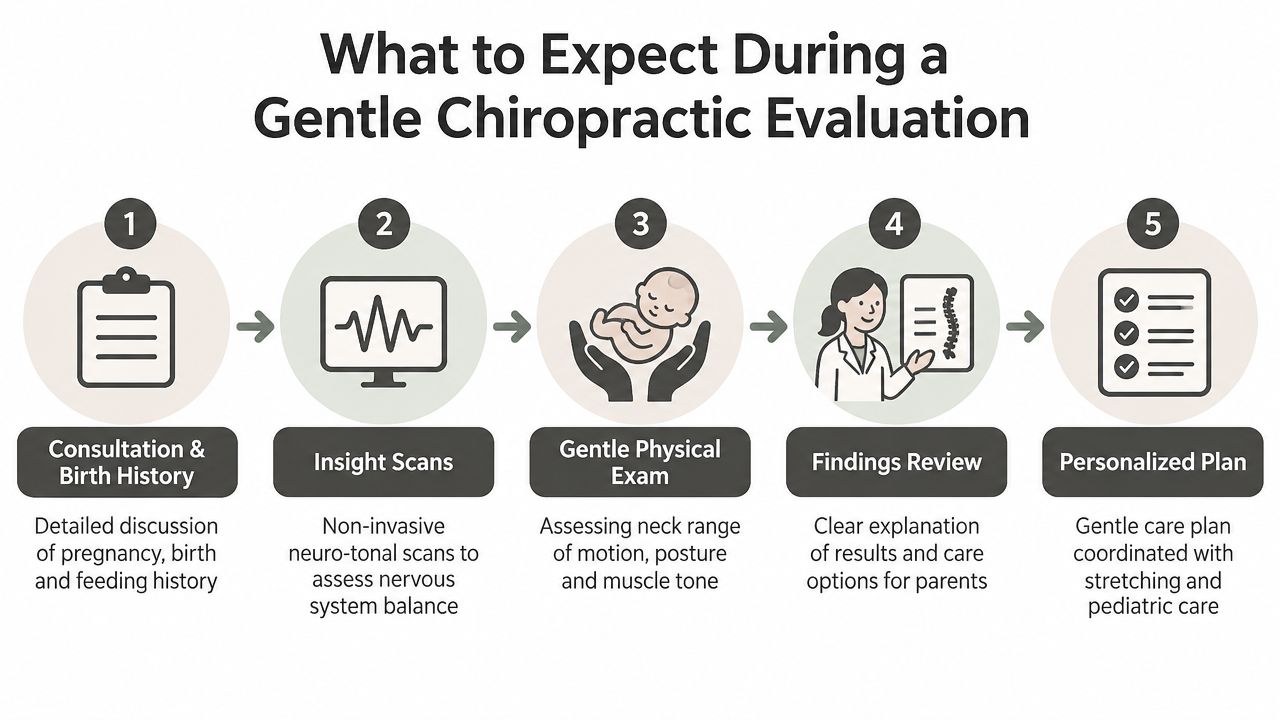
The consultation usually starts with pregnancy, birth, and feeding history. A clinician may ask about presentation before delivery, a difficult or traumatic birth, when the tilt was first noticed, preferred feeding positions, sleep positioning, tummy time, and any changes in movement. These details help distinguish a stable early pattern from a new or worsening problem.
What the physical examination should answer
A careful examination considers several separate findings:
- Passive cervical range of motion: How far the neck moves when guided gently by the clinician.
- Active range of motion: How far the baby turns independently toward a face, voice, or toy.
- Head tilt: Whether the tilt remains present at rest and during movement.
- Symmetry: Whether the baby moves the eyes, head, trunk, and limbs similarly on both sides.
- Motor development: Whether movement appears appropriate for the baby's age and current abilities.
These measures matter because a visible tilt alone doesn't reveal the cause or severity. A baby may have a preference without a meaningful passive restriction, while another may compensate through the trunk or shoulders. The examiner should explain what each finding means in everyday language.
Some clinics also use non-invasive tools such as Insight Scans as part of their own evaluation process. These scans may be presented as additional information about neuro-tonal patterns, but they shouldn't be treated as a replacement for a pediatric examination, range-of-motion assessment, developmental screening, or medical referral when red flags appear.
For a plain-language overview of what a pediatric chiropractic examination may include, see this pediatric chiropractic exam guide.
Where Torque Release Technique fits
First Steps Chiropractic describes a five-step process involving consultation, Insight Scans, examination, findings review, and a personalized plan. It also uses Torque Release Technique, a low-force approach that should be explained before it's applied. Parents should ask exactly where contact will be made, what the baby may feel, how the clinician monitors tolerance, and what would cause the provider to stop.
The evidence distinction is important. Chiropractic-specific research for infant torticollis is limited and largely consists of case reports, including a 1993 PubMed-indexed report titled “Chiropractic correction of congenital muscular torticollis” (PubMed record). Broader evidence reviews focus more strongly on practitioner-led stretching and physical therapy than on chiropractic manipulation itself.
A trustworthy evaluation ends with options, not pressure. You should leave knowing whether pediatric physical therapy is recommended, whether your pediatrician needs to assess the baby, what conservative care involves, and how progress will be measured.
Inside a Gentle Treatment Visit and How It Fits With Conservative Care
A baby may arrive alert, tired, or unsettled, so a gentle visit should adapt to the child rather than follow a rigid sequence. The clinician might observe how the baby turns toward a parent, checks the head position during feeding or play, and reassesses the movement that seemed limited during the evaluation. If distress increases, the visit should pause. Crying is a reason to check comfort and discuss the next step, not to increase force.

The provider should explain the planned contact before touching the baby. Depending on the clinician's training and approach, care may involve gentle contact or mobilization rather than an adult-style adjustment. Ask whether spinal manipulation or mobilisation is planned, where contact will occur, what the baby might feel, and what signs would make the clinician stop. A low-force contact and spinal manipulation are different procedures, so clear wording matters.
The conservative-care foundation
Pediatric physical therapy generally provides the main structure for conservative care. It can include assessment, cervical passive range of motion, active movement, positioning, parent education, and exercises taught for home use. A 2020 synthesis of systematic reviews found moderate favorable evidence for practitioner-led stretching to improve range of movement (PubMed-indexed evidence summary).
The reported results came from one study population, not every infant. In a cohort of 105 infants, 90% achieved a successful outcome in fewer than 10 physiotherapy sessions. Rotation deficits fell from 52% to 6%, lateral-flexion deficits from 54% to 14%, plagiocephaly improved in 82%, and symmetrical or near-symmetrical muscle function was recorded in 93% (cohort report indexed by PubMed). These findings help families understand what may be measurable during therapy, but they do not promise the same response for an individual baby.
A family may choose to include chiropractic care, but it should fit alongside pediatric and physical therapy input rather than replace it. Ask how the chiropractor will share findings with the care team, which goals will be tracked, and what result would change the plan or prompt referral.
How to judge progress
Immediate relaxation after a visit does not establish lasting benefit. Look for functional changes across daily routines:
- Is turning toward the less-preferred side easier?
- Does the head remain more centered during feeding?
- Is tummy time becoming more symmetrical?
- Is the visible tilt decreasing?
- Are developmental movements progressing comfortably?
These observations give parents useful information to share at follow-up. Visit frequency should depend on examination findings and response, not on a predetermined package. A complete plan explains what will be reassessed, why another visit is suggested, and what discharge would look like.
Evidence for chiropractic adjustment remains limited. A 2022 synthesis found insufficient evidence to support spinal manipulation or spinal mobilisation for infants with torticollis, and a randomized pilot study found no significant short-term advantage when manual therapy was added to physiotherapy (2022 evidence synthesis). This does not establish that every gentle contact has no effect. It does mean families should question claims presenting chiropractic adjustment as an established standard treatment.
At Home Positioning and Stretching Guidance That Supports Progress
Home care works best when it fits naturally into feeding, carrying, floor play, and diaper changes. Your clinician should demonstrate each exercise and watch you perform it before you practice independently. If the baby resists strongly, cries persistently, or seems uncomfortable, stop and ask for a modification.
Encourage balanced movement
During supervised awake play, place your face, voice, or a high-contrast toy on the side your baby tends to avoid. Keep the toy close enough to invite turning without forcing the neck. Change your own position around the play space so your baby has ordinary reasons to look in both directions.
Vary feeding and holding sides when comfortable and safe. A football hold, upright carry, or chest-to-chest position may create different opportunities for head movement, but the position must support the baby's airway and body. Don't use a feeding position that causes pain, poor latch, coughing, or fatigue to chase symmetry.
Tummy time can happen on a firm, clear floor surface or across a caregiver's chest while the baby is awake and watched. Short, repeated opportunities may be easier than one long attempt. The purpose is active head and trunk movement, not endurance at any cost.
For families also managing a flat spot, this guide on supporting a baby with a flat head can complement advice from your pediatric clinician. Keep safe sleep separate from awake positioning strategies. Babies should be placed to sleep according to current pediatric safe-sleep guidance, not positioned with loose items or devices intended to hold the head in place.
Stretch only as taught
A clinician may teach gentle neck passive range-of-motion work and trunk active range-of-motion activities. The exact direction depends on the baby's pattern, so don't assume that a generic stretch is appropriate. Support the shoulders and head as demonstrated, move slowly, and stay within the range that the provider has identified as comfortable.
Good tolerance may look like relaxed breathing, calm attention, and gradual acceptance of the movement. Stop for persistent crying, breath-holding, color change, gagging, marked stiffening, or an apparent increase in pain. Never bounce, yank, or use adult stretching force.
Track small wins in a simple note:
| What to observe | Example of a useful note |
|---|---|
| Head turning | “Looked toward the left during diaper change” |
| Feeding symmetry | “Settled more easily on the previously difficult side” |
| Tummy time | “Lifted and turned head with less trunk rotation” |
| Visible tilt | “Centered briefly while calm” |
The point isn't to create a medical chart at home. It's to give your care team concrete examples of change and to notice when progress stalls.
Timelines Red Flags and Knowing When to Refer
A baby may begin turning more freely within weeks, while another needs longer support. Earlier assessment often improves the outlook, and prompt care may shorten the treatment period, but no universal schedule fits every infant. Starting age, movement restriction, head-shape changes, developmental findings, tolerance of home exercises, and the underlying cause all affect progress.
Discharge should follow function rather than a preset number of visits. Useful targets include:
- Passive neck movement within 5 degrees of the unaffected side.
- Symmetrical active movement in both directions.
- Age-appropriate motor milestones.
- Resolution of the visible head tilt.
- Caregiver ability to monitor for recurrence.
These measures are part of structured guidance for infants from birth to 23 months. That guidance also recommends reassessment 3 to 12 months after direct services end. A clinician may adjust the follow-up plan for your baby, but should explain the reason and what changes to watch for.
Progress should look like function returning, not a quieter neck. Parents can note whether the baby turns toward both sides during play, keeps the head centered when calm, and feeds more comfortably on either side.
When not to adjust
Atypical, persistent, or worsening torticollis needs medical evaluation before manual intervention. A serious infant outcome has been reported when apparent torticollis was caused by a spinal cord astrocytoma. The case shows why clinicians must consider conditions beyond a muscular restriction before treatment (pediatric spinal manipulation safety review).
Seek prompt pediatric or urgent medical assessment for:
- Worsening asymmetry: The tilt or movement restriction is becoming more pronounced.
- Atypical onset: The problem appears suddenly after a period of normal movement.
- Neurological changes: New weakness, unusual stiffness, altered responsiveness, or concerning coordination changes.
- Persistent unexplained symptoms: The pattern does not behave like a straightforward muscular restriction.
- Feeding or general health concerns: Poor feeding, marked distress, or symptoms suggesting illness rather than a local neck problem.
Safety evidence remains limited. One large series of 695 infants reported no serious adverse events, yet reviews state that the true risk of moderate and severe adverse events is unknown. A 2026 international evidence-based pediatric position statement says spinal manipulation and mobilisation should not be performed on infants. Families considering infant torticollis chiropractic treatment should discuss this precaution, the evidence limits, and referral options with their pediatric team.
Information about torticollis and autism should not be used to infer a diagnosis or cause. Torticollis and developmental conditions require separate professional assessments.
First Steps Chiropractic can provide a pediatric consultation covering birth history, movement symmetry, range of motion, and referral needs, while coordinating conservative care with your child's pediatric team. Persistent head tilt or turning preference warrants an appropriate evaluation before treatment.