You're probably here because your pelvis feels “off” in a way that's hard to describe. Maybe your low back tightens when you stand up after sitting, maybe one hip feels like it's hiking higher than the other, or maybe pregnancy has made every small shift in your body feel bigger than it used to. That's exactly where pelvic alignment exercises can help, but only when they match the pattern you're dealing with.
The pelvis isn't a single posture problem. It's a working bridge between the spine and legs, a base for the pelvic floor, and a moving platform for the sacroiliac joints. Small changes in how it moves can affect comfort, breathing, load transfer, and, in pregnancy and postpartum care, how well the body handles changing demands. The goal here is simple, find the pattern, choose the right type of work, and know when home exercise is enough and when it isn't.
Why Pelvic Mechanics Matter More Than Posture
A pregnant patient might say, “My back is fine until I roll over in bed,” while a parent might notice, “My toddler keeps leaning to one side, and so do I when I carry them.” Those problems don't look the same, but they often point back to the same thing, the pelvis isn't moving or loading evenly. Posture advice like “stand up straight” misses that detail completely.
The pelvis is a moving system, not a fixed shape
The pelvis transfers force between the trunk and the legs every time you walk, squat, lift, or get out of bed. It also houses the pelvic floor muscles, which is why pelvic-floor training and pelvic mechanics so often show up in the same conversation. In pregnancy and postpartum care, exercise-based pelvic-floor training can have measurable effects on pelvic mechanics and function, and one broader meta-analysis reported a 41% reduction in the odds of urinary incontinence after childbirth across 8 randomized controlled trials, n=2005, OR 0.59, 95% CI 0.39 to 0.89 (systematic review and meta-analysis summary).
That doesn't mean every pelvis needs the same drills. It means the way the pelvis tilts, rotates, or stays level matters to how the rest of the body handles load.
Practical rule: If the pelvis can't move well, the low back, hips, or pelvic floor often pick up the slack.
Two people, two very different pelvic stories
A second-trimester mom with deep sacroiliac aching usually needs different work than a dad who notices one side of his pelvis feels compressed after carrying a toddler on the same hip every day. The first may need mobility plus gentle motor control. The second may need symmetry, endurance, and a better loading strategy.
That's why this topic deserves pattern-specific thinking. Pelvic alignment exercises aren't about forcing a neutral pose and calling it fixed. They're about restoring control where it's missing, then building the stamina to keep that control during real life.
Identifying Your Pelvic Pattern Before You Exercise

Before you stretch anything, stand in front of a mirror and look at where your ribs sit over your hips. That simple check gives you a starting hypothesis, not a diagnosis. If the low back looks overarched and the belly tips forward, you may be dealing with an anterior tilt pattern. If the pelvis looks tucked under and the lower back looks flatter, a posterior tilt pattern may fit better. If one side sits higher or rotates differently, think lateral asymmetry.
What each pattern usually feels like
Anterior tilt often shows up as low-back tightness, hip flexor stiffness, or a sense that the pelvis is always “stuck forward.” Posterior tilt tends to feel more like deep core weakness, limited hip extension, or a tucked-under posture that makes standing feel compressed. Lateral asymmetry is the one most consumer articles miss, because it can feel like one-sided SI discomfort, uneven weight-bearing, or the sense that one hip never quite shares the load.
If you want a quick self-check, place your hands on your iliac crests, then gently rock your pelvis forward and back. You're looking for movement that feels smooth and controllable, not forced. If one side moves differently from the other, that's useful information.
Match the pattern to the job
- Anterior tilt, usually needs mobility plus motor control, especially hip-flexor length, pelvic tilting control, and glute-driven extension.
- Posterior tilt, usually needs mobility plus extension tolerance, because the body often needs help finding the middle range again.
- Lateral asymmetry, usually needs symmetry training and endurance, not just more stretching on the tight side.
A useful benchmark comes from rehab guidance that favors 1 to 2 rounds per exercise and progression up to 60-second holds when tolerated, because session structure matters more than one magical corrective drill (pelvic stabilization guidance). Slow, symmetric, repeatable motion matters more than how hard the exercise feels.
If your self-check changes from day to day, don't panic. That's often a sign that load, fatigue, pregnancy changes, or compensations are shifting the picture, which is exactly the kind of clue a clinician uses.
A Complete At-Home Routine for Pelvic Alignment Exercises
Start with your body in a position that lets you breathe well. A mat, a wall, and a chair are enough for most of this sequence. If one movement makes you hold your breath, flare your ribs, or jam into your low back, the exercise is too aggressive right now.

Mobility first, because the pelvis has to move before it can stabilize
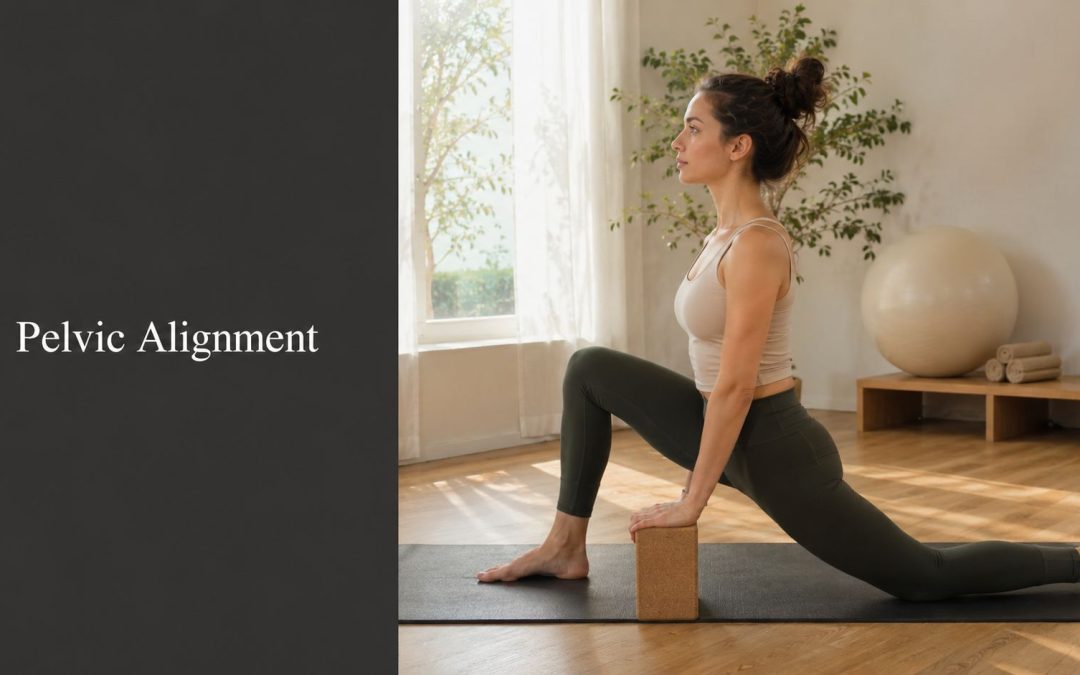
Begin with a half-kneeling hip-flexor stretch for 30 to 45 seconds per side. Keep the ribs stacked over the hips, and don't arch the low back to chase a bigger stretch. You should feel length in the front of the hip, not compression in the spine.
Move into 6 to 8 slow posterior pelvic tilts. Exhale as you tuck the pelvis, inhale as you return to center. The point is control, not range. If your ribs flare or your low back does all the work, shorten the range and slow down.
A few supported cat-cow repetitions help the spine and pelvis coordinate without strain. Then do about six 90/90 hip rotations per side to restore hip rotation capacity and lumbopelvic control. Keep both sit bones heavy and avoid twisting the trunk to fake the motion.
The best rep is the one you can repeat with the same shape, breath, and speed.
Motor control comes next
For an anterior-tilt type pattern, pelvic tilts and glute bridges are usually the bridge between mobility and strength. Common exercise guidance uses 10 to 15 reps for 2 to 3 sets with 5-second holds for pelvic tilts or bridges, then gradually progresses toward 15 to 20 reps for squat or bridge variations as control improves (anterior pelvic tilt exercise guidance). Keep the pelvis level and let the glutes, not the low back, finish the movement.
The most common mistakes are easy to spot. If the hamstrings cramp, the low back pinches, or the pelvis stays rotated, the drill is too advanced or the ribcage position is off. Dial it back and rebuild the shape.
Endurance locks the change in
Now add a simple dead bug progression and glute bridges. Use small, clean reps, not fatigue-driven reps. The goal is to keep the pelvis steady while the arms and legs move, which teaches the trunk and hips to share work.
If you want a deeper core sequence to pair with this routine, the progression in this core-strength guide fits well after the basic tilts and bridges. Keep it gentle and controlled, especially if your back tends to overarch.
A simple session you can save
- Half-kneeling hip-flexor stretch, 30 to 45 seconds each side.
- Posterior pelvic tilts, 6 to 8 slow reps.
- Supported cat-cow, a few smooth repetitions.
- 90/90 hip rotations, about 6 each side.
- Glute bridges, 10 to 15 reps with a 5-second hold.
- Dead bug progression, small sets with quiet ribs and slow breathing.
If you can finish feeling more centered, not more compressed, the session was the right size.
Adapting the Routine for Pregnancy and Postpartum
Pregnancy changes how the pelvis loads, how the ribs expand, and how much support the trunk needs during ordinary tasks. That means the same exercise can feel excellent in one trimester and wrong in another. Side-lying, incline positions, and supported kneeling usually stay friendlier than long periods flat on the back, especially later in pregnancy.
What to change during pregnancy
In the first trimester, listen to comfort and energy. In the second trimester, keep the work stable and avoid forcing deep range if the belly changes your balance. In the third trimester, use gentle motion, shorter holds, and positions that don't compress the abdomen or strain the low back.
The Webster Technique is often used in prenatal chiropractic care to improve pelvic biomechanics and support comfort as the body prepares for labor. At home, that pairs well with controlled tilts, hip mobility, and glute work, but it doesn't replace in-office care when symptoms are complex or worsening (Webster Technique overview).
What postpartum usually needs
After birth, the pelvis and trunk often need a slower return to load. That can be especially true after a C-section, because incision healing changes what feels comfortable. Feeding positions, baby carrying, and repeated rounding over a bassinet all matter, because they pull the ribcage and pelvis out of stack.
If abdominal doming shows up during bridges or dead bugs, simplify the movement and shorten the lever. If the body feels better in a side-lying or supported kneeling position, stay there for now. A postpartum routine should rebuild control before it asks for intensity.
The broad evidence on pelvic-floor training matters here too. In women with urinary incontinence, supervised training improved symptoms in 58.8% of stress-incontinence cases after 12 months, 17% of urgency-incontinence cases after 12 months, and 28% of mixed-incontinence cases after 6 months in one cited review, which is one reason pelvic mechanics and pelvic-floor rehab are often paired (systematic review summary).
A weekly rhythm that works in real life
Use the full mobility-control-strength sequence on nonconsecutive days. On other days, do a short reset with pelvic tilts, breathing, and one or two glute sets. That's often more realistic than trying to “fix” everything in one long workout.
The main point is simple. Pregnancy and postpartum aren't the time to chase perfect symmetry. They're the time to build enough control that daily movement feels safer and less effortful.
What Exercises Can and Cannot Change
Exercises can improve how the pelvis moves, how the trunk shares load, and how the body manages symptoms. They can also support pelvic-floor function, which is why exercise-based pelvic-floor training is part of so much pregnancy and postpartum care. They can't, by themselves, turn every asymmetry into the same posture or undo every source of pain.
The honest limits
A pelvis can look tilted because of muscle tone, coordination, habit, pain avoidance, or structural differences. That's why a blanket routine often feels inconsistent. Some people need more mobility. Others need more strength. Some need better control on one side, and some need a clinician to sort out whether the asymmetry is even exercise-correctable.
Practical rule: Stretching helps when stiffness is part of the problem, but it won't solve poor load transfer on its own.
Muscle-length changes alone don't reliably explain pelvic posture. The more useful lens is combined work, hip flexibility, glute strength, trunk control, and enough repetition for the nervous system to trust the new pattern. The changes tend to be modest, and they depend on adherence and the starting problem, not on one perfect drill.
Why results feel different from person to person
Pain can change before posture does, or posture can look better while symptoms barely move. That's normal. It's also why a person with lateral asymmetry may feel better after targeted stabilization even if a mirror check still looks uneven.
There's one more reason home care sometimes falls short. Pelvic mechanics are only part of the picture. Chiropractic care, especially neuro-tonal care, looks at how the nervous system is organizing tone and movement, which stretching alone can't address. Home exercise and professional care work best as partners, not competitors.
Signs You Need a Professional Evaluation
If symptoms are getting louder instead of quieter, stop trying to troubleshoot everything yourself. Some patterns need a prenatal chiropractor, some need a pediatric evaluation, and some need another licensed specialist. A home routine can support care, but it can't replace an exam when the body is sending a bigger signal.
Pregnancy and postpartum warning signs
In pregnancy, sudden pelvic pain with walking, pubic symphysis discomfort, breech concerns, or pelvic symptoms that seem tied to prodromal labor deserve evaluation. A Webster-certified prenatal chiropractor is often the right next step when pelvic mechanics and pregnancy comfort are both in play. For background on the kinds of neurologic and musculoskeletal patterns clinicians look for, see the clinic's overview of subluxation symptoms.
After birth, seek help if leaking is worsening, pelvic organ pressure shows up, abdominal doming is getting worse, or symptoms haven't improved after 6 to 8 weeks. That doesn't mean something is wrong with you. It means the recovery plan needs a closer look.
Infant and child concerns
For babies and children, head preference, plagiocephaly, latching difficulty, torticollis, or gross motor delays are reasons to get evaluated rather than guessing at home. A pediatric certified, neurologically focused chiropractor, or another appropriate pediatric specialist, can help determine whether the issue is positional, muscular, neurologic, or something else entirely. Home exercises can support care, but they can't assess tone, asymmetry, or developmental milestones.
If a movement changes symptoms dramatically, that's also data. Bring that pattern to the exam. The right clinician can tell the difference between a drill that's working and a body that needs a different plan.
Your First Week Plan and Quick Answers
A simple week is better than a perfect one. Do the full routine on three nonconsecutive days, then use a short mobility snack on the in-between days if your body likes it. Recheck your mirror or hand-on-iliac-crest self-assessment at the end of the week, not after every set.
| Day | Session Length | Focus | Reassessment Cue |
|---|---|---|---|
| Monday | 20 minutes | Mobility, motor control, endurance | Pelvis feels easier to center in the mirror |
| Tuesday | 5 minutes | Gentle tilts and breathing | Less rib flare or low-back gripping |
| Wednesday | 20 minutes | Full routine | One side feels less dominant during bridges |
| Thursday | 5 minutes | Hip rotation and reset | Walking feels more even |
| Friday | 20 minutes | Full routine | Better control during dead bug or squat prep |
| Saturday | 5 minutes | Light mobility only | Less asymmetry on your hand check |
| Sunday | Off or easy walk | Recovery | Compare to Monday, not to perfection |
Quick answers
How soon should you expect change? Some people notice comfort changes quickly, while posture and endurance usually take longer. The safest expectation is gradual improvement, not overnight realignment.
** Not usually. For many individuals, nonconsecutive sessions coupled with short mobility days are more effective than repeating the same drills daily.
What if one exercise aggravates symptoms? Stop that drill, shorten the range, and go back to the version you can do without bracing hard or holding your breath. If it still hurts, get evaluated.
How does this fit with chiropractic adjustments? Adjustments and exercise often complement each other. The adjustment helps restore motion, and the home work teaches the body how to keep it.
If you want help sorting out whether your pattern is anterior tilt, posterior tilt, or lateral asymmetry, First Steps Chiropractic offers prenatal, pediatric, and family care that pairs gentle assessment with practical home guidance. If you're in the Hayden, Idaho area and want a clinician who can connect pelvic mechanics, pregnancy comfort, and infant or child concerns, visit First Steps Chiropractic to schedule a visit.