

You roll over in bed at night, shift one knee forward, and get a sharp stab right at the front of the pelvis. Or you step onto the stairs, push off one leg, and feel a deep ache in one buttock that makes you grab the railing. That's the point where a lot of pregnant women start wondering whether this is just “normal pregnancy pain” or something they need to address.
It's usually pelvic girdle pain, and yes, it's common. It's also one of the most misunderstood pain patterns in pregnancy because people talk about it like it's one condition with one fix. It isn't. Relief depends a lot on which joint is irritated, how you're moving through the day, and whether your plan matches the pain pattern.
What Pelvic Girdle Pain Feels Like During Pregnancy
Pelvic girdle pain refers to pain coming from the ring of joints around the pelvis. In pregnancy, that usually means the pubic symphysis at the front and the two sacroiliac joints at the back. As pregnancy progresses, ligaments become more lax and the growing uterus changes load, balance, and movement strategy. Some women feel a nagging ache. Others feel pain that interrupts walking, sleep, exercise, work, or caring for older kids.
It's widespread. A major review reports that pelvic girdle pain affects about 20% to 70% of pregnant women depending on how it's defined, and a 2024 meta-analysis of 38 studies including 21,533 participants found a pooled prevalence of 63%. Earlier reviews found a mean prevalence of 45.3% across 28 studies, with estimates ranging from 3.9% to 89.9%. That wide spread tells you something important. The condition is common, but diagnosis varies a lot by timing and method, as detailed in this major review of pregnancy-related pelvic girdle pain prevalence.
Common ways it shows up
Some symptoms cluster around movement:
- Rolling in bed hurts because the pelvis doesn't like twisting under load.
- Getting dressed on one leg hurts because single-leg stance stresses one side of the ring.
- Getting in and out of a car hurts because wide leg separation can irritate the front of the pelvis.
- Longer walks flare it up because each stride asks the pelvis to transfer force from side to side.
Other women feel unstable more than painful. They'll say the pelvis feels “off,” “loose,” or like it might click.
Practical rule: Pelvic girdle pain may be common, but it should not be dismissed. If pain is changing how you walk, sleep, or move, it's worth treating.
What it usually does not mean
Pelvic girdle pain is miserable, but it is not usually dangerous to the baby. That matters because fear tends to make people stiffen, stop moving, and spiral into worse symptoms. Gentle treatment, smart activity changes, and the right support often help.
It's also worth separating it from other pregnancy discomforts. If your pain is more on the side of the lower belly and tied to quick position changes, it may overlap with ligament-related discomfort rather than true pelvic joint pain. This guide on round ligament pain relief can help you tell those patterns apart.
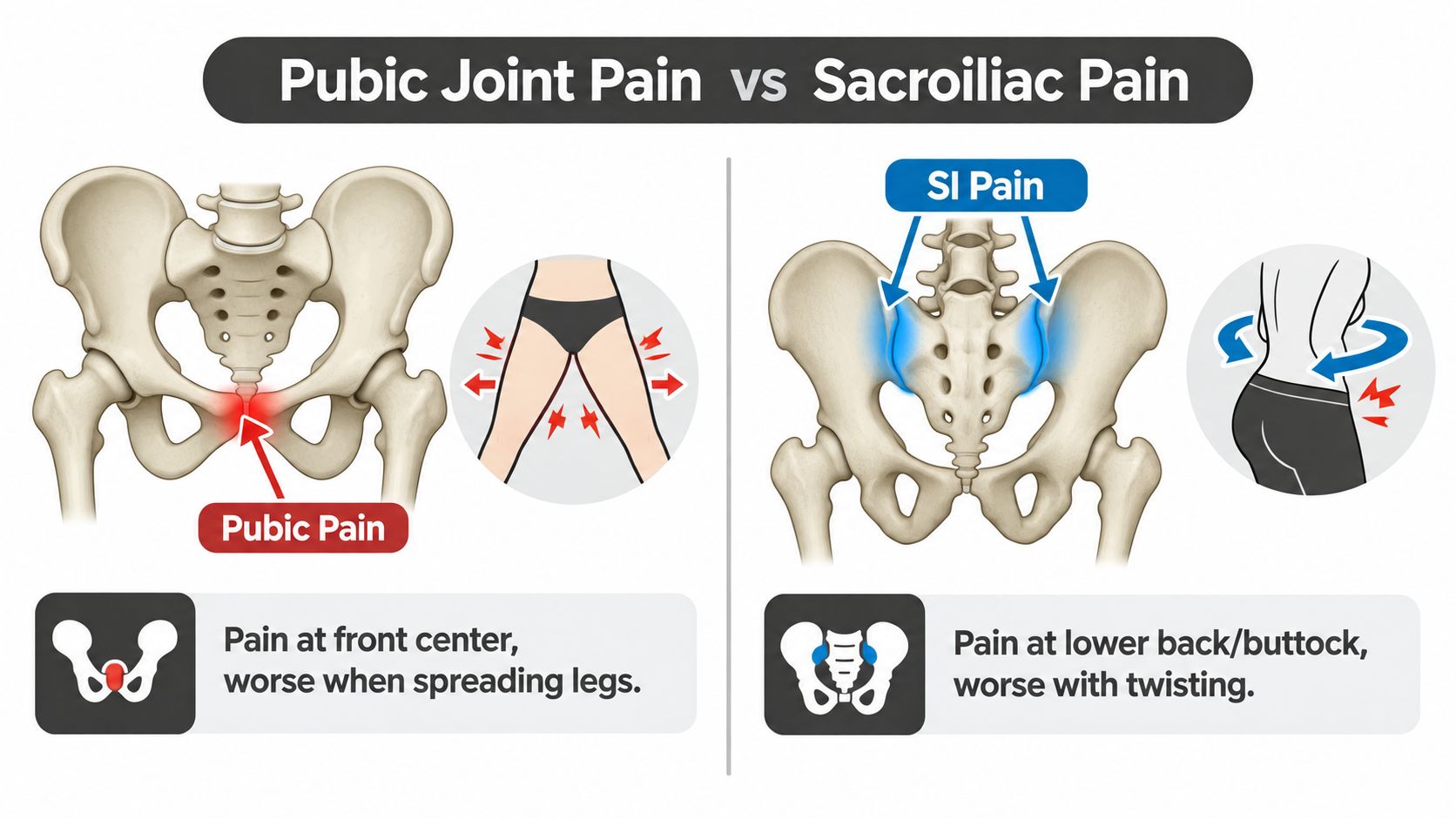
Pubic Joint Pain vs Sacroiliac Pain
Most bad advice starts here. Someone says “pelvic pain” and gives one generic list of stretches or one belt recommendation. But the pubic joint and the sacroiliac joints don't behave the same way, and they don't usually calm down with the same strategy.
Pubic joint pain
Pubic symphysis pain sits at the front center of the pelvis. Women often point with one finger right over the bone. It tends to flare when the legs separate or when one leg moves differently from the other.
Typical triggers include:
- Getting out of the car
- Rolling in bed with knees apart
- Climbing stairs
- Standing on one leg to dress
- Sex positions with hip separation
The sensation is often sharp, catching, burning, or grinding. Some women notice clicking.
Sacroiliac pain
Sacroiliac pain is different. It's usually felt on one side of the low back or deep in one buttock. Sometimes it travels into the back of the thigh, but it usually doesn't behave like true nerve pain running far down the leg.
This pattern often flares with:
- Weight-bearing on one leg
- Walking longer than usual
- Pushing off while climbing stairs
- Turning while carrying something
- Standing asymmetrically
If a patient tells me, “It feels like one butt cheek is bruised from the inside,” I start thinking sacroiliac before pubic.
A quick self-check
A simple way to sort it out:
| Pain pattern | Most likely source | Common trigger |
|---|---|---|
| Front center of pelvis | Pubic symphysis | Leg separation |
| One-sided buttock or low back | Sacroiliac joint | Single-leg loading |
| Both front and back | Mixed pattern | Multiple movement triggers |
If the pain is clearly at the front, treat it like a symmetry problem first. If it's clearly in one buttock, treat it like a load-transfer problem first.
Mixed presentations are common. That's when clinical assessment matters most, because the exercises and support that help one joint can irritate the other if used the wrong way.
Pelvic Stabilization Exercises You Can Start This Week
Exercise for pelvic girdle pain works best when it's specific, controlled, and boring in the best possible way. This is not the time to chase a sweat, heavy resistance, or big ranges of motion. The goal is to improve how the deep core, glutes, and hip stabilizers support the pelvic ring.
The evidence is mixed, but there's a useful pattern. A multicentre trial and review summary on pregnancy-related low back and pelvic girdle pain reported that a face-to-face, supervised, individualized exercise program plus a pelvic belt was associated with lower functional impairment at 1 month postpartum, while a regular group fitness program performed at least twice weekly for 12 weeks did not change the proportion of women reporting pelvic girdle pain during pregnancy or after childbirth. The practical takeaway is simple. A custom exercise plan tends to help function more reliably than generic fitness classes.
A simple starter routine
Do this routine 4 to 5 days per week. Stay in a pain-free range.
Diaphragmatic breathing with gentle pelvic floor support
Lie on your side or sit supported. Breathe into the ribs so they expand in all directions, then add a light pelvic floor lift on the exhale.
Do 2 sets of 10 breaths.Pelvic tilts on hands and knees
Move slowly between a relaxed spine and a gentle tuck. Don't force end range. This should feel like motion, not strain.
Do 2 sets of 10.Side-lying clamshells
Knees bent, heels together, open the top knee only as far as you can without rolling backward or provoking symptoms. Use a band only if it feels easy and calm.
Do 2 sets of 12 per side.Seated glute squeezes or standing isometric hip abduction against a wall
If side-lying work bothers the pelvis, use isometrics instead. In standing, press the outer knee gently into the wall without shifting your trunk.
Do 2 sets of 10-second holds for 8 reps.
What you should feel
You're looking for steady muscular effort, not joint irritation. A good session often leaves the pelvis feeling more supported, not more worked over.
Stop or scale back if you get:
- Pubic clicking
- Sharp groin pain
- Sacroiliac aching that lingers more than an hour afterward
The main mistake
The main mistake is making the exercises too big. Women often do better with small symmetrical work repeated often than with impressive-looking exercise. Endurance matters more than load. Control matters more than stretch.
The best pelvic stabilization exercise is the one you can repeat consistently without paying for it later that night.
Posture, Body Mechanics, and Sleep Positions
If your pelvis hurts, your day matters as much as your treatment. I've seen women do the right exercises and still flare up because the aggravator was how they got out of bed, sat at work, or carried a toddler on one hip all afternoon.
A national clinical guideline from Ireland emphasized conservative care. It advised staying as active as possible within pain limits, avoiding aggravating asymmetrical activities such as carrying toddlers on one hip, using rest strategically, and considering support belts, crutches, or TENS under specialist supervision. It also noted that paracetamol and codeine-based preparations may be used during pregnancy, while NSAIDs should only be used after delivery, as outlined in this Irish clinical guideline on pregnancy-related pelvic girdle pain.
Sleep and getting out of bed
Sleep is often the hardest part because symptoms build through the day and show up at night when you try to turn over.
Use these basics:
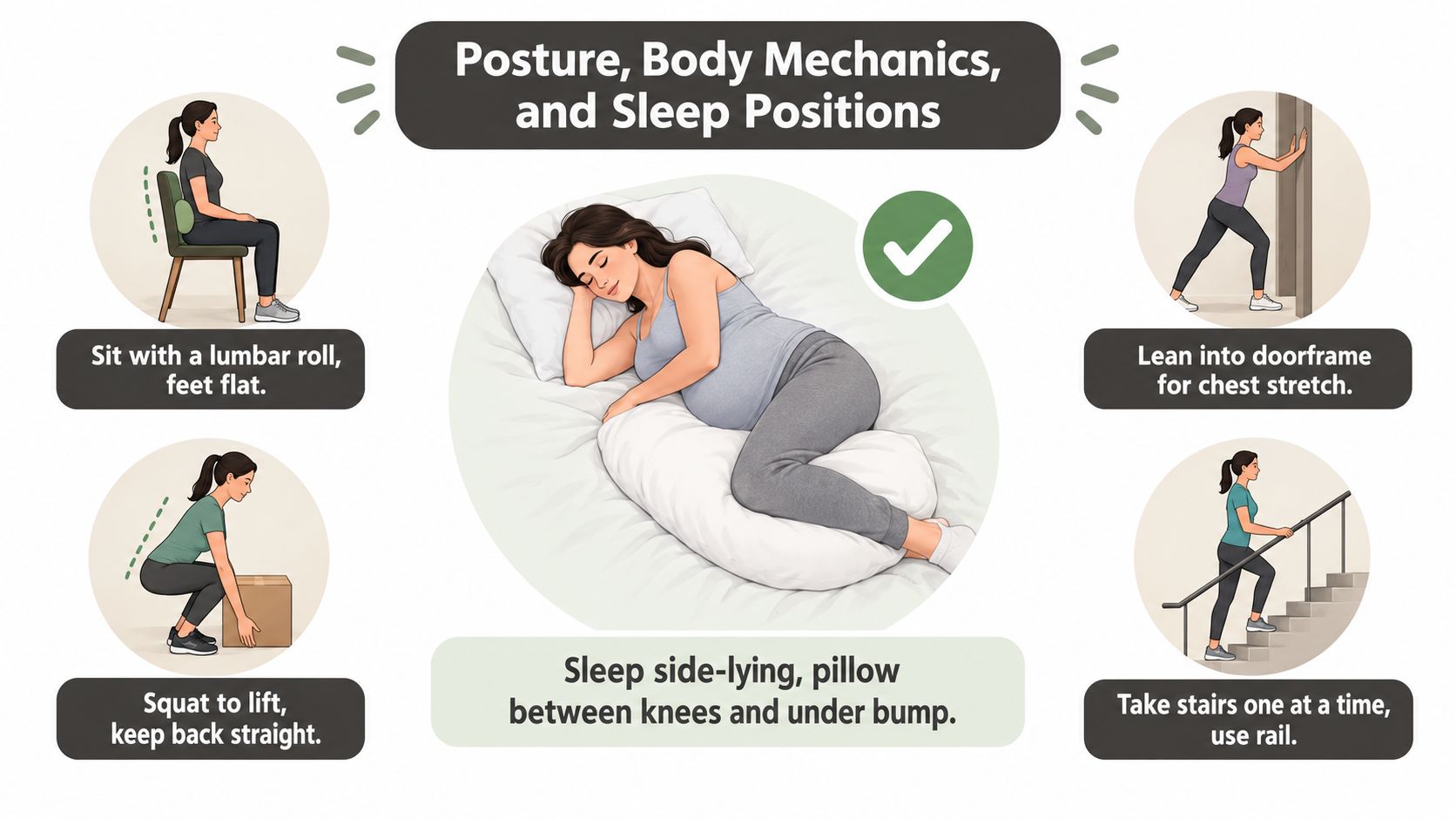
- Side-lying support with a pillow between the knees and another under the bump
- Keep knees together when rolling
- Log-roll out of bed instead of twisting from the waist
- Push up with your arms rather than jerking through the trunk
If turning in bed is your biggest trigger, this one change alone can calm things down.
Desk work, stairs, and lifting
At a desk, set up for symmetry:
- Feet flat
- Hips slightly above the knee crease
- Small lumbar support
- Screen at eye level
- Regular movement breaks
For stairs, avoid launching upward from one painful leg. Shorten the step, use the rail, and let the upper body move forward with you rather than twisting and pushing hard through the pelvis.
Here's a useful visual on day-to-day positioning:
The symmetry rule
If you remember one principle, make it this: symmetry reduces strain.
That means:
- Sit to put on pants
- Carry loads close to center
- Avoid crossing legs
- Don't hang on one hip
- Use shorter walks more often instead of one long walk that wrecks you
The cue that a posture fix is needed is simple. If you catch yourself bracing, shifting off one side, or dreading the next transition, your mechanics need attention.
Pelvic Support Belts and What the Evidence Shows
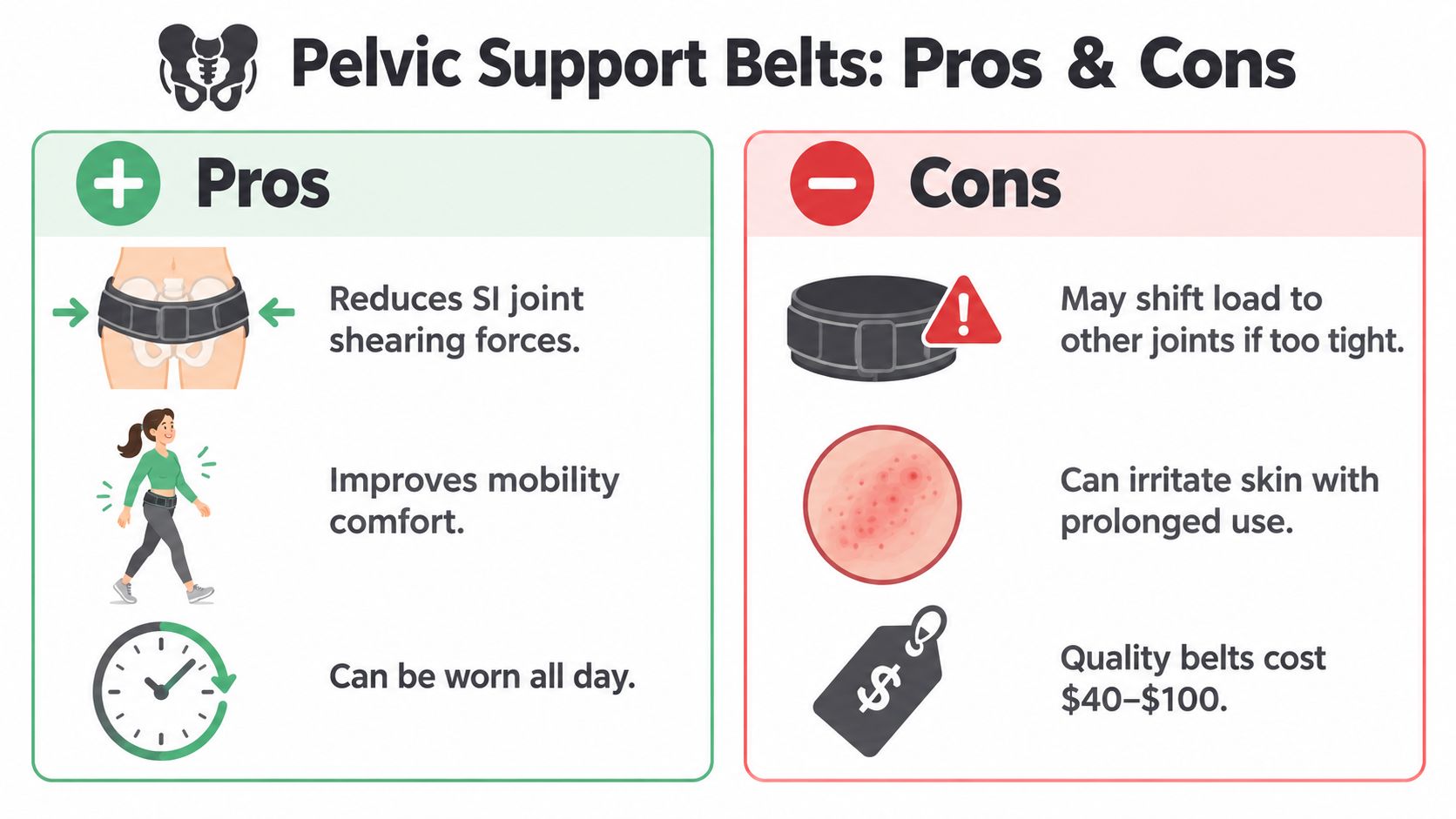
Pelvic support belts can help, but they're not magic. They work best when the issue is load transfer, especially with sacroiliac-driven pain during walking or standing. A rigid or semi-rigid belt worn low around the pelvis can give external compression and reduce the sense that the pelvis is moving too much.
What recent evidence actually says
A 2025 meta-analysis on pelvic belts for pregnancy-related low back and pelvic pain found that belts produced only modest pain reduction and minimal disability improvement, with evidence rated low to very low. That doesn't mean belts are useless. It means they should be presented transparently.
What they can do well:
- Take the edge off walking pain
- Improve comfort during errands or work
- Help some women tolerate activity better
What they usually don't do:
- Resolve pelvic girdle pain on their own
- Fix poor movement patterns
- Replace stabilization work
Positioning matters
A belt should sit low around the pelvis, roughly just above the greater trochanters, not over the bump. It should feel snug, not restrictive. If it rides up, digs in, or makes you brace harder, it's not set correctly.
Pubic joint pain is where trade-offs matter most. Some women with pubic symphysis irritation like gentle compression. Others feel worse because pressure increases irritation at the front. You have to test response, not assume.
If you're considering broader conservative options for spine and joint pain during pregnancy, this overview of non-surgical back pain treatments is a useful next read.
Prenatal Chiropractic Care and the Webster Technique
When pelvic girdle pain isn't settling with self-care alone, prenatal chiropractic care can fit well into a conservative treatment plan. The aim isn't to “put everything back into place.” The useful goal is more practical than that. Improve motion where a joint is restricted, reduce protective muscle guarding, and help the pelvis move more evenly under load.
What a prenatal adjustment targets
With sacroiliac-driven pain, treatment often focuses on the SI joints, surrounding ligaments, glutes, hip rotators, and lumbopelvic mechanics. With pubic pain, the work is usually gentler and more indirect because the front joint often hates aggressive force. The point is to reduce asymmetry, not stir up an already sensitive area.
That's why provider experience matters. A clinician who sees pregnant patients regularly tends to modify force, table setup, positioning, and home advice very differently than someone who doesn't.
Where the Webster Technique fits
The Webster Technique is a chiropractic analysis and adjustment approach used in pregnancy with the goal of reducing sacral dysfunction and balancing the muscles and ligaments that influence the pelvis. In practice, it's often used when there's pelvic imbalance, sacroiliac pain, tension through the round ligaments, or concern about making the pelvis function as well as possible for labor.
Evidence for Webster specifically is still mostly practitioner-reported and case-series based rather than built on large randomized trials. That's worth saying plainly. Clinically, though, many women prefer it because it fits the larger principle that pregnancy pelvic pain usually responds best to conservative, movement-oriented care rather than a medication-heavy approach.
How to vet a provider
Look for a chiropractor who has:
- Webster Certification through the ICPA
- Regular experience treating pregnant patients
- Pregnancy-specific tables or cushioning
- A plan that includes home care, not just adjustments
One local option is different types of chiropractic care, including prenatal care and the Webster Technique, when pelvic biomechanics and pregnancy-related pain are part of the picture.
A good prenatal chiropractor should be able to tell you what they think is driving your pain, what they plan to treat, and what you should do at home to keep the gains.
When to Seek Clinical Care and Your Next Step
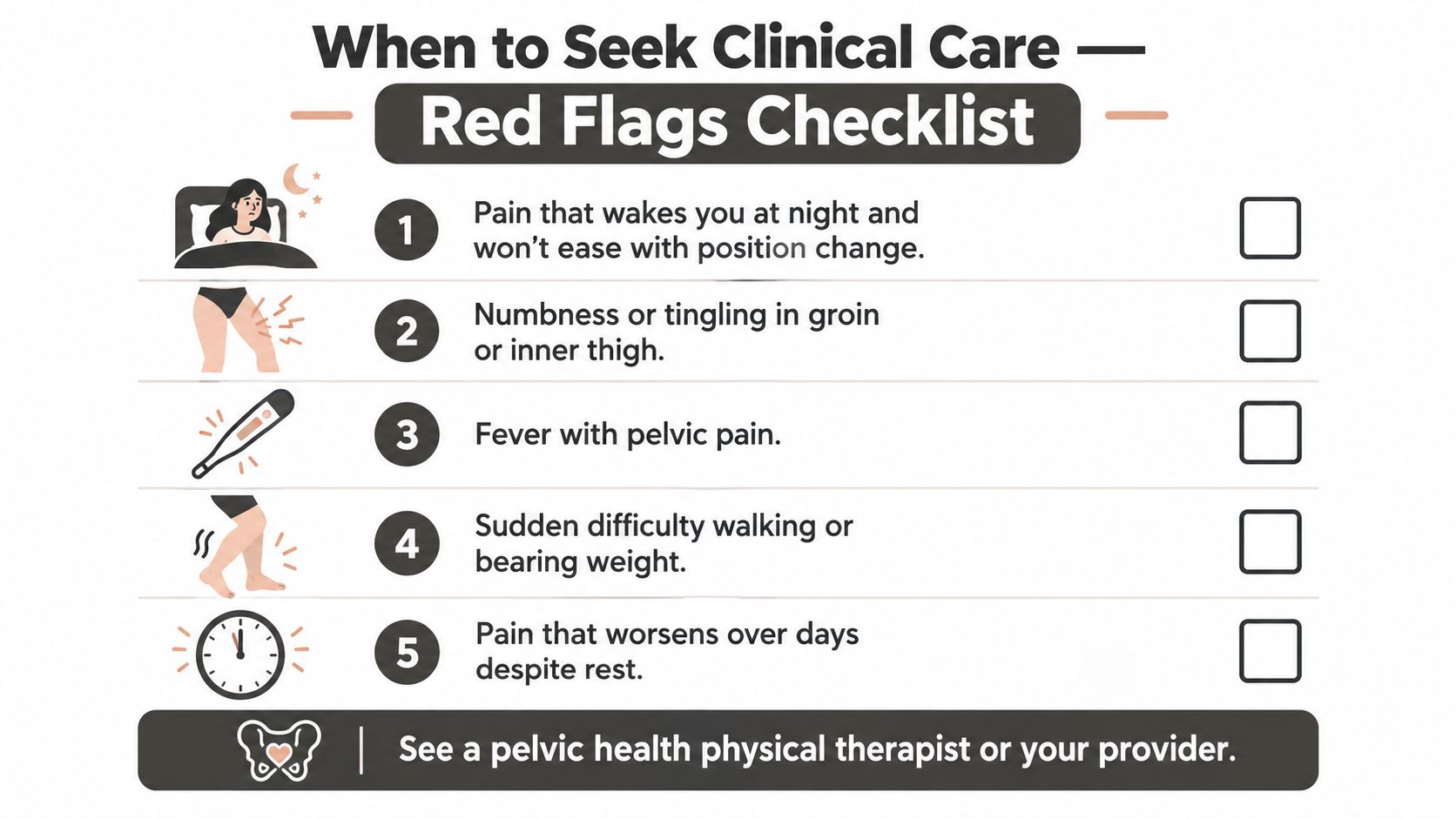
Most pelvic girdle pain can be managed conservatively, but some symptoms deserve prompt evaluation. If pain is changing how you function in a major way, or if the symptom pattern doesn't fit ordinary mechanical pelvic pain, don't wait it out.
Red flags that need assessment
Contact your provider promptly if you have:
- Pain that wakes you at night and doesn't ease with position changes
- Numbness or tingling in the groin or inner thigh
- Difficulty bearing weight on either leg
- Sudden swelling or visible asymmetry at the pubic bone
- Bladder or bowel changes
- Fever with pelvic pain
These symptoms deserve a closer look because they can point beyond routine pregnancy-related joint irritation.
Who to call first
A simple care ladder works well:
| Situation | Best first step |
|---|---|
| New pelvic pain, unsure what it is | OB or midwife |
| Ongoing mechanical pain with movement triggers | Pelvic health physical therapist |
| Joint-focused pain with asymmetry and mobility restriction | Prenatal chiropractor or pelvic PT |
| Severe or progressive symptoms, neurologic signs, inability to walk | Urgent medical evaluation and specialist input |
If you're not sure where to start, your OB or midwife is usually the cleanest entry point. They can help rule out non-musculoskeletal concerns and direct you to the right conservative provider.
Screenshot checklist for tonight
- Notice the location. Front center usually behaves differently than one-sided buttock pain.
- Change one sleeping variable. Put a pillow between the knees and keep the knees together during turns.
- Stop provoking single-leg tasks. Sit to dress and avoid standing on one leg.
- Write down your triggers. Bring a short list of movements that worsen symptoms to your appointment.
- Seek help sooner if walking, sleep, or basic function is falling off
Pelvic girdle pain pregnancy relief usually comes from the right combination of movement changes, targeted exercise, and the right kind of hands-on care. The faster you identify the pattern, the less time you spend guessing.
If pelvic girdle pain is making it hard to walk, sleep, or enjoy your pregnancy, First Steps Chiropractic offers prenatal chiropractic care, including Webster Technique, along with pregnancy-specific assessment and conservative support for pelvic biomechanics. If you want help figuring out whether your pain is more pubic-joint or sacroiliac-driven, visit First Steps Chiropractic to learn more or schedule a consultation.