
You're in the checkout line, your cart is half full, and your child suddenly falls apart. The lights feel too bright. The beeping scanner is too loud. A shirt tag that was “fine” in the car is now unbearable. Other people may see a tantrum. You're seeing something else. A child who looks overwhelmed in a way that seems bigger than the moment.
Or maybe your child isn't melting down at all. Maybe they're the one who never notices when their hands are sticky, crashes into the couch for fun, chews every pencil, or seems unable to sit still unless their body is moving. That can feel just as confusing. Parents often tell me, “I can't tell if this is behavior, anxiety, attention, or something sensory.”
If that's where you are, you're not overreacting and you're not alone. Sensory processing differences can change how a child experiences ordinary life, from getting dressed to riding in the car to walking into school. When you understand what the nervous system is doing, many of those puzzling behaviors start to make sense. And once they make sense, you can support your child with more confidence and less guesswork.
A Parent's Introduction to Sensory Worlds
A birthday party can be a perfect example.
One child runs straight toward the balloons, music, and games. Another child freezes at the doorway, buries their face in a parent's shirt, and refuses to go in. A third child races around the room, bumps into kids by accident, grabs frosting with both hands, and seems more wound up with every passing minute.
Those children may all be reacting to the same room. They're just not experiencing it in the same way.
That's often what parents notice first. Not a diagnosis. Not a textbook definition. Just a pattern that keeps repeating. Socks become a battle. Hair washing feels impossible. The blender sends your child into panic. Or your child seems to crave movement every waking hour and can't settle unless they're jumping, spinning, pushing, or chewing.
Sensory struggles often look like behavior problems from the outside, but from the child's point of view they can feel more like survival responses.
When I talk with concerned parents, I don't start by asking, “What label fits?” I start by asking, “What does your child do when the world feels too loud, too fast, too bright, too scratchy, or not stimulating enough?” That question usually opens the door.
Sensory processing differences are a helpful lens. They let us see a child's reactions as meaningful messages from the nervous system rather than willful misbehavior. That shift matters. It helps parents move from frustration to curiosity, and from curiosity to practical support.
Your child isn't trying to make daily life hard. More often, their nervous system is working overtime to sort, filter, and respond to sensory information.
What Are Sensory Processing Differences Really
Think of the brain and nervous system as an air traffic control tower. Sensory information is constantly arriving from every direction. Sound, light, touch, movement, body position, hunger, temperature. The control tower has to sort what matters, organize it, and direct an appropriate response.
When that process works smoothly, a child can ignore the hum of the refrigerator, notice their shoe feels tight, stay upright in a chair, and respond calmly when someone calls their name. When it doesn't, everyday sensations can feel jumbled, too intense, too faint, or hard to interpret.

These differences aren't rare. Epidemiological studies suggest sensory-processing-related symptoms affect 5% to 16.5% of children in the general population, and one U.S. parent survey found 13.7% of 703 returned kindergarten surveys met cutpoint criteria, with a conservative estimate of 5.3% in that same cohort, as summarized in this population overview of sensory-processing-related symptoms.
The eight senses, not just five
Most of us learned about five senses. Children rely on more than that.
- Sight helps a child manage light, movement, patterns, and visual clutter.
- Hearing takes in speech, background noise, alarms, music, and sudden sounds.
- Touch includes texture, pressure, pain, temperature, and physical contact.
- Taste affects food preferences, chewing, and tolerance for flavors.
- Smell can strongly influence comfort, appetite, and alertness.
- Vestibular sense is the balance and movement system. It helps with head position, motion, and spatial orientation.
- Proprioception is body awareness. It tells the brain where the body is and how much force to use.
- Interoception is the internal sense. It helps a child notice hunger, thirst, bathroom needs, pain, or a racing heart.
Why parents get confused
A child can be highly sensitive in one area and under-responsive in another. That's why sensory patterns can look inconsistent.
Your child might:
- Cover their ears at the sound of a hand dryer
- Not notice pain after bumping a knee
- Refuse jeans because the seams feel awful
- Seek rough play and constant movement
- Miss hunger cues until they suddenly melt down
That doesn't mean the child is being oppositional or dramatic. It means the nervous system may be processing incoming information unevenly.
Practical rule: If a reaction seems out of proportion, ask whether the sensation itself may feel out of proportion to your child.
The Three Key Patterns of Sensory Responses
Clinically, one of the most useful ways to understand sensory processing differences is the three-pattern model. It includes sensory modulation, sensory discrimination, and sensory-based motor differences, which helps explain why one child can be overresponsive in one sensory channel and underresponsive in another, as outlined by this overview of sensory patterns and subtypes.

Sensory modulation
This is about the brain's “volume dial” for sensation. It affects how strongly the nervous system amplifies or dampens input.
A child with modulation differences may be:
- Hyperresponsive. Sensory input feels too big, too fast, or too intense. They may cover their ears, avoid messy play, resist grooming, or become distressed in busy spaces.
- Hyporesponsive. Sensory input doesn't register strongly enough. They may seem slow to notice name-calling, pain, temperature, or social cues.
- Sensory seeking. They actively look for stronger input by spinning, crashing, chewing, squeezing, humming, or moving nonstop.
Parents often say, “My child is sensitive to everything.” Or the opposite. “My child doesn't seem to notice anything unless it's extreme.”
Sensory discrimination
Discrimination is about detail. The brain needs to tell one sensation from another accurately.
A child with discrimination challenges may struggle to:
- Tell where they were touched without looking
- Use the right amount of force when writing or opening a container
- Hear subtle sound differences in speech
- Find an object in a backpack by touch alone
- Judge where their body is in relation to a chair, stair, or doorway
This pattern can look like clumsiness, poor handwriting, or “not paying attention,” when the problem is that the sensory message isn't clear enough.
Sensory-based motor differences
This pattern affects posture, balance, coordination, and motor planning. The child may know what they want to do but struggle to organize the body to do it smoothly.
Common examples include:
- Poor balance on uneven surfaces
- Difficulty learning new movement sequences
- Awkward posture at the table or on the floor
- Challenges with fine motor tasks like buttons, scissors, or pencil control
- Trouble planning body movements for playground games or sports
A useful way to think about it is this. Modulation affects the intensity of the message. Discrimination affects the clarity of the message. Motor differences affect what the body does with the message.
Common Sensory Signs from Infancy to Childhood
Many parents don't notice a “big sensory issue” all at once. They notice a trail of small moments that don't seem connected until someone points out the pattern.

Infants and toddlers
In the earliest years, sensory differences often show up through feeding, sleep, movement, and comfort.
You might notice:
- Touch sensitivity that shows up as distress with certain fabrics, diaper changes, face wiping, nail trimming, or bathing
- Movement sensitivity in a baby who dislikes swings, car rides, being tipped backward, or quick position changes
- Movement seeking in a toddler who constantly rocks, spins, climbs, or wants to be bounced
- Feeding challenges such as gagging on textures, rejecting lumpy foods, or eating only a narrow range of foods
- Body awareness difficulties that make a child seem floppy, awkward, or less coordinated than expected
- Regulation struggles including short naps, difficulty settling, or becoming overwhelmed in noisy places
Sometimes parents describe this stage as, “My baby was either always on high alert or impossible to read.”
Preschoolers
By preschool age, the sensory world expands. Group settings, art projects, playgrounds, sound, transitions, and clothing all place more demands on the nervous system.
Common signs include:
- Sound sensitivity with vacuum cleaners, toilets flushing, hand dryers, music class, or crowded rooms
- Clothing battles over socks, tags, underwear seams, shoes, jackets, or hair brushing
- Messy play avoidance with glue, paint, shaving cream, sand, grass, or sticky foods
- Constant motion such as jumping off furniture, running in circles, crashing into cushions, or spinning
- Chewing behaviors like biting shirt collars, toys, pencils, or fingers
- Big reactions to transitions because the child is already using so much energy to regulate sensory input
- Toileting delays or accidents if interoceptive cues like bladder fullness aren't noticed clearly
- Difficulty with body boundaries such as standing too close, pushing too hard, or knocking things over
Some children don't avoid sensation. They chase it. That child who never stops moving may be trying to feel organized, not trying to be disruptive.
School-aged children
School can magnify sensory needs because children are expected to sit still, filter noise, manage clothing, tolerate cafeteria smells, move through crowds, and keep their bodies organized for learning.
Look for patterns like these:
- Distractibility in busy classrooms where background sound or visual clutter pulls attention away
- Fidgeting and postural collapse during seated work
- Handwriting fatigue or pressing too hard or too lightly on the pencil
- Avoidance of sports or playground games because movement feels unpredictable or hard to plan
- Strong reactions after school when a child has held it together all day and finally crashes at home
- Food selectivity tied to texture, temperature, smell, or mixed foods touching
- Difficulty recognizing internal cues like hunger, thirst, or the need for a bathroom break
- Social misunderstandings when sensory overload, body-space problems, or poor motor planning affect peer interactions
A quick way to observe at home
If you're trying to make sense of your child's patterns, track three things for a week:
- What happened first. Noise, touch, movement, hunger, transition, fatigue.
- What your child did next. Covered ears, ran away, chewed, crashed, froze, argued.
- What helped. Quiet space, deep pressure, snack, movement break, dim light, predictable routine.
That kind of simple observation often reveals more than memory alone.
The Neurological Link to Sensory Challenges
Sensory processing is not just a behavior issue. It's a nervous system task.
The brain has to receive sensory input, filter it, prioritize it, connect it to past experience, and direct a response through the body. If that system is under stress or poorly regulated, sensory information can feel chaotic. A child may become overloaded quickly, miss important cues, or swing between shutdown and seeking.
Researchers have also linked sensory differences to underlying neurological mechanisms. A review on sensory features in autism describes altered neural pathways, sensory gating dysfunction, atypical sensory modulation, and an increased excitatory-to-inhibitory ratio as one proposed mechanism involved in sensory and related neurodevelopmental differences, as discussed in this research review on sensory abnormalities in autism.
Why behavior is often the last thing we see
Parents usually see the output, not the process.
The output might be:
- Meltdowns
- Avoidance
- Impulsivity
- Freezing
- Clumsiness
- Fatigue after school
But underneath that output, the nervous system may be struggling to regulate incoming information.
This is one reason many families find it helpful to learn about nervous system regulation. It gives a more accurate framework than “good behavior” versus “bad behavior.” A regulated child can usually access coping skills. A dysregulated child often can't.
Sensory differences and autism
Sensory differences are especially common in autism. A 2022 CDC-linked study of 25,627 autistic children found that 74.0% had documented sensory features, including 70.1% at age 4 and 74.5% at age 8, which helped establish sensory differences as a core characteristic in large-scale surveillance data rather than only small clinical samples, according to this CDC-linked surveillance study on sensory features in autism.
That doesn't mean sensory differences only occur in autism. They can also appear alongside other developmental and emotional challenges, or on their own as a meaningful part of a child's daily experience.
When a child's sensory world feels unpredictable, their body often responds with protection first and learning second.
Creating a Sensory-Friendly Home Environment
Home doesn't need to be a therapy clinic. It needs to feel manageable, predictable, and safe for your child's nervous system.

Small changes often help more than dramatic ones. The goal isn't to remove every challenge. It's to reduce unnecessary overload and give your child better tools for regulation.
Build one calm space
Choose one part of the home that feels quieter and simpler.
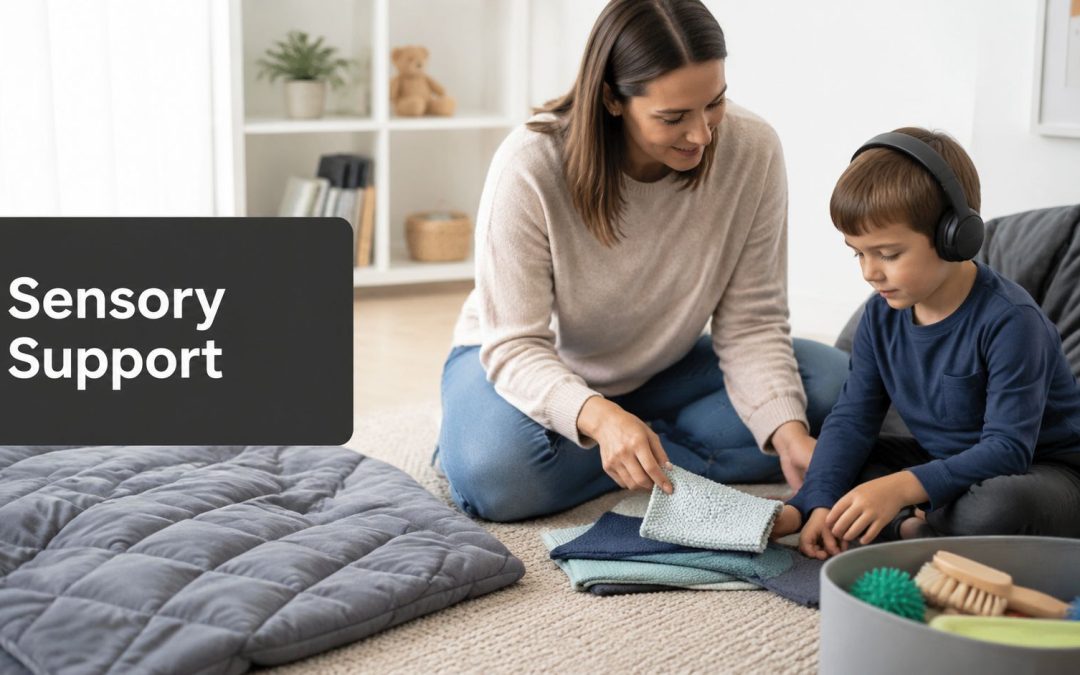
That space might include:
- Soft lighting instead of harsh overhead bulbs
- A bean bag or floor cushion for body support
- Noise-canceling headphones for sound-sensitive moments
- A few favorite fidgets rather than a huge toy pile
- A weighted lap pad or heavy blanket if your child enjoys deep pressure
- A visual cue like a picture card that means “break” or “quiet time”
This isn't a punishment spot. It's a retreat.
Support the body before behavior falls apart
Many children do better when sensory input is proactive instead of reactive. Some families call this a sensory routine or sensory diet. If you want ideas, First Steps Chiropractic has a practical guide on activities for sensory processing disorder.
Useful inputs often include:
- Heavy work like carrying groceries, pushing a laundry basket, wall pushes, or helping move cushions
- Movement breaks with jumping, animal walks, swinging, scooter boards, or short obstacle courses
- Oral input such as crunchy foods, chewy snacks, or water through a straw
- Deep pressure through snug blankets, couch cushions, or firm hugs if your child likes them
- Predictable transition cues like timers, songs, or visual schedules
A short video can help you think through simple home supports in a real-world way.
Reduce friction in daily routines
Some of the best strategies are boring. That's a good thing. Boring usually means sustainable.
Try adjusting routines like this:
| Daily challenge | Helpful home adjustment |
|---|---|
| Getting dressed | Offer two tolerated outfit choices and remove tags when possible |
| Morning rush | Use a picture schedule so fewer verbal directions pile up |
| Homework time | Add a wiggle cushion, foot support, or movement break before sitting |
| Meals | Keep one familiar food on the plate and avoid forcing textures |
| After school crashes | Protect a decompression window before errands or demands |
A child who seems “fine” at school may spend the whole day compensating. Home is often where the nervous system finally lets go.
When to Seek Professional Guidance
Some sensory challenges improve with home changes alone. Others keep interfering with school, sleep, mealtimes, play, safety, or family life. That's when a fuller evaluation can help.
Signs it's time to ask for support
Consider professional guidance when your child's sensory patterns:
- Disrupt daily routines like dressing, eating, bathing, riding in the car, or sleeping
- Cause distress that seems frequent, intense, or hard to recover from
- Affect learning through attention, sitting tolerance, handwriting, or classroom participation
- Impact relationships with siblings, peers, teachers, or caregivers
- Create safety concerns such as running off, not noticing pain, or missing important cues
Who can help
An occupational therapist, especially one with training in sensory integration, is often the lead professional for evaluating sensory patterns and building practical supports. They can help identify triggers, match strategies to the right sensory system, and guide home and school accommodations.
Some families also look at broader nervous system support. A neurologically-focused pediatric chiropractor may assess how tension, dysregulation, and stress patterns in the nervous system affect a child's ability to settle and process input. First Steps Chiropractic describes this approach in its article on sensory processing disorder therapy.
You don't have to choose between understanding behavior and supporting biology. The most helpful care plans usually respect both.
What to bring to an appointment
Bring concrete examples, not just general worry.
Helpful notes include:
- Specific triggers
- What your child does
- How long recovery takes
- What helps
- Where it happens most, such as home, school, stores, church, or the car
That information gives a professional a much clearer picture than “my child is sensitive.”
Frequently Asked Questions About Sensory Processing
Is SPD an official diagnosis
The terminology can be confusing. Many parents and professionals use the terms sensory processing disorder, sensory issues, or sensory processing differences in everyday conversation. In practice, what matters most is whether a child is having real functional difficulty.
Some clinicians prefer the phrase sensory processing differences because it describes the lived experience without getting stuck on labeling debates. If your child struggles with clothing, noise, movement, feeding, body awareness, or regulation, those challenges are still worth addressing.
Can a child outgrow sensory processing differences
Some children become much more comfortable over time. Their nervous system matures, they learn coping tools, and adults around them get better at matching environments to their needs. But “outgrow” can be misleading.
Often, what changes is not that the sensory system becomes ordinary overnight. What changes is that the child develops better regulation, stronger body awareness, improved communication, and more effective supports. A child who once melted down over socks may later learn exactly which fabrics work, how to prepare for busy places, and when to ask for a break.
Do adults have sensory processing differences
Yes. Sensory processing differences can persist into adulthood, and clinical research highlights ongoing effects on school, work, driving, and relationships, as summarized in this review of sensory processing in adults.
Adults may describe it differently than children do. Instead of saying, “The cafeteria is too loud,” they might say, “I can't think in open offices.” Instead of refusing clothes, they may become very particular about fabric, fit, or shoes. Some parents recognize these patterns in themselves while learning about their child, which can be both surprising and validating.
Does sensory behavior always mean autism
No. Sensory differences are very common in autism, but they are not limited to autism. A child can have meaningful sensory challenges without being autistic. That's one reason good assessment matters. It helps sort out the full picture rather than assuming one explanation for every child.
What should I do first if I feel overwhelmed
Start small. Pick one recurring problem, such as dressing, bedtime, car rides, or after-school meltdowns. Observe the trigger, adjust the environment, and test one support at a time. Parents often feel less overwhelmed once they stop trying to fix everything at once.
If your child's reactions to sound, touch, movement, or daily routines seem bigger than they should, it may help to look through a nervous system lens. First Steps Chiropractic provides pediatric and family care focused on neuro-tonal health and nervous system function, along with educational resources for parents navigating sensory processing differences. A thoughtful next step is to schedule a conversation, share what you're seeing, and find out whether that kind of support belongs in your child's care plan.