
You're watching your child play on the floor. Maybe they're stacking blocks, maybe they're wobbling through a few steps, maybe they're babbling happily and then suddenly melting down when a sound or change feels too big. Part of you feels proud. Another part wonders, “Is this on track?”
That mix of joy and concern is common. Parents notice things long before they have words for them.
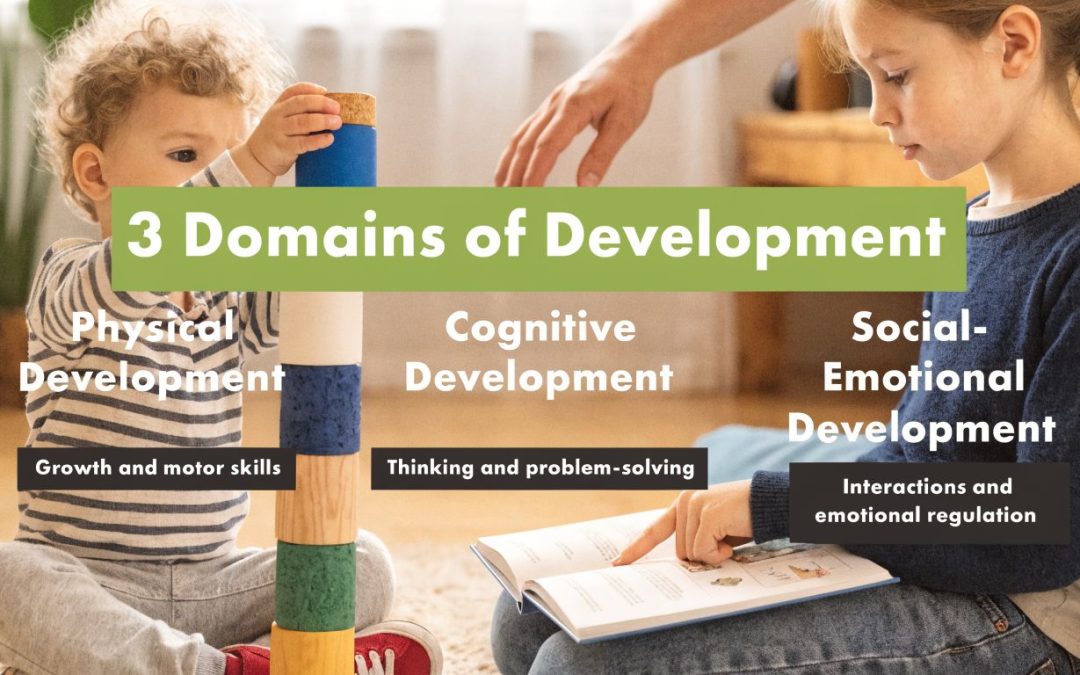
The 3 domains of development give you a simple way to understand what you're seeing. They help you look at growth through three big lenses: how your child moves, how your child thinks and learns, and how your child relates to people and emotions. That framework is useful, but it can also be misleading if we treat each area like a separate box.
A child who struggles with movement may also have trouble with attention. A child who seems delayed socially may also be overwhelmed by sensory input. Existing developmental content often misses this overlap, even though challenges with social interaction, language processing, and motor coordination can reflect a shared neurological root such as sensory processing issues, as discussed in the NCBI overview of developmental concerns.
As an educator, I want parents to have a map that feels clear, not scary. I also want that map to point to the foundation underneath all three domains: the nervous system. When the brain and body communicate well, development has stronger support. When that communication is strained, delays can show up in more than one area at once.
Your Child's Journey Through the 3 Domains of Development
Most parents don't start with the phrase “developmental domains.” They start with everyday moments. Your baby doesn't like tummy time. Your toddler falls more than expected. Your preschooler knows so much but can't seem to handle group play or transitions.
Those moments matter because development rarely unfolds in neat lines. Skills overlap. A child learning to balance also builds confidence. A child learning to point and label objects is growing communication and thinking at the same time. A child who avoids noise, touch, or movement may look “behind” in several ways when the deeper issue is how their nervous system is processing the world.
Why three domains help
Thinking in three domains keeps you from focusing too narrowly on one milestone. It helps you ask better questions:
- Physical growth: Is my child using their body smoothly and comfortably?
- Cognitive growth: Is my child learning, remembering, exploring, and communicating?
- Social-emotional growth: Is my child connecting, regulating, and responding to others?
That broader view often brings relief. It reminds parents that one skill never tells the whole story.
Practical rule: If something feels off in more than one area, look for patterns instead of judging each concern in isolation.
Why the nervous system matters
The nervous system is the common thread running through every milestone your child reaches. It coordinates movement, helps process sensory input, supports attention, and shapes how a child reacts to stress, novelty, and connection. So while we observe three domains, the body is working from one central communication network.
That's why a developmental concern isn't always just about a missing skill. Sometimes it's about the foundation that supports the skill.
Understanding the Three Interconnected Domains
A simple way to picture the 3 domains of development is a three-legged stool. Each leg supports the whole child. If one leg is weak or unstable, the stool can still stand for a while, but it won't feel steady.

If you want a broader definition of how professionals use the term, this overview of a developmental domain in child growth can help.
Physical domain
The physical domain includes large body movements and small hand movements. Parents usually notice gross motor skills first. Rolling, crawling, standing, walking, climbing. But fine motor skills matter just as much. Picking up a snack, turning pages, holding a crayon, stacking blocks, buttoning clothes.
Physical development is not just about strength. It's also about coordination, body awareness, balance, timing, and the brain's ability to organize movement.
A child might run across the room with ease but struggle to use scissors. Another child may avoid swings, stumble often, or seem floppy and tired during play. Those details help us understand how the nervous system is managing movement and sensory input.
Cognitive domain
The cognitive domain includes learning, memory, attention, problem-solving, and language. It's how children take in information and make sense of it.
This domain shows up in ordinary routines:
- Cause and effect: Dropping a spoon and waiting for you to pick it up
- Problem-solving: Turning a puzzle piece until it fits
- Memory: Knowing where a favorite toy is kept
- Language: Understanding simple directions or using words to ask for help
The cognitive domain also includes curiosity. A child who experiments, imitates, and explores is building this leg of the stool every day.
Social-emotional domain
The social-emotional domain covers connection, emotional regulation, empathy, self-awareness, and how a child responds to other people. This includes eye contact, shared smiles, turn-taking, coping with frustration, and gradually learning that other people have feelings too.
Some children are naturally cautious. Others are highly social. Temperament varies. What matters most is whether a child is slowly building the ability to connect and recover.
Why the domains affect each other
All domains of development are interconnected and mutually reinforcing, as described by NAEYC's principles of development and learning. A child using blocks isn't just practicing hand control. They're solving problems, noticing shapes, and often learning to share space with someone else.
| Domain | What parents often notice | What it also affects |
|---|---|---|
| Physical | Walking, grasping, climbing | Confidence, play, early writing readiness |
| Cognitive | Following directions, naming objects, solving simple problems | Communication, independence, learning routines |
| Social-emotional | Sharing, calming down, connecting with others | Attention, participation, resilience |
A wobble in one leg can affect the others. Support in one area can help all three.
A Guide to Developmental Milestones by Age
Milestones are best used as guideposts, not as a scorecard. Children develop at different rates, and many move forward in bursts. What helps is knowing what kinds of skills tend to emerge as the nervous system matures.

If you want a closer look at movement-based skills, this guide to motor development skills in children is a helpful companion.
Infants from birth through the first year
In the earliest stage of life, babies learn through their senses and movement. During the sensorimotor period, children build understanding by interacting with the world around them and gradually develop object permanence, which means learning that things still exist even when they can't be seen.
Physical examples
- Lifting the head during tummy time
- Reaching toward a toy
- Rolling, sitting, crawling, or beginning to pull up
- Bringing hands together or transferring an object from one hand to the other
Cognitive examples
- Turning toward a familiar voice
- Watching a dropped toy
- Exploring objects by mouthing, shaking, or banging
- Beginning to search for something that disappeared from view
Social-emotional examples
- Smiling in response to people
- Calming with a familiar caregiver
- Showing interest in faces
- Babbling back during interaction
Toddlers in the early years
Toddler development often feels uneven because so many systems are growing at once. You may see a big leap in movement followed by a quieter season in language, or the opposite.
Physical examples
- Walking, then running, climbing, and squatting during play
- Feeding with fingers and later with utensils
- Turning pages, stacking objects, scribbling
- Beginning to help with dressing
Cognitive examples
- Following simple directions and later short multi-step routines
- Matching shapes, sorting objects, and noticing patterns
- Using words, gestures, or sounds to ask for things
- Engaging in simple pretend play
Social-emotional examples
- Showing strong preferences
- Seeking comfort when upset
- Beginning turn-taking with support
- Testing independence while still checking back with a caregiver
A toddler can look “all over the place” developmentally and still be following a meaningful pattern. What matters is steady growth, not perfect symmetry.
Preschoolers through age five
These years bring more coordination, more language, and more social complexity. Children become better at imagining, planning, and participating in group routines.
Physical examples
- Jumping, balancing, climbing, dancing
- Using crayons, child-safe scissors, and simple tools
- Building with more control
- Managing some self-care tasks with help
Cognitive examples
- Telling parts of a story
- Asking many “why” questions
- Solving simple problems during play
- Remembering routines and anticipating what comes next
Social-emotional examples
- Playing beside others and gradually with others
- Naming basic feelings
- Taking turns with guidance
- Beginning to notice fairness, kindness, and the feelings of peers
Recognizing Common Developmental Red Flags
A red flag isn't a label. It's a sign that your child may need more support, a closer look, or a different kind of help. Parents often feel pressure to either panic or dismiss concerns. Neither response is useful.
The better approach is to look for patterns.

The first five years are the most critical period for brain development, and according to the AAP and CDC, a sequential failure to meet milestones that 75 percent of peers consistently perform is considered a red flag for developmental delays, which is why early attention matters so much, as summarized in this developmental milestones overview.
What red flags can look like
Here are examples that deserve closer attention when they persist or cluster together.
- Physical concerns: Frequent falling, strong dislike of movement, marked stiffness or floppiness, difficulty using hands for everyday play, avoiding tasks that require coordination
- Cognitive concerns: Trouble following simple directions, limited problem-solving during play, difficulty attending even briefly, little interest in cause-and-effect exploration
- Social-emotional concerns: Rare back-and-forth interaction, trouble settling even with support, strong reactions to everyday sensory input, limited interest in shared play over time
When to look beyond a single skill
One missed milestone by itself doesn't always mean a delay. A child may be tired, cautious, focused on another area, or moving at their own pace.
Concern rises when you notice things like:
- A repeated pattern: the same challenge shows up across weeks or months
- More than one domain affected: movement, communication, and regulation all seem hard at the same time
- Loss of a skill: a child stops doing something they used to do comfortably
Trust what you're seeing. You don't need to wait until concerns become dramatic before asking questions.
Actionable Strategies to Support Your Child's Growth
Parents often ask what they can do at home right now. The good news is that support doesn't have to be complicated. The most effective tools are usually simple, relational, and repeated often.

Support the physical domain through play
Children build motor skills best when movement feels fun, not forced.
- Create a mini obstacle path: Use pillows, couch cushions, and tape lines on the floor for crawling, stepping, and balancing.
- Offer hand-building activities: Play-Doh, stickers, chunky crayons, stacking cups, and clothespins all strengthen small muscles.
- Use rhythm and repetition: Clapping games, marching, and simple dance routines help the brain organize movement.
If your child avoids movement or gets overwhelmed quickly, make activities shorter and more predictable.
Support the cognitive domain in daily routines
Learning grows during ordinary moments. Bath time, snack time, cleanup, and neighborhood walks all build thinking skills.
Try these:
- Narrate what's happening: “You found the red cup.” “The block fell down.” This builds language and attention.
- Pause during reading: Let your child point, label, or finish a familiar phrase.
- Play simple problem-solving games: Sorting socks, matching lids, hiding a toy under a blanket, or building a tower and fixing it when it falls
A short visual example can spark new ideas at home.
Support the social-emotional domain with connection
Regulation grows inside relationships. Before a child can manage big feelings alone, they borrow calm from you.
- Name feelings clearly: “You're frustrated.” “That sound felt too loud.”
- Practice turn-taking in play: Roll a ball, take turns placing blocks, or play basic back-and-forth games.
- Build predictable routines: Repeated rhythms help the nervous system feel safer and more organized
Keep support whole-child, not siloed
One activity can help all three domains at once. Building a block tower supports hand control, problem-solving, and shared attention. A kitchen helper task supports sequencing, movement, and confidence. Outdoor play can support balance, curiosity, and emotional release.
That's the key. You don't need separate programs for every concern. You need experiences that help your child feel organized, engaged, and connected.
The Nervous System Your Child's Developmental Foundation
Think of the nervous system as your child's master operating system. The skills you can see, such as walking, talking, focusing, and calming down, are like apps on a screen. The nervous system is the system running underneath them.
When the brain receives information from the body clearly and sends instructions back efficiently, development has a steadier platform. Movement becomes easier to coordinate. Sensory input becomes easier to process. Attention and emotional regulation have more support.
How this shows up in real life
A baby reaching for a toy is using sensory input, muscle activation, balance, and attention all at once. A preschooler listening to a story and then answering a question is using hearing, memory, language, and self-regulation. None of those tasks happen in isolation.
The early years matter because the brain is wiring itself rapidly during this time. Experiences, movement, touch, stress, sleep, and regulation all shape how that wiring organizes.
Why some delays cross multiple domains
When parents notice challenges in several areas, that often feels confusing. It may seem like too many separate problems. Sometimes it isn't. Sometimes one underlying issue in nervous system regulation can affect coordination, learning, and social interaction at the same time.
The most useful question is often not “Which domain is broken?” but “What foundation is making several domains harder than they need to be?”
That shift helps parents move from symptom-chasing to whole-child support.
How Neurologically-Focused Chiropractic Can Help
When we look at development through a nervous system lens, chiropractic care enters the conversation as one possible foundational support, not as a stand-alone answer for every child. The goal is to help the brain and body communicate with less interference.
Cognitive development includes learning, attention, memory, and reasoning, and it depends on proper nervous system function. The Baylor lifespan development material used in the background for this topic states that neurological subluxations during infancy can impair neural pathways involved in cognitive processing, and that chiropractic intervention targeting spinal alignment can reduce interference with nerve transmission, supporting the neurological foundation for age-appropriate milestones.
What neurologically-focused care aims to do
Parents often understand this best through the idea of static. If the nervous system is carrying extra stress or interference, the signals between brain and body may not be as clear as they could be. A child may then show strain in movement, regulation, attention, or comfort.
Neurologically-focused chiropractic uses gentle assessment and adjustment techniques to support spinal and nervous system function. Some practices use tools such as Insight Scans to look at patterns of tension and regulation, then apply low-force approaches like Torque Release Technique.
For families who want to learn how this model works, this explanation of functional neurology and chiropractic care gives useful background.
Where this fits in a larger support plan
This kind of care works best as part of a broad developmental picture. A child may also benefit from pediatric evaluation, occupational therapy, speech support, movement-rich play, and home routines that reduce overload and build regulation.
At First Steps Chiropractic, neurologically-focused pediatric care centers on assessing nervous system stress and using gentle neuro-tonal techniques to support function. For some families, that becomes one part of a larger plan to help a child feel more regulated and available for growth across the physical, cognitive, and social-emotional domains.
That framing matters. The goal isn't to promise a cure. The goal is to support the foundation that development depends on.
Your Path to Holistic Family Wellness
Development isn't a race, and it isn't a single checklist. It's a living process shaped by movement, learning, connection, and the health of the nervous system underneath them all.
When you understand the 3 domains of development, you can watch your child with more clarity and less fear. You can notice strengths, spot patterns earlier, and choose support that matches the whole child rather than just one symptom.
If concerns keep showing up across several areas, it's worth seeking guidance. Sometimes the next best step is a developmental screening. Sometimes it's support for sensory processing, communication, or motor skills. Sometimes it's exploring whether nervous system regulation may be part of the bigger picture.
Parents don't need to know everything before asking for help. They just need to trust what they're seeing and take the next thoughtful step.
If you'd like to explore a gentle, nervous-system-centered approach for your child, First Steps Chiropractic offers families a place to ask questions, learn more, and decide whether neurologically-focused care belongs in their child's support plan.