When you hear the term developmental domain, what comes to mind? It’s simply a way of categorizing the different areas of a child’s growth. Think of them as a blueprint for tracking your child’s progress in key areas like physical movement, cognitive skills, communication, and social-emotional well-being.
The Building Blocks of Child Development
So, what exactly is a developmental domain in practice? Let’s use an analogy. Imagine you’re building a house. For that house to be safe and sound, you need a solid foundation, sturdy framing, working plumbing, and reliable electrical wiring. Each of those systems is distinct, but they all have to work together for the house to be complete.
Developmental domains are the fundamental building blocks of your child’s growth, and they function in much the same way. They give us a framework for understanding how different skills pop up and connect to one another.
Even though we often talk about them separately, these domains are deeply intertwined. A baby learning to crawl (a physical skill) is also exploring their environment and figuring out cause and effect (a cognitive skill). They are all connected.
Why These Domains Matter
Understanding these areas helps parents and caregivers really appreciate the complexity of a child’s journey. It’s not about checking off boxes on some rigid timeline. Instead, it’s about recognizing the incredible, interconnected progress that’s happening every single day.
Tracking growth across these domains is also crucial for early identification of areas where a child might need a little extra support. This is especially important when we consider that about 1 in 6 children aged 3 to 17 in the United States—that’s roughly 17%—has one or more developmental disabilities. Discover more insights about childhood development statistics on kutestkids.com.
To give you a quick overview, here are the five core domains we'll be exploring.
The 5 Core Developmental Domains at a Glance
This table breaks down each domain into its core function and provides a simple way to think about it.
| Domain | What It Covers | Simple Analogy |
|---|---|---|
| Physical | How your child moves their body, from big movements (gross motor) to small ones (fine motor). | The body's "Action" system. |
| Cognitive | How your child thinks, learns, reasons, and solves problems. | The brain's "Operating System." |
| Language | How your child understands language and expresses themselves through words, gestures, and sounds. | The "Communication Hub." |
| Social-Emotional | How your child understands their own feelings and interacts with others. | The "Heart and Friendship" center. |
| Adaptive | How your child learns practical, everyday life skills like feeding and dressing themselves. | The "Independence Toolkit." |
We'll dive much deeper into each of these, but this gives you a starting point for seeing how they all fit together.
A delay in one domain can create a ripple effect, influencing skills in others. A child struggling with fine motor skills might find it hard to write, affecting their academic progress, or a language delay could impact their ability to make friends.
Ultimately, viewing your child's growth through this lens empowers you to provide targeted, meaningful support. It turns simple observation into a proactive tool, helping you celebrate every tiny victory and navigate any challenges with confidence. It’s all about ensuring your child has the foundation they need to truly thrive.
A Closer Look at the Five Core Domains
Now that we have a bird's-eye view of what developmental domains are, let's zoom in. When you really understand what each one covers, you start to appreciate the incredible—and often tiny—steps your child takes every single day.
Think of these domains not as separate checklists, but as completely interconnected gears. Progress in one area almost always gives a little push to another, creating this beautiful, complex web of growth that builds a capable, resilient little person.
Let’s break down the five core areas into what they actually look like in the real world.
Physical Domain: Big and Small Movements
The physical domain is all about how your child learns to control their body. It's often the easiest one to see, and it’s split into two equally important parts that help your child explore and become more independent.
First up are the gross motor skills. These are the "big body movements" that use the large muscle groups in the torso, arms, and legs. This is what allows a baby to hold their head up, a toddler to chase you across the park, and a preschooler to conquer the playground ladder. These skills are the foundation for balance, strength, and confidence in their physical abilities.
Then you have the fine motor skills. These are the "small hand movements" that need precision and control from the tiny muscles in the hands and fingers. You see this when a baby learns to grasp a rattle, a toddler figures out how to use a spoon, or a child carefully holds a crayon to make their first masterpiece.
Cognitive Domain: Thinking and Problem-Solving
The cognitive domain is your child’s "thinking center." It’s all about how they process information, learn new things, remember what they’ve learned, and start to solve problems. This domain isn't about what they know, but rather how they learn to think.
This is the domain at work when a baby figures out that shaking a rattle makes a fun noise (cause and effect) or when they search for a toy you've hidden under a blanket (object permanence). As they get older, cognitive skills become more complex. A toddler solving a simple puzzle or a preschooler asking "why?" for the hundredth time are both flexing those cognitive muscles.
These skills are the building blocks for future academic learning, but they start with simple, everyday curiosity. Every time your child explores their environment, they are building new neural pathways and expanding their understanding of the world.
Language and Communication Domain: Expressing Needs and Ideas
This domain covers everything related to understanding and using language, and it starts long before your child says their first word. From a baby's first coos and babbles to a toddler pointing excitedly at what they want, communication is happening.
Language skills are generally broken into two parts:
- Receptive Language: This is all about understanding. It’s a baby turning their head when they hear their name or a toddler following a simple direction like "please get your shoes."
- Expressive Language: This is about communicating outwards. It starts with gestures and sounds, then moves to words, and eventually to stringing sentences together to share their big ideas and feelings.
Social-Emotional Domain: Connecting with Others and Self
The social-emotional domain is where your child learns to understand feelings—both their own and those of others—and how to navigate social situations. This is the bedrock for forming healthy, meaningful relationships throughout their entire life.
This area includes a huge range of skills, like sharing a toy with a friend, learning to take turns, showing empathy when someone is sad, and learning how to manage big emotions like frustration or excitement. It’s how your child develops their unique personality and learns to connect with the people around them.
Adaptive Domain: Gaining Independence
Finally, the adaptive or self-help domain is focused on all the practical, everyday skills that lead to independence. These are the tasks that allow a child to start taking care of themselves.
This domain includes learning to use a fork, drink from an open cup, get dressed on their own, and eventually, manage tasks like brushing their teeth. Every one of these new skills is a huge step toward self-sufficiency and helps build your child's sense of confidence and competence.
Mapping the Journey with Developmental Milestones
Developmental milestones are the beautiful signposts that pop up along your child’s unique path of growth. Think of them less as rigid deadlines and more as helpful markers that show the incredible progress happening inside their little bodies and brains. They are the tangible results of all the complex work happening behind the scenes.
For example, when a baby finally rolls over for the first time, it’s not just a cute party trick. It's a massive gross motor milestone! That single action shows off their growing strength, coordination, and body awareness—all key achievements in the physical domain. In the same way, a toddler who points to a picture in a book and says "doggy" is hitting a crucial language milestone, connecting words to the world around them.
Every one of these moments is a reason to celebrate. From a baby’s first real smile to a preschooler learning to share a toy, these milestones signal that the underlying systems are connecting and firing on all cylinders.
What Milestones Look Like in Action
Understanding what these milestones actually look like can help you really appreciate your child's efforts and see their growth in real-time. While every child’s timeline is absolutely their own, these signposts give us a general map of what to expect as skills build on top of one another.
This visual timeline gives you a great overview of the general progression, starting with the foundational skills of infancy and moving toward the more complex abilities of childhood and beyond.
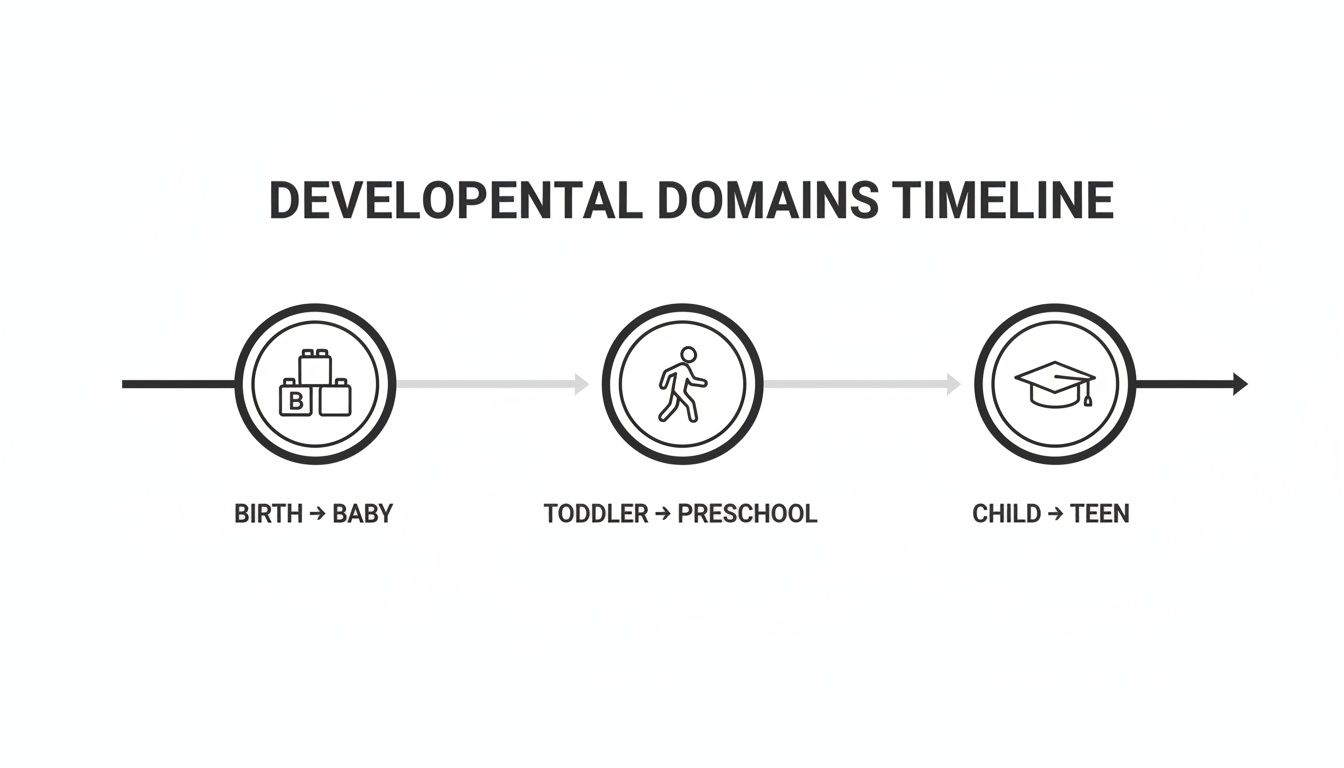
As you can see, development is a cumulative process. The skills learned in those early baby days provide the essential groundwork for everything that comes next.
It's also totally normal for a child to pour all their energy into mastering one area for a bit, while seeming to pause in another. A toddler laser-focused on learning to walk (a huge physical feat!) might slow down their babbling for a few weeks. This is a normal part of the process, as their brain wisely allocates resources to the task at hand. You can learn more about how these skills unfold in our guide on motor development skills.
Milestones are not a race. They are a sequence. A child must learn to sit up before they can stand, and they must learn to stand before they can walk. Each step prepares them for the next one.
This sequential nature is exactly why observing milestones is so valuable. It’s not about comparing your kid to the one next door; it’s about understanding their personal journey. It helps you become your child’s best and most informed advocate, ready to cheer them on and gently recognize when a little extra support might be helpful.
A Snapshot of Key Milestones
To bring this all to life, let's look at a few concrete examples across different age groups. Think of this table as a quick reference guide showing how various domains are active and developing at each stage.
Key Milestone Examples by Age Group
| Age Group | Gross Motor Milestone | Fine Motor Milestone | Language Milestone | Social-Emotional Milestone |
|---|---|---|---|---|
| Infant | Sits without support | Passes a toy from one hand to the other | Responds to their own name | Shows excitement around familiar people |
| Toddler | Walks independently and begins to run | Scribbles with a crayon | Says several single words and simple phrases | Shows increasing independence or defiance |
| Preschooler | Hops and stands on one foot for seconds | Draws a person with two to four body parts | Tells stories and uses sentences of 5+ words | Shows more cooperation with other children |
Viewing development this way transforms you from a worried spectator into an empowered partner on your child's team. It gives you the insight to provide the right kind of play and interaction to support them as they get ready for their next big step.
When to Seek Support for Developmental Delays
Every child’s journey is one-of-a-kind. It’s completely normal for their developmental timeline to look a little different from the textbook charts. But sometimes, you might notice patterns or persistent challenges that feel like more than just a minor detour. This is where it helps to understand what a developmental delay really is.
Let's go back to our house analogy. Think of an isolated delay as a single leaky faucet. It’s a specific issue that needs attention, but it doesn't mean the whole house is falling apart. For example, it’s quite common for a child to be a little behind in their gross motor skills while soaring ahead in their language development. These things often even out with a bit of targeted support and practice.
Recognizing Potential Red Flags
On the other hand, a global developmental delay (GDD) is more like discovering a problem with the house's foundation—it affects multiple systems all at once. This is what happens when a child shows significant delays in two or more developmental domains, like their physical, cognitive, and social-emotional skills.
Being on the lookout for these signs isn't about searching for problems. It’s about being an observant, proactive advocate for your child. These "red flags" are simply gentle nudges that it might be time to get some guidance.
Common examples might include:
- A toddler who consistently avoids making eye contact or doesn't seem to respond to their name.
- An 18-month-old who isn't trying to use any single words yet.
- A preschooler who really struggles to interact or play with other kids.
- A child who starts to lose skills they once had (this is called developmental regression).
Noticing these signs is the first step toward getting your child the right support to thrive. If you're wondering what lies at the root of these challenges, you can read our guide on what causes developmental delays.
The Interconnected Nature of Delays
Because all the developmental domains are so closely woven together, a hiccup in one area can easily create a ripple effect. Research is very clear on how interconnected these skills are. For instance, a major study on global developmental delay found that a staggering 54.5% of affected children had delays across four or even five domains. The most common single issue was with fine motor skills, which really shows how a physical challenge can radiate outward and impact other areas. Learn more about the findings on developmental delays in children.
Trust your intuition. You are the expert on your child. If you feel that something is off, even if you can’t pinpoint exactly what it is, your concerns are valid and worth exploring with a trusted professional.
Reaching out for support is never an admission of failure—it's a profound act of love. Early intervention is one of the most powerful tools we have to help children bridge developmental gaps. By addressing challenges as soon as they appear, you give your child the best possible opportunity to build a strong foundation for a happy, healthy, and successful future.
The Nervous System: Your Child's Developmental Command Center
We've walked through each developmental domain, from physical skills to social connection, but what is the one thing that links them all together? The answer is the nervous system. It’s the body's master control system, the brilliant conductor behind every single thought, feeling, and action your child has.
Think of it like the complex electrical wiring in a brand-new smart home. When the signals are clear and the connections are strong, every system—the lights, the thermostat, the security—works together perfectly. A command from the central hub gets to its destination instantly and does exactly what it's supposed to.
In the same way, a healthy, well-regulated nervous system creates a seamless highway of communication between your child's brain and their body. This clear signaling is the absolute foundation for hitting milestones, making sense of the world, and regulating big emotions.
When Communication Gets Scrambled
But what happens if there’s a short in that wiring? Physical stressors, especially from a difficult birth or even everyday tumbles, can create interference in this critical communication network. This disruption is what we in chiropractic call subluxation—a state of neurological stress that can jam the signals traveling between the brain and body.
When these signals get fuzzy, weak, or scrambled, the effects can pop up in any developmental domain. The instructions from the brain just aren't getting through clearly, making it harder for a child to coordinate their movements, process sensory input, or manage their emotional state.
This interference might look like:
- Difficulty with gross motor skills like crawling or walking.
- Challenges with sensory processing, leading to constant overstimulation.
- Struggles with social-emotional regulation, like frequent, intense meltdowns.
The nervous system is the conductor of the entire developmental orchestra. If the conductor's signals are unclear, the musicians (the different domains) can't play in harmony, and the beautiful symphony of development starts to sound disjointed.
By understanding the central role of this system, we can stop just chasing symptoms and start addressing the root cause. Gentle, neurologically-focused chiropractic care is specifically designed to find and help clear this interference. By restoring those optimal communication pathways, we help the body's innate intelligence coordinate development from the inside out.
You can dive deeper into this vital system in our detailed guide on how the nervous system works. When you support the command center, you support every single aspect of your child's growth.
How We Partner with Your Family's Developmental Journey
Our entire approach is built on a simple but powerful idea: we have to get to the root cause. Instead of just chasing symptoms, we focus on understanding and supporting the one system that acts as the command center for every single developmental domain—your child’s nervous system.
This is how we truly partner with you to help your child thrive. We’ve designed a supportive process to give you clarity and confidence every step of the way, so you feel empowered and informed, knowing exactly how our care connects to your child’s specific needs.
Our Five-Step Foundational Process
It all begins with a deep dive into your child's story. During an in-depth consultation, we sit down and listen. We want to hear your concerns, your goals, and every detail of your child's journey so far. This isn't just a formality; it's the foundation for everything that follows.
Next, we use advanced, non-invasive Insight Scans. These incredible scans give us a window into what’s happening "under the hood" by mapping out areas of stress and interference within the nervous system. Think of it as getting a precise roadmap showing where communication between the brain and body might be hitting roadblocks.
From there, we combine this data with a gentle, comprehensive chiropractic exam to build a fully personalized care plan. No two children are the same, and their care plans shouldn't be either. This plan outlines the specific, gentle adjustments designed to meet your child's unique neurological needs.
At the heart of our practice is the understanding that a calm, connected nervous system is the key to unlocking a child's full potential. When we reduce neurological stress, the body's innate ability to grow, learn, and heal can finally function optimally.
This is where the magic happens. By gently reducing that interference in the nervous system, we see incredible changes across every what is a developmental domain. For instance, better neurological function can directly support a child's ability to self-regulate (Social-Emotional domain) or improve their balance and coordination (Physical domain).
Our goal isn't to treat a symptom, but to empower your child's body to function at its absolute best, clearing the path for brighter, easier development.
Common Questions About Developmental Domains
As you watch your child grow, it's completely normal for questions and worries to pop up. You might hear different terms thrown around or just have that gut feeling that something isn’t quite right. Let's walk through some of the most common questions we hear from parents, offering clear, reassuring answers.
Our goal is to give you the confidence and knowledge you need to be your child’s best advocate on their unique journey.
What Is the Difference Between a Developmental Delay and a Disability?
This is such an important question, and we hear it all the time. Think of a developmental delay as a temporary detour on a child's developmental path. It means they aren't hitting their milestones in the expected time frame, but with the right support, they have every potential to catch up.
A developmental disability, on the other hand, is a more permanent condition that will likely affect a child’s daily life long-term. Conditions like autism or cerebral palsy fit into this category. The key takeaway for both is that early intervention is absolutely crucial—it gives every child the support they need to reach their full, amazing potential.
Are Chiropractic Adjustments Safe for Babies and Children?
Yes, absolutely. Pediatric chiropractic adjustments are incredibly safe and gentle. At First Steps Chiropractic, we use specialized, low-force techniques like the Torque Release Technique (TRT). The amount of pressure we use is often no more than what you’d use to check if a tomato is ripe—it’s designed specifically for a child’s delicate and developing nervous system.
Our doctors are certified by PX (The Pediatric Experience) and have extensive training in the unique needs of infants and children. This ensures every single adjustment is safe, specific, and supportive of their growth.
My Pediatrician Says My Child Will “Grow Out of It.” Should I Still Be Concerned?
While it’s true that every child develops at their own pace, the "wait and see" approach can sometimes mean missing a critical window for support. That little voice—your parental intuition—is powerful. If it’s telling you something feels off, it’s always worth getting a second opinion.
A neuro-functional assessment can offer deeper insights, helping to uncover any underlying issues that might be contributing to the challenges you're seeing. When it comes to your child's well-being, being proactive is always better than being reactive.
At First Steps Chiropractic, we believe in empowering parents with answers and giving children the best possible start. If you have concerns about your child's development, we're here to listen and help you get to the root cause.
Learn how our neurologically-focused care can support your family's journey by visiting us at https://firststepschiropractic.com.