
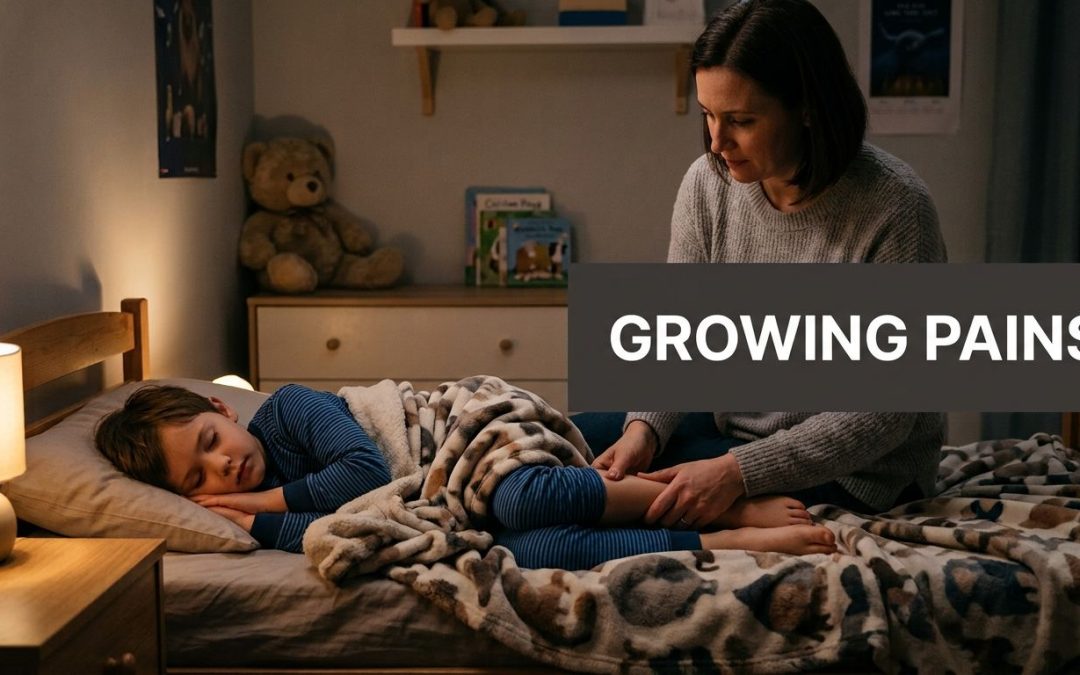
It's often the same scene. Your child went to bed fine, then suddenly calls out with aching legs, tears, and that worried look that makes your stomach drop. You rub their calves, help them settle, and then lie awake wondering whether this is normal, whether you missed something, or whether you should call someone in the morning.
If that's where you are tonight, you're not overreacting. Leg pain in children can be confusing because growing pains are common, but they're also widely misunderstood. According to the American Academy of Pediatrics scoping review, growing pains are one of the most common causes of recurrent musculoskeletal pain in children, and prevalence estimates range from 2.6% to 49.6%, with some estimates suggesting up to one-third of children may receive this diagnosis during childhood (AAP scoping review on growing pains).
Most parents have heard of growing pains. Fewer have been told what the actual signs of growing pains are, what falls outside that pattern, and why some kids seem especially affected. That last part matters. Sometimes the issue isn't only tired muscles. A child's nervous system sensitivity and body mechanics can shape how strongly they feel pain and how often it returns.
Is It Just Growing Pains
A parent usually doesn't ask that question during the day. They ask it at bedtime, or in the middle of the night, when their child says, “My legs hurt,” and there's no bruise, no obvious injury, and no clear explanation.
That uncertainty is hard. You want to be calm, but you also don't want to dismiss something important.
Why this catches parents off guard
Growing pains often show up in otherwise healthy children. They tend to happen in the age range most associated with active play, busy afternoons, and constant movement. A child may run, jump, climb, and seem completely fine, then later complain that both legs ache.
That pattern can feel odd, but it's one reason parents get confused. The pain is real, even though it doesn't behave like a typical injury.
A helpful starting point: Growing pains are common, but “common” doesn't mean every leg pain is a growing pain.
What parents usually notice first
The first clues are often simple:
- Nighttime complaints: Your child says their legs hurt after dinner, at bedtime, or during the night.
- No obvious injury: There's no fall you can point to, and nothing looks clearly wrong.
- Pain that comes and goes: Your child may be fine the next morning, then have another episode days later.
Reassurance and caution need to work together. Many children do have a benign pattern that fits growing pains. But parents shouldn't be expected to guess blindly. The signs of growing pains follow a fairly specific pattern, and once you know that pattern, things become much easier to sort through.
Recognizing the Classic Pattern of Growing Pains
Growing pains make more sense when you look for a repeated pattern instead of focusing on one painful moment. A single complaint of leg pain can come from many things. The details around it are what help you sort out whether the pattern is reassuring or whether it needs a closer look.

The classic pattern is fairly specific. The discomfort usually shows up in both legs, most often in the calves, shins, thighs, or behind the knees. It tends to appear later in the day, often after a busy afternoon of running, jumping, and climbing. By morning, the child is usually back to normal.
That last detail matters more than many parents realize.
A child with classic growing pains often looks completely well between episodes. They run normally, play normally, and do not show swelling, redness, or heat in the painful area. The pain comes and goes, rather than building into a constant problem.
What usually fits the classic pattern
Parents often recognize growing pains when several of these signs show up together:
- Both legs are involved: The aching is commonly felt on both sides, even if one side seems stronger that night.
- The pain is in the soft tissues: Children usually point to the muscles of the legs rather than one exact joint.
- The timing is predictable: Complaints often start in the evening, at bedtime, or during the night.
- Morning brings a reset: Your child wakes up walking, playing, and moving like usual.
- There are pain-free stretches: Episodes may happen off and on, with completely normal days in between.
A helpful way to picture it is this. Classic growing pains behave more like an intermittent alarm than a structural breakdown. The body gets noisy for a while, then settles. That pattern is one reason many families are told to wait it out.
Still, pain is information.
Why children describe it in different ways
Children rarely give textbook descriptions. One child says, “My legs hurt.” Another says, “My knees are tired,” even when the discomfort is really in the muscles above or below the joint. Younger children may only cry, rub their legs, or wake up wanting to be held.
That can make the picture feel blurry for parents. The location a child points to is helpful, but the overall pattern is usually more useful than one exact word or gesture.
A simple way to check the pattern at home
Ask yourself:
- Is the pain happening in both legs or shifting between both sides?
- Does it show up later in the day or at night?
- Is my child moving normally by morning?
- Do the legs look normal, without swelling, redness, or warmth?
- Are there pain-free days between episodes?
If you are answering yes to most of those questions, the pattern leans more toward classic growing pains.
If the pattern keeps repeating, it can help to look beyond the old idea that a child “overdid it.” In some children, leg pain shows up when the nervous system is under stress and the body is not handling movement and recovery as smoothly as it should. Muscle soreness may be part of the picture, but it is not always the whole story. Families who want a closer look at that connection often start with a pediatric chiropractor who evaluates nervous system and structural stress.
When to Worry Red Flags for Childhood Leg Pain
This is the part every parent needs most. Growing pains have a pattern. When the pain breaks that pattern, it deserves attention.

A child with benign growing pains may cry and need comfort, but they shouldn't have signs that suggest inflammation, infection, injury, or a more serious musculoskeletal problem.
Growing pains vs red flag symptoms
| Symptom | Typical Growing Pains | Potential Red Flag (See a Doctor) |
|---|---|---|
| Timing | Late afternoon, evening, or night | Morning pain, all-day pain, or constant pain |
| Location | Both legs | One leg only |
| Pain area | Muscles of calves, shins, thighs, behind knees | Joint-focused pain |
| Walking | Normal walking by morning | Limping, refusing to walk, weakness |
| Visible changes | No redness, swelling, or warmth | Swelling, redness, warmth, bruising |
| Whole-body symptoms | Child otherwise seems well | Fever, rash, appetite loss, weight loss |
The comparison becomes clearer once you know the “not normal” signs.
Signs that need prompt medical evaluation
The Cleveland Clinic description of red flags in growing pains notes that pain in a single leg, morning pain, limping, joint swelling, fever, rash, or unexplained bruising are signs that require medical evaluation rather than being treated as benign growing pains.
Watch more closely if you notice any of the following:
- One-sided pain: If your child keeps pointing to the same single leg, that's not the usual pattern.
- Pain that's there in the morning: Growing pains should resolve by morning.
- Limping or avoiding walking: A child who won't bear weight needs more than reassurance.
- Swollen or red joints: Growing pains don't create visible joint changes.
- Fever, rash, or unusual bruising: These signs point outside the typical picture.
- Loss of appetite or unexplained weight loss: This needs a medical assessment.
- Pain that keeps escalating: If each episode seems stronger, more frequent, or less responsive to comfort, don't assume it's harmless.
For a clear visual summary, this short video can help parents review the difference between typical and concerning symptoms.
When your instincts matter
Parents often apologize for being “too worried.” Don't. If your child's pain doesn't match the classic signs of growing pains, trust that concern and get it checked.
Practical rule: Nighttime, both legs, normal by morning fits the usual pattern. Morning pain, one leg, limping, swelling, or fever does not.
If you're trying to decide whether a child's symptoms warrant a closer pediatric musculoskeletal evaluation, a provider experienced with children's movement and nervous system patterns can help you sort through that question. Some families start by looking for a pediatric chiropractor near me as part of that broader support team, but red flag symptoms should be medically assessed promptly.
Beyond Muscle Fatigue The Neurological and Structural Links
A common bedtime scene goes like this. Your child was active all day, seemed completely fine at dinner, then melts down at night with aching legs. If that keeps happening, it makes sense to ask whether this is only tired muscles or whether something deeper is making their body react so strongly.
For some children, leg pain is not just about how much they used their muscles. It also reflects how their nervous system processes stress and how their body handles force through the legs.

The nervous system side
A PubMed Central review on growing pains describes a pattern many parents already sense. Some children with growing pains appear to have a lower pain threshold and broader sensory sensitivity.
That does not mean the pain is exaggerated or emotional. It means the body's alarm system may be set to react faster and louder. A small amount of physical strain can feel much bigger to a child whose nervous system is already running in a more reactive state.
A simple comparison helps here. Two homes can have smoke detectors that both work, but one is so sensitive it goes off while toast is browning. The signal is real. The response is just stronger than expected for the trigger.
Parents may notice clues that fit this pattern, such as irritability after busy days, trouble winding down at night, or a child who seems unusually bothered by bumps, tags, noise, or minor discomfort. Pain is not created only in the muscles. The brain, spinal cord, and sensory nerves all help shape how intensely that pain is felt.
If you want more background on how regulation and body signals connect, this article on how chiropractic care relates to the nervous system explains that relationship in parent-friendly terms.
The structural side
Structure matters too. A child's body works like a chain. If the feet roll in, the knees rotate inward, or the hips and pelvis are not moving well, the legs may absorb everyday play with more strain than they should.
You may see this in children with flat feet, very flexible joints, frequent tripping, or a posture that looks collapsed by the end of the day. They can still be healthy and active. They just may not distribute force efficiently.
That helps explain why one child can run, jump, and climb all afternoon with no issue, while another has aching calves or thighs at bedtime after the same kind of day. The difference is not always toughness or fitness. Sometimes it is mechanical load adding up through the lower body.
Why standard remedies sometimes help, but do not solve the pattern
Massage, heat, and stretching often calm an episode, and those tools are useful. But they usually address the sore tissues after the body has already become irritated.
If the nervous system is on high alert, the child may feel normal activity as more intense. If alignment or movement patterns are creating repeated stress, the same areas may keep getting overloaded. In that situation, home care can soothe the flare without changing the reason it keeps returning.
That is why some children improve for a night but continue to cycle through the same bedtime pain pattern. Looking at both nervous system regulation and structural alignment gives a fuller explanation of why growing pains can be so persistent, and why some families need more than temporary comfort measures.
Effective At-Home Strategies for Pain Relief
When your child is hurting, you need something useful right away. Gentle home care often helps calm an episode and makes bedtime easier for everyone.
The Scottish Rite for Children guidance on growing pains recommends gentle massage, heat application, and dynamic stretching of leg muscles, with acetaminophen or ibuprofen sometimes used for severe cases. It also states that aspirin is strictly contraindicated in children because of the risk of Reye's syndrome.
What to do during an episode
Try a calm, simple routine:
- Massage the sore areas: Use slow pressure through the calves or thighs rather than quick rubbing.
- Apply warmth: A warm bath or heating pad can help muscles relax.
- Help your child settle: Dim lights, slow your voice, and reduce stimulation.
- Use medication carefully if needed: If pain is more intense, ask your child's pediatric provider what's appropriate for them. Don't use aspirin.
What may help between episodes
Some children do better when you support the body earlier in the day rather than waiting until bedtime.
- Gentle daytime stretching: Stretch the calves, hamstrings, and thighs without forcing range.
- Activity awareness: If a very active day tends to trigger pain, add extra recovery time that evening.
- Comfortable sleep routines: Kids who are more sensitive often benefit from predictable wind-down routines.
A warm bath, steady touch, and a quiet bedtime routine can help the body shift out of “alert mode” and into rest.
Some parents also focus on reducing overall body stress and irritation, especially after long activity days. If that's your interest, this article on how to reduce inflammation offers general family-friendly ideas.
What home care can and can't do
Home care is excellent for comfort. It helps the child feel safe, supported, and physically soothed. What it can't do on its own is tell you whether a recurring pattern has a deeper sensory or structural driver.
That's why persistent, disruptive, or unusual pain deserves a closer look, even when the classic remedies help a little.
A Neuro-Tonal Approach to Lasting Relief
When a child's leg pain keeps returning, many parents end up in a frustrating cycle. They massage, stretch, use warmth, get through the night, and then wait for the next episode. Relief matters, but lasting answers matter more.

A more complete approach asks different questions. Is the child's nervous system stuck in a more reactive state? Are movement patterns placing extra stress through the legs? Is the body adapting well to activity, or compensating poorly?
Why a deeper assessment matters
The American College of Rheumatology overview notes that up to 30% of children with growing pains have flat feet or joint hypermobility, which means a meaningful group of children may have an underlying structural contributor.
That doesn't automatically mean every child needs orthotics or specialized care. It does mean recurring pain shouldn't always be brushed off as “just one of those things.”
A neuro-tonal perspective looks at both regulation and mechanics:
- Nervous system regulation: How well the child shifts from stress and activity into rest and recovery
- Spinal and postural balance: Whether the body is organizing movement efficiently
- Lower-body mechanics: How feet, knees, hips, and pelvis share load
- Sensory reactivity: Whether the child experiences normal physical input as unusually intense
What a gentle chiropractic lens adds
In pediatric practice, a chiropractic evaluation doesn't need to be forceful to be meaningful. The focus is often on careful observation, history, movement patterns, and how the child's body handles stress.
For children whose signs of growing pains keep repeating, this kind of evaluation can help identify whether there's more going on than simple overuse. The goal isn't to label every pain episode as structural or neurological. The goal is to stop missing those factors when they are present.
What parents should expect
If you seek this kind of support, the visit should feel thorough and calm. A good pediatric-focused process usually includes:
- A detailed conversation about timing, triggers, sleep, activity, and the exact pain pattern.
- Observation of posture and movement to look for asymmetry or extra strain.
- Age-appropriate assessment that respects the child's comfort level.
- Clear guidance on whether the pattern seems benign, structural, sensory, or in need of medical referral.
That last point is important. Good care doesn't force every problem into one box. It helps parents know when home support is enough, when gentle neuro-musculoskeletal care may help, and when a medical workup is the right next step.
If your child's leg pain keeps returning and you want a calmer, more complete way to understand it, First Steps Chiropractic offers a neurologically focused approach for children and families. Their team uses a five-step process that includes an in-depth consultation, Insight Scans, a thorough chiropractic exam, a personalized care plan, and gentle adjustments designed to support nervous system function and whole-body balance.