
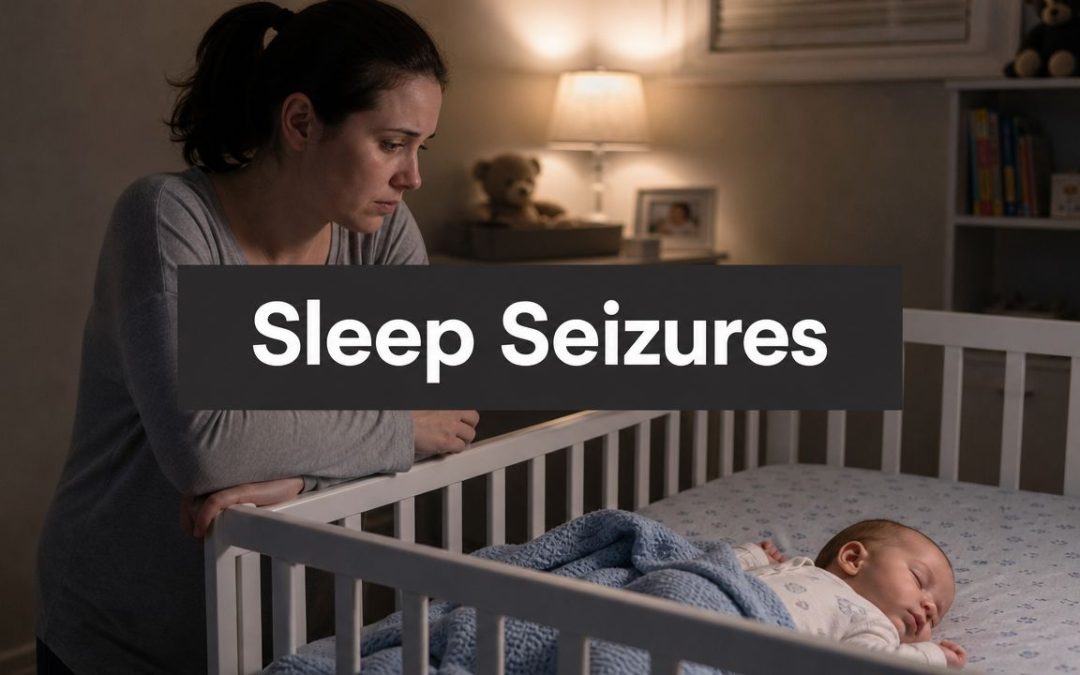
You lean over the crib at 2 a.m. and see it. A sudden jerk. Then another. Maybe your baby's arms fling out. Maybe their legs twitch in little bursts. Maybe their face scrunches for a second and then relaxes. Your mind goes straight to the hardest possibility. Was that a seizure?
That fear is understandable. Sleep can make normal baby movements look alarming, and alarming movements can happen when a baby is half asleep, fully asleep, or just waking up. In the dark, with your own heart racing, those differences can be hard to sort out.
The good news is that not every unusual movement in sleep means epilepsy. In fact, some events that parents report as seizures turn out to be non-neurological sleep movements. At the same time, some movements do need prompt medical attention. The key is learning what to watch for, what to record, and when to act right away.
That Moment of Panic Understanding Infant Sleep Movements
It often starts in the quietest part of the night. You check on your baby and see a sudden jerk, a stiff little curl, or a cluster of movements you have never noticed before. For a few seconds, it can feel impossible to tell whether you just saw a normal sleep movement or something more serious.
That reaction makes sense. A baby's sleep can look surprisingly active, especially in the first year when the brain and nervous system are still learning how to organize sleep, movement, and reflexes. Babies may twitch, stretch, startle, grimace, shudder, or briefly cry out without fully waking. If your baby often makes noise or fusses while asleep, this guide on infant crying during sleep can help you sort out common sleep behaviors from signs that deserve more attention.
Part of the confusion comes from how immature infant sleep is. Adult sleep is usually more settled. Infant sleep is more like a system still under construction. Signals between the brain, body, and reflexes can look messy before they look organized. That is why normal movements and concerning movements can both show up around naps, bedtime, and waking.
Another reason this feels so hard is that parents are trying to make a fast judgment during a stressful moment. You do not need to label the event perfectly on the spot. Your job is to notice patterns and get help if something seems off.
One point helps clear up a common misunderstanding. Infantile spasms are a specific seizure type, and they usually happen around transitions out of sleep rather than during sleep itself, as noted earlier in this article's medical sources. They can look like brief repeated tensing or jerking episodes, which is one reason families may mistake them for unusual sleep movements at first.
A calmer, more useful approach is to observe the episode the way a pediatric clinician would. Focus on a few simple clues:
- Timing. Did it happen during deep sleep, light sleep, or right as your baby was waking?
- Pattern. Was it one random jerk, or did the movement repeat in a similar way?
- Response. Did the movement stop if your baby woke, was touched, or was gently soothed?
- Breathing and color. Did your baby keep breathing normally and stay their usual color?
These details matter because they help separate common sleep-related movement from events that may need urgent evaluation.
This is also where a wider, nervous-system-focused view can help. Standard medical care is the priority for diagnosing possible seizures. At the same time, it helps to remember that an infant's nervous system affects sleep quality, muscle tone, regulation, and startle patterns. Looking at the whole picture, not just one isolated movement, often gives families a clearer path forward and helps the care team decide what needs medical testing versus what may reflect a baby's developing system.
If something felt unusual, trust that instinct. Then shift from panic to observation. A short video, the timing of the event, and a few notes about what you saw can give your pediatrician far more useful information than trying to solve it alone in the dark.
Normal Twitches vs Potential Seizure Activity
The hardest question is usually the most basic one. Is this a normal sleep movement, or could it be seizure activity?
Some reassurance helps here. Recent neurology studies suggest that up to 30% of reported “infant seizures during sleep” are misdiagnosed non-neurological events, such as benign sleep myoclonus, according to Michigan Medicine's discussion of sleep concerns in children with epilepsy. That doesn't mean you should ignore unusual episodes. It means not every twitch is an emergency.

What normal sleep movements often look like
Benign movements usually look disorganized, brief, and inconsistent. They may happen during light sleep, during a startle, or as a baby shifts between sleep states.
Common examples include:
- Startles or jerks a quick arm fling, body jump, or leg twitch, often after a sound or movement
- Benign sleep myoclonus repetitive jerking that happens during sleep but stops when the baby wakes
- Stretching and scrunching facial grimacing, brief stiffening during a stretch, or irregular wiggles
- Trembly movements short, fine shaking that settles with containment, repositioning, or waking
Parents also often notice muscle-related movements and wonder if they signal something serious. This article on infant muscle spasms can help you think through movement patterns in a more organized way.
What can make a doctor more concerned
Potential seizure activity tends to have a more repetitive, fixed pattern. It may not stop when you touch, hold, or gently reposition your baby. There may also be a change in awareness, eye position, breathing, color, or muscle tone.
A concerning event may involve:
| Sign | More suggestive of benign movement | More suggestive of seizure activity |
|---|---|---|
| Pattern | Irregular, scattered, variable | Rhythmic, repeated, similar each time |
| Response to touch | May settle with touch or waking | Often continues despite touch or repositioning |
| Eyes | Closed or briefly opening normally | Fixed stare or eyes deviating to one side |
| Breathing and color | Normal breathing, normal color | Breathing pause, blue color, or unusual limpness |
| After the event | Baby returns to normal quickly | Baby seems hard to rouse, unusually floppy, or very different |
One detail parents often miss
A movement can be dramatic and still be benign. A movement can also be subtle and still deserve urgent evaluation. Intensity isn't the only clue. Pattern matters more.
Practical rule: If the same unusual movement keeps happening in the same way, especially if your baby seems hard to wake or not fully responsive, contact your doctor.
Sleep stage confusion is real
Sleep itself changes what you may see. Research summarized in this review on sleep and epilepsy notes that seizures are more likely to be triggered during NREM sleep, while REM sleep tends to suppress them. That same review reports that 41% of daytime seizures occur during waking and only 20% during sleep, which helps explain why many parents overfocus on nighttime events and miss the bigger pattern.
This is one reason a full history matters. If your baby has unusual daytime spells too, that's important information.
Red Flags When to Call Your Doctor or 911
When you're scared, it helps to have a simple decision tool. Your job in the moment is to keep your baby safe, note what you see, and decide how urgently you need help.
Start with this checklist.

Call 911 right away
Call emergency services if any of these happen:
- Breathing changes your baby stops breathing, struggles to breathe, or turns blue
- Prolonged event the seizure or seizure-like episode lasts longer than 5 minutes
- Poor recovery your baby remains unresponsive or very difficult to wake for more than a few minutes after it stops
- Injury your baby gets hurt during the episode
- Repeated events without recovery one event starts after another and your baby doesn't return to baseline in between
If there's any question about breathing or color, treat it as an emergency.
Call your pediatrician promptly
Contact your doctor the same day or as soon as possible if:
- It's the first suspected seizure, even if it was brief
- You keep seeing repeated unusual movements during sleep or on waking
- Your baby seems hard to rouse
- You're noticing developmental concerns along with the movements
- Something felt clearly different from normal sleep twitching, even if your baby seemed okay afterward
A short educational video may help you think through urgent response in a more practical way.
Why timing matters in some newborn emergencies
In newborns, seizures can be linked to a problem around birth rather than a long-term epilepsy diagnosis. One major cause is hypoxic-ischemic encephalopathy, or HIE, which happens when the brain doesn't get enough oxygen and blood flow around the time of birth. According to ABC Law Centers' overview of infant seizures and HIE, hypothermia therapy must begin within six hours of the injury to reduce permanent brain damage and lower later seizure burden.
That doesn't mean every nighttime twitch points to HIE. It does mean that in a very young baby, especially one with a complicated birth history, unusual movements should never be brushed off.
The Path to a Diagnosis What to Expect Next
Once you've called your pediatrician, many parents fear the next part because it feels unfamiliar. It helps to know that diagnosis usually follows a fairly predictable path.

The most helpful thing you can do at home
If it's safe, record the event on your phone. Video is often more useful than a detailed description because doctors can see the exact movement pattern, body position, breathing, and response.
Try to capture:
- The whole body not just the face or one limb
- The face and eyes if you can do that safely
- A short lead-in and aftermath start recording as soon as possible and keep going after the movement stops
- Your voice describing the time and what happened if that helps you remember details later
Don't delay emergency care to get video. Safety comes first.
What the first medical visit may include
Your pediatrician will usually ask very specific questions. Parents sometimes worry because they don't know all the answers. That's okay. Bring what you have.
Expect questions about:
- Age at first event
- How often it happens
- How long it lasts
- Whether it occurs in sleep, on waking, or while fully awake
- Any pregnancy, birth, or NICU history
- Whether your baby acts differently afterward
A pediatrician may then refer you to a pediatric neurologist, the specialist who evaluates seizures and other brain-related events in infants.
Bring a simple timeline to the appointment. Dates, times, video clips, and a one-line description of each event are enough.
EEG, video EEG, and imaging in plain language
The main test many families hear about is the EEG, or electroencephalogram. That test records the brain's electrical activity through small sensors placed on the scalp. It doesn't hurt. The goal is to see whether the unusual movement lines up with seizure-like brain activity.
Sometimes a doctor orders a video EEG, which records both the baby's behavior and the brain wave pattern at the same time. That can be especially useful when events are happening during sleep or on waking and no one is sure whether they're neurological.
An MRI may also be ordered if the care team needs a closer look at the brain's structure, especially if they're worried about an underlying cause.
What parents should expect emotionally
The testing process can feel slow, especially if the episodes are intermittent. That doesn't always mean something is being missed. Some events are hard to capture. Some babies need more than one layer of evaluation before the picture becomes clear.
A normal first test also doesn't always end the conversation. Doctors diagnose the child, not just the test result. That's why your observations matter so much.
Understanding Infant Seizure Treatments and Outcomes
Hearing the word seizure attached to your baby can make the future feel blurry all at once. The next step is to make that picture clearer. Treatment is based on two things: what kind of seizure your baby is having, and what is causing it.
Doctors often start with the same goals. Stop the seizures. Protect the developing brain. Support feeding, sleep, comfort, and milestones while the team keeps looking at the bigger picture.
Some infants need anti-seizure medicine. Some need treatment for an underlying problem, such as a metabolic issue, infection, birth injury, or a specific epilepsy syndrome. A smaller group may need specialized therapies, including diet-based treatment under close medical supervision. For babies who are also struggling with rest, steady routines can support recovery and observation at home. These newborn sleep support strategies do not treat seizures, but they can make patterns easier to notice and help the nervous system settle between medical visits.
Why early treatment matters
A baby's brain is developing at high speed. Repeated seizures can interrupt that work, much like static interrupting an important phone call. The concern is not only the movement you can see. It is also the abnormal electrical activity doctors are trying to stop quickly.
That is why conditions such as infantile spasms are treated urgently. As noted earlier, doctors take these episodes seriously because delays in treatment can affect development and make seizure control harder.
What outcomes can look like
There is no single forecast that fits every baby. Some infants have a short-term problem that resolves. Others need longer follow-up for epilepsy, development, or both. The main factors are the cause, how quickly seizures come under control, and how your child is doing over time.
Research on neonatal seizures shows that some children later develop epilepsy, especially in the first year after those early seizures, according to this study on neonatal seizures and later epilepsy risk. That information helps doctors plan follow-up. It does not tell you exactly what will happen for your child.
Outcomes are also bigger than seizure counts. Your care team may watch feeding, sleep quality, muscle tone, eye contact, motor skills, and language as your baby grows. Those signs help show how the nervous system is functioning day to day.
A hopeful and grounded view
Many babies improve with the right medical treatment and close follow-up. Some also benefit from added support such as physical therapy, occupational therapy, feeding therapy, early intervention, and other nervous-system-focused care that fits safely within the medical plan.
Families often ask where supportive care belongs. It belongs alongside, not instead of, pediatric and neurology care. A neurologically focused chiropractor, for example, is not a seizure specialist and should not diagnose or treat seizures, but some families choose this kind of supportive care to help with comfort, regulation, tension patterns, and overall nervous system stress while their medical team leads seizure management.
The goal is broader than stopping a single episode. It is helping your child develop as strongly and safely as possible, with a team that looks at the whole child.
Your Action Plan Questions to Ask Your Doctor
When you're waiting for answers, having a short plan can make you feel less helpless. Focus on three jobs. Observe, record, and ask clear questions.
What to do starting today
- Keep a log Write down the date, time, what happened, how long it lasted, whether your baby was asleep or waking, and how they acted afterward.
- Take video when safe Try to capture the whole episode, not just the end.
- Note patterns Did it happen after a short nap, after a feeding, or right after waking?
- Track development Jot down anything that worries you about feeding, eye contact, motor skills, or milestones.
- Protect sleep Keep a consistent routine while you're waiting for evaluation. Supportive sleep habits can help you notice patterns more clearly. These tips on how to help a newborn sleep may make the nights a little easier while you monitor what's happening.
Questions worth asking at the appointment
You don't need to ask everything. Pick the questions that fit your situation.
- Based on my video, what's your first impression
- Does this look more like a normal sleep movement, reflux-related behavior, or possible seizure activity
- Do we need an EEG or video EEG
- Should we see a pediatric neurologist now
- What signs mean I should call 911 if this happens again
- What should I do during an episode
- Could the timing matter if it happens during sleep versus right after waking
- Are there birth history or medical factors that change how concerned we should be
- What should I monitor at home while we wait
- If this is a seizure disorder, what treatment paths might be considered
What to bring
A short, organized packet helps more than a long story told from memory.
Bring:
- Your phone videos
- Your event log
- A list of medications or supplements
- Birth and NICU details if relevant
- A second adult if possible, because it's easy to miss instructions when you're anxious
Building Your Child's Supportive Care Team
If seizures are suspected or confirmed, one clinician usually takes the lead. That's the pediatric neurologist. This specialist helps direct testing, diagnosis, treatment, and long-term monitoring. But most families do better with a broader support system around them.

The core medical team
A strong care team may include:
- Pediatrician for general health, coordination, and day-to-day concerns
- Pediatric neurologist for seizure diagnosis, treatment decisions, and follow-up
- Therapists or developmental specialists if movement, feeding, communication, or learning become concerns later
- Social support such as a counselor, social worker, or parent support community
This team approach matters because seizures don't only affect a single moment. They can affect sleep, development, family stress, and daily routines.
Where supportive care fits
Families often ask about complementary care. That question makes sense. When a baby's nervous system is under stress, parents want to support the whole child, not just manage isolated episodes.
A responsible way to think about this is simple. Complementary care should support, not replace, medical seizure evaluation and treatment. If your baby may be having seizures, your first steps are pediatric and neurological assessment.
Some families also choose supportive therapies focused on comfort, regulation, feeding, sleep quality, posture, and overall nervous system function. That may include lactation support, physical or occupational therapy, counseling for parents, and in some cases neurologically-focused chiropractic as part of a broader care plan.
A balanced perspective on chiropractic support
Chiropractic care is not a treatment for seizures themselves. It should never be presented as a substitute for EEG testing, medication when needed, emergency care, or specialist management.
What some families value in neurologically-focused pediatric chiropractic is the goal of supporting overall nervous system balance and mechanical comfort through very gentle, age-appropriate care. In a collaborative setting, that kind of support may help with tension patterns, regulation, and general well-being. The important part is keeping every provider informed and making sure the neurologist remains the lead for seizure-related decisions.
Good supportive care asks, “How do we help this child function as well as possible?” It never asks parents to choose between holistic support and appropriate medical treatment.
A thoughtful team doesn't compete. It communicates.
If you're looking for a family-centered clinic that understands the nervous system side of infant care, First Steps Chiropractic offers neurologically-focused pediatric chiropractic in Hayden, Idaho. Their approach is designed to complement, not replace, your child's medical care, with gentle support for regulation, comfort, and overall nervous system function. If you have questions about whether supportive chiropractic belongs in your child's broader care team, they offer a place to start that conversation.