
Your child covers their ears when the blender turns on. They cry when you put on a shirt with a tag. They crash into the couch cushions all afternoon, then melt down in the grocery store under the lights and noise. You may have heard, “They're just sensitive,” or “They'll grow out of it.”
Sometimes that's partly true. Kids do have preferences, phases, and rough patches.
But sometimes those daily struggles point to something deeper in how the nervous system takes in and organizes sensory input. That's when an assessment for sensory processing disorder can bring clarity. Not because it puts a label on your child, but because it helps explain why ordinary moments can feel so hard and what kind of support may be helpful.
Is It More Than Just a Quirk Understanding When to Seek an Assessment
A child who gags at certain food textures, panics in noisy places, or never seems able to sit still can look “quirky” from the outside. From the inside, that child may be working much harder than everyone realizes.
Sensory processing is the brain and nervous system's way of sorting incoming information. Sound, touch, movement, body position, and visual input all have to be noticed, filtered, and organized. When that process is inefficient, a child may overreact, underreact, or constantly seek more input.
What parents usually notice first
Most families don't begin with a clinical term. They begin with patterns.
- Clothing battles: Socks feel “wrong,” waistbands seem unbearable, or hair brushing triggers tears.
- Noise distress: Toilets flushing, hand dryers, vacuum cleaners, or birthday parties lead to shutdowns or panic.
- Movement seeking: A child jumps, spins, crashes, or fidgets almost nonstop.
- Daily unpredictability: One day a child tolerates something fine, and the next day the same input causes a meltdown.
If that sounds familiar, it can help to compare your child's behaviors with common sensory processing disorder symptoms in everyday life.
Parents often know something's off before they know what to call it.
You're not overreacting
Sensory challenges are common enough that they deserve real attention. The Cleveland Clinic notes that researchers estimate about 5% to 15% of the general U.S. population has sensory processing disorder, and some school-based research has found rates in children as high as 13.7% in the samples studied, according to Cleveland Clinic's overview of sensory processing disorder.
That doesn't mean every sensitive child has SPD. It does mean you're not alone, and it does mean these concerns aren't too small to bring up.
A good assessment doesn't start from the assumption that something is “wrong” with your child. It starts with curiosity. Why does your child respond this way? Which settings are hardest? What patterns show up at home, school, and in public? Those questions matter because they lead to practical support, not guesswork.
Screening Checklists vs Full Clinical Evaluations
A lot of parents start with a quiz. That makes sense. It's fast, private, and easy to do after a hard day when you're trying to make sense of what's happening.
A checklist can be useful. It can also be misleading if you expect it to answer more than it can.
What a checklist can do
A screening checklist helps you notice patterns you may have brushed past before. You might realize your child isn't only “picky” with clothes. They also avoid toothbrushing, seek constant movement, and get overwhelmed in bright stores.
That kind of pattern recognition is valuable. A tool like this sensory processing disorder quiz can help parents organize observations before talking with a pediatrician or therapist.

What a checklist cannot do
A checklist can't observe your child move through space. It can't compare home behavior with school behavior. It can't tell whether sensory symptoms are standing alone or overlapping with something else.
That's the key difference. A screening points to concerns. A clinical evaluation investigates them.
Here's the side-by-side view:
| Type | Main purpose | What it looks like | What you get |
|---|---|---|---|
| Screening checklist | Flag possible sensory concerns | Short questions answered by a parent or caregiver | A reason to seek more evaluation, not a diagnosis |
| Full clinical evaluation | Understand the child's functioning in depth | Observation, standardized tools, history, and professional interpretation | A detailed report and recommendations |
When to move beyond screening
You don't need to wait until things become severe. It's worth seeking a full evaluation when:
- Daily routines are hard: Getting dressed, eating, bathing, sleep, or transitions regularly become a struggle.
- School concerns are showing up: Teachers report attention problems, movement needs, or distress during classroom tasks.
- Your child's reactions seem out of proportion: Common sensory experiences trigger very large responses.
- You're seeing functional impact: Your child's sensory responses are limiting participation at home, school, or in the community.
Practical rule: If sensory behaviors are affecting your child's comfort, learning, or participation, it's time to ask for a professional evaluation.
A parent checklist is a flashlight. It helps you see where to look. A full assessment is the careful investigation that follows.
Your Assessment Team Who Performs an SPD Evaluation
Once you decide to pursue an evaluation, the next question is usually simple and stressful at the same time. Who do you call first?
The answer depends on your child's needs, but most thorough evaluations involve more than one professional. That's a strength, not a complication. Different specialists see different parts of the picture.

The occupational therapist's role
For many families, an occupational therapist, especially one with sensory integration training, is central to the process. An OT looks closely at how sensory processing affects daily life.
That means more than asking whether your child dislikes noise. It means asking whether noise disrupts dressing, eating, play, sleep, classroom participation, coordination, or emotional regulation.
An OT often helps answer questions like these:
- Is this sensory modulation? Is your child overresponsive, underresponsive, or seeking sensory input?
- Is motor planning part of the issue? Does your child struggle to plan and carry out new movements?
- How is function affected? Which daily activities are hardest, and where are your child's strengths?
The pediatric and developmental medical side
Your child's pediatrician may be the first person you talk to. They can review medical history, hear your concerns, and refer you to the right specialists.
In more complex cases, a developmental pediatrician may be involved. That clinician looks broadly at development, behavior, attention, communication, and medical factors that may overlap with sensory symptoms.
When psychologists join the process
A psychologist or neuropsychologist may become part of the team if questions arise about attention, learning, autism, anxiety, or emotional regulation.
That matters because a child who avoids group settings may be overwhelmed by sensory input, anxious in busy environments, struggling with social communication, or dealing with some combination of those factors. The right evaluator won't guess. They sort through the possibilities carefully.
What multidisciplinary care looks like
A strong team doesn't work in silos. Parents, teachers, therapists, and medical providers each hold part of the story.
You may hear input from:
- Parents and caregivers, who know the daily patterns best
- Teachers, who see classroom demands and peer settings
- Occupational therapists, who evaluate sensory and functional skills
- Pediatric or developmental specialists, who consider medical and developmental context
- Psychologists, when differential questions need closer review
No single professional knows your child the way you do. But a team can turn your observations into a clear, useful clinical picture.
What to Expect During the SPD Assessment Process
The word “assessment” can sound stiff and intimidating. In real life, a good evaluation often looks more like guided play, careful observation, and a long conversation than a child sitting at a desk taking a test.
The most important thing to know is this. There is no single gold standard test that diagnoses all subtypes of SPD. Best practice uses a combination of standardized testing, clinical observation, and parent-report questionnaires, as described by the STAR Institute's guidance on identifying sensory differences.
The parent interview matters more than people expect
Many evaluations begin with your story. You may be asked about pregnancy and birth history, early milestones, sleep, feeding, toileting, meltdowns, school behavior, coordination, and routines at home.
This part matters because context changes everything. A child who seeks movement all day but melts down during grooming may have a very different profile from a child who seems withdrawn, misses sensory cues, and struggles to notice body signals.
Bring examples if you can. Not broad labels like “sensitive,” but moments such as:
- Morning dressing takes 30 minutes because socks trigger tears
- The cafeteria is so loud your child stops eating
- Your child constantly bumps into furniture and people
- Haircuts, nail trimming, or toothbrushing lead to major distress
What the clinician watches
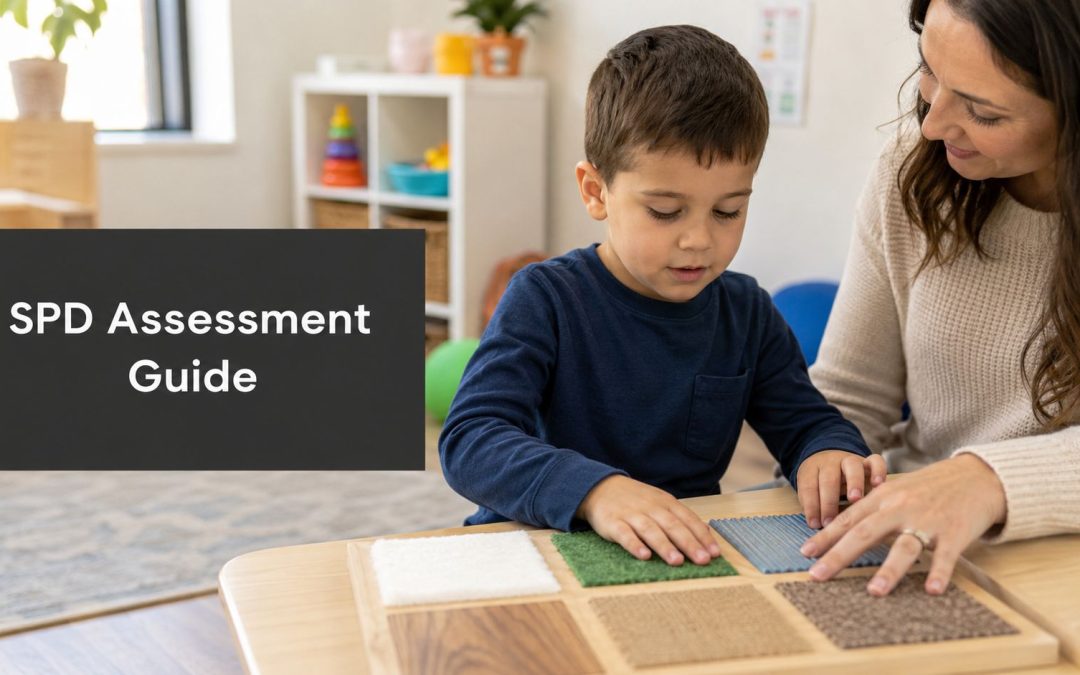
During observation, the evaluator may invite your child to swing, climb, touch different materials, stack objects, imitate movements, or complete tasks that involve balance and coordination.
To a parent, it may look like play. To the clinician, it's information.
They may be watching for:
- Response to touch: Does your child pull away, crave pressure, or seem unaware?
- Movement and balance: Does your child seek spinning, avoid swings, or appear unsteady?
- Motor planning: Can your child figure out a new action after it's demonstrated?
- Regulation: How easily does your child recover when a task feels hard or unfamiliar?
The clinician isn't trying to catch your child failing. They're trying to understand how your child's nervous system handles real-world demands.
Why several methods are used
One child may look calm in the clinic but struggle at home with bathing and bedtime. Another may perform tasks well one-on-one but fall apart in noisy group settings. That's why a multi-method evaluation is so important.
A single score can miss too much. A questionnaire alone can't capture movement quality. Observation alone can miss patterns across settings. History alone can't separate sensory concerns from other developmental questions.
The assessment works best when those clues are brought together like pieces of the same puzzle.
Common SPD Assessment Tools Explained
Assessment names can sound technical fast. Parents often hear a list of acronyms and leave wondering what was measured.
The easiest way to think about these tools is this. Some capture your child's everyday sensory patterns, and others look closely at specific sensory and motor functions in a structured way.
The questionnaires parents often see
The Sensory Profile and related short forms are commonly used caregiver questionnaires. They ask about everyday reactions to sound, touch, movement, routines, and behavior.
These tools are useful because they capture what life really looks like outside the clinic. A child may hold it together for an hour in an evaluation room, but a questionnaire can reveal what happens during mealtime, school pickup, or bedtime.
The structured testing side
The most established technical benchmark in the research literature is the Sensory Integration and Praxis Tests, or SIPT. A review of sensory assessment tools describes SIPT as the gold standard for assessing sensory discrimination and sensorimotor disorders. It includes 17 tests across vestibular, tactile, kinesthetic, and visual systems, as summarized in this literature review on sensory-based measures.
What praxis means in plain language
Praxis means motor planning. It's the ability to come up with an action, organize the steps, and carry it out.
A child with praxis challenges may know what they want to do but struggle to make the body do it smoothly. You might notice this when your child has trouble learning a new playground sequence, copying movements, navigating obstacle courses, or using both sides of the body together.
That matters because sensory concerns don't all look the same. Some children are mainly overwhelmed by input. Others also have difficulty planning and coordinating movement. A careful assessment helps sort out which pattern fits best.
Common SPD Assessment Tools at a Glance
| Tool Name | What It Measures | Format |
|---|---|---|
| Sensory Profile | Sensory patterns in daily life, based on caregiver report | Questionnaire |
| Short Sensory Profile | A shorter snapshot of sensory-related behaviors | Questionnaire |
| SIPT | Sensory discrimination and motor planning, including praxis | Structured standardized testing |
| Miller Function and Participation Scales (MFUN) | Functional motor and participation-related concerns often reviewed in broader sensory evaluations | Standardized assessment |
Why tool choice matters
A child who avoids messy play and cries during grooming may need tools that capture sensory modulation. A child who seems clumsy, gets lost in movement sequences, and has trouble imitating actions may need tools that also capture praxis.
That's why a strong evaluation doesn't just hand every child the same form. The clinician chooses tools based on the child's actual presentation, then combines those findings with observation and parent history.
Interpreting the Results and Understanding the Report
The report can feel like a lot. You may see standardized scores, clinical terms, observations, and recommendations all packed into one document.
Try not to read it as a verdict. Read it as a map.
What clinicians are putting together
A clinician doesn't rely on scores alone. They compare formal test results with what they saw in the room and what you reported from daily life.
That synthesis matters because children are rarely simple on paper. A child may score in a concerning range in one area, look strong in another, and show uneven regulation depending on task, setting, or fatigue.
Why differential diagnosis is so important
One of the most important parts of an assessment for sensory processing disorder is differential diagnosis. Many sensory symptoms overlap with ADHD, autism, and anxiety. A thorough evaluation looks not only for SPD-related patterns but also for co-occurring or alternative explanations, as outlined in this review on sensory processing assessment and differential diagnosis.
That means the evaluator may ask questions such as:
- Is the child distracted because sensory input feels overwhelming, or because attention regulation is impaired?
- Is the child avoiding activities because of texture and sound, or because anxiety rises in unpredictable settings?
- Are social difficulties rooted in sensory overload, autism-related differences, or both?
A careful report doesn't just name symptoms. It explains what may be driving them.
What to ask when you review the report
When you meet with the team, these questions can help:
- Which findings matter most for daily life right now?
- What are my child's strengths?
- Are there signs of co-occurring conditions that need follow-up?
- Which therapies or supports fit these results best?
- What should home and school focus on first?
A good report should leave you with more direction, not more confusion. If something isn't clear, ask for plain language. You deserve that.
From Diagnosis to Action Your Child's Integrated Support Plan
The report is finally in your hands. You may feel relieved to have an explanation, but also unsure what Monday morning is supposed to look like.
That reaction is common. An SPD assessment is a multi-step investigation, so the plan that follows should also have more than one part. The goal is not to chase every symptom at once. It is to build support around the patterns the evaluation uncovered, then turn those findings into practical help at home, at school, and in daily routines.

Occupational therapy usually anchors the plan
For many children, occupational therapy is the main starting point after diagnosis. OT takes the assessment findings and applies them to real life. If your child struggles with dressing, noise in the classroom, grooming, transitions, or body awareness, OT helps connect those daily challenges to the sensory patterns identified in the evaluation.
That often leads to recommendations such as:
- Home routines: changes to dressing, mealtime, bedtime, or transitions
- Sensory supports: activities or environmental changes that help regulation
- Skill-building: work on coordination, praxis, and tolerance for challenging input
- School collaboration: strategies that improve access to learning and reduce overload
If you want a clearer picture of how treatment options may fit together, this guide to sensory processing disorder therapy can help.
Where a neurologically focused chiropractic approach fits
Sensory processing is tied to the nervous system. That is one reason some families look beyond a single therapy and ask whether other forms of support could help their child regulate more consistently.
A neurologically focused chiropractic approach fits as one possible part of a broader wellness plan after diagnosis. It does not replace occupational therapy, developmental care, behavioral support, or mental health care when those are needed. Instead, it is considered alongside them, with the aim of supporting brain-body communication and helping the nervous system settle into a more regulated state.
A helpful comparison is a team working on the same house from different angles. An occupational therapist may focus on how your child functions in daily life. A school team may address classroom access. A pediatrician may rule out or monitor related medical concerns. A neurologically focused chiropractor looks at nervous system stress patterns and how they may relate to regulation, comfort, and function.
For some families, that means adding one more provider to the care team. First Steps Chiropractic offers pediatric, neurologically focused chiropractic care that includes consultation, Insight Scans, exam findings, and individualized care planning.
Here's a helpful overview of how support often comes together:
Build the plan around function
The clearest support plans focus on function first. In other words, what does your child need help doing with less stress and more success?
That might mean:
- Getting dressed without a battle
- Participating in class without overload
- Handling grooming and mealtimes with less distress
- Improving coordination and confidence in play
- Recovering faster when sensory stress builds up
Progress is often quiet at first. You may notice smoother mornings, fewer shutdowns after school, better tolerance for touch, or more flexibility when plans change. Those small shifts matter because they tell you the plan is helping your child feel safer and function more comfortably in everyday life.
If your family is trying to make sense of sensory challenges and you want a next step that considers nervous system function as part of the bigger picture, First Steps Chiropractic can help you understand your options and decide whether a neurologically focused approach belongs on your child's care team.