
When parents first hear a potential diagnosis, one of the first questions that comes to mind is often, "what are the stages of autism?" The simple answer is that Autism Spectrum Disorder (ASD) doesn't have official, linear stages like cancer. Instead, it’s a unique developmental journey, with patterns and needs that evolve and change over a lifetime.
Rethinking the Journey: What Are the Stages of Autism?
It’s completely natural to look for a predictable roadmap, a step-by-step guide to what’s coming next. But thinking about autism in terms of rigid "stages" can actually be misleading and create unnecessary anxiety.
A much better way to think about it is like tending to a unique garden. Each plant—like each child—follows a general pattern of growth, but every single one has its own timeline, needs, and way of blooming. Some need more sun, others thrive in the shade, and none of them follow an exact, identical schedule.
This guide is designed to replace that rigid idea of "stages" with a more flexible and empowering perspective. We'll walk you through the developmental journey of autism, focusing on the kinds of signs you might see and the support needs that can arise at different ages. Knowing what to look for is a powerful tool for providing the right help at the right time.
A Journey, Not a Checklist
When you shift your mindset from a clinical checklist to a supportive partnership with your child, everything changes. The goal isn't to push them from one "stage" to the next. It's about deeply understanding their unique neurology and giving them the tools they need to flourish at every single phase of life.
This timeline helps visualize that exact shift—moving away from seeing autism as a problem to be fixed (misconception) and toward understanding it as a lifelong path (journey) where the right support makes all the difference.
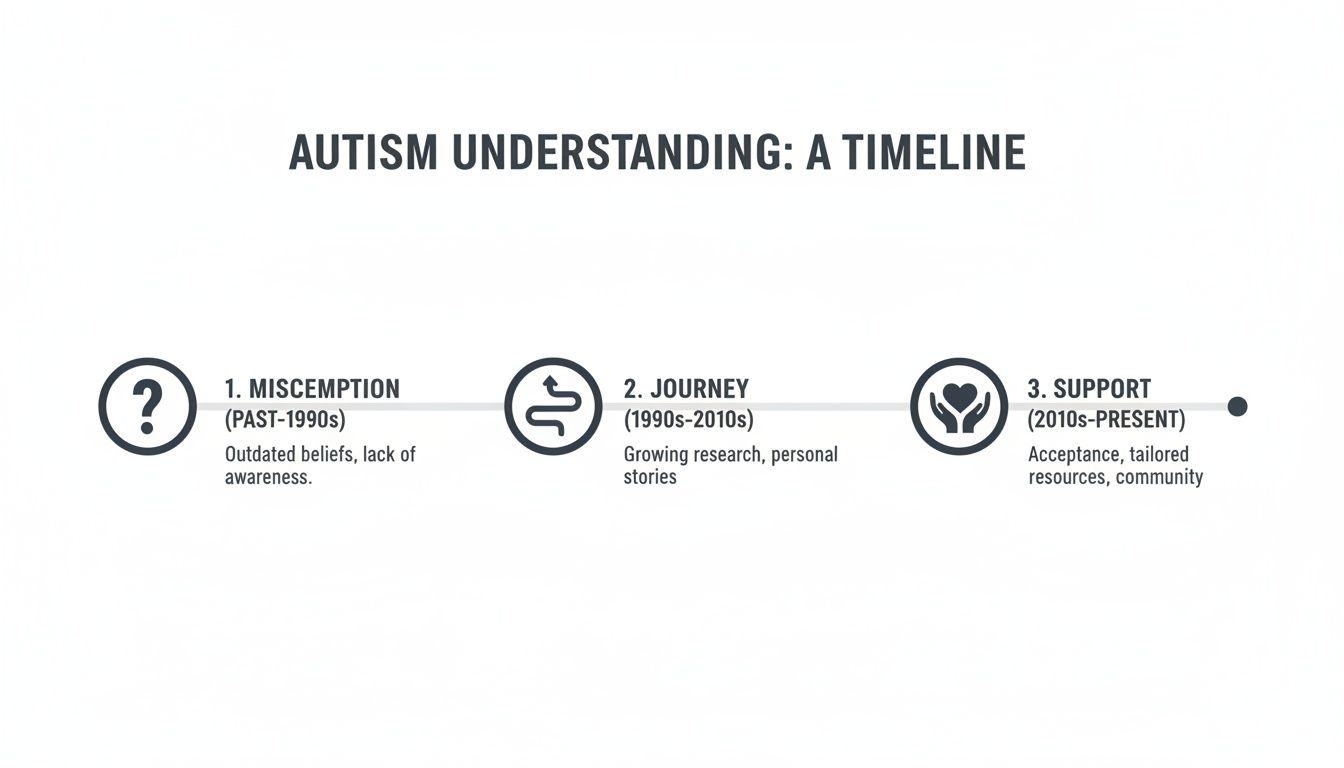
Ultimately, the most important takeaway is that proactive, informed support is the single most critical element in your child's developmental journey.
Understanding the Developmental Path
While there are no official stages, experts do recognize that early indicators often appear in observable phases. This has never been more important. With global prevalence now at about 1 in 100 children, the increase in awareness and better screening means more families are getting answers sooner. Recognizing these developmental progressions empowers parents to seek proactive care and get the ball rolling on support.
This guide will cover:
- Early Signs by Age: From infancy and toddlerhood through the school-age years and into adolescence.
- The Diagnostic Pathway: What to expect from the initial screening to a formal evaluation.
- Building a Support System: How therapies and neurologically-focused care can work together. You can learn more about the role of the nervous system in our detailed article.
By reframing the conversation from "stages" to "developmental phases," we can better focus on what truly matters: providing personalized, compassionate support that helps each child thrive on their own terms. This journey is about progress, not perfection.
Observing Early Signs in Infants and Toddlers
The path of autism often reveals itself through subtle signs, especially during that critical window from birth to age three. For parents, learning about these early indicators isn't about rushing to a diagnosis. It's about becoming a more tuned-in observer of your child’s beautifully unique development. This period is less about hitting rigid milestones and more about noticing consistent patterns as they emerge over time.
Think of it like tending a brand-new seedling. You watch how it responds to light and water, noticing if it’s turning toward the sun as you’d expect. In the same way, observing your infant’s early social and communication “sprouts” can give you incredibly valuable insights.

Key Indicators in Infancy (0-12 Months)
During their first year, babies are fundamentally wired for social connection. And while every single baby develops at their own pace, some patterns in social communication might call for a closer look.
The focus here is really on the reciprocal nature of interaction—those delightful back-and-forth "conversations" that happen long before any words are spoken. How an infant responds to their social world is a cornerstone of development.
Some early signs to watch for might include:
- Limited Eye Contact: The baby might not consistently meet your gaze, even during quiet moments like feeding or cuddling.
- Infrequent Social Smiling: By six months, most babies flash warm, engaging smiles in response to others. This may be rare or seem to be missing.
- Lack of Response to Their Name: Around nine months, you’ll typically see an infant turn their head or react when their name is called.
- Minimal Babbling or Cooing: A noticeable quietness or a lack of vocal play and experimentation can be an early flag.
Remember, these signs are not a checklist for a diagnosis. They are simply invitations to observe more closely and gather information. A single indicator means far less than a consistent pattern of several signs over weeks or months.
Shifting Signs in Toddlerhood (12-36 Months)
As a child steps into toddlerhood, their world expands in huge ways. This is often when social and communication differences can become more apparent, especially as their peers start blossoming with new language and play skills.
A key indicator that can emerge during this time is a regression of skills, where a child might lose words or social abilities they once had. For example, a toddler who was saying a few words might suddenly go quiet. Research shows this kind of developmental regression happens in about 20-30% of children with autism.
Other signs often surface in how toddlers play and interact. A classic example is a preference for meticulously lining up toys instead of using them for pretend play. If you're looking for more details on this age group, our guide on the early signs of autism in toddlers can offer more clarity.
Common Toddler-Age Flags
Here are some specific patterns parents often notice between the ages of one and three:
- Delayed Speech or Atypical Language: This can range from not speaking any words by 16 months to using language in unusual ways, like repeating phrases from TV shows (echolalia).
- Lack of Gestures: The child may not point to objects to show you something interesting, wave "bye-bye," or use other common gestures by 12-14 months.
- Prefers Solitary Play: Of course, all toddlers play alone sometimes. But an autistic toddler might consistently show very little interest in playing with or even near other children or adults.
- Repetitive Behaviors: This can include actions like hand-flapping, rocking back and forth, or spinning in circles.
- Intense Interest in Specific Objects: A child might become fascinated with parts of objects, like the spinning wheels on a toy car, rather than playing with the car itself.
Observing these patterns is the first step. If you notice a consistent cluster of these signs, it empowers you to start a meaningful conversation with a healthcare provider, moving your family toward the clarity and support you deserve.
Navigating Autism in Preschool and School-Age Years
When a child's world expands into preschool and elementary school, their journey with autism often enters a new, more visible phase. While you might have noticed early signs within the comfort of your home, the structured social and academic worlds of school can bring a child's unique neurology into much sharper focus. This isn’t a new “stage” of autism, but a new environment where traits simply become more apparent.
Imagine a unique plant that grows perfectly well in a quiet, controlled greenhouse. But when you move it into a bustling garden with different soil, weather, and a crowd of other plants, its distinct needs suddenly stand out. School is that bustling garden, full of new social rules, sensory information, and academic expectations.

Unwritten Rules of Social Interaction
For many autistic children, the playground and the classroom are where social communication challenges really come to the forefront. Neurotypical kids often just absorb the unwritten rules of friendship through observation, but an autistic child might need these rules to be explained, step by step.
This can show up in a few key ways:
- Difficulty with Imaginative Play: While other kids are lost in complex make-believe games, an autistic child might prefer to focus on the concrete parts of toys, like spinning a doll's hair or meticulously lining up action figures. They may struggle to jump into or follow the constantly shifting storyline of pretend play.
- Literal Interpretation: A teacher who exclaims, "It's raining cats and dogs," might be met with a genuinely confused look. Sarcasm, idioms, and jokes can be especially tricky to decode.
- Challenges in Group Dynamics: Figuring out the back-and-forth of a conversation or how to join a game that’s already started can be a huge hurdle. This can sometimes lead to social isolation—not because the child doesn't want to connect, but because they just don't know how.
The Impact of Sensory Sensitivities
School environments are an absolute minefield of sensory input. What’s just background noise for one child can feel like a full-blown assault to an autistic child whose nervous system processes sensory information differently. This isn’t a choice or a behavior issue; it's a neurological reality.
A child’s distress or what looks like "misbehavior" at school can often be traced right back to a sensory trigger. Think about:
- The overwhelming roar of a school cafeteria.
- The constant, humming flicker of fluorescent lights.
- The scratchy, annoying tag on a school uniform.
- The sudden, jarring sound of a fire drill.
When a child's sensory system is overloaded, it’s nearly impossible for them to focus on learning or manage their emotions. This can lead to shutdowns, where they withdraw completely, or meltdowns, which are intense, involuntary responses to being completely overwhelmed.
A key part of supporting an autistic child in school is becoming a "sensory detective." By working with educators to identify and accommodate these sensitivities, you can help create an environment where your child feels safe enough to learn and connect.
The Need for Predictability and Routine
Many autistic children find immense comfort in knowing what’s going to happen next. A consistent daily routine acts as a calming anchor in a world that often feels chaotic and unpredictable. When that routine is suddenly broken—a substitute teacher, a canceled art class, a surprise assembly—it can cause a lot of distress.
This isn't stubbornness; it's a genuine need for structure to feel secure. A child who gets extremely upset by a change in the classroom schedule is communicating that they need more preparation and support during transitions. Using tools like visual schedules can be incredibly effective, helping them see what’s coming next and reducing the anxiety that comes with uncertainty.
By understanding these core challenges—social, sensory, and routine-based—you can become a powerful and effective advocate for your child. The next step is collaborating with teachers to create a supportive, inclusive learning environment where your child has everything they need to truly thrive.
Understanding Autism Through Adolescence and Adulthood
The journey with autism doesn’t end in childhood; it just navigates a much more complex landscape as kids enter their teenage and adult years. Adolescence, especially, can feel like the difficulty level was suddenly cranked way up.
The social rules of the elementary school playground, which might have been learned and manageable, are suddenly replaced by the nuanced, unspoken world of high school cliques, dating, and peer pressure.
This transition throws a whole new set of challenges into the spotlight. For a teenager who thrives on clear, direct communication, the constant sarcasm, subtle social cues, and fast-paced banter of adolescence can be completely exhausting. What might look like social withdrawal is often just a sign of being totally overwhelmed from trying to decode a non-stop stream of confusing social information.
Navigating Executive Function and Co-Occurring Conditions
Beyond the social scene, the demands on executive functioning skyrocket. Think of this as the brain's project manager—the part responsible for planning, organizing, and actually getting things done. Juggling multi-step homework assignments, long-term projects, and extracurriculars requires a whole new level of organization that can be a massive hurdle for many autistic teens. This is often when parents realize their child needs a new kind of support system to help build these crucial life skills.
It's also during these later stages that co-occurring conditions like anxiety and depression can become much more noticeable. The constant effort of "masking"—or trying to blend in with neurotypical expectations—takes a serious mental toll.
Globally, autism affects about 1% of people, which means 75 million individuals and their families are navigating these very same challenges. For parents, this phase is often about learning to support their child's mental health while also managing overlapping conditions like ADHD, all while helping them build resilience for the future. You can read more about this in a detailed study about autism's global impact.
The Path to Adult Independence
As autistic individuals step into adulthood, the focus naturally shifts toward independence, but the need for a strong support network is as important as ever. This path looks incredibly different for every single person.
Some of the key areas that come into focus include:
- Higher Education: Making the leap to college requires more than just academic skills. It demands self-advocacy, time management, and knowing how to find and use campus disability resources.
- Employment: Many autistic adults shine in jobs that play to their unique strengths, like intense focus, pattern recognition, and honesty. But the social hurdles of job interviews and workplace politics can be major barriers to getting and keeping a job.
- Building Relationships: Forming meaningful friendships and romantic partnerships means navigating complex emotional territory. Finding social groups built around shared interests can be a fantastic way to build genuine connections.
It's so important to remember that "independence" doesn't mean doing everything alone. For many autistic adults, independence means successfully managing a network of supports—from therapists and job coaches to trusted family and friends—to live a life that is fulfilling and self-directed.
Recognizing Autistic Strengths
While it's crucial to address the challenges, it's just as important to recognize and celebrate the incredible strengths that come with an autistic brain. Thinking differently isn't a deficit; it's a powerful asset that leads to amazing insights and accomplishments.
Many autistic teens and adults have qualities that are incredibly valuable:
- Intense Focus: The ability to dive deep into a topic of interest can lead to true expert-level knowledge.
- Honesty and Authenticity: A straightforward, genuine communication style that cuts right through social pretense.
- Unique Perspectives: Seeing the world from a different angle is the very foundation of creative problem-solving and innovation.
- Loyalty: When an autistic person forms a connection, they are often the most loyal and dedicated friends you could ask for.
The journey through the stages of autism is a lifelong one. The support, understanding, and skills built during childhood lay the essential foundation for a resilient, capable, and thriving adult life. By focusing on strengths and providing the right support at the right time, we can empower autistic individuals to navigate the complexities of adulthood and share their unique gifts with the world.
The Diagnostic Pathway From First Concern to Clear Plan

The journey from your first gut feeling that something might be different to getting a clear, actionable plan can feel like navigating a maze. This process isn’t just about getting a label; it’s about gaining a deep understanding of your child’s unique neurology so you can provide the best possible support. Think of it as assembling a detailed map that will guide your family toward the right resources.
Your role as a parent is the most important one in this entire process. You are the expert on your child. Your observations are the starting point for everything that follows.
From Initial Concern to First Steps
When you first have concerns, the most powerful thing you can do is start documenting what you see. Don't worry about using clinical language. Just make simple, specific notes about behaviors, communication patterns, and sensory responses.
For example, instead of writing "socially awkward," you might note: "At the park, he didn't look at the other kids who tried to play with him and spent 20 minutes just spinning the wheel on the toy truck." This kind of detailed observation is incredibly helpful for your pediatrician.
Once you have your notes, the next step is to schedule an appointment with your child’s primary care provider. They will likely use a standardized developmental screening tool, like the M-CHAT-R for toddlers, to get an initial sense of your child’s development. If the screening raises flags, they will refer you to a specialist for a formal evaluation.
The Formal Evaluation Process
A comprehensive diagnostic evaluation is typically handled by a specialist, like a developmental pediatrician, child psychologist, or neurologist. This isn't a quick check-up. It's a thorough process designed to get a complete picture of your child's strengths and challenges across every developmental domain.
The evaluation usually involves several key parts:
- Detailed Parent Interview: You’ll walk the specialist through your child’s developmental history, from birth to the present.
- Direct Observation: The specialist will interact and play with your child, observing their social, communication, and play skills firsthand.
- Standardized Assessments: Tools like the ADOS-2 (Autism Diagnostic Observation Schedule) are used to systematically assess behaviors related to autism.
Understanding the DSM-5 Functional Levels
If your child receives an autism diagnosis, the report will include a "level" based on the DSM-5 criteria. It’s critical to understand that these are not rigid, lifelong stages of autism. They are simply a snapshot of the amount of support an individual needs at that specific time.
A diagnostic level is a starting point, not a final destination. It describes current support needs, which can and often do change over time with effective intervention and developmental progress.
- Level 1 "Requiring Support": An individual may have noticeable challenges with social communication and organization that interfere with daily functioning.
- Level 2 "Requiring Substantial Support": Social and communication deficits are more apparent, and repetitive behaviors are frequent enough to be obvious to a casual observer.
- Level 3 "Requiring Very Substantial Support": An individual has severe deficits in verbal and nonverbal communication and displays extreme difficulty coping with change.
Assembling a Multidisciplinary Care Team
A diagnosis is the key that unlocks access to a team of dedicated professionals. This team works together to create a support plan that addresses your child's specific needs. Your team might include speech therapists, occupational therapists, and behavioral therapists.
Additionally, many families find incredible value in including neurologically-focused care, like specialized pediatric chiropractic. This approach isn't a treatment for autism itself. Instead, it focuses on helping the nervous system become more balanced and less "stuck" in a state of stress.
A calmer nervous system can improve sleep, reduce sensory overload, and help a child better engage with and benefit from their other therapies, creating a strong foundation for all-around progress.
Frequently Asked Questions About the Stages of Autism
Navigating the world of autism can stir up a lot of questions. As you get to know your child’s unique way of experiencing the world, it’s completely natural to want clear, straightforward answers. We’ve put together this section to tackle some of the most common questions we hear from parents, aiming to demystify the terminology and empower you with reliable information.
Feeling confident about the language professionals use, knowing what to expect from different therapies, and understanding your next steps are all part of this journey. Our goal is to address those big questions head-on so you can focus on what matters most—supporting your child.
Are There Official Medical Stages of Autism?
This is one of the first and most important questions parents ask. The short answer is no; clinically, autism isn’t defined by a sequence of stages like other conditions. The idea of "stages" is really a common-sense way for parents to think about how their child’s signs and support needs change as they grow up, but it’s not an official medical framework.
Instead, the formal diagnosis uses three functional "levels" described in the DSM-5.
- Level 1 "Requiring Support"
- Level 2 "Requiring Substantial Support"
- Level 3 "Requiring Very Substantial Support"
What’s crucial to understand is that these levels are not a ladder. A child doesn't progress from Level 1 to Level 2 and then to Level 3. They are simply a snapshot in time, describing how much support a person needs with social communication and repetitive behaviors at the moment they are evaluated.
Can a Child's Autism Level Change Over Time?
Absolutely. An individual’s support needs are not set in stone—they can and often do change throughout their life. This is precisely why thinking in terms of fluid support needs is so much more helpful than getting stuck on rigid "stages."
Through consistent, effective therapies and just the natural process of growing up, a child can build new skills that lessen their need for support in certain areas. For example, a child who initially needed substantial help with communication might, after dedicated speech therapy, develop skills that shift their support profile significantly.
It’s all about building skills and fostering independence, not about changing the core of who your child is. A child's autism diagnosis remains, but their ability to navigate the world—and the support they need to do it—can transform beautifully.
On the other hand, big life changes, new environments, or periods of high stress can temporarily increase a child's need for support. The key takeaway is that these levels are dynamic and reflect a person's current abilities interacting with the demands of their environment.
What Is the First Step If I Suspect My Child Has Autism?
If your gut is telling you something might be different about your child's development, the first and most important step is to trust that instinct. Schedule an appointment with your child's pediatrician. You are the expert on your child, and your observations are the most valuable tool you have.
To make that conversation as helpful as possible, try to jot down specific examples of the behaviors that concern you before you go. Note when you first noticed them and how often they happen. Giving the doctor concrete information is much more effective than speaking in general terms.
Your pediatrician can perform an initial developmental screening. If that screening points to a need for a closer look, they will refer you to a specialist—like a developmental pediatrician, child psychologist, or neurologist—for a full, comprehensive assessment. Remember, early screening is the best way to get access to supportive resources sooner rather than later.
How Does Nervous System Support Fit into an Autism Care Plan?
This is a fantastic question that gets to the heart of building a truly comprehensive care plan. Many autistic children live with a chronically stressed nervous system, almost like their internal alarm bell is always ringing. Being stuck in this "fight or flight" mode can crank up sensory sensitivities, make emotional regulation a huge challenge, and disrupt things like focus and sleep.
Nervous system-focused care, like specialized pediatric chiropractic, works to gently soothe and regulate this overactive system.
The goal isn’t to “treat” or “cure” autism itself. Instead, the focus is on improving the body's foundational ability to adapt to stress and process sensory information more effectively. When a child's nervous system is more balanced and regulated, they are often in a much better headspace to engage with and benefit from their other therapies.
Think of it like this: if a child is constantly feeling overwhelmed by sights, sounds, and textures, it's incredibly difficult for them to participate in a speech therapy session or learn a new social skill. By helping create a calmer internal state, you build a stronger foundation upon which all other developmental progress can be made. It becomes a valuable, complementary piece of a truly well-rounded care plan.
At First Steps Chiropractic, we specialize in neurologically-focused care to help children better adapt to life's stressors and thrive. To learn how our gentle approach can support your child's nervous system and complement their existing care plan, please visit us at https://firststepschiropractic.com.