You can absolutely learn how to stop the fight-or-flight response. It starts with using immediate, in-the-moment calming techniques like deep breathing and grounding to signal safety to your nervous system. These simple but powerful actions help shift your body out of high alert and back into a state of rest and recovery. For lasting change, building resilience through consistent lifestyle adjustments and professional support will help you manage the triggers much more effectively over the long run.
What Is the Fight or Flight Response Anyway?

Ever felt your heart pound before a big presentation or your palms get clammy when an unexpected bill arrives? That sudden, overwhelming surge of energy is your sympathetic nervous system kicking into high gear. It’s a powerful, ancient survival mechanism designed to protect you from legitimate, physical threats—think a predator in the wild.
In our modern world, however, this very same system gets activated by stressors like a packed inbox, rush hour traffic, or a difficult conversation. Your nervous system doesn't know the difference between a saber-toothed tiger and a stressful deadline; it just senses a threat and prepares your body to either confront it (fight) or escape from it (flight).
The Physiology Behind the Panic
When your brain perceives danger, it sets off a rapid-fire cascade of physiological changes. Neuroscience shows this response involves a massive surge of stress hormones like norepinephrine, which almost instantly jack up your heart rate, blood pressure, and blood sugar. These are the exact symptoms that define an acute anxiety or panic attack, and they are what we aim to manage with calming interventions.
This isn’t a flaw in your design—it's an incredibly efficient system that primes your muscles with oxygenated blood and sharpens your focus for survival. The problem starts when this state becomes chronic, leaving you feeling constantly on edge. Recognizing these symptoms of an overactive sympathetic nervous system is the very first step toward regaining control.
Your Roadmap to Calming the Fight or Flight Response
Getting back to a state of balance is entirely possible, but it takes a multi-layered approach. You need tools that work in the heat of the moment as well as strategies that build long-term resilience. Think of it like having both a fire extinguisher for immediate crises and a fireproof foundation for lasting safety.
To help you navigate the solutions in this guide, here’s a quick overview of the different strategies we'll cover.
| Strategy Timeline | Techniques | Primary Goal |
|---|---|---|
| Immediate | Breathing exercises, grounding, vagal toning | Deactivate the acute stress response within minutes |
| Short-Term | Sleep hygiene, mindful movement, nutrition | Build daily resilience and reduce trigger sensitivity |
| Long-Term | Therapy, nervous-system-focused care | Address root causes and rewire chronic stress patterns |
This table breaks down the path from immediate relief to deep, lasting change. Let’s dive into the practical tools you can start using today.
Immediate Techniques to Ground Yourself in Minutes
When a wave of panic hits, your body isn’t listening to logic. Your heart is pounding, your breath is shallow, and your mind is racing with worst-case scenarios. In these moments, you need simple, physical actions that send a direct message to your brain: you are safe right now.
These techniques are your emergency toolkit, designed to interrupt the fight or flight response and bring you back to the present. Forget trying to "think" your way out of panic. We're going to use your body to calm your mind. These are practical, quick resets you can use anywhere—stuck in traffic, before a difficult meeting, or in a crowded grocery store.
Harness Your Breath to Change Your Biology
The advice to "just take a deep breath" can feel completely dismissive when you're in a state of high alert. But the way you breathe has a direct and powerful impact on your nervous system. The secret isn't just breathing deeply but breathing slowly and rhythmically.
This practice is often called paced breathing. Research shows that breathing at a slow pace of about four to six breaths per minute significantly increases what's known as heart rate variability (HRV). This is a clear, measurable sign that your body is shifting from the sympathetic (fight or flight) state to the parasympathetic (rest and digest) state. Studies report HRV increases of 20–50% and notable reductions in anxiety after just a few sessions. If you're curious about the science, how the fight or flight response affects the brain on ScienceNews.dk is a great resource.
Here’s a simple way to practice it:
- Inhale slowly through your nose for a count of four.
- Hold your breath gently for a count of two.
- Exhale slowly through your mouth for a count of six.
- Repeat this cycle for one to three minutes.
Focus on making your exhale longer than your inhale. This extended exhale is what truly stimulates the vagus nerve, your body’s main calming pathway.
Use Your Senses with the 5-4-3-2-1 Grounding Method
When anxiety takes over, it's common to feel disconnected from your body and your surroundings—a state known as dissociation. Grounding techniques pull your awareness out of the chaotic storm in your head and anchor it firmly in the physical world. The 5-4-3-2-1 method is one of the most effective because it systematically engages all of your senses.
Here’s how it works. Wherever you are, just pause and gently identify:
- 5 things you can see: Look around and name five distinct objects. Notice their color, shape, and texture. "I see the blue pen on my desk, the dust on the window, the grain in the wood floor."
- 4 things you can feel: Bring your attention to physical sensations. "I feel the smooth fabric of my shirt, the cool metal of my watch, the solid chair beneath me, my feet flat on the ground."
- 3 things you can hear: Listen closely to the sounds around you. "I hear the hum of the computer, the distant sound of traffic, my own breathing."
- 2 things you can smell: Take a moment to notice any scents in the air. "I smell the faint aroma of coffee, the scent of hand soap."
- 1 thing you can taste: Focus on the taste in your mouth. "I can taste the lingering flavor of my mint tea."
This exercise forces your brain to focus on concrete, neutral information, effectively interrupting the spiraling thought patterns that fuel the fight or flight response.
Pro Tip: This technique is incredibly discreet. You can do it during a tense meeting or on a busy train, and no one will have a clue you're actively calming your nervous system. It's your secret weapon for staying present under pressure.
Activate Your Vagus Nerve for a Quick Reset
Your vagus nerve is the superhighway of your parasympathetic nervous system—the part that tells your body to calm down. Directly stimulating it can rapidly slam the brakes on an acute stress response. Best of all, you don't need any special equipment.
Stimulating this critical nerve is a core principle in many nervous system regulation practices. By intentionally activating it, you're helping your body remember how to switch back into a calm state. For a deeper dive, our guide on parasympathetic nervous system stimulation offers more insights into these powerful connections.
Try one of these simple vagal toning exercises:
- Cold Water Immersion: Splash your face with cold water or hold an ice pack to your cheeks and neck for 30 seconds. The shock of the cold triggers something called the "mammalian dive reflex," which instantly slows your heart rate.
- Humming or Gargling: The vibrations from humming, chanting, or even gargling with water stimulate the vagal nerve endings in the back of your throat.
- Gentle Neck Stretches: Slowly tilt your head to one side, bringing your ear toward your shoulder until you feel a gentle stretch. Hold for 30 seconds, then switch sides. This helps release tension around this important nerve pathway.
These immediate techniques are your first line of defense. By practicing them, you learn to become an active participant in your own nervous system regulation, empowering you to find calm in the midst of chaos.
Lifestyle Adjustments That Build Resilience
While those in-the-moment techniques are your first line of defense, the real long-term goal is building a more resilient nervous system—one that doesn't get hijacked by every little stressor that comes your way. This is where consistent lifestyle adjustments come into play.
Think of these daily habits as small, steady deposits into your "calm" bank account. Over time, they create a buffer that makes you far less susceptible to slipping into a fight or flight response in the first place. These aren't about dramatic overhauls, but rather intentional, daily choices that signal safety to your body.
Fuel Your Calm with Nervous System Nutrition
It's no secret that what you eat directly impacts how you feel, but its effect on your nervous system's stability is profound. A diet high in processed foods, sugar, and caffeine creates a volatile internal environment. The resulting blood sugar spikes and crashes can be interpreted by your body as a threat, triggering an unnecessary stress response.
On the other hand, a diet rich in whole foods creates a stable foundation for a well-regulated nervous system. Certain nutrients are particularly crucial for producing calming neurotransmitters and keeping your stress hormones in check.
Here's what to focus on:
- Magnesium-Rich Foods: Often called the "calming mineral," magnesium is a heavyweight in nervous system regulation. You'll find it in leafy greens like spinach, almonds, avocados, and even dark chocolate.
- Omega-3 Fatty Acids: These are essential for brain health and have been shown to help reduce anxiety. Good sources include fatty fish like salmon, plus walnuts and chia seeds.
- Complex Carbohydrates: Foods like oats, quinoa, and sweet potatoes provide a slow, steady release of energy. This prevents the blood sugar dips that can leave you feeling anxious and on edge.
- B Vitamins: Crucial for neurotransmitter function, B vitamins are found in whole grains, meat, eggs, and legumes. They help your body better manage the physiological fallout from stress.
By prioritizing these foods, you’re not just nourishing your body; you're giving it the raw materials needed for a calmer mind.
Move to Soothe, Not to Stress
Exercise is almost always recommended as a stress reliever, but the type of movement you choose matters immensely when you're trying to calm an overactive fight or flight response.
High-intensity workouts can sometimes mimic the physiological state of stress—a pounding heart, rapid breathing—which can be counterproductive if your system is already on high alert. The key is to choose restorative movements that actively engage your parasympathetic (your "rest and digest") nervous system.
Gentle, mindful movement teaches your body that it can experience physical exertion without being in danger. It helps decouple physical sensations from the panic response, building a new association between movement and safety.
Instead of pushing for exhaustion, try these soothing options:
- Walking in Nature: The combination of gentle, rhythmic movement and the proven calming effects of being outdoors can significantly lower cortisol levels.
- Yoga or Tai Chi: These ancient practices are brilliant because they integrate mindful breathing with slow, deliberate movements, directly toning the vagus nerve and promoting a state of deep calm.
- Stretching: Simply taking a few minutes to stretch releases physical tension where we so often store it—in the neck, shoulders, and hips.
This simple infographic summarizes a powerful grounding technique you can use anytime to interrupt the stress cycle.
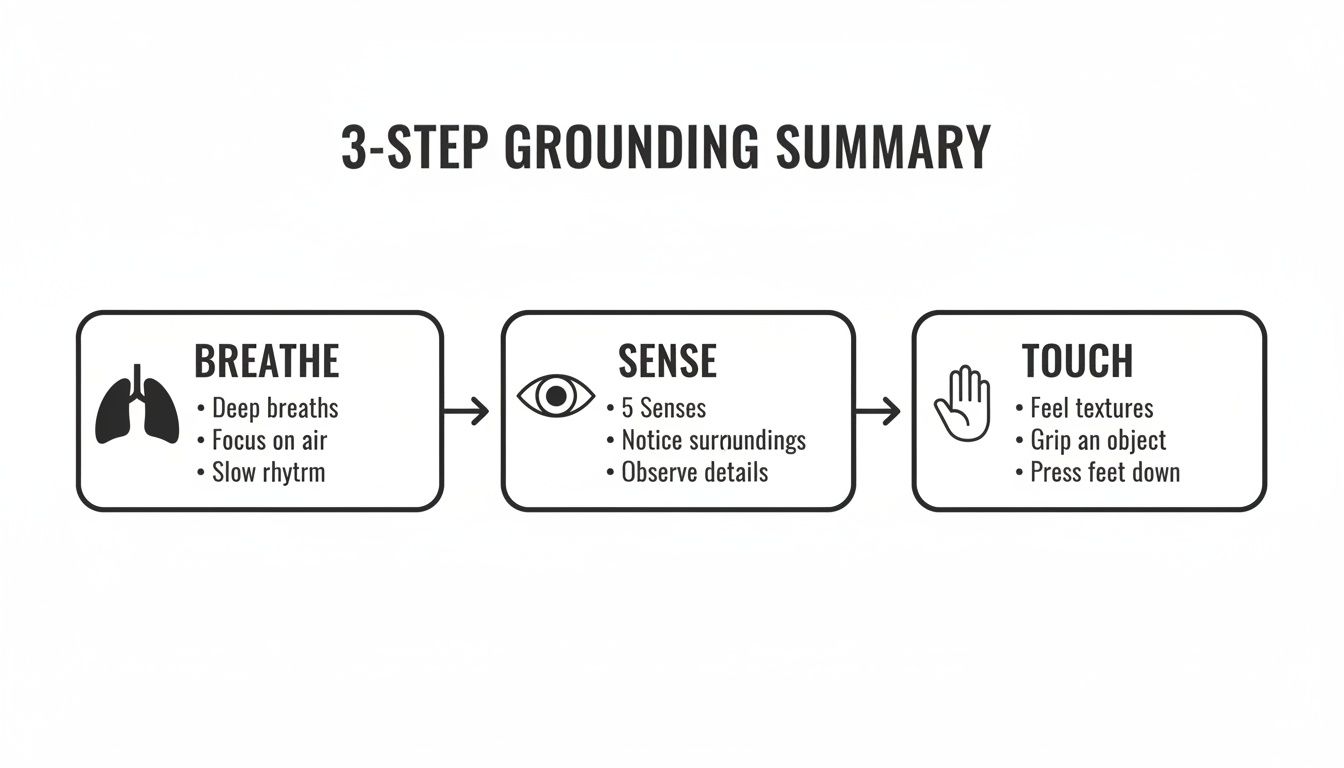
It visualizes a three-step process—Breathe, Sense, and Touch—that quickly brings your awareness back to the present moment, deactivating the panic signal.
Prioritize Sleep for Nervous System Recovery
Sleep is absolutely non-negotiable for a healthy nervous system. It's during these crucial hours that your brain and body repair, process the day's events, and essentially reset your entire stress response system.
A lack of quality sleep leaves you with a frayed nervous system, a shorter fuse, and a much lower threshold for stress. When you're chronically sleep-deprived, your body produces higher levels of cortisol. This creates a vicious cycle: stress disrupts sleep, and poor sleep amplifies stress, leaving you stuck in a state of hypervigilance.
Creating a consistent and relaxing bedtime routine is one of the most powerful things you can do. These long-term strategies support the entire body, but if you're looking for more targeted information, our guide explains how to repair your autonomic nervous system with specific interventions.
Commit to these sleep hygiene practices:
- Maintain a Consistent Schedule: Go to bed and wake up around the same time every day—yes, even on weekends. This helps regulate your body's internal clock.
- Create a Sanctuary: Optimize your bedroom for sleep. Make it dark, cool, and quiet to minimize stimulation for a sensitive nervous system.
- Establish a Wind-Down Routine: An hour before bed, disconnect from screens. Engage in calming activities like reading a book, taking a warm bath, or listening to soothing music to signal to your body that it's time to prepare for rest.
The table below gives a quick overview of how small, daily choices can either push you toward stress or guide you toward calm.
Nervous System Supporting Lifestyle Adjustments
| Lifestyle Area | Stress-Activating Habits | Calm-Promoting Habits |
|---|---|---|
| Morning Routine | Checking phone/news immediately, rushing, skipping breakfast | Gentle stretching, sunlight exposure, hydrating, eating a balanced meal |
| Diet | High sugar, processed foods, excessive caffeine, irregular meals | Whole foods, lean proteins, healthy fats, complex carbs, regular meals |
| Movement | High-intensity exercise only, sedentary lifestyle | Daily walks, yoga, tai chi, stretching, mindful movement |
| Work Habits | Multitasking, no breaks, poor posture, constant screen time | Single-tasking, taking regular breaks, ergonomic setup, screen-free time |
| Evening Routine | Watching intense shows, working late, scrolling on phone | Reading a book, taking a warm bath, journaling, avoiding screens |
| Sleep | Inconsistent sleep schedule, bright/noisy room, phone in bed | Consistent bedtime, dark/cool/quiet room, no electronics in bedroom |
Making these lifestyle adjustments consistently will compound over time, building a robust and resilient nervous system that is better equipped to handle whatever comes your way.
Professional Support for Lasting Change
If you’ve tried all the breathing exercises and lifestyle shifts but still feel stuck on high alert, please know you're not alone. Sometimes, the roots of a dysregulated nervous system run deep, often tangled up in past experiences or patterns that are just incredibly tough to tackle on your own.
This is where professional support becomes essential. Reaching out isn’t a sign of weakness; it’s a sign of incredible self-awareness. It means you’re ready to get to the bottom of why your body is stuck in survival mode. The goal is to find a practitioner and a method that truly resonates with you, creating a safe space to do this important work.
Rewiring Your Thoughts with Cognitive Behavioral Therapy
Cognitive Behavioral Therapy (CBT) is one of the most trusted and well-researched approaches for anxiety and chronic stress. The core idea is simple but powerful: your thoughts, feelings, and behaviors are all connected. Change your thought patterns, and you can change your emotional and physical responses.
For someone stuck in fight-or-flight, CBT is all about identifying the triggers and the automatic negative thoughts that kickstart the cascade. Let's say a critical email from your boss sends your heart racing. A CBT therapist helps you catch that immediate thought—"I'm about to be fired"—and gently challenge it, reframing it into something more balanced, like, "This is feedback. I can address these points and learn from it."
This process typically involves:
- Spotting cognitive distortions: Learning to recognize common thinking traps like black-and-white thinking or jumping to worst-case scenarios.
- Behavioral experiments: Safely testing your anxious assumptions to prove to yourself that you can handle challenging situations.
- Building a toolkit: Developing practical coping skills to manage anxiety as it arises, which reinforces your ability to self-regulate.
CBT gives you a structured, goal-oriented framework to become your own therapist over time.
Healing the Body with Somatic Therapies
Ever notice you can't just "think" your way out of a panic attack? That’s because trauma and chronic stress don't just live in the mind—they get stored in the body. Somatic therapies are body-centered approaches designed to release that trapped tension.
Instead of only talking about a stressful event, a somatic therapist helps you tune into the physical sensations that go with it—that tightness in your chest, the knot in your stomach. The idea is to allow your body to process and discharge that stuck survival energy without getting overwhelmed.
Key Insight: Somatic Experiencing (SE), a well-known somatic therapy, guides you through "titration" (feeling small, manageable bits of distress) and "pendulation" (shifting between feelings of distress and feelings of safety). This slowly and gently expands your nervous system's capacity for stress.
This approach can be a game-changer for people who feel like traditional talk therapy is missing a piece of the puzzle. It teaches you to listen to your body’s own wisdom.
Processing Difficult Memories with EMDR
Eye Movement Desensitization and Reprocessing (EMDR) is a unique therapy designed to help people heal from trauma and deeply distressing life events. It’s especially effective when a persistent fight-or-flight response is tied to specific, haunting memories.
During EMDR, a therapist uses bilateral stimulation—like guided eye movements or alternating taps—while you briefly focus on a difficult memory. This process helps your brain get back to its natural information-processing state, similar to what happens during REM sleep. The memory doesn't go away, but its emotional charge gets dialed way down.
The result? The memory becomes just that—a memory—instead of a live wire that keeps triggering your survival response in the present. Many people describe it as a profound sense of relief, feeling like the past no longer has a chokehold on their daily life.
Neurologically-Focused Chiropractic Care
Another powerful avenue for support is neurologically-focused chiropractic care, which directly addresses the function of the nervous system. This approach goes beyond just adjusting the spine to assess and correct imbalances within your autonomic nervous system.
Using gentle, specific techniques, this type of care helps shift the body out of sympathetic dominance (fight-or-flight) and into a more balanced, parasympathetic state (rest-and-digest). For families dealing with chronic stress, anxiety, or sensory challenges, it can be a foundational piece of the healing puzzle.
This care helps build a more resilient and adaptive nervous system from the inside out, making it easier to manage daily stressors and stop the fight-or-flight response before it even starts. Choosing the right professional is a deeply personal decision, but exploring all your options empowers you to find the best fit for your unique journey.
Important Considerations and When to Seek Help
Learning how to settle your nervous system is a personal journey, but that doesn’t mean you have to go it alone. While the self-help techniques we’ve covered are powerful, there are times when persistent symptoms or specific situations call for a more guided, professional approach.
Knowing when to lean on others for support ensures you and your loved ones get the right care at the right time.
This is especially true when it comes to kids. Children learn how to manage their own big feelings and chaotic moments by borrowing from the calm of a trusted adult. It’s a process called co-regulation, and it’s a biological necessity for their developing nervous systems. When a child is overwhelmed, they look to you to be their anchor in the storm.
By responding with your own steady presence, a soothing voice, and gentle reassurance, you teach their brain and body that it's safe to power down from high alert.
Special Guidance for Pregnancy
Pregnancy brings a wave of physical and hormonal changes that can make the nervous system feel more sensitive and reactive. While many calming techniques are perfectly safe, it's smart to prioritize gentle practices that honor your changing body.
Focus on these safe and effective strategies:
- Paced Breathing: The slow, rhythmic breathing exercises we've talked about are fantastic for managing stress during pregnancy without putting any strain on your body.
- Mindful Movement: Gentle prenatal yoga, walking, or simple stretching can help release tension and create a sense of well-being. Always listen to your body and stop if anything feels uncomfortable.
- Professional Support: Working with practitioners who specialize in prenatal care, like a Webster Technique certified chiropractor, can offer targeted support for both nervous system regulation and physical comfort.
Always check in with your healthcare provider before trying any new practice to make sure it’s a good fit for you and your baby.
Knowing When It’s More Than Just Stress
It's vital to know the difference between a normal stress response and a potential anxiety disorder. The fight-or-flight response is your body's short-term reaction to a specific trigger. An anxiety disorder, on the other hand, involves persistent, excessive worry that gets in the way of your daily life, often without a clear or proportional cause.
Anxiety disorders are incredibly common, affecting an estimated 359 million people globally in 2021. Unfortunately, there's a huge treatment gap—only about one in four people with the condition receive any kind of care. You can read the full report from the World Health Organization to learn more about this urgent need for accessible ways to restore nervous system balance.
If you feel like your fight-or-flight switch is stuck in the "on" position, it could be a sign that something more is going on.
A Crucial Distinction: A stress response is your body reacting to a challenge. An anxiety disorder is when that reaction becomes chronic, overwhelming, and starts to shrink your world.
When to Consult a Professional
Think of self-help tools as the first leg of your journey, not the final destination. If you feel like you're trying everything but still not getting relief, or if your symptoms are getting worse, that's a clear signal to seek professional help. A doctor or therapist can give you a proper diagnosis and create a plan that's tailored to you.
Consider reaching out to a professional if you’re experiencing any of the following:
- Your anxiety or panic is consistently interfering with your work, school, or relationships.
- You're starting to avoid certain situations or places because you're afraid of triggering a response.
- You're dealing with frequent physical symptoms like digestive upset, headaches, or chronic fatigue.
- You have a persistent sense of dread or hopelessness that you just can't shake.
- You find yourself using substances like alcohol to cope with your feelings.
Asking for help is a sign of strength and a proactive step toward getting your life back. It connects you with the resources and strategies you need to move from just surviving back to truly thriving.
Frequently Asked Questions
As you get more familiar with your nervous system, it's natural for questions to pop up. Understanding how to manage your fight-or-flight response when it feels stuck in the "on" position is a process, and getting clear on a few key ideas can make a huge difference. Let's tackle some of the most common questions we hear from families in our practice.
Can You Get Rid of the Fight or Flight Response?
This is a question we hear all the time from people who feel completely drained by being in a constant state of high alert. The short answer is no—and honestly, you wouldn't want to.
Your fight-or-flight response is a brilliant, hardwired survival tool. It’s the instinctual surge that helps you slam on the brakes to avoid an accident or gives you the strength you need in a true emergency. It's designed to save your life.
The real goal isn't to eliminate it, but to regulate it. We want to retrain the nervous system so it only flips that switch when genuinely needed. More importantly, we want it to easily return to a state of calm and safety afterward. The problem isn't the response itself; it's when chronic stress makes that "on" switch sticky.
How Long Does It Take for Calming Techniques to Work?
The timeline really depends on the technique and your own nervous system, but it helps to think about it in two ways.
First, there are the immediate, in-the-moment tools. Things like a physiological sigh or the 5-4-3-2-1 grounding method can offer noticeable relief within just a few minutes. They are designed to act as a pattern interrupt for an acute stress response, creating an immediate shift out of that panicked state.
Building true, long-term resilience, however, is a practice that unfolds over weeks and months. Consistent habits—like daily mindful movement, fiercely protecting your sleep, and eating for nervous system health—gradually build up your capacity to handle stress. Think of it like building muscle at the gym; one workout won’t make you strong, but consistent effort creates lasting strength and adaptability in your nervous system.
Key Takeaway: Immediate techniques are for in-the-moment relief. Consistent, daily practices are what build a solid foundation of calm over time. You need both to truly regulate your nervous system.
Is This a Panic Attack or Fight or Flight?
People often use these terms to mean the same thing, but there's a small yet important difference. The fight-or-flight response is the underlying physiological process—it's the flood of adrenaline and cortisol that gets your body ready for action. A panic attack is what can happen when that response gets triggered intensely, often without a clear or present danger.
- Fight or Flight Response: This is the broad physiological reaction to a threat you can identify. For example, your heart starts pounding before you have to give a big presentation.
- Panic Attack: This is a sudden, terrifying episode of overwhelming fear paired with intense physical symptoms like chest pain, dizziness, or a feeling of losing control. It often peaks within minutes and can feel like it comes out of nowhere.
Basically, you can think of a panic attack as an extreme and frightening expression of the fight-or-flight response. Knowing the difference can help you explain what you're experiencing to a healthcare professional so you can get the right kind of support.
At First Steps Chiropractic, we specialize in helping families build more resilient and balanced nervous systems. Our neurologically-focused approach addresses the root causes of chronic stress and anxiety. Schedule a complimentary consultation today to learn how we can support your journey to lasting wellness.