
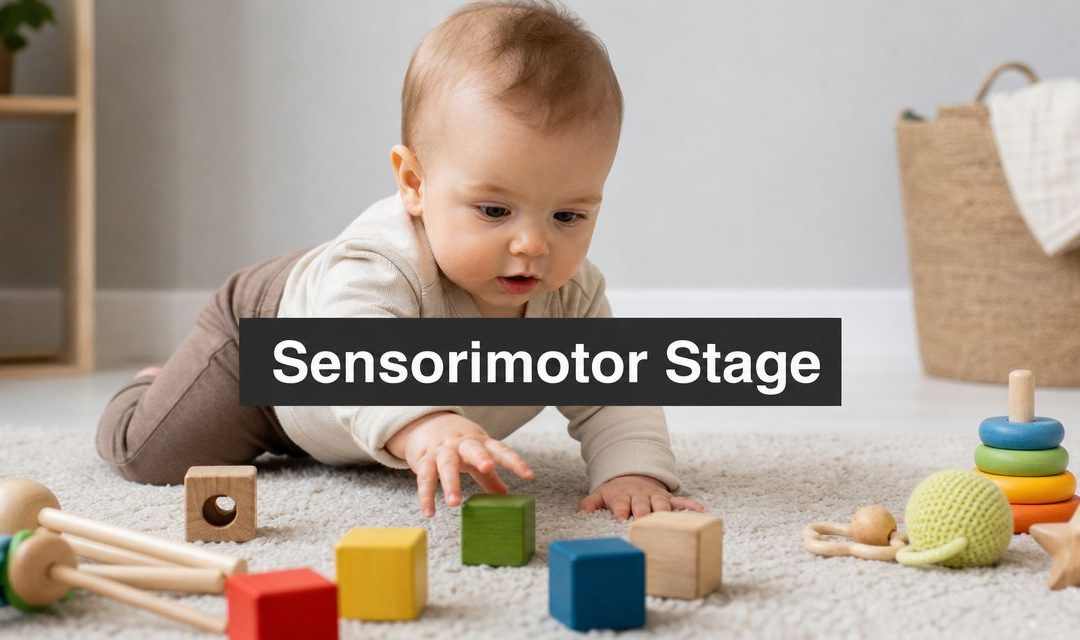
You set your baby down for a moment, and by the time you turn back, something has changed. The newborn who once curled inward and gripped on reflex is now twisting, reaching, dropping, searching, and studying your face with clear intent. For parents, that shift can feel exciting and hard to read at the same time.
Piaget called this early period the sensorimotor stage. It spans birth through the first two years and describes how babies build understanding through sensory input and movement, progressing from reflex-driven responses toward early problem-solving and representation.
Parents usually ask a practical question. How do I support this in a way that helps?
A nervous-system lens gives that question useful context. Babies learn through touch, movement, balance, vision, sound, and repetition. Every roll, latch, head turn, reach, startle, and toy search depends on the brain taking in sensory information and organizing a coordinated motor response. If that process is strained by tension, poor postural control, retained reflex patterns, or inefficient sensory processing, development can look less smooth even when a child is still moving forward.
As a pediatric chiropractor, I view these milestones as connected, not isolated. Cognitive development is tied to spinal motion, primitive reflex maturation, vestibular function, proprioceptive input, feeding mechanics, regulation, and a baby's ability to engage comfortably with the world around them. Families often understand this quickly once they see how body awareness affects everything from tummy time tolerance to visual tracking and exploration. Parents who want a clearer picture of that connection can start with this guide to proprioception and sensory processing.
Chiropractic care is not a substitute for pediatric medical care or developmental therapies. It can be a useful part of a broader support plan by helping improve comfort, movement quality, regulation, and the input the nervous system relies on during rapid growth.
The examples below focus on what parents commonly notice at home and what those behaviors may reflect underneath the surface. The goal is to help you spot meaningful patterns early, support healthy development with more confidence, and know when a child may benefit from closer evaluation.
1. Object Permanence and Spatial Awareness
One of the most memorable examples of sensorimotor stage development is the moment a baby starts looking for what disappeared. A toy falls off the tray. Instead of acting like it vanished from the universe, your baby leans, searches, and tries to find it. That shift matters.
In Piaget's model, object permanence typically emerges around 8 to 12 months during the coordination-of-secondary-circular-reactions substage, and infants who've developed it will continue searching for a toy after it's hidden under a blanket, as summarized by Lumen Learning's sensorimotor-stage review. Clinically, this is one of the clearest signs that a child is moving from purely immediate sensory response into intentional, goal-directed behavior.
What it looks like at home
Peek-a-boo starts working differently. At first, babies react to the surprise. Later, they anticipate your return. The same thing happens when a ball rolls under the couch or a favorite stuffed animal gets tucked under a blanket.
This milestone also overlaps with spatial awareness. To search successfully, a baby has to process where an object was, how their body is positioned, and what movement is needed to reach it. That calls on visual tracking, balance, neck control, trunk stability, and proprioceptive awareness.
Practical rule: If a baby wants to explore but seems frustrated by turning, rolling, or orienting in space, look beyond the toy and pay attention to how their body is organizing movement.
A chiropractic perspective parents can use
From a neurologically focused chiropractic viewpoint, movement quality matters more than milestone obsession. A baby who can rotate smoothly, tolerate tummy time, and coordinate eyes, head, and trunk usually has a stronger platform for object search and early problem-solving than a baby who's always fighting discomfort or asymmetry.
What tends to work well:
- Floor-based exploration: Safe floor time gives babies room to turn, pivot, reach, and reorient.
- Simple hiding games: Cover part of a toy, then all of it, and watch whether your baby tracks and searches.
- Observation of symmetry: Notice whether your baby consistently turns one way, resists looking up, or avoids weight-bearing through one arm.
What doesn't work well is overusing containers. Swings, loungers, and seats have their place, but they don't give the same vestibular and proprioceptive input as free movement.
For families wanting to better understand the body-awareness side of this milestone, this explanation of proprioception and sensory processing gives useful context. In practice, when object permanence is lagging, I don't jump straight to cognition. I first ask whether the baby can comfortably organize the movement needed to explore.
2. Reflex Integration and Primitive Reflex Maturation
A parent brings in a two-month-old who startles constantly, arches during feeds, and only settles on one shoulder. That pattern often looks behavioral from the outside. Clinically, it often points back to reflex-driven movement that is still running too loudly.
Reflexes are the nervous system's early survival programs. Rooting helps a baby find the breast or bottle. Palmar grasp closes the hand around touch. The Moro reflex reacts to sudden changes in position or sensation. These responses belong in early development, but they are meant to become less dominant as the brain and body organize more controlled movement.
Piaget described the first part of the sensorimotor stage as reflex-based, then gradually more repetitive and purposeful. In practice, parents usually see that shift as less startling, easier feeding, smoother head turning, and better tolerance for being moved, dressed, or placed on the floor.
Here's a familiar example of the grasp reflex in action:

Common reflex examples parents notice
A newborn turns toward touch on the cheek. That is rooting. A tiny hand closes around your finger. That is palmar grasp. A baby suddenly throws the arms outward with a startle, then pulls back in. Parents notice that one quickly because it can interrupt sleep, feeds, and calm alert time.
From a neurologically focused chiropractic perspective, the question is not whether reflexes exist. They should. The question is whether the baby can gradually shift from automatic patterns into more organized, comfortable movement. If that shift is delayed, families may see persistent stiffness, a strong head preference, trouble with tummy time, shallow latching, or difficulty settling after routine handling.
I pay close attention to symmetry, muscle tone, and how easily a baby transitions between positions. A baby whose reflexes stay dominant often uses extra tension to do simple tasks. That creates real trade-offs. Energy that could go toward feeding, social engagement, and motor learning gets spent on basic regulation.
Where support helps
Parents usually get poor advice at both ends. One side dismisses obvious patterns for too long. The other turns every retained reflex into a frightening diagnosis. A better approach is skilled observation, then a focused exam if the same concerns keep showing up in daily routines.
Useful things to watch at home include:
- Feeding comfort: Does your baby latch well on both sides, or strongly resist one position?
- Head and body symmetry: Does your baby consistently turn one way, arch back, or collapse to one side?
- Recovery after startle: Can your baby settle again, or does each startle trigger a long stretch of crying and tension?
- Progress toward voluntary movement: Over time, automatic reactions should give way to smoother head control, midline hand use, and more comfortable floor play.
This is also where body support matters. Babies build out of reflexes through repeated, well-organized movement experiences. Floor time, varied carrying positions, calm transitions, and support for postural control all help. Parents who want practical ideas for what comes next can use these fine motor skill activities for babies and young children to encourage more intentional hand use as reflexes mature.
In a pediatric chiropractic office, care should be gentle, age-appropriate, and centered on nervous system function. I am looking for signs that joint motion, muscle tone, and sensory processing are making it harder for the baby to move out of reflex dominance. When comfort and organization improve, babies often feed better, tolerate positioning more easily, and show smoother, less effortful movement.
A short demonstration can help parents recognize these early responses more clearly:
What tends to backfire is forcing milestone drills while ignoring regulation, asymmetry, or discomfort. Reflex maturation works best when the nervous system feels safe, supported, and free enough to practice better movement patterns over and over.
3. Hand-Eye Coordination and Visuo-Motor Development
Some of the easiest examples of sensorimotor stage development to spot are visual tracking, reaching, grasping, and mouthing objects. Parents usually describe this phase as, “Now everything goes straight to the mouth,” and that's not wrong. It's exploration.
A baby sees a rattle, tracks it, reaches, misses, tries again, grabs it, shakes it, and then mouths it. That sequence is cognitive and motor at the same time. The eyes guide the hand. The hand gathers information. The nervous system compares what was expected with what happened.

The real-world signs
Early on, babies start following faces and high-contrast objects. Later they reach for toys, transfer items between hands, bang objects together, and eventually stack blocks or scribble with a crayon. Each step asks the brain to integrate visual input with neck stability, shoulder control, trunk support, and hand function.
This is why I never look at fine motor skills in isolation. If a child has poor head control, resists tummy time, or collapses through the trunk, hand skills often look weaker too. The hand works best when the rest of the body gives it a stable base.
Good reaching is usually built from the shoulder inward, not just the fingers outward.
What tends to help most
Parents often want more complex toys when a child seems delayed. Usually, simpler is better. One easy-to-grasp toy, enough floor space, and repeated opportunities work better than an overstimulating pile of gadgets.
Useful strategies include:
- Position first: If baby is slumped, tilted, or uncomfortable, reaching practice won't be clean.
- Track both sides: Offer toys to the midline, then slightly to the right and left, and notice whether one side is consistently avoided.
- Choose objects with purpose: Rattles, soft blocks, rings, and textured toys give feedback the nervous system can use.
If your child is moving into toddlerhood and you're thinking about how these early patterns connect to later dexterity, this guide on improving fine motor skills is a helpful next step.
What doesn't work is chasing “advanced” skills before the foundation is there. If the neck, upper back, shoulders, and trunk aren't coordinating well, forcing pincer grasp tasks too early usually creates frustration instead of progress.
4. Cause-and-Effect Understanding and Sensorimotor Problem-Solving
A parent hands over a spoon. It hits the floor. They hand it back. It drops again. By the fifth round, it can feel like a test of patience. In development, though, that repetition usually means a baby is running an experiment.
This stage is not about random activity. It is about learning that an action creates a predictable result. Shake the rattle, hear the sound. Press the button, see the light. Drop the cup, watch what happens. These are early examples of sensorimotor problem-solving, and they show that a child is starting to connect movement, sensation, and outcome.
Why repeated experiments matter
Cause-and-effect learning depends on organized sensory input. A baby has to feel their own movement, notice the sound or visual change that follows, and register that the same action often leads to the same result. That is a nervous system task as much as a cognitive one.
From a chiropractic perspective, I pay attention to how well the child can stay regulated while exploring. A baby who is uncomfortable, tense through the trunk, overstimulated, or hard to settle may still want to learn, but the learning can look scattered. They may swat, fling, or abandon the activity before the brain has enough clean repetition to build a pattern.
That does not mean every child who drops toys needs care. It means the quality of the pattern matters.
What parents often notice at home
You will usually see cause-and-effect learning show up in ordinary moments, not formal play sessions:
- Rattle play: baby repeats the motion after discovering that their hand creates the noise
- High-chair drops: the object falls the same way each time, and that consistency is interesting
- Buttons and pop-up toys: toddlers repeat one action because predictable results help the brain organize information
- Social response patterns: babies learn that a sound, gesture, or cry changes what a caregiver does next
Repetition is often a sign of learning, not misbehavior.
The chiropractic lens adds an important layer here. Intentional play works best when the body can support it. If a child has poor postural stability, difficulty organizing both sides of the body, or signs of sensory overload, problem-solving can look less efficient because the nervous system is spending too much energy on regulation.
What helps most
Families usually get better results with an uncluttered environment, one action-and-result toy at a time, and enough pause for the child to repeat the same experiment. That slower pace gives the brain a fair chance to map cause and effect.
Real trade-offs matter here. More toys do not always mean more learning. Constantly switching activities can keep a baby entertained, but it often reduces the repetition needed for pattern-building. In practice, I would rather see a child spend several focused minutes with one useful toy than bounce through a pile of noisy options without clear engagement.
What tends to help most is simple and consistent. Watch what your child chooses to repeat. Notice whether they can stay organized during the activity. If their play looks frantic, one-sided, unusually avoidant, or hard to sustain, it is worth looking at regulation and body comfort, not just the toy itself.
5. Imitation and Social Mirroring Development
Some examples of sensorimotor stage development are social before they're verbal. A baby opens their mouth when you do. They smile back. They copy clapping, waving, or a simple sound. Those moments can seem small, but they reflect a lot of nervous system coordination.
Imitation asks the child to notice another person, process the expression or movement, organize their own body, and then reproduce it. That's visual processing, timing, motor planning, and engagement all working together. If one piece is weak, imitation often looks less frequent or less precise.
The milestone parents feel before they can define
Parents usually notice this as connection. “He lights up when we play face games.” “She started copying my clap.” “He babbles back when I repeat his sounds.” These are meaningful social-motor patterns.
A child might imitate:
- Facial expressions: open mouth, tongue out, surprise face
- Gestures: waving, clapping, reaching arms up
- Sound patterns: babbling back and forth with a caregiver
- Body actions: bouncing, patting, simple dance-like movements
This area deserves a balanced view. Reduced imitation can be a sign that a child needs more support, but it's not wise to jump to conclusions based on one behavior. I always look at the broader picture. Is the child orienting to people, tracking well, regulating touch and sound, and using their body comfortably?
A hands-on developmental clue practitioners can use
Observational research adds an interesting layer here. In a 2021 study, children's spontaneous gestures after hands-on object interaction showed that 16 children produced spontaneous representational gestures, and 13 of those children produced at least one re-enactment gesture that recreated a prior action. Practically, that tells us something important. Children often show understanding through gesture and reenactment before they can fully explain it in words.
In practice, I use that principle all the time. If a child can imitate an action sequence with objects or gestures, that's useful developmental information even when expressive language is still limited.
Clinical observation: Don't measure social learning only by words. Watch faces, gestures, body copying, and turn-taking.
What helps most is slow, repetitive interaction. Face-to-face songs, mirrored expressions, simple actions, and predictable routines usually work better than fast, noisy input. What doesn't help is overloading the child and then calling them inattentive when they disengage.
6. Symbolic Thinking and Language Development Emergence
A parent hands their 20-month-old a wooden spoon, and it becomes a microphone, then a wand, then something to stir an empty bowl. Soon after, that same child points to the family dog and uses the same sound each time. Those everyday moments mark a major developmental shift. The child is no longer learning only through direct touch and movement. They are starting to hold an idea in mind and use a symbol to represent it.
In Piaget's sensorimotor stage, this shift typically shows up near the end of the period, around 18 to 24 months. Earlier learning through movement, sensation, repetition, and exploration starts getting organized into mental representation. That matters for more than play. It lays groundwork for language, memory, planning, and social communication.
What symbolic thinking actually looks like
Symbolic thinking shows up in simple, observable ways. A block becomes a phone. A toddler pretends to feed a doll. A shoe might become a boat in the bath. These are signs that the brain is linking past experience with present action and creating meaning from it.
Language emerges from the same foundation. A child begins to attach sounds, gestures, and then words to people, objects, needs, and routines. Pointing to the fridge for milk, bringing a book for the same song, or using one word to request a familiar activity all count. Parents sometimes wait for clear spoken words and miss the earlier signs. In practice, gesture, joint attention, pretend play, and comprehension often show us where the system is heading before vocabulary expands.
From a neurologically focused chiropractic perspective, this stage depends on more than exposure to words. The child needs good regulation, steady postural control, comfortable neck movement, coordinated breathing, and efficient sensory processing. If the nervous system is working too hard to manage tension, poor body awareness, or constant dysregulation, communication often becomes less consistent. The child may know more than they can express.
What I look for clinically
I watch whether the child can stay present with a caregiver, shift attention between a person and an object, and use their body comfortably during play. I also pay attention to how they sit, breathe, vocalize, and turn toward sound. These are practical clues about whether the nervous system is supporting communication or creating extra friction.
A child does not need perfect speech at this stage. They do need a developmental pattern that is moving forward. Pretend play is expanding. Gestures are becoming more purposeful. Comprehension is improving. New sounds or words are gradually appearing.
Support that respects the whole child
Families usually get the best results from simple, repeatable input at home, paired with evaluation when progress feels stalled.
- Narrate real routines: Use clear, repetitive language during meals, dressing, bath time, and cleanup.
- Build symbolic play into the day: Offer dolls, toy animals, cups, spoons, cars, and household objects used safely in pretend ways.
- Watch for pre-verbal communication: Pointing, showing, bringing items, and shared attention matter as much as early words.
- Support body regulation: Good sleep, floor play, movement variety, and calm interaction help the brain organize language.
- Get help early when concerns persist: If symbolic play, understanding, gesture use, or expressive language seem limited, guidance on speech delay and early intervention can help families decide what to do next.
The trade-off is simple. Waiting can be reasonable when a child is steadily progressing across communication, play, and engagement. Waiting without tracking those patterns can delay support for a child who is already showing signs of strain. Early attention gives families better information, and in many cases, a better outcome.
6-Point Comparison of Sensorimotor Stage Examples
| Milestone | Implementation complexity 🔄 | Resource requirements ⚡ | Expected outcomes 📊 | Ideal use cases 💡 | Key advantages ⭐ |
|---|---|---|---|---|---|
| Object Permanence and Spatial Awareness | Moderate, monitoring, developmental play, targeted assessments | Low–Medium, caregiver time, toys, optional pediatric chiropractic/Insight Scan | Improved object tracking; better balance and proprioception | Infants ~4–8 months; delays in tracking or orientation; birth trauma history | Supports vestibular/proprioceptive integration; enhances motor planning |
| Reflex Integration and Primitive Reflex Maturation | High, regular assessment and reflex-specific intervention | Medium–High, trained pediatric practitioner, repeated visits, possible OT/PT | Integration of primitive reflexes; improved feeding and voluntary motor control | Newborns–18 months; retained reflexes, feeding or motor delays | Prevents developmental delays; establishes foundational nervous system patterns |
| Hand‑Eye Coordination and Visuo‑Motor Development | Moderate, monitoring plus targeted reaching/tracking activities | Low–Medium, toys, caregiver guidance, optional chiropractic checks | Better visual tracking, reaching, grasping; improved fine motor skills | 0–24 months; delayed reaching/tracking; early fine motor concerns | Foundation for writing/self‑care; enhances visual‑motor integration |
| Cause‑and‑Effect Understanding and Sensorimotor Problem‑Solving | Low–Moderate, provide exploratory play and observe responses | Low, simple cause‑and‑effect toys, supervised play, optional scans | Increased intentional actions; early problem‑solving and goal‑directed behavior | 8–12 months; delayed intentional play or sensory processing issues | Fosters cognitive trial‑and‑error learning; supports motor planning |
| Imitation and Social Mirroring Development | Moderate, social engagement, modeling, coordinated therapies | Medium, caregiver interaction, speech/OT coordination, possible chiropractic support | Improved imitation, early social bonding, language precursors | 8–12 months; social or speech delays; autism/sensory risk | Supports language/social learning; activates mirror neuron pathways |
| Symbolic Thinking and Language Development Emergence | High, multidisciplinary monitoring and interventions | High, speech therapy, regular assessments, caregiver programs, chiropractic as indicated | First words, pretend play, symbolic representation; improved communication | 18–24 months; speech delays or language disorder risk | Critical for communication and academic readiness; enables abstract thought |
Your Next Steps: Fostering a Healthy Foundation
The most useful thing about understanding examples of sensorimotor stage development is that it changes how you watch your child. A dropped spoon becomes a cause-and-effect experiment. Peek-a-boo becomes evidence of emerging object permanence. A copied clap, a pretend phone call, or a search for a hidden toy all tell you something about how the nervous system is organizing sensation, movement, and meaning.
That perspective also helps parents stay grounded. Milestones matter, but they're not a rigid checklist. Development unfolds through broad patterns, and caregiving and cultural context can shape how motor exploration and object play appear, as noted in this discussion of sensorimotor development and cultural context. That's why I encourage families to look for steady progression, quality of movement, and growing engagement instead of comparing one child to every chart online.
From a chiropractic standpoint, the practical question is simple. Is the child comfortable enough, organized enough, and regulated enough to explore well? When babies struggle with turning, feeding, asymmetry, tension, irritability, or poor tolerance for movement, those issues can affect how they interact with the world. Support should start with careful observation and an appropriate evaluation.
What tends to work best is a layered approach. Give babies floor time, simple toys, face-to-face interaction, and repeated opportunities to experiment. If something feels off, involve the right professionals early. Depending on the concern, that may include your pediatrician, a speech-language pathologist, an occupational therapist, a physical therapist, or a pediatric chiropractor.
Chiropractic care fits best when it's used thoughtfully. It isn't a shortcut to milestones, and it shouldn't be presented that way. Its role is to support nervous system function, movement quality, and regulation so the child has a better foundation for development. In a family-centered practice, that often means looking at posture, tension patterns, birth history, feeding mechanics, comfort, sleep, and sensory responses.
If you want a proactive next step, keep watching how your child moves, plays, searches, imitates, and communicates. Those behaviors are the earliest language of development. When needed, a neurologically focused office such as First Steps Chiropractic may be one option for families who want their child's movement and nervous system function evaluated as part of a broader support plan.
If you're concerned about developmental progress, feeding tension, sensory challenges, or you desire a proactive check on how your child's nervous system is functioning, First Steps Chiropractic offers complimentary consultations for families who want to explore whether neurologically focused chiropractic care belongs in their child's support team.