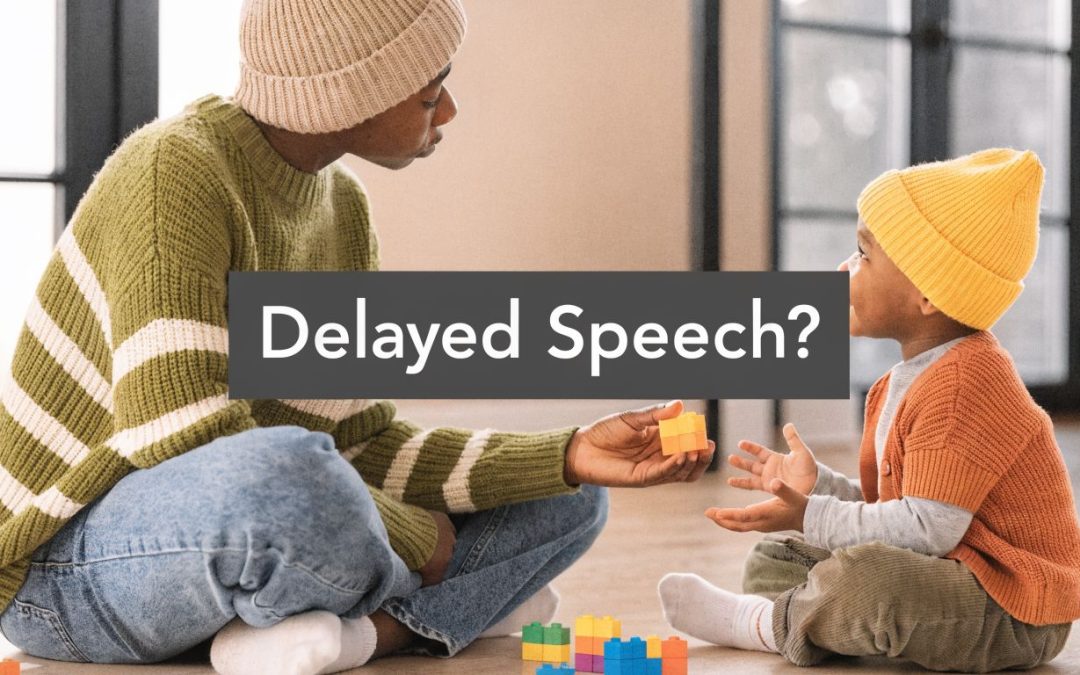
You're watching your child closely. Maybe they point instead of using words. Maybe they understand you beautifully but stay mostly quiet. Maybe another child the same age seems to chatter nonstop, and now you're wondering whether your child is taking their time or whether something more important needs attention.
That worry is familiar to many parents, and it makes sense. Communication is one of the clearest ways we see development unfolding in real time. When speech seems slow to arrive, parents often feel pulled between reassurance from others and a persistent inner voice saying, “Something feels off.”
That instinct matters.
Speech delay is a real and common concern. The National Institute on Deafness and Other Communication Disorders reports that about 1 in 14 U.S. children ages 3 to 17, or 7.2%, has experienced a disorder related to voice, speech, or language in the past 12 months (NIDCD quick statistics on voice, speech, and language). For toddlers, language delay is also common enough that many families face this question early.
What helps most is not panic, and not passive waiting. It's clarity. Parents need to know what delayed speech means, what signs deserve attention, what causes are possible, and what kinds of support can help. When you understand how speech depends on hearing, movement, comprehension, social connection, and nervous system coordination, the whole picture starts to make more sense.
Is My Child's Quietness a Sign of Delayed Speech
Some children are naturally observant. They watch before they join. They point, gesture, smile, and seem to take everything in. Quietness by itself doesn't automatically mean delayed speech.
What matters is how your child communicates overall.
A child may be quiet and still be developing normally if they respond to voices, understand simple directions, use gestures, engage socially, and gradually add sounds or words. Another child may also be quiet, but show signs that communication itself is harder. That's when it's worth looking more carefully.
Parents often get mixed messages. One person says, “He'll talk when he's ready.” Another says, “My daughter barely spoke until later too.” Sometimes that turns out fine. Sometimes it delays needed support.
Practical rule: If your concern keeps coming back, it deserves attention.
Speech development doesn't happen in isolation. A child's brain has to hear sound clearly, process meaning, plan movement, coordinate the lips and tongue, and connect communication to relationships. In other words, speech is one visible outcome of a much bigger developmental system.
That's why “what is delayed speech” is a more useful question than “why is my child quiet?” Delayed speech refers to a noticeable lag in developing spoken communication compared with expected milestones. It can involve difficulty making sounds, using words, combining words, or being understood.
What parents often notice first
- Fewer words than expected: Your child may use very few spoken words, or none consistently.
- Heavy reliance on gestures: Pointing, pulling your hand, or whining may replace words.
- Frustration during communication: Your child seems to know what they want but can't get it across.
- Uneven skills: They may understand a lot, yet still not speak much.
Quietness can be part of a child's temperament. Delayed speech is about communication development. Those are not always the same thing.
Understanding Speech Versus Language
Parents often use “speech” and “language” as if they mean the same thing. Clinically, they don't. This distinction clears up a lot of confusion.
Speech is the physical act of producing sounds. It involves breath, voice, timing, and precise movement of the lips, tongue, jaw, and palate.
Language is the system of understanding and using meaning. It includes knowing what words mean, following directions, combining words into messages, and using communication socially.
A simple way to think about it is this. Language is the message. Speech is the vehicle that delivers it.

A hardware and software analogy
If communication were a computer, speech would be more like the hardware, the moving parts that carry out the task. Language would be more like the software, the meaning, organization, and instructions.
A child can have trouble with the hardware, the software, or both.
- Speech difficulty: The child knows what they want to say, but producing the sounds is hard.
- Expressive language delay: The child understands more than they can say.
- Receptive language difficulty: The child struggles to understand what others say.
- Mixed delay: Both understanding and speaking are affected.
That middle distinction matters a great deal.
Expressive versus receptive language
A child with expressive delay may seem bright, connected, and aware. They follow directions, point to objects, enjoy songs, and understand routines, but spoken words are late to emerge.
A child with receptive language difficulty may have trouble understanding words, questions, or directions. That usually changes the clinical picture because understanding is the foundation for using language.
According to KidsHealth's parent guide to language delay, children who only have expressive delay often have a much better prognosis than children with receptive language problems. That same review notes that prognosis is excellent for developmental speech or language delay, while receptive language disorder has a much smaller response to therapy and is rarely fully normalized.
When a child understands well but speaks late, the outlook is often more encouraging than when understanding is also delayed.
Why this is easy to miss
Many parents focus on spoken words because words are easy to count. Understanding is quieter. A child may not say much, but if they can:
- follow familiar directions
- look toward named objects
- respond to routines
- point when asked
- show shared attention
that tells you something important about how language is developing under the surface.
The nervous system plays a role here too. For language to work, the brain has to receive input, interpret it, plan a response, and send coordinated motor signals back to the body. So when parents ask what is delayed speech, the better question is often, “Is my child struggling to understand, to express, to coordinate speech movements, or some combination of those?”
That's the distinction professionals try to sort out first.
Charting Your Child's Language Milestones
Milestones are best used as a road map, not a judgment tool. They help you notice patterns. They don't measure your love, your parenting, or your child's future.
Still, milestones matter because they show whether communication is unfolding in the usual sequence. Development can vary, but there are certain markers that deserve attention when they're missing.

Early communication milestones by age
Birth to 6 months
At this stage, babies are building the earliest foundations for speech and language.
Look for:
- Sound awareness: Startling, calming, or turning toward sounds
- Early vocal play: Cooing, gurgling, and pleasure sounds
- Social response: Smiling and engaging with faces and voices
6 to 12 months
Communication becomes more interactive.
Typical signs include:
- Babbling: Repeated sound patterns like “bababa” or “dadada”
- Voice response: Reacting to their name or familiar voices
- Gestures: Reaching, showing, or waving
12 to 18 months
Many children begin using meaningful words during this window.
You may notice:
- First real words: Simple, familiar words used consistently
- Growing understanding: Following simple directions
- Pointing to communicate: Not just to reach, but to share interest
18 to 24 months
Language often starts combining.
Common signs:
- More vocabulary: A growing number of everyday words
- Two-word combinations: Phrases like “more milk” or “mommy up”
- Better comprehension: Understanding simple routines and requests
2 to 3 years
Children usually become more verbally interactive.
You may hear:
- Short sentences: Simple combinations of words
- Questions: Early “what” or “where” questions
- Everyday conversation attempts: Even if pronunciation is still immature
3 to 4 years
Speech and language usually become easier for others to follow.
Look for:
- Longer phrases and sentences
- Simple storytelling
- Back-and-forth conversation
Red flags that deserve prompt attention
Evidence-based red flags include no babbling by 9 months, no pointing or gesturing by 12 months, no intelligible single words by 16 months, no two-word phrases by 24 months, and predominantly unintelligible speech at 36 months (clinical review on speech delay red flags).
That list matters because it gives parents something more concrete than vague comparisons with other children.
Missing one milestone doesn't define your child. A pattern of missed communication milestones is what deserves evaluation.
Development is broader than speech alone
Speech sits inside a larger developmental picture that includes movement, sensory processing, social engagement, and regulation. If you want a parent-friendly overview of how those pieces interact, this guide to the three domains of development is a useful way to think about the whole child instead of focusing on words alone.
A child who isn't talking much but is socially engaged, playful, and understanding language presents differently from a child who also struggles with gestures, interaction, attention, or motor planning. That broader context is why milestone tracking is helpful, but never the whole story.
Exploring the Common Causes of Speech Delays
Speech delay is not a single diagnosis. It's a symptom. That's one of the most important things for parents to understand.
Several different pathways can lead to late or difficult speech. The reason matters because the right support depends on the mechanism underneath it. In clinical frameworks, delayed speech may relate to hearing impairment, central nervous system disorders, developmental language disorder, speech-production disorders, anatomic differences, or environmental deprivation.

Physical causes that affect speech input or output
Some causes involve the body structures and functions needed for speech.
A child has to hear language clearly before they can learn it efficiently. Hearing loss isn't always obvious. According to Expressable's overview of common causes of speech delay, hearing loss can be subtle and may show up as poor response to name despite visual attention.
Speech also depends on coordinated movement of the mouth. That same clinical guidance notes that oral-motor impairment can reflect poor neurologic coordination of the lips, tongue, and jaw, often with feeding difficulty or drooling. That can happen in speech-production disorders such as apraxia or dysarthria.
Neurodevelopmental causes
Other children have broader developmental differences that affect communication. These can include global developmental delay, intellectual disability, autism spectrum disorder, or other central nervous system conditions.
In those situations, speech delay may be one of several signs rather than the only concern. Parents might also notice differences in play, joint attention, gesture use, sensory regulation, or social connection.
Here's where the nervous system lens becomes useful. Speech isn't just about talking. The brain has to:
- Receive input: Hear sounds and notice social cues
- Process meaning: Understand words and context
- Plan movement: Organize the sequence for speech
- Execute action: Coordinate breathing, voicing, and mouth movements
If any part of that chain is disrupted, communication can slow down.
Environmental and relational factors
Children also learn language through repeated interaction. Rich verbal engagement, responsive caregiving, shared attention, and back-and-forth play all support communication. When those experiences are limited, language development can be affected.
That doesn't mean parents are to blame. Often families are doing a tremendous amount already. It means speech develops in relationship, not in isolation.
Why nervous system function matters
The nervous system is the body's master communication network. It coordinates sensation, movement, attention, regulation, and learning. From a developmental perspective, speech relies on smooth brain-body communication.
If a child has subtle motor discoordination, feeding challenges, sound sensitivity, poor regulation, or tension patterns in the body, those clues may belong to the same bigger picture. Families who want a broader look at contributing factors can also explore this overview of speech delay causes, which discusses several of these patterns from a nervous system-centered perspective.
Speech delay can come from many directions. That's why guessing rarely helps. Careful assessment does.
When to Seek Professional Guidance
Parents often get told to “wait and see.” Sometimes that advice comes from kindness. Sometimes it comes from the assumption that all late talkers eventually catch up.
The problem is that waiting doesn't tell you which kind of delay your child has.
If your child has missed red-flag milestones, seems hard to understand, isn't using gestures or words as expected, or shows uneven development, it's time to ask for an evaluation. That is not overreacting. It's informed parenting.
Why early action matters
Evidence-based guidance says all children with suspected speech and language delay should be referred for formal assessment, and a literature review notes that although a wait-and-see approach is common for late talkers, early intervention can significantly improve language outcomes (AAFP review on speech and language delay in children).
That doesn't mean every child will need long-term therapy. It means evaluation is the safest next step when concerns are present.
Seeking an assessment doesn't label your child. It gives you clearer information.
Signs that should move you to act
Consider reaching out if you notice any of the following:
- Missed milestone patterns: Your child isn't progressing in communication over time
- Limited understanding: They don't seem to follow simple language consistently
- Motor clues: Feeding difficulty, drooling, or trouble coordinating mouth movements
- Social communication concerns: Limited pointing, shared attention, or response to interaction
- Parent concern: You can't shake the feeling that something isn't developing smoothly
Who to contact first
Start with your child's pediatrician. You can say something simple and direct: “I'm concerned about my child's speech and language development, and I'd like a formal evaluation.”
If you want a parent-focused explanation of why timing matters, this early intervention article on speech delay gives a helpful overview of the reasoning behind acting sooner rather than later.
The goal isn't to create alarm. It's to reduce delay in getting answers.
The Assessment Process What to Expect
Many parents hesitate because they don't know what an evaluation involves. They imagine a stressful test, a child who won't cooperate, or a meeting full of labels. In reality, good assessment is usually much more practical and child-centered than parents expect.
It often begins with conversation.
The pediatric visit
Your pediatrician usually starts by asking what you're noticing. They may want examples of words your child uses, whether your child follows directions, how they respond to their name, and whether there are concerns about hearing, feeding, social interaction, or development more broadly.
Bring observations from daily life. Short notes help:
- when you first became concerned
- what your child says regularly
- what your child seems to understand
- whether frustration is increasing
- any history of ear issues or feeding difficulty
That history gives context. It helps the pediatrician decide which referrals are appropriate.
The hearing evaluation
Hearing checks are essential in speech delay workups because a child can't reliably build speech from sound they don't hear clearly.
An audiologist uses age-appropriate methods to see how your child responds to sound. For toddlers, this often looks more like play than a traditional adult hearing test. The goal is simple. Rule out reduced or inconsistent access to sound.
The speech-language evaluation
A speech-language pathologist looks more closely at communication itself. This isn't only about counting words.
They may assess:
- Understanding: Does your child follow language and identify familiar items?
- Expression: What words, sounds, gestures, or phrases does your child use?
- Speech production: Are sounds clear, consistent, and coordinated?
- Play and interaction: How does your child communicate socially?
- Oral-motor function: Are there signs of movement difficulty involving the mouth?
Some children talk very little during an evaluation. That doesn't make the visit useless. Skilled clinicians learn a lot from play, gestures, sound attempts, and parent report.
What the outcome may include
The evaluator may recommend one service or several. Depending on the child, next steps might include:
- speech-language therapy
- hearing follow-up
- developmental screening
- occupational therapy
- monitoring with a structured plan
Sometimes families hear that the child appears to be a late talker with stronger understanding than expression. Other times, the evaluation points to a broader developmental pattern. Either answer is useful because it replaces uncertainty with direction.
The best assessments don't just answer “Is there a delay?” They answer “What kind of delay is this, and what support fits best?”
How You Can Support Your Child's Speech Development
You may leave an evaluation with relief that answers are finally coming, then feel a new worry on the drive home. What do I do tomorrow morning, at breakfast, during play, in the middle of a meltdown, or when my child points but still does not say the word?
That question matters because speech development does not grow from one hour of therapy alone. It grows across the whole day. Practice, connection, regulation, movement, and repetition all shape how a child learns to communicate.

Start with the supports that match your child's profile
The most helpful plan is based on the reason communication is hard. One child needs help producing sounds. Another understands little of what is said. Another wants to communicate but struggles to organize the mouth and body well enough to do it.
Speech-language therapy is often the center of that plan. Other children also benefit from hearing care, developmental follow-up, occupational therapy, or feeding support. Early help is common, appropriate, and often reassuring for families because it turns vague concern into a clear path.
Use everyday routines as language practice
Parents do not need to recreate a clinic at home. Children usually learn best in ordinary moments with familiar people.
Try building communication into routines you already have:
- Narrate simple actions: “Shoes on.” “Milk in.” “Wash hands.”
- Read in a back-and-forth way: Point to pictures, label one or two things, then pause.
- Follow your child's focus: If your child is interested in bubbles, cars, or snack, talk about that instead of changing the topic.
- Add one step to what your child says: If your child says “dog,” you can model “big dog” or “dog running.”
- Wait a few seconds before jumping in: That small pause gives the nervous system time to process, plan, and respond.
Small repetitions matter more than long lessons. Ten brief, connected moments across a day usually help more than one pressured practice session.
Reduce pressure and increase connection
Children speak more easily when they feel safe, engaged, and regulated. Constant quizzing can have the opposite effect, even when parents mean well.
A better approach is to create chances to communicate. Hold the snack for a moment. Pause before opening a favorite toy. Offer two choices. Smile when your child attempts a sound, gesture, look, or word. Communication starts before clear speech, and those early attempts are worth noticing.
Support the brain-body systems behind speech
Speech is not only about words. It also depends on attention, sensory processing, motor planning, muscle coordination, breathing, and regulation. Those functions are shaped by the nervous system.
Consider the effect of static on a radio signal. If the signal is noisy, the message does not come through clearly. In child development, the signal includes sensory input, regulation, motor planning, and communication between the brain and body.
That helps explain why some children make progress quickly once language is taught directly, while others need support for the underlying brain-body patterns that affect learning and expression. A child who is tense, dysregulated, easily overwhelmed, or poorly coordinated may have a harder time using communication skills consistently, even with good teaching.
Some families add complementary care alongside standard therapies for that reason. Neurologically-focused chiropractic is used by some as a supportive approach, not a replacement for speech therapy or medical evaluation. The goal is to support nervous system regulation and brain-body communication, which may help a child engage more fully in developmental work.
For example, First Steps Chiropractic describes a pediatric process that includes consultation, Insight Scans, a chiropractic exam, and gentle neuro-tonal adjustments such as Torque Release Technique. Families who choose this type of care generally use it as one piece of a broader support plan.
Here's a helpful visual explanation related to that broader perspective:
Takeaway: Children often make the best progress when support includes direct communication help, responsive interaction at home, and attention to nervous system regulation.
No single strategy fits every child. The goal is not to do everything. The goal is to choose supports that fit your child's needs and help their whole system work together more smoothly.
Frequently Asked Questions About Speech Delays
Are boys more likely to have speech or language problems
Yes. Research from the National Institute on Deafness and Other Communication Disorders reports that boys ages 3 to 17 are more likely than girls to have a voice, speech, or language disorder, 9.1% compared with 5.2%. That difference is one reason clinicians take parent concerns seriously when communication seems off early.
Will my child catch up
Some children do catch up, especially when the delay is mainly expressive and understanding is strong. Others need longer support. The key point is that prognosis depends on the type of delay, not only on how many words a child says today.
Is delayed speech the same as autism
No. Speech delay can happen for many reasons, and autism is only one possible cause. What raises more concern is when language delay appears alongside differences in social connection, joint attention, play, gesture use, or behavior patterns.
Can I just wait a few more months
If you're already concerned, it's better to ask for assessment than to keep guessing. Evaluation gives you information. It doesn't commit you to any one outcome.
What if my child understands everything but doesn't talk much
That pattern can be more reassuring than a delay that affects both understanding and expression. It still deserves professional review, but children with stronger receptive skills often follow a different path than children whose comprehension is also lagging.
Does speech delay mean I caused this
No. Speech delay is not a sign of bad parenting. It reflects how your child's communication system is developing. Your role now isn't to blame yourself. It's to notice, respond, and support.
If you're concerned about your child's speech development and want a nervous system-centered perspective alongside standard evaluation, First Steps Chiropractic offers pediatric care focused on neuro-tonal function for families in Hayden, Idaho. A consultation can help you decide whether your child may benefit from additional support as part of a broader developmental plan.