
If you've ever seen a child flap their hands in excitement or rock back and forth when they feel overwhelmed, you've seen stimming. Short for self-stimulatory behavior, stimming is any repetitive motion or sound that helps an autistic person regulate their emotions, manage sensory input, or express themselves.
Think of it as a natural pressure release valve. For a nervous system that's either overwhelmed by the world or desperately needs more input, stimming is an essential tool. These behaviors aren't just quirks; they are a core part of the autistic experience.
Unpacking the Meaning of Stimming
While the term "stimming" might sound a bit clinical at first, the concept behind it is deeply human. It's a vital strategy autistic individuals use to navigate a world that can often feel too loud, too bright, or simply too chaotic. It’s a physical response to an internal state, helping to organize sensory information and bring a sense of calm to the nervous system.
You might see a child flap their hands with pure joy while watching their favorite cartoon. Or you might see them rock gently in a noisy classroom to soothe their anxiety. These are classic examples of stimming, rooted in the unique way their brain is wired. With Autism Spectrum Disorder (ASD) now affecting about 1 in 36 children in the U.S., these behaviors are far more common than many people realize.
Why Stimming Happens
Instead of seeing stimming as a meaningless habit that needs to be stopped, it’s much more helpful to see it as a form of communication—and a powerful coping mechanism. It serves several crucial purposes for an autistic person, often tied to managing differences in how they process sensory information. If this is a new concept for you, our guide on what is sensory processing disorder can provide more context.
Stimming is not a behavior to be eliminated but a signal to be understood. It tells you what a person is feeling on the inside when they may not be able to express it with words.
To help you get a clearer picture, here’s a quick breakdown of the "why" behind these actions.
The Core Functions of Stimming at a Glance
This table breaks down the primary reasons why an autistic individual might stim, helping parents quickly understand the purpose behind the behavior.
| Function | What It Looks Like | The Underlying Need |
|---|---|---|
| Sensory Seeking | Spinning, staring at lights, or humming loudly. | The need to increase sensory input to feel "just right." |
| Emotional Regulation | Rocking, hand-flapping, or pacing when anxious or excited. | The need to manage intense feelings and calm the nervous system. |
| Self-Expression | Flapping hands with joy or making happy vocal sounds. | The need to express emotions when words are insufficient. |
Understanding these core functions is the first step toward supporting your child effectively. When you know the why, you can better respond to their needs instead of just reacting to the behavior itself.
Why Stimming Is a Natural Response
Stimming is so much more than a random habit—it's a deeply purposeful response to how the autistic brain experiences the world.
Think of the nervous system like a car engine. For it to run smoothly, it needs to maintain a steady idle. You don't want it revving sky-high with stress or sputtering from a lack of engagement. Stimming acts like the foot on the gas or the brake, helping bring that engine back into a stable, regulated state.
This kind of self-regulation is essential because the autistic experience often involves a completely different sensory reality. For many, the world can feel like a constant barrage of overwhelming information. For others, it can feel dull and understimulating. Stimming is a powerful, physical tool to manage that internal experience in real time.
The Brain’s Built-In Coping Mechanism
Stimming primarily serves three critical functions that are central to an autistic person’s well-being. When we understand what’s driving the behavior, we can reframe it from something unusual to something incredibly functional.
- Managing Sensory Input: Imagine if bright lights felt like spotlights or background chatter sounded like a chaotic symphony. Stimming helps filter that sensory overload by creating a predictable, rhythmic sensation the brain can focus on, effectively turning down the volume on the outside world.
- Regulating Emotions: Intense feelings like anxiety, excitement, or even frustration can send the nervous system into overdrive. Repetitive motions like rocking or hand-flapping actually release neurochemicals that produce a calming effect, helping to manage those powerful emotional states.
- Communicating Needs and Joy: When words aren't enough, stimming becomes a form of expression. A burst of happy hand-flapping can communicate pure joy more effectively than any sentence ever could, just as vigorous pacing might signal that stress is building up.
At its core, stimming is a testament to the brain’s incredible ability to adapt. It’s a self-created strategy for finding balance in a world that wasn't built for the autistic nervous system.
A Pathway to Regulation
When a child’s nervous system is balanced and regulated, they are far better equipped to handle the daily sensory and emotional challenges life throws their way. This is where understanding what is stimming in autism becomes so important for parents. A well-regulated nervous system is simply less likely to get overwhelmed, which can naturally reduce the need for intense stimming as a coping tool.
By supporting the foundational health of the nervous system, we empower children to feel more grounded and resilient. This approach doesn't aim to stop stimming. Instead, it addresses the underlying dysregulation that makes stimming so necessary in the first place. The goal is to help their internal "engine" run more smoothly on its own, giving them more capacity to learn, connect, and thrive.
Recognizing Different Types of Stimming
Stimming is as unique as the individual doing it, showing up in countless different ways. Think about how some people tap a pen when they’re deep in thought or bounce a leg when they feel anxious. An autistic child’s stims are just as specific, tailored to meet their sensory or emotional needs at that exact moment. Learning to recognize these behaviors is the first real step toward understanding the "why" behind them.
At its core, stimming is a way to interact with the world through the senses. A child might be trying to ramp up sensory input when they feel understimulated, or they might be creating a predictable, rhythmic sensation to block out an environment that feels chaotic and overwhelming. This is why stimming behaviors are often grouped by the sensory system they engage.
Categorizing Stims by Sense
When you start to see stims through a sensory lens, you can better understand what your child is trying to achieve. For instance, in the U.S., where about 1 in 31 kids were diagnosed with autism in 2020, common stims like hand-flapping (60%), rocking (50%), or repeating sounds (40%) are often used to manage sensory overload in busy places like classrooms or grocery stores. You can find more autism statistics on stepaheadaba.com.
To help you get a clearer picture, we’ve broken down the most common types of stimming by the sense they involve.
A Guide to Common Stimming Behaviors by Sense
This table organizes different stims by the sensory system they’re connected to, offering some concrete examples of what you might see.
| Sensory System | Common Examples |
|---|---|
| Visual | Staring at spinning objects (fans, wheels), flicking fingers in front of the eyes, repeatedly turning lights on and off, lining up toys. |
| Auditory | Making vocal sounds (humming, grunting), repeating words or phrases (echolalia), tapping on objects to create rhythms, covering ears. |
| Tactile | Hand-flapping, rubbing soft or specific textures, scratching or picking at skin, clapping hands, finger-tapping. |
| Vestibular | Rocking back and forth or side to side, spinning in circles, swinging for long periods, jumping up and down. |
| Oral | Chewing on shirt collars or non-food items, biting fingernails, licking objects, grinding teeth. |
Seeing these behaviors categorized can help you notice patterns you might have missed before.
Stimming isn't a random collection of habits. Each behavior, from humming a tune to rocking in a chair, serves a distinct purpose—calming the nervous system, expressing joy, or making a chaotic world feel more predictable.
By recognizing these different forms of self-stimulation, you can start connecting the dots. You might notice your child seeks out specific types of input when they are stressed versus when they are happy. This knowledge is empowering because it shifts the focus from just the behavior to the underlying need it fulfills. You can learn more by reading our guide on sensory seeking behavior.
When to Support Stimming and When to Intervene
One of the first questions parents ask is, "Is my child's stimming okay?" The answer, in almost every case, is a resounding yes. The vast majority of stimming behaviors are not only harmless but are essential tools for self-regulation, communication, and comfort.
Accepting stimming as a natural part of your child’s neurotype is one of the most powerful things you can do to support them.
Think of it this way: telling an autistic child to stop stimming is like asking someone to stop sneezing. You can try to hold it in, but the underlying need doesn’t just disappear. Suppressing the behavior often just bottles up the sensory or emotional pressure, leading to more distress and anxiety down the road. The goal isn’t to stop the stim, but to understand the need behind it.
Identifying When Redirection Is Necessary
While acceptance is the foundation, there are a few specific, limited situations where gentle redirection might be needed. The key here is that the decision should never be about making a child appear more "neurotypical" or saving them from social judgment. It should always be guided by their safety and well-being.
Intervention is only warranted if the stimming behavior:
- Causes physical harm to the child or others (e.g., head-banging against a wall, severe skin picking, or biting).
- Consistently prevents learning or participation in essential activities (e.g., a vocal stim is so constant it prevents them from hearing a teacher’s instructions).
- Leads to significant social isolation that genuinely causes the child distress.
This visual helps break down how different stims connect back to a core sensory need—whether it’s visual, auditory, tactile, or something else.
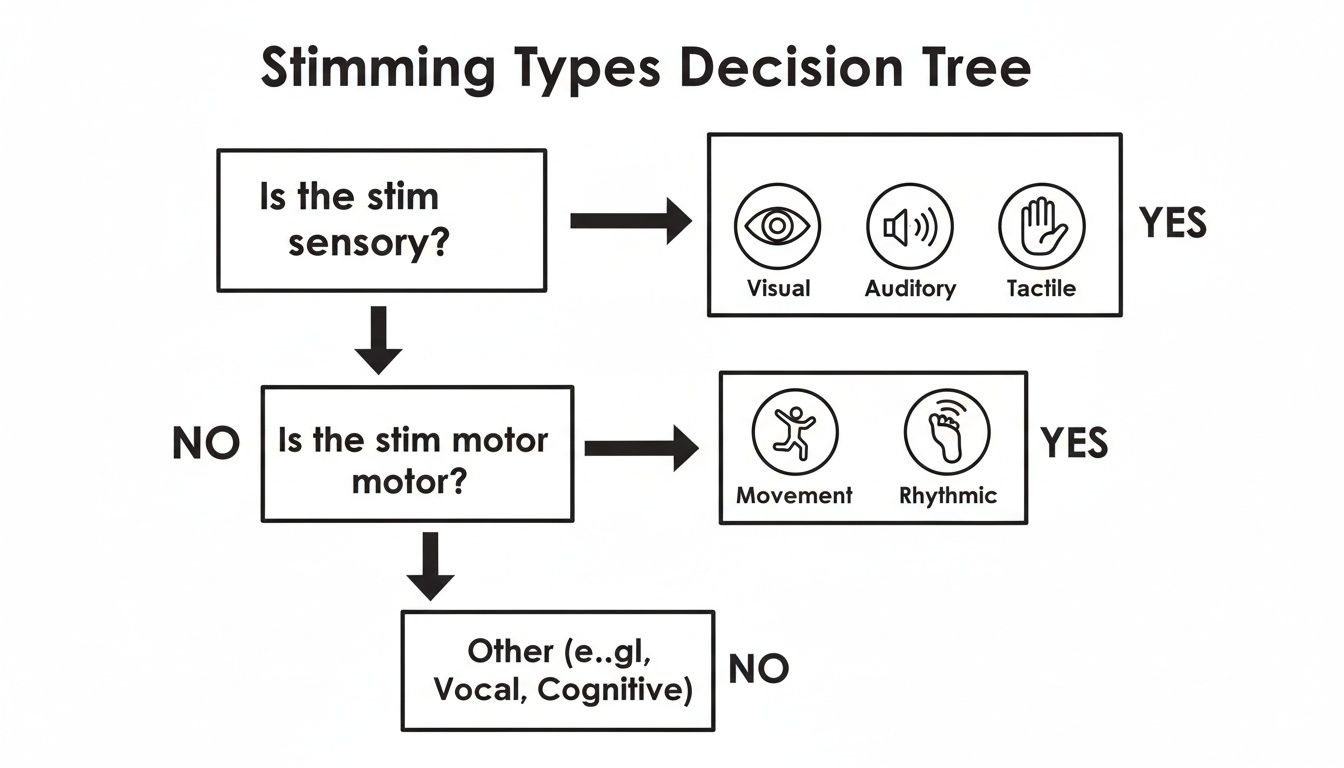
Understanding this connection is the first step to finding supportive alternatives if a stim truly is unsafe.
Supportive Strategies Over Punishment
If a stim does require redirection, the approach must always be supportive, never punitive. The goal isn't to eliminate the behavior but to find a safer or more functional alternative that still meets the same underlying sensory need.
Punishing a stim is like punishing a symptom. To create lasting change, you have to address the root cause—the sensory or emotional need driving the behavior.
For example, if a child chews on their shirt collar until it's full of holes, you could introduce a safe, wearable chewable necklace. If they are hitting their head, an occupational therapist might recommend activities that provide similar deep-pressure input, like using a weighted blanket, a compression vest, or doing "heavy work" like pushing a box.
This approach honors the child's needs while ensuring their safety. It empowers parents to make informed, compassionate decisions that support their child exactly as they are.
How Nervous System Health Impacts Regulation
Stimming is a direct, physical expression of what’s happening inside a child's nervous system. You can think of the nervous system as the body's master control center, responsible for processing every single sight, sound, touch, and sensation. When this system is balanced and regulated, a child can manage the constant flow of daily sensory input and emotional shifts with much greater ease.
But when the nervous system is dysregulated or stuck in a state of stress, it's basically on high alert all the time. This stress can start incredibly early—even at birth, physical tension and misalignments can impact how the brain and body communicate. A dysregulated system struggles to filter information, making a child far more susceptible to sensory overload and increasing their need to stim just to cope.

Identifying and Addressing Nervous System Stress
So, how do we get to the bottom of this dysregulation? We can use advanced tools that go way beyond just guesswork. One of the most important is Insight Scans, a type of thermography that safely and non-invasively measures nervous system activity. These scans give us a detailed map showing exactly where stress and tension are being stored, revealing how efficiently (or inefficiently) the nervous system is functioning.
This information is a game-changer because it allows for a precise, targeted approach to care. Instead of just trying to manage the outward behaviors like stimming, we can finally address the underlying neurological patterns that are contributing to them. This is where gentle, focused interventions make all the difference.
A regulated nervous system is the foundation for a child's ability to adapt, learn, and connect. When we support the body's core functions, we create the conditions for better emotional and sensory resilience.
Restoring Balance Through Neuro-Tonal Adjustments
Once we've identified those areas of stress, neuro-tonal chiropractic adjustments can help restore balance from the inside out. These adjustments are incredibly gentle and specifically designed for kids. They work by releasing stored tension along the spine and improving the communication pathways between the brain and the body, which effectively "turns down the volume" on the stress response.
By helping the nervous system shift out of that constant state of fight-or-flight, this care supports foundational health. This is absolutely vital for the 75 million people worldwide on the autism spectrum, especially since nearly 80% use stimming to manage anxiety. Addressing root causes like nervous system dysregulation can help reduce the intensity of stimming that's tied to sensory challenges. You can read more about these findings on nervous system dysregulation on pmc.ncbi.nlm.nih.gov.
The goal isn't to stop a child from stimming altogether. It's to help their nervous system operate more efficiently, which can naturally ease the intensity of the behaviors and improve their overall well-being and resilience. By supporting the body's innate ability to self-regulate, we empower children to feel calmer and more comfortable in their own skin. You can learn more about the connection between autism and the nervous system in our detailed guide.
Answering Your Questions About Stimming
As a parent, seeing your child stim can bring up a lot of questions. It's completely natural to wonder what these behaviors mean, whether they're okay, and how you can best support your child. We hear these concerns all the time, and we're here to offer some clear, straightforward answers to help you navigate this with confidence.
Think of these as the starting points for understanding—practical insights you can use right away. Because truly understanding is always the first step toward providing the most effective support.
Does Stimming Always Mean My Child Has Autism?
This is one of the first questions many parents ask, and it's an important one. While stimming is a hallmark characteristic of autism, it is not exclusive to it. The truth is, almost everyone stims in some way.
Think about a time you've seen someone bounce their leg during a meeting, tap a pen while concentrating, or twirl their hair when they're nervous. Those are all forms of self-stimulation.
The real difference often comes down to the frequency, intensity, and function of the behavior. For an autistic child, stimming isn't just a minor habit; it’s a much more fundamental and essential tool. It’s a vital coping mechanism for regulating a nervous system that experiences and processes the world in a profoundly different way.
If you notice your child's repetitive behaviors are intense, happen frequently throughout the day, and show up alongside other developmental differences—especially in social communication or play—that's a strong reason to consult a developmental specialist. They can offer a comprehensive evaluation to give you a clearer picture of your child's unique path.
Should I Try to Stop My Child From Stimming?
In the vast majority of cases, the answer is a firm no. Trying to stop a stim is like taking a life raft away from someone in choppy waters. It removes a critical tool they use to stay afloat emotionally and sensorially, and suppressing it often leads to even more anxiety and distress because the underlying need still isn't being met.
The focus should almost always be on acceptance. The only time you need to step in is if the stim:
- Causes direct physical harm, like head-banging or severe skin picking.
- Damages property in a significant way.
- Severely and consistently gets in the way of learning or essential daily activities.
Even then, the goal is never to just stop the behavior. It’s to redirect it to a safer alternative that fills the exact same sensory or emotional need. An occupational therapist can be an incredible partner in finding these safer, more functional alternatives that honor your child’s needs.
Forcing a child to stop stimming can send a powerful message that their natural way of coping is wrong or shameful. The most supportive approach is to embrace stimming as part of who they are while making sure they stay safe.
How Can I Help My Child Manage Stims in Public?
Navigating public spaces is about preparation and support, not about suppression or asking your child to "mask" who they are. The real goal is to help them feel regulated and comfortable, not to force them to hide their needs for the sake of making others comfortable.
Start by becoming a "sensory detective." If you know that loud, crowded stores always ramp up your child’s need to stim, you can plan ahead. Maybe that means visiting during off-peak hours, bringing noise-canceling headphones, or having them wear a weighted vest.
It’s also incredibly helpful to put together a portable "sensory toolkit" filled with discreet items your child can use on the go. This might include:
- Chewable jewelry (or "chewelry")
- A small, quiet fidget toy
- A piece of soft, textured fabric
- A stress ball
Finally, preparing a simple, confident explanation for curious onlookers can be empowering for you both. Something as straightforward as, “This is how he expresses himself and stays calm,” can respectfully end a conversation and normalize the behavior.
How Does Chiropractic Care Help With Stimming?
Our approach with neuro-tonal chiropractic care is to get to the root cause of dysregulation—the nervous system itself. The nervous system is the body's main processing center. When it gets stuck in a state of stress (the "fight-or-flight" response), a child's ability to handle sensory input plummets. This often leads to more frequent and intense stimming as a way to cope with feeling constantly overwhelmed.
Using advanced tools like Insight Scans, we can pinpoint exactly where that underlying stress is being held in the nervous system. Our gentle, specific adjustments are designed to release that stored tension and restore balance. This helps the nervous system calm down and function more efficiently.
By improving this foundational regulation, we help the body adapt better to its environment. Many parents tell us that as their child’s nervous system becomes more balanced, they seem less overwhelmed by sensory input. This can naturally reduce the need for constant, intense stimming by supporting the body's innate ability to self-regulate from the inside out.
At First Steps Chiropractic, we are dedicated to helping your child's nervous system function at its best, creating a strong foundation for them to thrive. Learn how our gentle, neurologically-focused approach can support your family’s well-being by visiting us at https://firststepschiropractic.com.