
The signs of a so-called "pinched" vagus nerve can be incredibly confusing and show up all over the place. We see it manifest as everything from digestive distress and anxiety to sensory challenges and sleep problems. And while a literal "pinch" is pretty rare, what's really happening is irritation or compression of this critical nerve. This disrupts your body's internal communication system, leading to a whole host of issues that might seem completely unrelated.
Figuring out what these symptoms are is the absolute first step toward finding gentle, effective solutions for your family.
What Pinched Vagus Nerve Symptoms Actually Feel Like

To really get what these symptoms feel like, picture the vagus nerve as your body’s main information superhighway. It’s this massive communication cable that links your brain to your most important organs—we’re talking heart, lungs, and the entire digestive tract. More than anything, it's the primary driver of the “rest, digest, and heal” side of your nervous system.
Now, imagine there's a huge traffic jam on that superhighway, usually caused by physical or emotional stress. The signals get delayed, jumbled up, or just plain blocked. This breakdown in communication is what you and your child actually experience as symptoms. It's not just one thing; it's a cascade of effects that can throw your entire well-being off-kilter.
This state of nervous system imbalance has a clinical name: dysautonomia.
To help you connect the dots, here is a quick look at some of the signs we see most often in our practice.
Quick Guide to Potential Vagus Nerve Symptoms
| Symptom Category | Potential Signs and Symptoms |
|---|---|
| Digestive & Gut Health | Reflux, colic, constipation, chronic bloating, trouble swallowing, "picky eating" related to discomfort. |
| Emotional Regulation | Constant anxiety, frequent meltdowns or tantrums, feeling easily overwhelmed, social anxiety. |
| Sleep Patterns | Difficulty falling asleep, frequent night wakings, restless sleep, not feeling rested upon waking. |
| Sensory Processing | Oversensitivity to noises, lights, or touch; sensory-seeking behaviors; challenges with focus. |
| Physical & Motor Skills | Poor muscle tone (hypotonia), chronic neck tension or torticollis, challenges with coordination. |
This table isn't exhaustive, but it highlights how a struggling vagus nerve can impact nearly every aspect of a child's (or adult's) life. Seeing these patterns is the key.
Common Signs of Vagus Nerve Irritation
The symptoms that come from vagus nerve dysfunction can be subtle at first, but they have a tendency to become more persistent over time. What we often see is a collection of issues that don't seem connected on the surface. For parents and expectant mothers, seeing these signs can be especially worrying.
Here are some of the most common physical and emotional symptoms:
- Digestive Distress: This is a huge one. It can look like reflux that won’t quit, constant bloating, constipation, or even difficulty swallowing.
- Anxiety and Overwhelm: A constant feeling of being "on edge," an inability to truly relax, or frequent feelings of panic are classic signs of poor vagal function.
- Sleep Disturbances: So many parents tell us about their child's trouble falling asleep, staying asleep, or waking up still feeling exhausted.
- Sensory Challenges: Kids might get easily overwhelmed by loud noises, bright lights, or even the feeling of certain textures on their skin.
The key takeaway is that these aren't just isolated problems. They are often signs of a deeper imbalance within the nervous system, where the body is stuck in a state of stress ("fight or flight") instead of being able to shift into a state of calm ("rest and digest").
Recognizing these "pinched" vagus nerve symptoms is the most important part of the journey. It allows you to stop chasing individual issues and start addressing the root cause—the interference messing with that vital communication highway. Once you understand these connections, you can begin to explore gentle, effective solutions to restore balance and health for your entire family.
Your Body's Master Regulator: The Vagus Nerve
To really get a handle on what a "pinched" vagus nerve means and why it can cause so many different issues, we have to start with the nerve itself. Don't just picture a single wire. Instead, think of the vagus nerve as the master conductor of your body's entire orchestra.
It’s the longest cranial nerve we have, starting its journey at the brainstem and weaving its way down through the neck, chest, and into the abdomen, making connections with nearly every major organ system it passes.
Its main responsibility is running your parasympathetic nervous system—what we often call the "rest, digest, and heal" system. This is the essential counterbalance to our "fight or flight" stress response. When the vagus nerve is working as it should, it keeps our internal world calm, balanced, and ready to recover from whatever life throws at us.
The Vagus Nerve as a Stress Dimmer Switch
A great way to think about this is to imagine a dimmer switch for your body’s stress levels. A healthy, properly functioning vagus nerve has high vagal tone. This means your dimmer switch is working perfectly; you can easily dial down the intensity of stress, which lets your body relax, recover, and heal effectively.
When you have high vagal tone, your heart rate slows down quickly after a scare, your digestion runs like clockwork, and you can drift off into a restful sleep without trouble.
But when the vagus nerve is irritated, compressed, or just not working right, you end up with low vagal tone. That dimmer switch is essentially broken and stuck on the brightest setting. This locks your body into a constant state of high alert, unable to access those crucial healing and calming modes. It's this non-stop "on" state where so many confusing and frustrating symptoms start to pop up.
When the body's 'stress switch' is stuck on, it's like a car engine that's always revving high, even when parked. This sustained state of alert consumes energy, wears down systems, and prevents essential maintenance and repair, leading to a cascade of health issues over time.
Tracing the Nerve's Critical Pathway
The physical path the vagus nerve takes is the key to understanding why it's so easily irritated, especially right up in the neck. After it leaves the skull, it travels down through the neck, passing directly by the top two vertebrae: the atlas (C1) and the axis (C2).
This specific spot is a critical bottleneck. Misalignments right here in the upper cervical spine are a huge deal, and they often stem from things like:
- Birth Trauma: Interventions like forceps, vacuum extraction, or even C-sections can put a ton of strain on a newborn’s very delicate neck and spine.
- Physical Stressors: For kids and adults, things like falls, sports injuries, car accidents, or even just chronic poor posture (think "tech neck") can cause these important bones to shift.
- Pregnancy: The major postural changes and physical load of pregnancy can easily create tension and misalignment in the upper neck and spine.
When these top vertebrae are even slightly out of their proper position, they can create direct physical tension and irritation on the vagus nerve as it squeezes past. This structural interference is the "traffic jam" on the information superhighway we talked about earlier. It messes with the signals trying to travel between the brain and the body, contributing directly to low vagal tone.
This connection is what explains how a physical problem starting in the neck can show up as digestive upset, anxiety, or sensory challenges. The issue isn't really with the stomach itself, or even the brain's emotional centers, but with the communication line that connects and regulates them all.
To learn more about this connection, you can explore the details of what vagus nerve function entails in our in-depth guide. Understanding this pathway is the first step toward finding real solutions that address the root cause, not just chase the downstream symptoms.
Uncovering the Causes of Vagus Nerve Irritation
So, what’s really behind the symptoms of a “pinched” vagus nerve? It's rarely a single, dramatic event. Instead, the journey often starts with a series of physical stressors that build up over time, creating interference along this vital nerve pathway. For many families, these stressors begin much earlier than you’d expect, setting the stage for future challenges.
Imagine the vagus nerve's route through the neck as a superhighway passing through a narrow mountain tunnel. The vertebrae of your upper neck are the walls of that tunnel. When everything is lined up perfectly, traffic flows freely. But if physical tension causes those vertebrae to shift—even just a little—it's like a rockslide narrowing the tunnel. This creates a traffic jam, irritating the nerve and disrupting the flow of information.
This diagram shows just how critical that pathway is, tracing the vagus nerve from the brain, through that narrow passage in the neck, and down to all the core systems of the body.
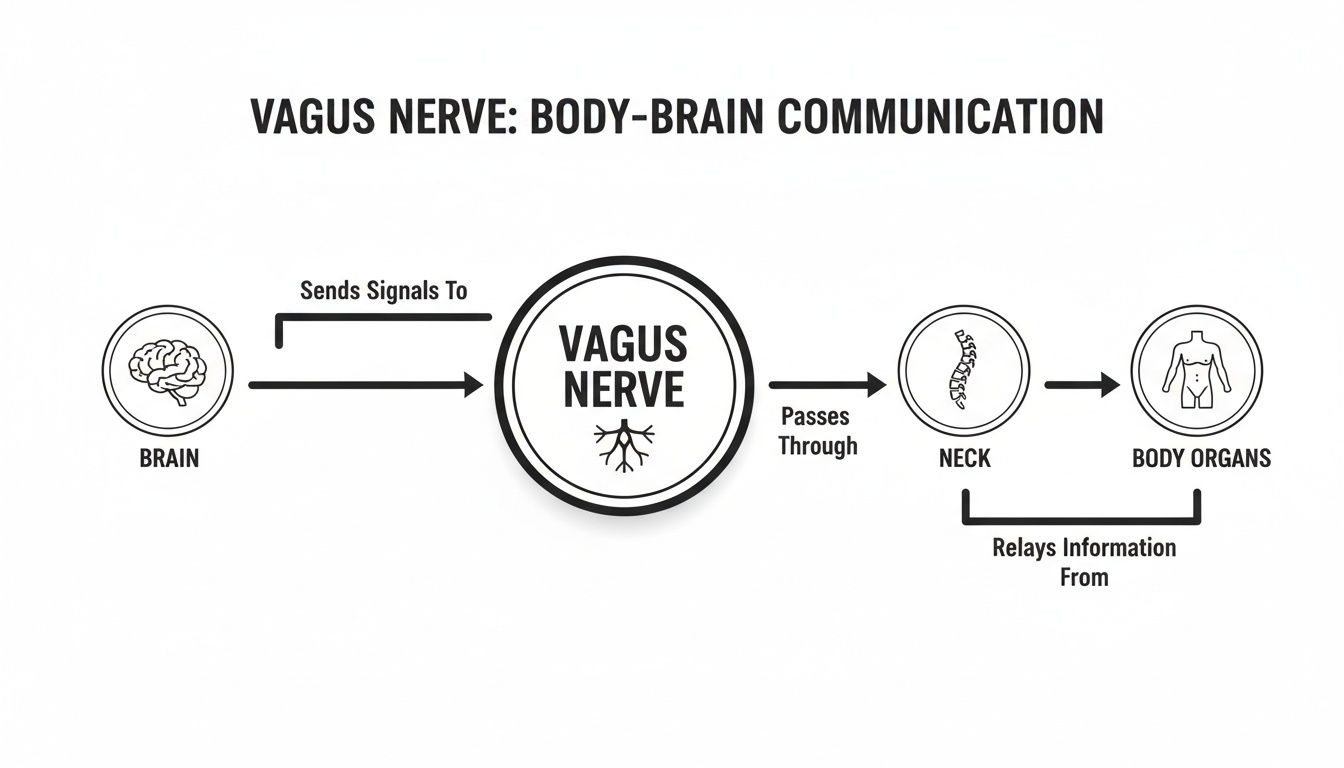
You can see why the neck is such a crucial—and vulnerable—spot for nerve function. It’s the direct link between the health of your spine and the regulation of your entire body.
Early Life and Childhood Stressors
For a newborn, the very first major physical stress can come from the birthing process. Interventions like forceps, vacuum extraction, or even the intense pulling and twisting common in C-sections can put an incredible amount of strain on a baby's tiny neck and upper spine. This is often where the first misalignment, or subluxation, happens, creating the initial interference with the vagus nerve.
As kids get older, the sources of physical stress just keep coming. Think about the countless tumbles a toddler takes when learning to walk, the falls off a bike, or all the bumps and impacts from playground fun and sports. Kids are amazingly resilient, but these repeated physical knocks can add up, causing misalignments to stick around.
Even our modern habits are playing a huge role:
- "Tech Neck" from kids spending hours hunched over phones and tablets.
- Heavy Backpacks that pull on the neck and shoulder muscles day after day.
- Poor Posture from sitting at school desks or slouching on the couch.
Each of these seemingly small things adds to the constant physical tension that can directly irritate the vagus nerve.
Pregnancy and Postural Shifts
For expecting moms, pregnancy brings a whirlwind of physical changes that can throw the nervous system for a loop. As the baby grows, a mother’s center of gravity pulls forward, and her body has to compensate. This usually means a more pronounced curve in her lower back and a head posture that juts forward.
This new posture puts a massive strain on the muscles and ligaments in the neck and upper back. It’s this constant structural tension that can easily lead to misalignments in the upper cervical spine—creating the perfect setup for vagus nerve irritation right when a calm, connected nervous system is needed most.
The cumulative effect of these life stressors—from birth trauma to daily posture—is what often leads to the symptoms of a "pinched" vagus nerve. The problem isn't a single injury but a pattern of sustained interference that prevents the nervous system from functioning at its best.
On top of all this, some people are simply more prone to these issues because of how their vagus nerve is built. Anatomical variations are surprisingly common. Research shows that the overall prevalence of these variations is 36.2%, but that number jumps to 47.4% in people aged 60 and older. These variations are most often found in the lower cervical region—the exact area where structural chiropractic care focuses on restoring proper alignment and function. You can learn more about the findings on vagus nerve variations and why they matter clinically.
Common and Atypical Vagus Nerve Symptoms in Families
When the vagus nerve's communication highway gets jammed, the symptoms can be really confusing because they pop up all over the body. One family might be dealing with constant gut issues, while another is navigating anxiety or sensory meltdowns.
The key is recognizing that these aren't separate problems. They're often different expressions of one underlying issue—a nervous system stuck in overdrive.
Let's break down the classic and less obvious signs we see in our practice every day, using real-world examples to help you connect the dots for your own family.
Classic Digestive and Physical Symptoms
The most well-known signs of a "pinched" vagus nerve often involve the gut and throat, which makes sense because the nerve directly controls these areas. Think of it like static on the phone line between the brain and the digestive system. The signals for normal digestion and swallowing get totally distorted.
This interference frequently shows up as:
- Persistent Digestive Distress: This is a huge one. In infants, it might look like chronic reflux or colic. In older kids and adults, it could be constipation that just won't go away, or constant bloating and gas.
- Swallowing and Voice Changes: Have you ever felt like there's a lump in your throat? Some people also have trouble swallowing or find their voice is suddenly hoarse or weak. That's because the vagus nerve controls the muscles in the voice box, so irritation can directly mess with your voice.
- Heart Rate and Breathing Irregularities: Since the vagus nerve is the body's natural brake pedal, irritation can cause a heart rate that feels too fast or fluctuates wildly. It can also lead to shallow, inefficient breathing patterns.
These physical signs are often the first clues that the body's primary calming nerve isn't working as it should.
The Less Obvious Neurological and Emotional Signs
While gut issues are common, the most overlooked symptoms are often neurological and emotional. This is where so many families feel lost, because the link between a nerve in the neck and a child’s behavior isn't immediately obvious.
When the "rest and digest" system is offline, the "fight or flight" system takes over and runs the show. This sustained stress state is behind so many of the challenging symptoms we see.
The real question becomes: Is your child just being "difficult," or is their nervous system physically incapable of calming down? Often, behaviors like sensory meltdowns or constant anxiety are not choices but physiological responses to a nervous system that's stuck on high alert.
Does your child get completely overwhelmed in a noisy Target or a crowded restaurant? As a parent, do you feel a constant, low-grade buzz of anxiety for no clear reason? These are powerful signs of poor vagal tone.
Consider these less-obvious indicators:
- Sensory Processing Disorder (SPD): This is when kids are hypersensitive to sounds, lights, or touch. A tag in a shirt can feel like sandpaper, or a normal level of noise sounds like a rock concert.
- Emotional Dysregulation: This can look like frequent, intense meltdowns over seemingly small things, chronic irritability, or just being unable to bounce back from an emotional upset.
- Poor Sleep Quality: Struggling to fall asleep, waking up constantly, or never feeling rested are common complaints when the vagus nerve can't signal the body that it's time to relax.
- Anxiety and Focus Challenges: Vagus nerve dysfunction is a massive contributing factor to conditions like anxiety, ADHD, and even POTS (Postural Orthostatic Tachycardia Syndrome) because it messes with the body's ability to self-regulate.
Clinical research absolutely backs this up, showing that vagus nerve compression in the upper neck can present with a specific cluster of symptoms that might otherwise seem unrelated—like new-onset anxiety, a rapid heart rate, bloating, and nausea. When that compression becomes chronic, it can lead to dysautonomia, where the "fight or flight" system dominates.
For parents, noticing these patterns of anxiety, digestive issues, and sleep problems in their kids could point straight to an underlying structural issue affecting vagal function. You can learn more about the clinical signs of vagus nerve compression and its widespread effects.
How We Assess and Address Vagus Nerve Dysfunction
Just realizing that a whole collection of seemingly random symptoms might be connected to vagus nerve irritation is a massive first step for most parents. The natural next question is, "Okay, so what do we do about it?"
Our approach is different. We don't just manage symptoms. We focus entirely on finding and addressing the root cause of the interference. It’s a precise, data-driven process designed to get your family’s nervous system back on track.
Chasing symptoms is a lot like playing whack-a-mole; you might knock down one issue for a little while, but another one will just pop up if the real problem isn't fixed. Our goal is to find the exact source of the "traffic jam" on the nervous system's superhighway and gently clear it out. When we do that, the body can finally heal and regulate itself the way it was designed to.
Starting with Your Story
Everything we do begins with a detailed consultation. This isn’t about filling out a quick intake form. It's a deep dive into your family's entire health journey. We work with you to connect the dots between your child's birth story, their developmental milestones, the challenges you're facing now, and even your own health history as an expectant mother.
This conversation is absolutely crucial because it gives us the context for what we might find in our objective scans. It helps us understand the layers of stress—physical, chemical, and emotional—that have built up in your family's nervous system over time. Your story is what helps us start to pinpoint where the interference likely began.
Measuring Nervous System Stress with Insight Scans
After we understand your story, we move on to objective measurement. We use advanced Insight Scans to get a clear, non-invasive look at exactly how the nervous system is functioning. These scans are completely safe for everyone, from newborns to pregnant moms, and they give us real, concrete data about where stress is being stored.
Think of it like this: your nervous system has a certain amount of energy, or "gas in the tank." The scans show us exactly how much of that precious energy is being wasted just dealing with stored stress and tension. This is a total game-changer for understanding pinched vagus nerve symptoms because it objectively shows us the "traffic jams" that are messing with nerve function. You can learn more about how a chiropractic nerve scan works and the incredible information it provides.
Our scans have three key parts:
- Thermography: This scan measures tiny temperature differences along the spine, which points us to where inflammation and nerve irritation are happening.
- Surface EMG (sEMG): This looks at muscle tone, showing us exactly where muscles are overworked, tight, and exhausted from constantly holding onto tension.
- Heart Rate Variability (HRV): This is a direct measure of your vagal tone. It tells us how well your body can adapt to stress and shift from that "fight or flight" mode back to a calm "rest and digest" state.
Pinpointing the Root Cause
The data from the Insight Scans is our map, guiding our comprehensive chiropractic exam. This is where we put our hands on the spine to feel for the exact spots of misalignment and restriction—what we call subluxations—that the scans flagged.
When it comes to the vagus nerve, we pay extremely close attention to the upper cervical spine (the very top of the neck). This is a critical bottleneck where interference happens most often. By combining your health history, the scan data, and our physical exam, we can pinpoint the precise location and severity of the structural interference bogging down the nervous system.
Our entire approach is built on one simple but powerful principle: the body has an incredible, innate ability to heal itself. Our job isn't to do the healing for you, but to find and remove the interference that's stopping your body from doing its job.
This detailed assessment lets us create a care plan that is 100% personalized. We use gentle, specific adjusting techniques, like the Torque Release Technique (TRT), that are designed to remove interference without any of the popping or cracking people often associate with chiropractic. This process restores balance, improves vagal tone, and empowers your family's nervous system to function at its best, leading to lasting health and true resilience.
Gentle Ways to Improve Your Family's Vagal Tone

While neurologically-focused chiropractic care is the foundation for getting to the root cause of vagus nerve irritation, we believe in empowering families with strategies you can use right at home. These gentle, simple steps can help improve vagal tone, making your body more resilient between adjustments.
Think of it like this: our gentle adjustments are like clearing a major roadblock on a highway, finally letting traffic flow smoothly again. The at-home exercises are like improving daily traffic patterns with good driving habits, which helps keep everything running efficiently for the long haul.
Simple At-Home Exercises for Vagal Tone
These activities are easy enough for the entire family to do together. They work by directly stimulating the vagus nerve through vibrations and movements in the throat and diaphragm.
Here are a few of our favorites you can try today:
- Deep Belly Breathing: Place a hand on your belly and take a slow, deep breath in through your nose, feeling your stomach expand like a balloon. Now, exhale even more slowly. This deep diaphragmatic breathing directly activates the vagus nerve’s powerful relaxation response.
- Humming or Singing: The vibrations created in your throat and chest when you hum a favorite tune or sing a song are a fantastic way to gently stimulate the nerve. Turn on some music and make it a fun family activity!
- Gargling: Vigorously gargling with water for 20-30 seconds contracts the muscles in the back of the throat, which is another direct line of stimulation to the vagus nerve.
The goal of these exercises is to gently nudge the nervous system out of "fight or flight" and back into "rest and digest." By practicing them regularly, you are actively training your body to access a state of calm more easily.
Integrating these simple practices into your daily routine can make a real difference. For a deeper look into these techniques and more, check out our guide on natural vagus nerve stimulation.
The Science of Non-Invasive Stimulation
Beyond these simple exercises, the science behind stimulating the vagus nerve has grown by leaps and bounds. A field known as non-invasive vagus nerve stimulation (nVNS) uses gentle electrical impulses, often through a small device clipped to the ear, to activate the nerve.
This approach aligns perfectly with our goal in chiropractic care—optimizing nervous system function without drugs or surgery. Clinical trials have shown some pretty impressive results. For instance, in studies of atrial fibrillation, vagus nerve stimulation decreased episodes by 85% compared to those without treatment. For people with POTS, it has been shown to reduce heart rate spikes upon standing by 15 beats per minute and lower adrenaline surges. You can explore more research on the broad benefits of non-invasive stimulation techniques.
Ultimately, both at-home exercises and advanced nVNS point back to the same core principle we focus on in our practice. Gentle, specific chiropractic adjustments work by removing structural interference in the upper neck, which improves the body's own innate ability to regulate itself. This allows the vagus nerve to function optimally, creating lasting change from the inside out.
Your Vagus Nerve Questions Answered
When you’re exploring vagus nerve health for your family, a lot of questions come up. It's completely normal. Let's walk through some of the most common ones we hear from parents just like you, so you can feel clear and confident about your next steps.
Are Vagus Nerve Adjustments Safe for Babies and Pregnant Women?
Absolutely. This is our specialty, and it's a world away from what most people picture when they think of "chiropractic." The adjustments we use in our pediatric and prenatal care are incredibly gentle and precise.
For a baby, the amount of pressure is often no more than what you'd use to check if a tomato is ripe. Seriously, that’s it. These adjustments are specifically designed for the unique needs of a developing baby's nervous system or an expectant mother’s body. Our entire focus is on restoring proper function without any forceful twisting, popping, or cracking.
How Soon Can We Expect to See Improvements?
This is a great question, and the honest answer is that every child's nervous system heals on its own timeline. Some families notice big shifts very quickly—better sleep, smoother digestion, or a calmer demeanor—especially in infants, whose systems are so new and responsive.
For others, especially when we're dealing with more chronic or layered stress, it can take a bit longer for the body to unwind and regulate itself. Our care plans are built around your family’s specific Insight Scans and health goals, so we know exactly what we’re working on and can track progress every step of the way.
Every healing journey is unique. The key is consistency and addressing the root cause, which allows the body to make lasting changes rather than just temporarily masking symptoms.
Can Vagus Nerve Problems Come Back After We Finish Care?
Our primary goal is to get to the root of the nerve irritation and make a lasting correction. By improving the overall function of the nervous system, we’re actually helping your child’s body become more resilient and better able to handle the everyday bumps, tumbles, and stresses of life.
However, life happens. New stressors like a big fall, a period of emotional stress, or even prolonged poor posture can create new challenges. This is why many of our families choose to continue with periodic wellness check-ups. Think of it like regular dental cleanings—it's proactive care to maintain optimal function and catch little issues before they become big problems again.
If you're ready to get to the bottom of your family's health challenges and find a path toward lasting wellness, First Steps Chiropractic is here for you. We invite you to schedule a complimentary consultation to talk about your family's specific needs and see how our neurologically-focused care can make all the difference.