

Behavioral issues in 2-year-olds are rarely what they seem. They often come from a perfect storm brewing inside your toddler: a brain developing at lightning speed, a fierce new drive for independence, and very few words to explain all those big, overwhelming feelings.
When you see hitting, biting, or intense tantrums, it’s not your child trying to be defiant. Think of these behaviors as communication signals from a little person who is completely overwhelmed. Understanding this simple but powerful idea shifts everything. You stop managing a "problem" and start supporting a child who is struggling to cope.
Understanding Your 2-Year-Old’s Big Feelings
Welcome to the beautiful, wild ride of the “twos.” If you’re feeling rattled by your toddler's sudden emotional explosions, their new favorite word ("no!"), and meltdowns that seem to come out of nowhere, you are definitely not alone. This is a critical—and yes, very challenging—stage of development where your child’s brain is undergoing some seriously massive changes.

Picture your two-year-old's brain as being under construction. The emotional, impulsive part of their brain is fully online and running the show. But the logical, rational part—the bit responsible for self-control and thinking things through—is still years away from being finished. This imbalance is exactly why they can flip from pure joy to total fury in seconds, with no ability to pump the brakes on that intense emotional shift.
The Perfect Developmental Storm
At age two, a few key developmental forces collide, creating the perfect storm for some truly tough behaviors. It’s not just one thing, but a powerful combination of internal drives all happening at once:
- A Drive for Independence: Your toddler is having a huge realization: they are their own person, with their own ideas and wants. This sparks a powerful need for autonomy, leading them to test every boundary and say "no" as they practice making their own choices.
- Limited Language Skills: Their vocabulary is growing, but they just don't have the words yet for complex feelings like frustration, disappointment, or jealousy. When they can't say, "I'm really upset that you cut my sandwich into squares instead of triangles," they might hit, throw their food, or collapse into a tantrum instead.
- An Overwhelmed Nervous System: Their little bodies and brains are still figuring out how to process all the sensory information the world throws at them while managing emotional energy. Something as simple as a trip to the grocery store or a missed nap can easily overload their system, triggering a meltdown that seems to appear from thin air.
When you look at it this way, you can see that these behavioral "problems" are less about defiance and more about a desperate attempt to communicate an unmet need or an internal struggle. Your child isn't giving you a hard time; they are having a hard time.
By reframing these moments, you can shift your perspective from frustration to compassionate curiosity. Instead of asking "Why are you doing this to me?" you can start asking, "What is your behavior telling me right now?"
Normalizing the Struggle
It’s so easy to feel alone and judged when your child is the one having a full-blown meltdown in the library. But trust me, these challenges are far more common than you might think. While most toddlers aren’t formally diagnosed with a behavioral disorder, research shows that a significant number experience behavioral issues that are intense and disruptive.
A landmark policy statement from the American Academy of Pediatrics reported that at least 8–10% of children under 5 have emotional or behavioral difficulties severe enough to impair their daily functioning. Think about that. In a community of 10,000 preschoolers, that means roughly 800 to 1,000 children may struggle with problems that affect family life, sleep, and learning. This data really highlights just how normal—and frequent—disruptive behaviors are during the toddler years. You can read more about these early childhood findings from the American Academy of Pediatrics.
The Hidden Drivers of Toddler Behavior
To really get a handle on the challenging behaviors we see in 2-year-olds, we have to look under the hood. Their actions—whether it’s a full-blown tantrum or a defiant "no!"—are rarely just random. They’re more like the visible tip of an iceberg, powered by strong internal and external forces that are often completely hidden from view.
Figuring out what’s driving the behavior is the first step to shifting from just reacting to their meltdowns to proactively supporting what they actually need. It helps to think of yourself as a detective looking for clues. Every meltdown has a story, and every tough moment is a signal. Once you understand the four main drivers, you can start decoding those signals with more compassion and confidence.
Developmental and Environmental Forces
At two years old, your child is trying to make sense of a world that is both incredibly exciting and totally overwhelming. Their brain is firing on all cylinders, forming new connections at a dizzying pace, but their ability to manage all that new input is still very limited. This developmental stage is a huge driver of their behavior, creating a constant tug-of-war between what they want to do and what they’re actually capable of.
They desperately crave independence but don’t have the words to negotiate for it, which leads to intense frustration that often explodes as hitting, yelling, or collapsing in tears.
Their immediate environment acts as a massive amplifier for these developmental struggles. A toddler's world is their home, their daily rhythm, and the energy of the people around them. Inconsistent schedules, not enough sleep, or overstimulation from noisy places can quickly drain their already limited coping skills.
Modern life adds its own layer of challenges. Screen time, especially, is now clearly linked to behavioral issues in young kids. One study found that 57.7% of young children exceeded the recommended screen time limits. The risk for behavioral problems shot up with more exposure: among children with more than five hours of screen time a day, 62.5% were at risk, compared to just 15% of those with under one hour. You can read the full research about screen time and behavior to see the connections to restlessness and issues with sleep and eating.
Sensory and Neurological Responses
Even deeper than development and environment are two other drivers: sensory needs and neurological wiring. Every child experiences the world through their senses, but some kids process that input far more intensely. For them, the tag in a shirt, the low hum of the fridge, or the texture of a certain food isn’t just annoying—it can be genuinely distressing.
When a child’s sensory system gets overwhelmed, it can trigger a defensive, fight-or-flight response that looks just like a behavioral problem. They aren't trying to be difficult; their brain is literally interpreting everyday sensations as a threat. This constant sensory static makes it incredibly hard for them to stay calm and regulated. If this rings a bell, you can learn more about sensory processing disorder in our detailed guide.
This brings us to the most foundational driver of all: the nervous system.
Think of your child’s nervous system like a car alarm that’s set way too sensitive. Instead of only going off for a real threat, it’s being triggered by a gust of wind or a truck driving by. For many toddlers, their internal alarm is stuck in this hyper-alert state.
When a child's nervous system is chronically stuck in "fight or flight" mode (the sympathetic state), their body is flooded with stress hormones. This makes them irritable, anxious, and prone to explosive meltdowns over things that seem tiny to us. They are not choosing to be dysregulated; their biology is keeping them perpetually on high alert. This neurological state is the engine powering so many of the most challenging behaviors in 2-year-olds, making it nearly impossible for them to access the calm, focused, and connected parts of their brain.
Gentle Strategies for Calming the Storm
When your two-year-old hits peak meltdown mode, it can feel like you're trying to reason with a tiny hurricane. In those intense moments, traditional discipline usually just adds fuel to the fire, making the behavior you want to stop even worse. That's because their logical, thinking brain has completely checked out.
The real key isn't to control them—it's to connect with them. We need to use gentle strategies that help calm their overwhelmed nervous system from the outside in. This approach isn't about punishment; it’s about a powerful concept called co-regulation.
Think of yourself as the calm, steady anchor in their emotional storm. By keeping your own nervous system regulated, you can essentially lend them your calm, helping their little body and brain find their way back to a feeling of safety.

Riding the Tantrum Wave
A tantrum is like an emotional wave. It has to build, crest, and then fall. Trying to stop it midway is like trying to hold back the ocean—it's impossible and just creates more chaos. The goal is to safely ride that wave out with them.
First, stay physically close and emotionally present. Your quiet presence sends a powerful message without saying a word: "You aren't alone in this big, scary feeling. I'm right here, and you are safe." You don't have to fix anything. Just be there.
Next, validate their feelings without giving in to demands. Acknowledge their reality with simple, empathetic phrases. This isn't about agreeing that a broken cracker is the end of the world, but it is about showing them you see their struggle.
- "You are so mad that we have to leave the park. It's really hard to go when you're having so much fun."
- "You're feeling very sad because you wanted the blue cup. I hear you."
- "It’s frustrating when the blocks keep falling down. You worked so hard on that tower."
This simple validation helps them feel seen and understood, which is often the first step toward calming down. It doesn't mean they get what they want; the boundary (leaving the park, using the red cup) stays firm, but it's held with compassion.
Use Your Body as a Calming Tool
Your own nervous system is the most powerful tool you have. A child’s brain is literally wired to mirror the state of their caregiver. If you're tense, breathing shallowly, and speaking in a high-pitched, frantic tone, their nervous system will stay on high alert.
To co-regulate, you have to regulate yourself first.
- Drop Your Voice: Intentionally lower the pitch and volume of your voice. Speak slowly and calmly, even if you just whisper. This directly signals safety to their brain.
- Breathe Deeply: Take slow, exaggerated breaths. Let your child see and hear you breathing. Often, without even realizing it, they will begin to match your rhythm.
- Get Low: Sit or kneel to get on their level. Towering over a small child can feel threatening. Getting down low is a non-verbal cue that you are an ally, not an adversary.
These simple physical shifts can make a world of difference, de-escalating the situation and strengthening your connection. Understanding how your own system impacts theirs is a game-changer, and you can explore more ways to calm an overactive nervous system in our detailed guide.
By consciously using your voice and body, you are not just managing a behavior in the moment. You are actively teaching your child's nervous system what calm feels like, building a foundational pathway for future self-regulation.
Creating a Yes Environment
So many behavioral struggles with 2-year-olds come from constant power struggles and hearing "no" all day long. A "Yes Environment" is a proactive strategy that flips this script, structuring your home to invite cooperation instead of defiance.
It simply means childproofing and organizing your space so your toddler has the freedom to explore safely. Instead of constantly saying, "No, don't touch that," you create a space where most things are okay to touch.
Here are a few ways to build a "Yes Environment":
- Accessible Bins: Keep their toys, books, and art supplies in low, open bins they can reach themselves. This empowers them to make choices and helps with cleanup.
- A Safe Space for Big Energy: Designate an area where it's okay to jump, climb, and be loud. A small pile of pillows in a corner or a mini trampoline can be a lifesaver.
- Low Hooks and Stools: Place hooks at their height for coats and bags. Keep a sturdy stool in the bathroom and kitchen. This fosters independence and reduces their need to constantly ask you for help.
By thoughtfully designing their environment, you remove countless potential battlegrounds from your day. This empowers your child, respects their deep developmental need for autonomy, and lets you save your "no's" for what truly matters—their safety.
As a parent, your intuition is one of your greatest assets. You know your child inside and out, and that nagging feeling in your gut that something just isn’t right is absolutely worth listening to. While tantrums, defiance, and huge emotions are all part of the standard operating procedure for a two-year-old, there are times when the intensity, frequency, or type of behavior signals a deeper struggle.
Trusting that instinct isn't about failing as a parent—it's about being your child's best advocate. The goal isn't to get a label. It's about finding the right support to help their nervous system find its balance and calm, letting their true, happy self shine through.
Red Flags That Go Beyond Typical Behavior
So, when do common behavioral problems in 2 year olds cross the line from "just a phase" to something more concerning? It’s rarely about one single incident. Instead, it’s about consistent patterns that disrupt daily life for both your child and your family.
Here are a few specific things to keep an eye out for:
- Persistent Aggression: An occasional hit or bite can happen as toddlers learn boundaries. But when the behavior frequently harms others or themselves and doesn’t respond to gentle correction, it's a concern.
- Extreme Rigidity: We all know toddlers love routine, but an intense, unshakable need for things to be exactly the same can point to an overwhelmed nervous system. If tiny changes trigger explosive meltdowns, it's a sign they're struggling to cope.
- Significant Sleep Disruption: Chronic difficulty falling asleep, staying asleep, or experiencing night terrors that go far beyond a typical sleep regression can signal underlying stress.
- Loss of Skills: This one is a big one. If your child suddenly loses language, motor, or social skills they once had, it’s critical to speak with a professional right away.
- Inability to Be Soothed: All toddlers have meltdowns. But if your child is regularly inconsolable for long stretches and can't be calmed even by your comforting presence, it may point to a high level of nervous system dysregulation.
These patterns often tell us that a child's nervous system is stuck in a state of high alert, making it nearly impossible for them to handle the normal demands of their day.
Who to Turn to for Help
If any of these red flags sound familiar, a great first step is always to chat with your child's pediatrician. They can help rule out any underlying medical issues and can provide referrals to developmental specialists if that’s the right next step.
But there's another critical piece of the puzzle that often gets overlooked: addressing the function of the nervous system itself. This is where neurologically-focused chiropractic care comes in as a foundational support. It’s not a "cure" for behavior, but a powerful way to get to the physiological stress that so often drives it.
By using gentle and specific adjustments, we help reduce the tension stored in your child’s nervous system. This helps shift their body out of that "fight or flight" stress mode and into a state of rest, growth, and development.
Making this shift can improve a child’s resilience, making it easier for them to manage their emotions. It also helps them get so much more out of other therapies they might be doing, like speech or occupational therapy.
Research backs this up. Measuring toddler behaviors is a standard part of understanding child development, and international studies using tools like the Child Behavior Checklist show that a huge number of toddlers have measurable behavioral challenges. In one U.S. sample, a "moderate" level of symptoms was actually the average, which normalizes the reality that many toddlers struggle with hitting, meltdowns, and pushing limits. These numbers show that seeking early, supportive interventions aimed at calming the nervous system is a proactive—not extreme—step. You can discover more insights about these findings on child behavior here.
How Neurologically-Focused Chiropractic Care Helps
When your two-year-old is having a complete meltdown, it’s natural to focus on the behavior you can see—the hitting, screaming, and defiance. But what if the root cause isn't "bad behavior" at all? What if it's a physiological response from a nervous system stuck in overdrive?
This is where neurologically-focused chiropractic care comes in. We offer a gentle, foundational approach that helps improve your child's function from the inside out.
Let's be clear: neuro-tonal pediatric chiropractic isn’t about treating back pain or cracking bones. It’s about gently reducing built-up stress on the central nervous system, which is the master control system for the entire body. Think of it like helping your child’s internal "computer" reboot so it can run more smoothly and efficiently.
The Perfect Storm and Your Child's Nervous System
So many of the intense behaviors we see in 2-year-olds can be traced back to what we call the 'Perfect Storm.' This idea explains how layers of stress can build up from the very beginning—sometimes starting with a stressful pregnancy, a difficult birth, or early challenges like colic, reflux, and ear infections.
Each one of these events can push a child's nervous system into a state of defense, or sympathetic dominance. This is the "fight or flight" mode. When a child's system is stuck there, they are constantly on high alert. Their body is primed for danger, which makes it incredibly difficult for them to relax, regulate their emotions, sleep well, or connect with others.
Our goal is to gently guide their nervous system out of this chronic stress state and into the parasympathetic tone—the "rest, digest, and develop" mode. This is the state where real healing, growth, and emotional regulation can finally happen.
Making this shift creates the essential foundation for better behavior because it addresses the underlying neurological imbalance driving the struggle. When a child’s nervous system is calm, they have a much greater capacity to manage those big feelings and navigate their world without constant meltdowns.
This visual shows the simple journey families can take when seeking support to understand and address their child's challenges.
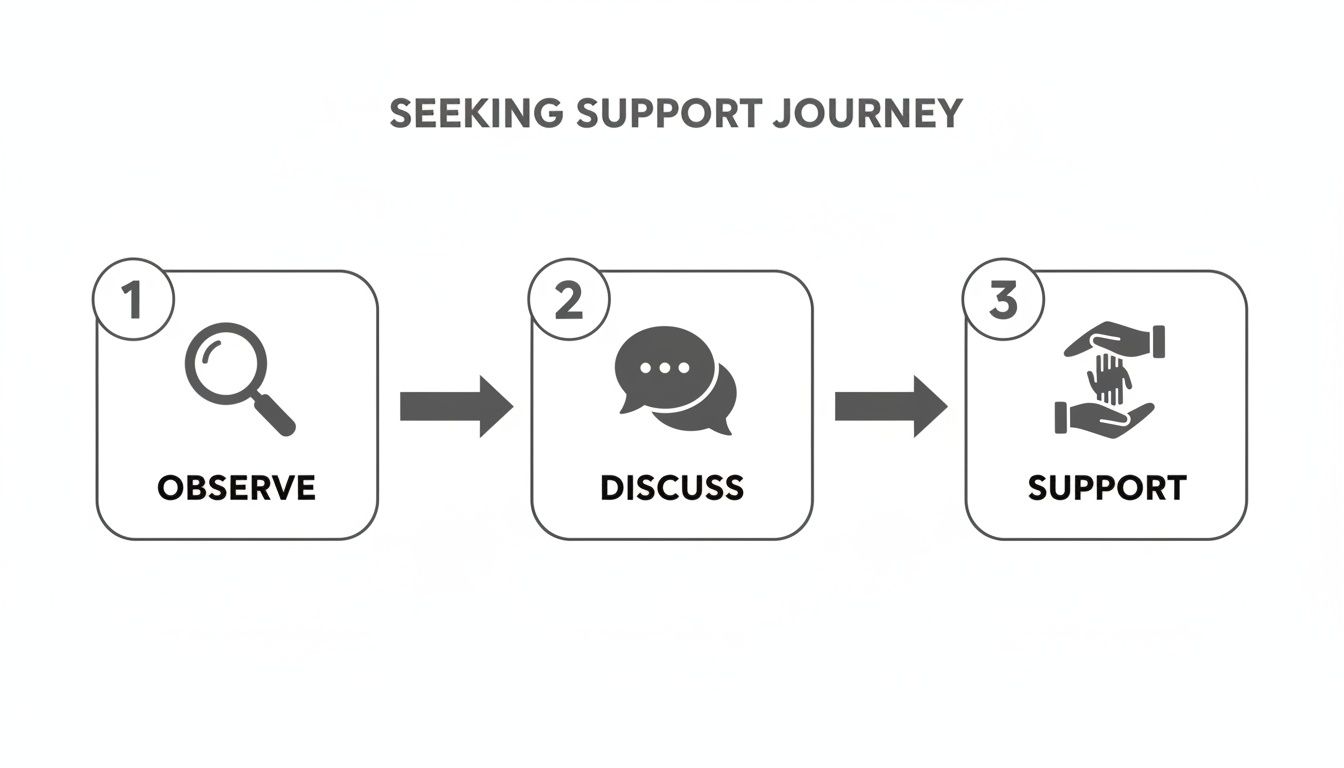
This process emphasizes a proactive, supportive approach, moving from careful observation to collaborative action.
Our 5-Step Neurological Support Process
To find out exactly what’s going on inside your child’s nervous system, we use a clear, five-step process that is both thorough and reassuring for parents. We don’t guess; we test. Here’s a look at our unique approach to understanding and supporting your child’s neurological health.
| Step | What It Involves | Why It Matters for Your Child |
|---|---|---|
| 1. Initial Consultation | We start by listening. You share your story, your concerns, and your goals for your child as we review their complete health history. | This helps us understand the full picture and connect the dots between past stressors and current challenges. |
| 2. Insight™ Scans | Using gentle, non-invasive scanning tech, we map out areas of stress and dysregulation in your child’s nervous system. | These scans give us objective data, showing us exactly how much stress their body is under and where it's stored. |
| 3. Chiropractic Exam | We perform a complete physical and neurological exam to assess posture, reflexes, and tone. | This allows us to connect the scan findings with your child’s physical state, confirming the areas that need support. |
| 4. Personalized Care Plan | Using all the data, we create a specific, customized plan of care. We explain the findings and show you the scans. | You'll see exactly what we see and understand the recommended steps to help their body heal and rebalance. No surprises. |
| 5. Gentle Adjustments | Adjustments are incredibly gentle, often using no more pressure than you’d use to check a ripe tomato. | We use precise techniques to release stored tension, allowing the nervous system to calm down and function at its best. |
This structured process ensures we get to the root of your child’s challenges. By understanding the neurological patterns at play, we can provide targeted support that helps their body truly thrive. You can dive deeper into this topic by reading more about the principles of functional neurology chiropractic in our dedicated article.
Ultimately, by calming the nervous system, we help create the neurological "space" for your child to develop better emotional regulation, get more restful sleep, and build stronger connections with you. It’s not about changing who your child is—it's about helping their body find the balance it needs to let their best self shine through.
Frequently Asked Questions About Toddler Behavior
When you’re in the thick of parenting a two-year-old, questions are bound to come up. You’re trying to do the best for your child, but figuring out the next step can feel overwhelming, especially when you’re looking into a new approach for their health.
We get it. Here are the answers to some of the most common questions we hear from parents about toddler behavior and our gentle, neurologically-focused care. Our hope is to give you the clarity and confidence you need to move forward.
Is Chiropractic Care Safe for a 2 Year Old?
This is usually the very first question parents ask, and we love answering it. The answer is a clear and confident yes. Pediatric chiropractic care is incredibly safe and gentle—it’s nothing like the adjustments an adult might experience.
The amount of pressure we use is remarkably light, often no more than what you’d use to check if a tomato is ripe. There is absolutely no cracking, popping, or twisting. Our techniques are specifically tailored for the delicate, growing spines of little ones, designed to restore proper nervous system function with precise, gentle touches.
How Can Chiropractic Adjustments Help With Behavior?
It helps to imagine the nervous system as the body’s main communication highway. When stress and tension get stuck along this highway (what we call subluxation), it’s like having non-stop traffic jams. These blockages can trap a child’s nervous system in a constant state of high-alert, or "fight or flight" mode.
A child stuck in this state is neurologically wired for survival, not for learning, calm, or managing their big emotions. This is why we see so many behavioral problems in 2 year olds—their internal operating system is simply overloaded. Gentle adjustments work to clear those neurological "traffic jams," easing the stress on their nervous system.
This allows their body to shift out of that constant stress response and into a state of rest, growth, and development. When their internal world is calmer, their external behavior naturally follows suit.
What if My Toddler Won’t Sit Still for an Adjustment?
We hear you, and honestly, we expect it! We work with toddlers all day long, and our office is built for it. We've created a fun, welcoming, and kid-friendly space where children feel comfortable. We never, ever force a child to do something they aren’t ready for.
Adjustments can happen while your little one is playing with a toy, sitting in your lap, or even sleeping. The process itself is quick and gentle, and our entire team is skilled at meeting kids right where they are. Building trust and making this a positive experience for your whole family is our top priority.
How Many Visits Will It Take to See a Change?
Every child’s nervous system is unique, which means the timeline for seeing changes will be, too. The number of visits we recommend is based on the level of stress we find during their initial Insight Scans and how long that stress has been building up.
Some parents notice small shifts right away—maybe their child starts sleeping a bit more soundly or can focus on a toy for a minute longer. For others, the changes are more gradual as their nervous system learns to hold the adjustments and build new, healthier patterns. We create a personalized care plan for every child and will walk you through our specific recommendations after their first visit. Our goal is to create lasting neurological change, not just a temporary fix for symptoms.
If you're ready to get to the root cause of your child's behavioral struggles and explore a gentle, effective path toward a calmer and more connected family life, we are here to help. At First Steps Chiropractic, we provide the answers and the care your family deserves. Schedule your complimentary consultation today.