Watching your child grow is one of life’s most incredible journeys, filled with first steps, first words, and countless tiny discoveries. As a parent, you’re trying to make sense of it all, and that’s where understanding the five developmental domains comes in. Think of these—Physical, Cognitive, Communication, Social-Emotional, and Adaptive Skills—as a practical roadmap, helping you see all the interconnected ways your child learns and develops.
A Parent's Guide to Child Development
Every parent I meet has wondered at some point if their child is "on track." But here’s the thing: development isn't a race with a rigid finish line. It's a unique path for every single child.
Viewing their growth through the lens of the five developmental domains helps us shift our focus from a strict checklist to a more complete, holistic picture of our child’s well-being. It allows you to appreciate their individual journey while recognizing how different skills—like learning to wave hello and learning to walk—are actually building on one another.
This guide is designed to demystify that journey. We’ll explore each domain in simple, clear terms, showing you how they are all woven together. If you've ever felt a knot of anxiety about your child's progress, you're not alone. In fact, it’s far more common for kids to have variations in their developmental timeline than you might think.
The reality is, many children aren't perfectly aligned with every single milestone by the time they start school. For example, recent data from the Australian Early Development Census shows that in 2021, just under 55% of children were considered 'on track' across all five developmental areas. This highlights just how common it is for kids to have their own unique pace. You can learn more about these developmental trends and see the full data story.
The Foundation of Healthy Growth
So, how do all these different areas actually connect? Think of your child’s nervous system as the "master control system" for their entire body. It’s the foundation upon which all learning, growth, and development are built.
A calm, well-regulated nervous system is what allows your child to process information from the world, coordinate those first clumsy steps, manage big feelings without a total meltdown, and build meaningful social connections. It’s the hub for everything.
Throughout this guide, we’ll keep coming back to this central idea. You’ll learn how supporting the nervous system creates the right internal environment for your child to thrive—physically, emotionally, and cognitively. This perspective helps us move beyond simply observing milestones and instead focus on strengthening the core system that governs all of them. By understanding this connection, you can better support your child's amazing developmental journey from the ground up.
Exploring Each of the Five Developmental Domains
Think of the five developmental domains as different lenses for viewing your child's growth. Each one brings a unique aspect of their journey into focus, but they all work together to create the full picture. These domains aren't siloed off; they're deeply interconnected, and you'll often see a leap in one area trigger a ripple of growth across the others.
To get a better sense of this, here’s a map showing how each domain connects back to the nervous system—the body's central command center.
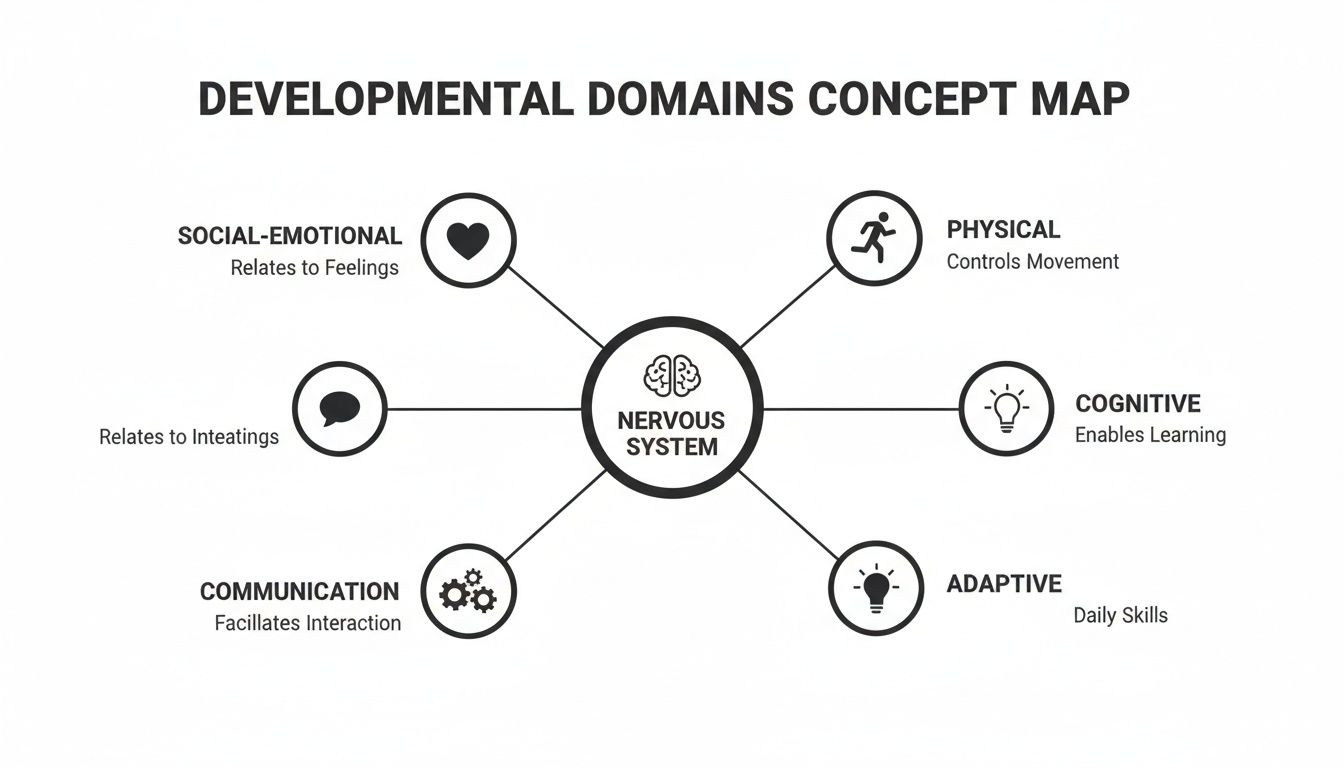
This really drives home the point that a healthy, well-regulated nervous system is the foundation that supports everything from physical movement and learning to communication, emotional regulation, and daily life skills.
For a quick overview, this table breaks down what each domain covers.
Snapshot of the Five Developmental Domains
| Developmental Domain | What It Means | Examples of Skills |
|---|---|---|
| Physical | How a child's body grows and learns to move. | Sitting, crawling, walking, grasping, drawing. |
| Cognitive | How a child thinks, learns, and solves problems. | Following directions, solving puzzles, asking questions. |
| Communication | How a child understands and uses language. | Babbling, first words, forming sentences, listening. |
| Social-Emotional | How a child feels, relates to others, and manages emotions. | Sharing, showing empathy, forming friendships, self-soothing. |
| Adaptive | How a child learns to handle everyday, practical tasks. | Feeding and dressing themselves, potty training, helping. |
Now, let's unpack what each of these domains looks like in real life.
Physical Domain: Movement and Growth
The physical domain is usually the easiest one to spot. It’s all about how your child’s body grows and masters control over its muscles and movements. Think of it as the body’s hardware—the bones, muscles, and nervous system learning to work together in beautiful harmony.
We usually split this domain into two main types of skills:
- Gross Motor Skills: These are the big, powerful movements that use large muscle groups in the arms, legs, and torso. Running, jumping, climbing, and even just sitting up are all gross motor wins.
- Fine Motor Skills: These involve the smaller, more precise movements using the little muscles in the hands, fingers, and wrists. Things like grasping a Cheerio, using a crayon, or buttoning a shirt fall into this category.
A child’s progress here lays the groundwork for so much more. For instance, the ability to sit still and hold a crayon (physical skills) directly supports their ability to learn and draw (cognitive skills). You can learn more about how these abilities stack on top of each other in our guide to understanding motor development skills.
Development in Action: A baby first develops the core strength to hold their head steady. This gross motor skill lets them look around, which fuels their cognitive curiosity. Later, as a toddler, their ability to run and climb not only builds physical confidence but also expands their social world at the playground.
Cognitive Domain: Thinking and Learning
If the physical domain is the hardware, then the cognitive domain is the operating system. This is where your child learns to think, problem-solve, and make sense of the world. It’s the home of memory, curiosity, and imagination.
This is where a child starts connecting cause and effect—like realizing that shaking a rattle makes a fun noise. It’s also where they develop object permanence, that critical understanding that things still exist even when they can't be seen.
Here are a few cognitive milestones you might see:
- Infants (0-1 year): Exploring objects with their mouth, tracking a moving toy with their eyes, and eventually searching for a toy you've hidden.
- Toddlers (1-3 years): Sorting shapes and colors, engaging in simple pretend play (like feeding a doll), and following two-step instructions.
- Preschoolers (3-5 years): Asking "why" about everything, understanding basic time concepts (like "yesterday"), and finishing simple puzzles.
Cognitive development isn't just about academics; it's about the fundamental wiring for learning. Encouraging play, asking open-ended questions, and reading together are some of the most powerful ways you can support this critical domain.
Communication Domain: Expressing and Understanding
The communication domain is how your child plugs into the world with language. It’s a two-way street, covering both understanding what others say (receptive language) and expressing their own thoughts and needs (expressive language).
Long before the first word is spoken, communication is already well underway. A baby’s cry, a coo, a pointed finger—these are all early forms of expressive language. They are telling you something important without using a single word.
As they grow, their communication skills get more complex:
- Babbling and Gestures: The first stage involves making sounds and using gestures like waving "bye-bye."
- First Words: Many children start saying their first meaningful words around their first birthday.
- Putting Words Together: Toddlers begin combining words into simple phrases to express more complex ideas.
Supporting this domain is as simple as talking, singing, and reading to your child from day one. When you narrate your day ("Now we're putting on your red socks!") or respond to their babbles, you are literally building the neural pathways for language.
Social-Emotional Domain: Feeling and Connecting
This domain is truly the heart of your child’s development. It’s where they learn to understand their own feelings, read the emotions of others, and build relationships. It covers everything from learning to share a toy to developing empathy and self-control.
A child's social-emotional health is the bedrock for their mental well-being and their ability to form healthy, secure attachments. It’s all about feeling safe, loved, and capable.
Key skills developed here include:
- Forming attachments with parents and caregivers.
- Learning to self-soothe when they're upset.
- Developing empathy by recognizing how others feel.
- Learning to share and take turns with their friends.
- Managing big emotions like frustration or excitement in healthy ways.
Picture a toddler who wants a toy another child is playing with. Their first impulse might be to just grab it. Social-emotional development is the whole process of learning to wait, ask for a turn, or manage the disappointment if the answer is no. Modeling kindness and talking about feelings are essential ways to nurture this area.
Adaptive Domain: Daily Life Skills
Finally, the adaptive domain is all about the practical, everyday skills that lead to independence. Sometimes called self-help skills, this is where a child learns to take care of themselves and navigate their world safely and effectively.
Think of these skills as the bridge that connects all the other domains to real-world tasks. To feed themselves with a spoon, a child needs fine motor skills (physical), an understanding of how the spoon works (cognitive), and the desire to be independent (social-emotional).
Examples of adaptive skills include:
- Self-Feeding: Progressing from using their hands to using utensils.
- Dressing: Pulling on socks, zipping a coat, and eventually choosing their own clothes.
- Personal Hygiene: Helping to wash their hands, brushing teeth, and learning about potty training.
- Household Help: Putting toys away or helping to set the table.
Fostering these skills builds a child’s sense of competence and self-esteem. When you let your toddler "help" you sweep—even if it makes a bigger mess—you are sending a powerful message that they are capable. That feeling of capability is a vital part of their journey toward becoming a confident, independent person.
How to Recognize When Your Child Needs More Support
As a parent, your intuition is one of the most powerful tools you have. You know your child better than anyone. While every kid hits milestones on their own unique timeline, your gut feeling that something might be off is invaluable. Noticing the signs early isn’t about creating panic; it’s about being proactive so your child gets the right support at the right time.
Think of it like tending a garden. You notice when a plant’s leaves start to yellow or when it leans a little too far to one side. These aren't signs of failure—they're just signals that the plant might need a little more sunlight or water. Developmental red flags work the same way. They are simply your child's way of signaling that something in their internal system or environment needs a gentle adjustment.
Trusting Your Gut and Knowing the Signs
It’s important to see the whole picture. Delays in one area of development can often be connected to challenges in another. For example, a child whose nervous system is dysregulated and stuck in "fight or flight" mode will have a hard time mastering everything from motor skills to emotional control. This is why a holistic view is so crucial.
Here are a few common red flags, broken down by age, to help you frame your observations. This isn't a diagnostic tool, but rather a guide to help you become a more confident observer of your child’s journey.
By 6 Months, consider a conversation with a professional if your child:
- Doesn’t try to reach for or grab objects.
- Shows little or no affection for their caregivers.
- Doesn't roll over in either direction.
- Doesn't respond to sounds around them.
By 1 Year, it's worth noting if your child:
- Is not crawling or drags one side of their body while crawling.
- Doesn't search for things that they see you hide.
- Doesn't use gestures like waving or shaking their head.
- Loses skills they once had.
By 18 Months, pay attention if your child:
- Is not yet walking.
- Doesn’t point to show things to others.
- Doesn't have at least a few single words.
If you're noticing some of these signs, you're not alone. An estimated 53 million children worldwide live with developmental delays that affect one or more of the five domains. Unfortunately, many aren't identified until they reach school age. Research also shows how much a child’s environment and family life can shape their growth, with factors like income and gender linked to different outcomes. You can explore the research on environmental factors in child development here.
Why Early Detection Is Key
When a child’s development stalls, it’s often because their nervous system is stuck in a state of stress. This makes it incredibly difficult for them to learn, adapt, and master new skills. This can be triggered by anything from a difficult birth to everyday environmental stressors. Identifying this underlying stress early on opens the door for gentle interventions that can get their development right back on track.
The goal of early detection isn't to label a child but to support their foundational systems. By addressing the root cause of the delay—often related to nervous system interference—we can unlock a child's potential across all five developmental domains, creating a stronger foundation for all future learning and growth.
When a child’s nervous system is better regulated, parents often see incredible changes that seem unrelated at first glance. A child who starts sleeping better suddenly has the energy and focus to make huge leaps in their communication skills. A child whose motor control improves feels more confident and starts engaging with friends on the playground.
Getting to the root cause is the first step toward finding real solutions. If you're wondering what might be contributing to your child's challenges, our guide on what causes developmental delays offers deeper insights.
Ultimately, you are the expert on your child. If you feel that something isn’t quite right, it is always worth exploring. A conversation with a trusted professional can provide the clarity, peace of mind, and clear path forward your family needs to help your child truly flourish.
The Nervous System's Role in Healthy Development
We've walked through the five developmental domains—Physical, Cognitive, Communication, Social-Emotional, and Adaptive—that map out your child’s growth. So, what’s the common thread tying them all together? It all comes back to the one system that acts as the body's master control center: the nervous system.
Think of your child’s nervous system like the complex electrical wiring in a house. When every connection is clear and secure, power flows smoothly. Lights turn on, appliances run, and everything works just as it should. In the body, this smooth flow of information is what allows for coordinated movement, clear thinking, and calm emotional responses.
But what happens when something disrupts that wiring? Stressors from a difficult birth, childhood tumbles, or even big emotional events can act like a short circuit or flip a dimmer switch on that flow. In chiropractic, we refer to this interference as subluxation, which creates roadblocks in the nervous system’s critical communication pathways.
The Impact of Nervous System Interference
When this "master control system" is stressed, the body can get stuck on high alert. You might know it as the "fight or flight" response. A child living in this state isn't just being difficult; their body is pouring all its energy into survival mode, leaving very little left over for growth and development.
This neurological interference can pop up in all sorts of ways that parents often see as separate, unrelated issues. But more often than not, they are simply different symptoms of the same root cause—a dysregulated nervous system.
Common challenges we see linked to nervous system stress include:
- Sensory Processing Issues: The brain gets its wires crossed trying to interpret sensory input, leading to big reactions to everyday sounds, textures, or touch.
- Sleep Difficulties: The body can’t flip the switch to the calm, restorative "rest and digest" state, making it a battle to fall asleep or stay asleep.
- Trouble Focusing: A brain stuck in survival mode struggles with higher-level tasks like paying attention in school or learning new things.
- Emotional Dysregulation: Small triggers can lead to huge meltdowns because the child's system is already overloaded and running on empty.
Instead of just chasing symptoms, getting to the root of nervous system health helps build a strong foundation for progress across all five developmental domains. By clearing the interference, we allow the body’s incredible innate intelligence to get back to work. You can learn more about the fundamentals by reading our guide on how the nervous system works.
Creating a Foundation for Growth
Supporting the nervous system is just like making sure the foundation of a house is solid and stable before you put up the walls and roof. When a child’s nervous system is balanced and functioning well, they finally have the internal resources they need to hit those developmental milestones.
A regulated nervous system is the launching pad for all development. It allows a child to move from a state of surviving to a state of thriving, unlocking their potential to learn, connect, and grow with ease and confidence.
This means their body can better coordinate the physical skills needed for crawling and walking. Their brain has the capacity to focus on cognitive tasks like problem-solving. Their social and emotional skills blossom because they finally feel safe and regulated in their own bodies.
Ultimately, by focusing on the root cause—the health of the nervous system—we help create lasting change. We’re simply helping restore the body’s natural ability to heal and develop, paving the way for a child to flourish in every part of their life.
How Neurologically Focused Chiropractic Supports Development
Knowing the connection between your child’s nervous system and the five developmental domains is the first step. The next is knowing how to support it. At First Steps Chiropractic, our entire approach is designed to get to the true root cause of developmental challenges by gently and precisely restoring balance to the nervous system.
We don't chase symptoms. Instead, we focus on helping your child’s body function at its absolute best, creating the internal calm they need to learn, grow, and thrive. This is especially vital in those early years when the foundation for their future is being built brick by brick.
Our Five-Step Process for Unlocking Potential
Our process is clear, thorough, and designed to give you answers. It all starts with us listening to your story during an in-depth consultation. From there, we use advanced scanning technology to pinpoint exactly where your child’s nervous system is stuck in a state of stress.
Here’s a look at how we identify the root cause of your child's challenges:
- In-Depth Consultation: We start by listening. Your goals, your concerns, and your observations are the most important part of the puzzle.
- Insight Scans: These gentle, non-invasive scans measure how the nervous system is functioning. They give us a clear, objective picture of stress patterns and show us how they might be affecting development.
- Comprehensive Chiropractic Exam: We perform a detailed physical exam to assess your child’s spinal alignment and movement, connecting our scan findings to their physical state.
- Personalized Care Plan: Using all the data we've gathered, we create a specific, customized plan of care designed to address your child’s unique needs.
- Gentle Adjustments: We use neurologically-focused techniques, like the Torque Release Technique (TRT), which are incredibly gentle and specifically tailored for kids.
This process allows us to see beyond the surface-level symptoms and understand the underlying neurological patterns that may be holding your child back.
By measuring nervous system function, we can see precisely where communication breakdowns are happening. This allows us to deliver targeted care that helps restore the body’s natural ability to regulate itself, paving the way for developmental progress.
How We Address Nervous System Stress
The core of our care is the Torque Release Technique (TRT). Unlike traditional chiropractic adjustments you might be familiar with, TRT is exceptionally gentle and specific. It uses a small, handheld instrument to deliver a precise and light force to targeted areas of the spine, helping to release stored tension and clear interference from the nervous system.
Think of it like tuning a guitar. When a string is too tight or too loose, the instrument can't make beautiful music. TRT helps "tune" the nervous system, allowing it to function in a state of harmony and ease. This restored balance is what enables the brain and body to communicate more effectively.
This improved communication is critical for school readiness. The U.S. Department of Education identifies five domains of school readiness that directly mirror the developmental domains we've discussed. Research shows that children who lag in one or more of these areas before kindergarten are more likely to face academic and behavioral challenges, with some gaps appearing as early as 18–24 months. You can learn more about the importance of school readiness.
Connecting Care Back to the Five Domains
So, how does a balanced nervous system actually translate to real-world improvements? The benefits ripple across every single aspect of your child’s life.
-
Physical Domain: When the nervous system is functioning optimally, motor control and coordination naturally improve. This can help with everything from crawling and walking to mastering fine motor skills like holding a crayon.
-
Cognitive & Communication Domains: A calm nervous system is a prerequisite for learning. Better regulation enhances a child's focus, memory, and ability to process new information, which supports both cognitive growth and language development.
-
Social-Emotional & Adaptive Domains: Improved nervous system function leads to better emotional regulation. Children are less likely to be stuck in "fight or flight," making it easier for them to manage big feelings, connect with others, and handle daily routines with confidence.
Better sleep is often one of the very first changes parents notice. When a child's body can finally shift into a "rest and digest" state, they get the deep, restorative sleep they need to fuel growth and development across all five domains.
Actionable Next Steps for Supporting Your Child

Now that you have a better understanding of the five developmental domains, you’re in a great position to be your child's best advocate. Your intuition as a parent is one of the most powerful tools you have, and this guide is meant to arm you with the confidence to have those important conversations with healthcare providers. Always trust what you observe.
Figuring out how to best support your child doesn't have to be an overwhelming journey. The most important thing you can do is simply take the first step. When we focus on the root cause—the health of their nervous system—we create a strong foundation for growth across all five domains.
You know your child better than anyone. If your gut tells you that something needs a closer look, that is always the right time to seek answers and support.
Your Path Forward
We're here to be your partners on your child’s developmental journey, every step of the way.
- Schedule a Consultation: We invite you to book a complimentary consultation with our team. We’ll take the time to listen to your family’s story and help you understand what's happening within your child’s unique nervous system.
- Explore Resources: It can be helpful to keep your observations organized. Tools like the CDC’s Milestone Tracker App are fantastic for tracking progress and making notes before your next appointment.
Here at First Steps Chiropractic, we are dedicated to providing the clarity, answers, and care your family deserves. Let’s work together to unlock your child’s full potential.
Have Questions? Let's Talk.
When you're diving into the five developmental domains, a lot of questions can pop up. It's totally normal. Here are a couple of the most common ones we hear from parents just like you in our practice.
Is Chiropractic Care Safe for Babies and Children?
Absolutely, and it's a question we're always happy to answer. Pediatric chiropractic isn't anything like adult adjustments. The techniques are incredibly gentle and designed specifically for a child's delicate, developing spine and nervous system.
We use methods like the Torque Release Technique (TRT), which applies such a light amount of force—often compared to the pressure you'd use to check if a tomato is ripe. Our doctors have extensive, specialized training and certifications in pediatric care to ensure every visit is safe, comfortable, and positive for your little one.
How Can Chiropractic Help with Something Like a Speech Delay?
This is a great question that gets to the heart of what we do. Your nervous system is the master control system for everything your body does, and that includes the incredibly complex coordination needed for speech—all those tiny muscles in the tongue, jaw, and larynx.
If there's interference or stress on the nerves that control those areas, it can make it much harder for a child to form sounds and words. Think of it like static on a phone line. By gently addressing that neurological stress, we help clear up the communication pathways between the brain and the body. This supports all the hard work you're doing with speech therapists by creating a healthier foundation for language to build upon.
Key Insight: While every child develops at their own pace, the 'wait and see' approach can sometimes mean missing a crucial window for early support. Monitoring the five developmental domains is all about recognizing patterns that might point to an underlying issue, like nervous system dysregulation.
A neurologically-focused assessment can give us a much clearer picture of why your child might be hitting a roadblock. Getting to the root of the issue early on is always the best path, as it helps build a strong foundation for all the learning and growing that lies ahead.
If you're ready to get to the root cause of your child's developmental challenges, our team at First Steps Chiropractic is here to help. Schedule your complimentary consultation today!