
When you want to help your child improve their fine motor skills, the best place to start is with simple, hands-on play. Activities like squishing play-dough, stacking blocks, and using little tweezers to pick things up are fantastic for strengthening the small muscles in their hands, fingers, and wrists.
These aren't just games; they are the fundamental building blocks for a well-connected nervous system and the key to unlocking everyday independence.
What Are Fine Motor Skills and Why Do They Matter
Fine motor skills are all about those small, precise, and coordinated movements of the hands and wrists. Picture your toddler trying to pick up a single Cheerio, your preschooler buttoning their own coat, or your school-aged child carefully coloring inside the lines. Each of these actions depends on a complex network of nerves and muscles working together in perfect harmony.
When we talk about improving fine motor skills, what we’re really talking about is strengthening that brain-body connection. Every single deliberate movement, from grasping a crayon to snapping a LEGO brick into place, starts with a signal from the brain. That signal travels down the spinal cord and through a web of nerves to fire up the exact muscles needed for the job.
So, you see, strong fine motor skills are a direct reflection of a healthy, efficient nervous system. They tell us that the communication pathways are clear, allowing for smooth, controlled, and confident movements. This is why supporting fine motor development is about so much more than just helping a child write their name—it’s about nurturing the very foundation of how they interact with their world.
The Foundation of Independence
Mastering fine motor skills is absolutely crucial for a child's growing independence. These abilities open the door to countless self-care and academic tasks. When a child can finally zip their own jacket or hold a pencil the right way, they gain a powerful sense of accomplishment and self-reliance. On the flip side, struggles in this area can lead to a lot of frustration and even a reluctance to try new things.
It’s also important to see how fine motor control connects to other developmental areas:
- Gross Motor Skills: The large muscle movements involved in sitting upright and maintaining core stability provide the steady base needed for those precise hand movements. You can learn more about how these two skill sets are connected by exploring the fundamentals of gross motor development.
- Cognitive Development: Activities like finishing a puzzle or building with LEGOs require problem-solving and spatial reasoning, which are directly tied to fine motor execution.
- Social-Emotional Growth: Successfully taking part in crafts and games with friends boosts confidence and encourages positive social interaction.
A well-connected nervous system acts as the body's command center, orchestrating every tiny movement with precision. Supporting this system is the most effective way to help a child master the fine motor skills needed for life.
Key Strategies at a Glance
Navigating your child's development can feel overwhelming, but supporting their fine motor skills doesn't have to be complicated. We've put together a quick guide to summarize the key strategies we'll explore. Think of this as your roadmap for turning everyday moments into powerful opportunities for skill-building.
Quick Guide to Boosting Fine Motor Skills
| Strategy | What It Means | Why It Works |
|---|---|---|
| Play-Based Learning | Using games and fun, hands-on activities like playdough, painting, and puzzles. | It removes pressure, making skill-building enjoyable and motivating for children. |
| Nervous System Support | Ensuring clear brain-body communication through gentle chiropractic care. | It addresses the root cause of motor challenges by clearing interference in nerve pathways. |
| Age-Appropriate Tasks | Providing activities that match a child's current developmental stage. | This prevents frustration and builds confidence by setting achievable goals. |
| Sensory Integration | Incorporating different textures and materials like sand, water, and finger paints. | It enhances neural connections by engaging multiple senses during motor activities. |
This table is just the starting point. As we dive deeper, we'll unpack each of these strategies with practical, age-specific activities you can start using right away to support your child’s journey.
A Parent's Guide to Fine Motor Milestones
Every child hits their milestones on their own unique timeline. It’s far more helpful to think of these developmental markers as a flexible roadmap rather than a rigid checklist. Understanding the typical progression of fine motor skills helps you know exactly how to support your child at the right time, turning simple, everyday play into powerful moments for growth.
These milestones are more than just physical accomplishments; they’re the visible proof of a well-connected nervous system coordinating incredibly complex actions.
Think of it this way: for your child to simply pick up a small block, their brain has to send a very specific signal. That signal needs to travel all the way down the spinal cord and through a whole network of nerves to activate just the right tiny muscles in their hands and fingers.
This infographic breaks down that foundational process, from the initial brain signal all the way to muscle action.
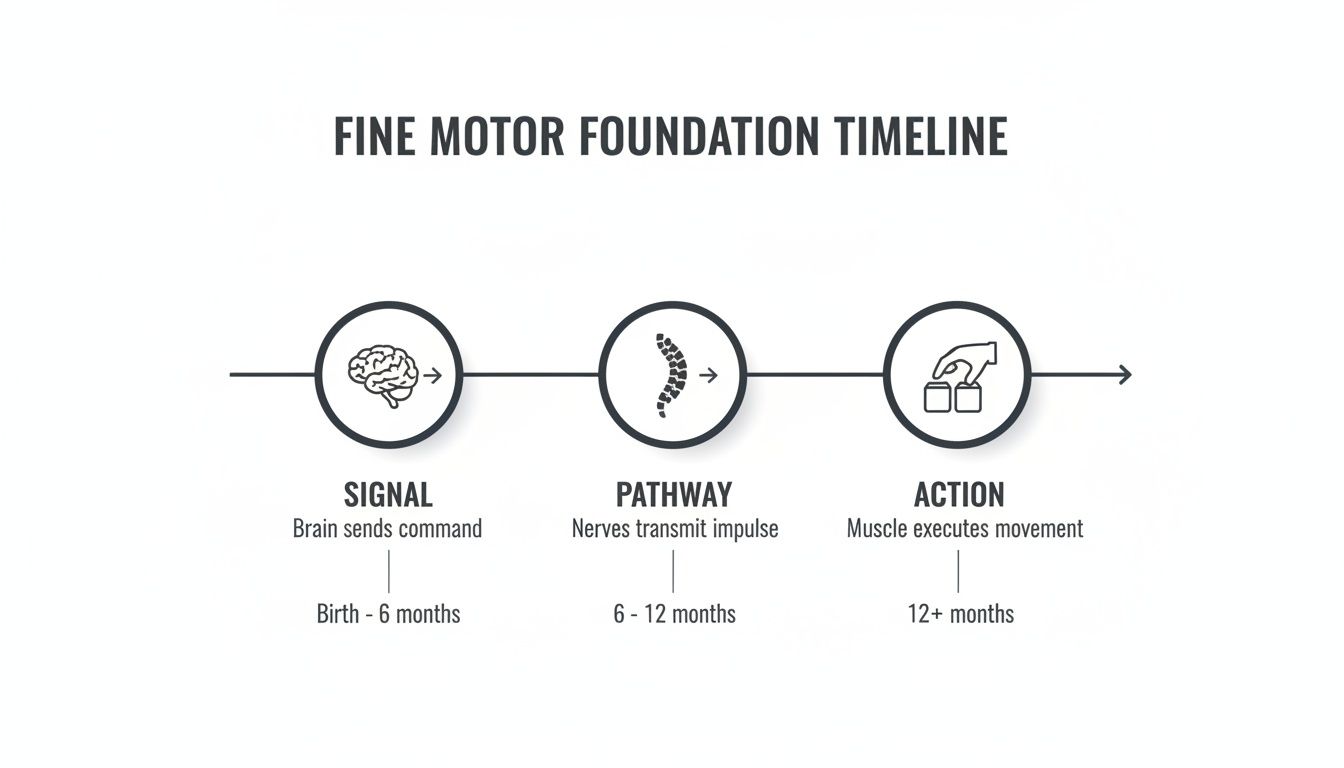
As you can see, any kind of interference along that pathway—from the brain to the hand—can make even simple tasks feel much more challenging. Making sure this communication channel is clear and free of roadblocks is a huge step in helping a child improve their fine motor skills.
Milestones From Infancy To Toddlerhood
A baby’s fine motor journey starts right at birth. Those early, instinctual grasps you see quickly evolve into more deliberate, purposeful movements as their nervous system matures.
-
Birth to 3 Months: Right away, you'll notice a newborn’s hands are often held in tight fists. They have a reflexive grasp, meaning they'll automatically grip an object placed in their palm, but they can't yet let go on purpose. This is a foundational neurological reflex kicking in.
-
3 to 6 Months: In this window, your baby will start reaching for objects, even if their aim is a bit clumsy at first. They begin bringing their hands to their mouth and can hold onto a rattle or small toy for a few moments.
-
6 to 12 Months: This is a huge period of discovery! Babies start to voluntarily grasp and release objects. They develop the all-important pincer grasp—using their thumb and forefinger to pick up small items like cereal puffs or peas. You’ll also see them clapping, banging toys together, and transferring items from one hand to the other.
As they roll into toddlerhood, these fundamental skills become the launching pad for more complicated actions. When a toddler stacks their first tower of blocks, they aren't just playing; they're running a complex experiment with hand-eye coordination, grasp strength, and spatial awareness.
The pincer grasp, which typically emerges between 9 and 12 months, is a pivotal milestone. It demonstrates a significant leap in cognitive and neurological development, paving the way for future skills like writing and buttoning.
Milestones For Preschoolers And School-Aged Kids
By the time a child reaches preschool, their fine motor skills are becoming much more refined. They’re now starting to use their hands as precise tools for creativity, learning, and self-care.
-
2 to 3 Years: Toddlers in this stage love to build. They can typically stack a tower of six or more blocks, turn the pages of a book one at a time, and start making big, circular scribbles with a crayon. They also begin trying simple dressing tasks, like pulling up their own pants.
-
3 to 4 Years: A preschooler's dexterity just explodes during this time. They can now draw basic shapes, use child-safe scissors to snip at paper, and manipulate smaller objects like large buttons or beads for stringing. This is also when you'll see a more mature pencil grip begin to form.
-
4 to 5 Years: Fine motor control becomes much more automatic. Kids in this age group can often write some letters of their name, cut along a straight line with better accuracy, and manage zippers and large buttons all on their own. Their drawings become more detailed and recognizable, too.
If you start to notice your child is consistently struggling with these age-appropriate tasks, it might be a sign of some underlying interference in their brain-body communication. For instance, subtle misalignments in the upper neck—sometimes present from the birth process itself—can disrupt the nerve signals that control hand and finger movements. This can lead to frustration and cause a child to avoid fine motor activities altogether.
Exploring all aspects of your child’s growth can give you more context; you can learn more by reading about the progression of motor development skills in our detailed guide. Understanding this connection allows for a more supportive approach to skill-building that addresses the root cause, not just the symptom.
Fun and Easy Activities to Build Fine Motor Skills
When it comes to improving your child's fine motor skills, the best approach is always through play. Forget about tedious drills. Kids learn and build those critical neural pathways when they're genuinely engaged and having a good time.
The great news is you don’t need a basket full of expensive, complicated toys. In my experience, some of the most powerful activities use simple things you probably already have lying around the house. The goal is to weave skill-building so seamlessly into your child's day that it just feels like a game. Repetition is key for muscle memory, and kids will happily repeat something they find fun.
Playful Ideas for Toddlers and Preschoolers
This age is all about hands-on exploration. We want to focus on foundational skills—grasping, pinching, and hand-eye coordination—in a really low-pressure way.
- Painter's Tape Peel: This one is surprisingly effective. Just stick strips of painter's tape to a highchair tray or a smooth floor. Peeling it off requires a pincer grasp—that delicate use of the thumb and forefinger that's so important later on.
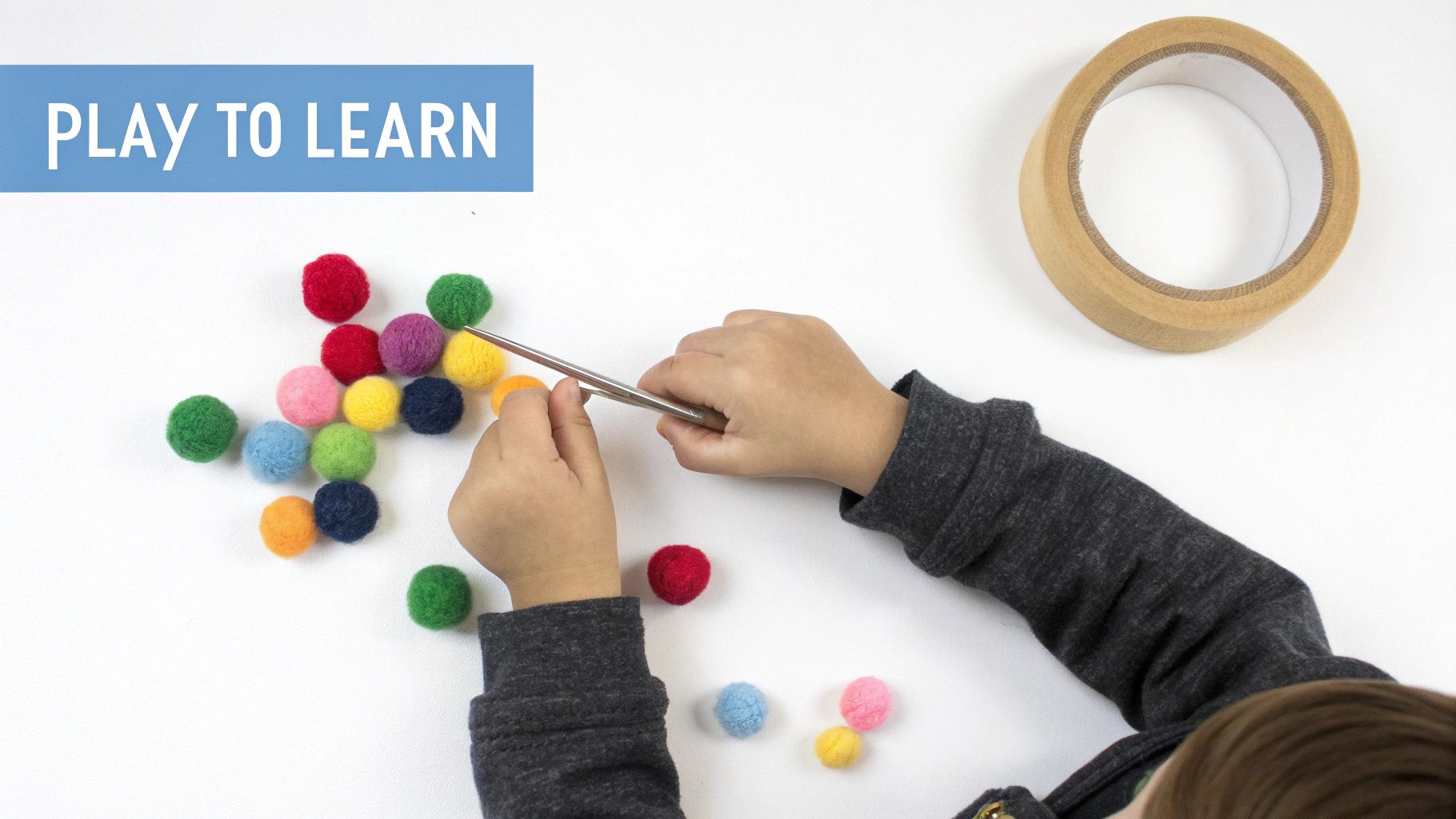
- Pom-Pom Sorting: Hand your little one some kid-safe tweezers or tongs and have them sort colorful pom-poms into an ice cube tray. This is fantastic for refining hand-eye coordination and strengthening the exact muscles they'll need for a proper pencil grip.
- Stringing Fun: Start simple. A pipe cleaner or even a piece of uncooked spaghetti is rigid enough for a child to string Cheerios or large pasta onto. Once they get the hang of it, you can level up to yarn or a shoelace with bigger beads.
Think of these simple games as powerful, secret workouts for little hands. They demand concentration and the coordinated use of both hands—essential precursors for bigger tasks like zipping a coat or using scissors.
Sensory Play for Enhanced Skill Building
Sensory play is a true powerhouse for fine motor development. When kids engage multiple senses at once—touch, sight, maybe even sound—their brains form much stronger, more meaningful connections.
The tactile feedback from squishing playdough or sifting through sand amplifies motor learning in a way simple drills just can't match.
Sensory experiences create a richer learning environment for the brain. The simple act of squishing playdough sends a flood of information through the nervous system, helping to refine motor control and pressure modulation.
It gives the nervous system more data to work with. A child learns how much force it takes to roll a ball of dough versus the delicate touch needed to pick up a single water bead.
Simple Sensory Activities to Try at Home
You don't have to make a huge mess to integrate sensory play. Just start with one or two of these and watch your child’s engagement skyrocket.
- Playdough Creations: A classic for a reason! Rolling, squishing, pinching, and cutting playdough builds hand strength like nothing else. For an extra challenge, hide small beads inside for them to dig out, which really encourages finger isolation.
- Sand or Grain Tray: Fill a shallow baking sheet with sand, uncooked rice, or cornmeal. Let your child "write" letters and draw shapes with their finger. The tactile feedback helps solidify the motor patterns they'll need for writing.
- Water Play with Tools: Fill a basin with water and provide droppers, toy syringes, or squeeze bottles. Moving water from one container to another is an amazing (and fun!) way to build the hand strength required for using a hole puncher or scissors.
Recent data really underscores why focusing on these skills is so important. In 2023-2024, 93.3% of children aged 2 to 2.5 years in England met the expected fine motor skills benchmark. While that’s a slight improvement, it’s still below the pre-pandemic rate of 94.1%. This shows that being proactive matters more than ever.
From a neuro-tonal perspective, this highlights the value of early, gentle intervention. Techniques like the Torque Release Technique (TRT) can address subtle misalignments that may disrupt the nerve pathways responsible for hand-eye coordination, helping children hit these crucial milestones. You can explore the full findings on child development outcomes on GOV.UK.
Activities for Developing Precision and Strength
As your child grows, you can introduce activities that demand more precision and muscle. These build on those foundational skills and get them ready for school-based tasks.
- Cutting Practice: Don't start with paper! Let them practice cutting logs of playdough first. Then, move on to thick paper or cardstock, starting with straight lines and progressing to wavy and zigzag ones. This is great for bilateral coordination (using both hands together).
- Building with LEGOs™: Snapping small bricks together is an incredible workout for finger strength and spatial awareness.
- Using a Hole Puncher: Punching holes in old greeting cards or scrap paper requires a surprising amount of hand strength. It’s a perfect pre-scissor skill builder.
- Classic Games: Never underestimate the power of board games. Think about games like Operation™, Jenga™, or Connect 4™. They are fantastic for developing a steady hand, precision, and strategic thinking without feeling like "work."
By folding these fun activities into your daily routine, you give your child endless opportunities to practice and perfect their skills. This playful approach doesn't just build stronger hands; it builds a love for learning and a "can-do" attitude that will serve them for years to come.
As a parent, it’s completely natural to wonder if your child is hitting all their developmental milestones on time. While every child’s journey is wonderfully unique, knowing what to look for can help you spot when it might be time to seek a little extra support.
Recognizing potential fine motor skill delays isn’t about causing alarm—it’s about gentle, loving observation and understanding what your child’s actions are trying to tell you.
One of the clearest signs we see is consistent avoidance. If a child regularly steers clear of activities that demand hand-eye coordination—like puzzles, LEGOs, or drawing—it might be because those tasks are genuinely difficult or frustrating for them.
This isn't defiance. More often than not, it's a signal that their brain-body communication needs a little tune-up to make those intricate movements feel easier and more natural.
Common Red Flags to Watch For
Observing your child during playtime and daily routines can offer incredible insights. The key is to look for consistent patterns, not just isolated incidents. After all, every single one of us has off-days.
Here are a few specific things to keep an eye on across different age groups:
- Unusually Clumsy Hand Movements: While all kids are clumsy sometimes, consistently dropping things, struggling to hold a fork, or having a weak-looking grasp for their age can be a red flag.
- Extreme Frustration with Self-Care: Do tasks like buttoning a shirt, zipping a coat, or trying to tie shoes quickly lead to a major meltdown? If your child gives up almost immediately or gets incredibly upset, it's worth paying attention to.
- Difficulty with Writing Tools: A preschooler or school-aged child might still be using an awkward, fist-like grip on a crayon long after their peers have adopted a more mature grasp. You might also notice them applying way too much or too little pressure, resulting in faint lines or torn paper.
These challenges are often more than just a lack of practice. They can be outward symptoms of underlying interference within the nervous system. When the communication pathways between the brain and the hands aren't firing optimally, it can feel like trying to tune a radio station with a lot of static—the signal just doesn't come through clearly.
The goal is never to label a child but to understand the root cause of their struggles. By identifying where the breakdown in communication is happening, we can provide targeted support that helps their nervous system function at its best.
A Neurologically-Focused Approach
When parents come to us with these concerns, we know they're looking for real answers, not just temporary fixes. That’s why we use a specific, five-step clinical process to get to the absolute heart of the issue.
We want to understand precisely how your child’s nervous system is functioning and pinpoint any areas of interference that could be holding back their fine motor development. This is especially helpful for kids who also have sensory challenges, because motor control and sensory processing are deeply intertwined in the nervous system.
Our process is designed to be a clear, supportive partnership with you:
- In-Depth Consultation: First, we listen. This is where we learn about your child’s history from day one, your specific concerns, and what you hope to achieve for your family.
- Insight Scans: We use advanced, non-invasive technology to get an objective look at your child’s nervous system. These scans measure nerve activity and spinal muscle tone, showing us exactly where stress and interference are stuck.
- Comprehensive Chiropractic Exam: This hands-on evaluation lets us assess spinal alignment, muscle tone, and neurological reflexes, connecting the dots between what we learned from you and what the scans show us.
- Personalized Care Plan: We bring all the findings together to create a specific, customized plan of action. We explain exactly what we found, how it relates to your child’s fine motor struggles, and how gentle adjustments can help.
- Gentle Adjustments: Using specialized, low-force techniques like the Torque Release Technique (TRT), we perform precise adjustments to reduce nervous system interference. This helps restore that crucial brain-body communication.
By addressing the root neurological cause, we empower children to build skills with less frustration and more confidence. Our approach helps clear the pathways so their body can finally do what their brain is asking it to.
The Nervous System's Role in Motor Development
Every single time your child threads a bead or fastens a button, you’re witnessing an incredible conversation happening inside their body. These tiny, precise movements aren’t just about the hands; they start as a spark of an idea in the brain. Truly understanding this brain-body connection is the first step in helping your child master their fine motor skills.
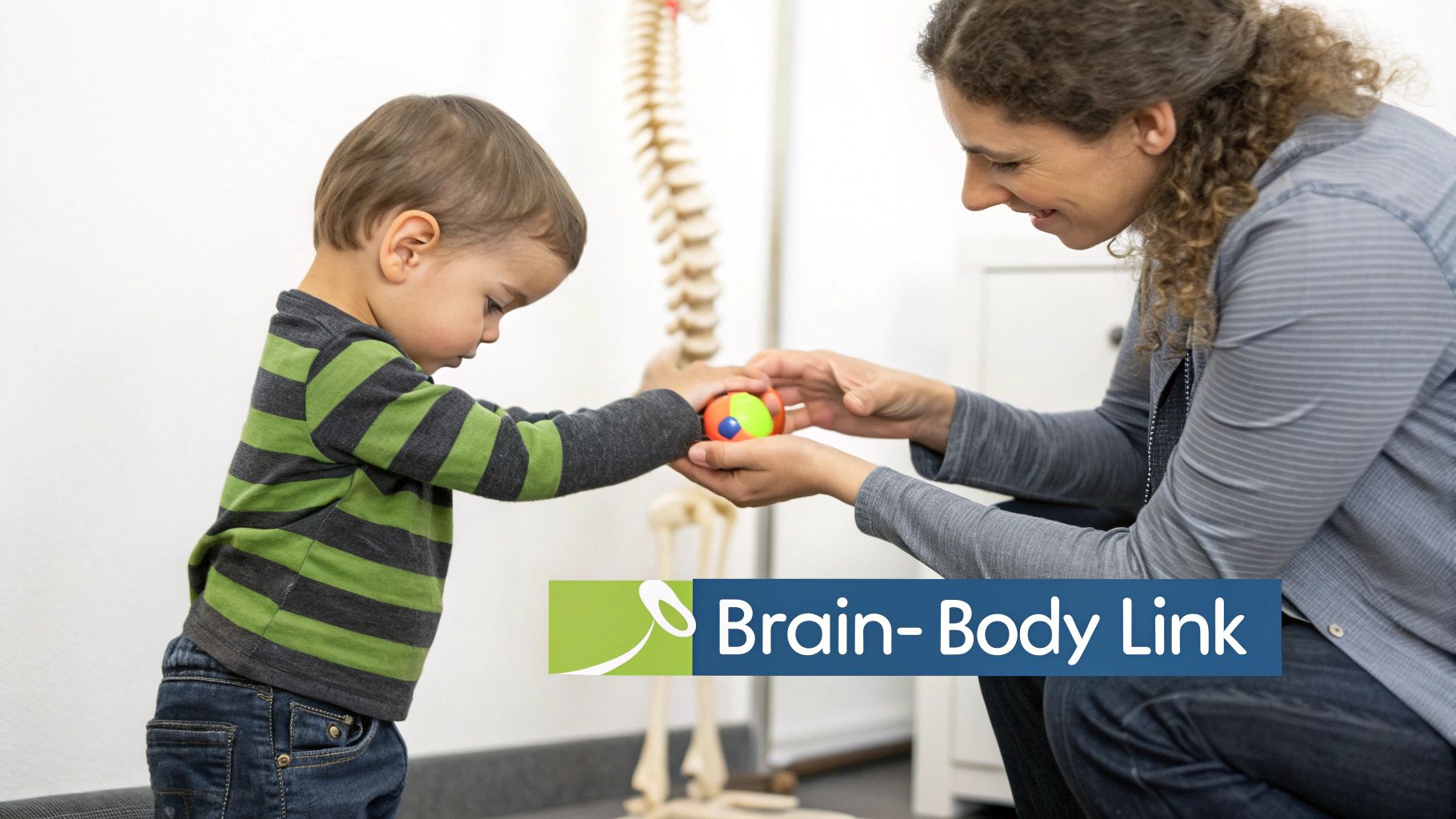
Think of the nervous system as a highly sophisticated communication network. The brain is the command center, the spinal cord is the main information highway, and the nerves that travel out to the fingertips are the local roads. For any fine motor action to happen, a clear, lightning-fast message has to travel from the brain, down that highway, and along those local roads to tell the right muscles exactly what to do.
When Communication Lines Get Fuzzy
But what happens if there’s static on the line? This "static," or interference, can garble the signals, making those precise tasks feel nearly impossible. Instead of a smooth, coordinated movement, the action might be clumsy, weak, or just plain frustrating for your little one.
This isn't some abstract idea. This interference often comes from real, physical stress on the nervous system. Some common causes we see include:
- Birth Trauma: The journey into the world, even a smooth one, can place a lot of strain on a baby’s delicate neck and spine, potentially creating misalignments that affect nerve function right from the start.
- Everyday Tumbles: Those countless bumps and falls that come with being a toddler can add up, causing subtle shifts in the spine that clog up that main communication highway.
- Postural Habits: Things as simple as "tech neck" from constantly looking down at a tablet can create chronic tension and interfere with critical nerve pathways.
When this happens, the brain might be sending a perfect signal, but it gets distorted on its way to the hands. The result? We see kids struggling with buttons, holding a pencil with an awkward grip, or avoiding hands-on activities altogether.
Clearing the Static for Better Control
This is exactly why a neurologically-focused approach is so crucial. Instead of just drilling the same task over and over, we look at the root cause—that interference within the nervous system. Our goal is to clear the static so the brain's messages can get through loud and clear.
We use gentle, specific techniques aimed at restoring proper function to the nervous system. It's all about making sure the command center can communicate effectively with the muscles it needs to control.
A healthy, interference-free nervous system is the foundation for all motor development. When the brain-body connection is clear, a child's potential for fine motor control, coordination, and learning is unlocked.
For example, neuro-tonal chiropractic care centers on the tone and tension held within the nervous system. By addressing these built-up stress patterns, we help the body release that tension and improve the overall efficiency of its internal communication network.
The Role of Gentle Chiropractic Techniques
You might be wondering how a chiropractic adjustment can possibly influence something as delicate as finger dexterity. It all comes back to improving the function of that main information highway—the spine and nervous system.
One of our primary tools is the Torque Release Technique (TRT). This is an incredibly gentle and precise method that has none of the popping or twisting people often associate with chiropractic. TRT uses a specialized instrument to deliver a very specific, light impulse that helps the nervous system reset itself and clear out interference.
- It’s Precise: TRT allows us to make targeted adjustments to the exact spinal segments that are causing nerve interference.
- It’s Gentle: The technique is comfortable and completely safe for every age, from newborns to grandparents.
- It’s Neurologically-Based: The entire focus is on improving the function and tone of the nervous system.
By restoring balance and clearing that static, we help create the best possible internal environment for motor skills to flourish. The brain's signals can travel without disruption, allowing the tiny muscles in the hands to respond with the speed and accuracy they need for complex tasks. This approach gets to the underlying cause, helping your child build skills with more confidence and far less frustration.
Your Fine Motor Skills Questions Answered
As parents, it's completely normal to have questions as you watch your child learn and grow. I hear many of the same concerns from families, so let’s walk through some of the most common ones with practical answers rooted in child development and neurology.
Does Screen Time Hurt My Child's Fine Motor Skills?
The short answer is yes, it can. While tablets and phones have their place, relying on them too much can definitely sideline the hands-on play that builds critical fine motor skills. The repetitive, two-dimensional motions of swiping and tapping just don't challenge the small hand muscles in the same way real-world objects do.
Activities like building with blocks, molding playdough, or coloring with crayons are what truly develop the dexterity and strength needed for essential life skills like writing, buttoning a shirt, or using a fork. The goal isn't to eliminate screens entirely but to strike a healthy balance where they don't crowd out the rich, tactile play that lays a strong developmental foundation.
My Child Hates Writing. How Can I Help?
This is a big one. When a child really resists writing, it's often a signal that they haven't yet developed the foundational hand strength and coordination that make it feel comfortable. Pushing them to "just try harder" can backfire, so instead, let’s shift the focus to fun, no-pressure activities that build those skills without them even realizing it.
Think about things like squeezing a spray bottle to water plants, using kid-friendly tweezers to pick up pom-poms, or rolling long "snakes" out of playdough. These are fantastic for building hand and finger strength. From a pediatric chiropractic perspective, we also look for any underlying nervous system stress that might make holding a pencil physically uncomfortable or neurologically frustrating. This lets us address the root cause of their aversion, not just the symptom.
Resistance to a task is often a child’s way of communicating a challenge. By focusing on strengthening the underlying skills through play, you can turn frustration into confidence and make learning feel like a game again.
What's the Difference Between Fine and Gross Motor Skills?
It’s really about big movements versus small, precise movements.
Gross motor skills involve the large muscle groups—the torso, arms, and legs. These are the skills your child uses for running, jumping, climbing, and throwing a ball.
Fine motor skills, on the other hand, use the small, intricate muscles in the hands, fingers, and wrists for tasks like picking up a cheerio, buttoning a coat, or holding a crayon.
The two are deeply connected. A child needs a strong, stable core and good body awareness (gross motor skills) to provide a steady base for detailed hand movements (fine motor skills). Our neurologically-focused approach is designed to support the entire nervous system, which acts as the master coordinator for both.
Sometimes, motor skill challenges are tangled up with how a child processes sensory information from their environment. To learn more about this crucial connection, check out our guide on sensory processing disorder therapy. Understanding the whole picture helps us create a much more effective and supportive plan for your child.
At First Steps Chiropractic, our focus is on ensuring your child's nervous system has a clear path to function at its best. If you have questions about your child's motor development or overall well-being, we're here to provide answers and support. Book a complimentary consultation with us today.