

If you're a parent watching your child struggle with big, overwhelming emotions or behaviors, you've probably come across the term "sensory processing disorder." It’s a term used to describe a neurological condition where the brain gets its wires crossed when trying to make sense of the information coming in from the senses. This can turn everyday experiences—like hearing a loud vacuum, wearing a shirt with a tag, or getting a hug—into something intensely uncomfortable, confusing, or even painful.
Decoding Your Child's Sensory World
Let's try an analogy. Think of your child’s brain as the air traffic control tower for their senses. Every single second, tons of "planes" carrying information—sights, sounds, smells, tastes, and textures—are flying in, and they all need to be identified, sorted, and guided to a safe landing. For most kids, this happens automatically. The tower is calm, efficient, and keeps everything moving smoothly.
But for kids with sensory processing disorder (SPD), that control tower is in a state of constant "neurological traffic jam." The signals get scrambled, jumbled, or misinterpreted. A normal, everyday sound might feel deafeningly loud. The tag on a t-shirt could feel like sandpaper scratching their skin. A gentle, loving touch might even feel like a threatening shove.
It’s crucial to understand this isn't a choice or just bad behavior. It’s a real, tangible difference in how their brain is wired to experience the world around them.
More Than Just Five Senses
This sensory mix-up often goes deeper than the five senses we all learned about in school. Two other critical, lesser-known senses are frequently at the heart of the challenges for kids with sensory processing disorder:
- The Vestibular System: This is our "balance" sense, located deep in the inner ear. It governs our sense of movement and our awareness of where we are in space. A child with vestibular challenges might be terrified of the swings at the playground, or they might be the complete opposite—a "sensory-seeker" who seems reckless and is constantly in motion, craving that input.
- Proprioception: This is our internal body map, the sense that tells us where our arms and legs are without having to look at them. A child struggling with proprioception might seem clumsy, press way too hard with their pencil, or absolutely love rough-and-tumble play because it helps their brain figure out where their body is.
Understanding this internal chaos is the very first step toward having empathy for your child. When they have a complete meltdown over getting dressed or flat-out refuse to eat certain foods, it's almost never defiance. It’s their nervous system screaming, "I'm overloaded and I cannot handle one more thing!"
The most important thing you can do is acknowledge that your child’s problem is real and not just ‘poor behavior.’ It’s a physiological response to a world that feels unpredictable and overwhelming.
This condition is so much more common than most people realize. In fact, research suggests that sensory processing disorder affects a huge portion of kids worldwide, with estimates ranging from 5% to 16.5%. To put that in perspective, in the United States alone, over 220,000 kindergarten-aged children may have SPD, making it as common as ADHD. You can take a deeper look at the research on SPD prevalence on Frontiersin.org.
When you shift your perspective from seeing defiance to recognizing a genuine struggle, you can start building the supportive foundation your child needs to navigate their sensory world with more confidence and calm. This guide will give you the tools to do just that.
Recognizing the Signs of SPD at Different Ages
So often, parents tell us they have a gut feeling that something is different, but they just can't put their finger on it. That's a really common starting point. Behaviors that might look like defiance or simple fussiness could actually be your child’s only way of telling you their nervous system is in distress.
Learning to spot the signs of sensory processing challenges is the very first step toward understanding the "why" behind their actions.
The way these sensory challenges show up can change dramatically as a child grows. A toddler’s complete meltdown over a scratchy sweater and a teenager’s intense social anxiety might seem worlds apart. But believe it or not, both can stem from the same root cause: a brain that's struggling to properly manage sensory information from the world around it.
Let's break down what this can look like at each stage of development.
Signs of SPD in Toddlers and Preschoolers
This is often the age when sensory differences become most obvious. For a toddler, the world is a constant flood of new sensations. For a child with a sensitive nervous system, it can be completely overwhelming.
They don't have the words to say, "This noise is too loud," or "This texture feels painful." Instead, their discomfort comes out in their behavior.
Common signs you might notice include:
- Extreme reactions to food. They might refuse anything with a certain texture, temperature, or smell, leading to a very limited diet.
- Intense meltdowns over getting dressed. The feeling of seams in socks, tags on shirts, or even certain fabrics can feel genuinely unbearable.
- Avoidance of messy play. You might see a child who hates the feeling of sand, finger paint, or grass on their skin.
- Constant motion or a deep fear of movement. Some toddlers are perpetual motion machines—crashing, spinning, and jumping just to feel their bodies. Others are terrified of playground equipment like swings or slides.
While many of these behaviors can be a normal part of toddlerhood, for kids with sensory processing disorder, the reactions are more frequent, far more intense, and significantly disrupt daily family life.
A key indicator is the sheer intensity. It’s not just a dislike; it’s a full-blown, fight-or-flight response to a sensory trigger that most people wouldn’t even notice.
Signs of SPD in School-Aged Children
Once children enter school, the sensory demands of the environment skyrocket. Think about it: buzzing fluorescent lights, the scraping of chairs on the floor, the constant chatter of a classroom. For a child with SPD, this can be an incredibly difficult landscape to navigate all day long.
At this age, sensory challenges are frequently mislabeled as behavioral problems or attention issues like ADHD. It's so important to look deeper for the potential sensory roots of these struggles.
This map helps visualize how the brain is supposed to take in information from all our senses and produce an appropriate behavioral response.

When the brain mismanages that input, the resulting "output"—the child's behavior—can seem confusing or out of place to us.
Challenges you might observe in this age group include:
- Difficulty with focus and attention. A child might be constantly fidgeting, chewing on their shirt collar, or easily distracted by background noises that others can tune out.
- Poor fine motor skills. Handwriting may be messy and laborious because they struggle to feel the pencil in their hand or apply the right amount of pressure.
- Social awkwardness. They might stand too close to friends or play too roughly, not because they are aggressive, but because they have poor body awareness.
To better understand these behaviors, it helps to see how kids can be either "sensory avoiders" or "sensory seekers."
Sensory Over-Responsivity vs. Under-Responsivity in Children
This table breaks down the common signs of being hypersensitive (over-responsive) versus hyposensitive (under-responsive) to sensory input.
| Sensory Input | Over-Responsive (Sensory Avoider) | Under-Responsive (Sensory Seeker) |
|---|---|---|
| Touch | Dislikes messy play, avoids hugs, bothered by clothing tags/seams. | Constantly touches objects and people, craves deep pressure. |
| Sound | Covers ears for loud noises (vacuums, sirens), easily distracted. | Makes loud noises, seems not to hear when called. |
| Sight | Bothered by bright lights, prefers dim rooms, easily overwhelmed. | Stares at lights, fascinated by spinning objects. |
| Movement | Fearful of swings/slides, gets carsick easily, cautious mover. | Always in motion, spins, jumps, and crashes into things. |
| Taste/Smell | Extremely picky eater, gags on certain textures or smells. | Chews on non-food items, prefers strong flavors, smells things. |
Recognizing which category your child falls into—or if they're a mix of both—is a huge step in figuring out what kind of support they need.
Signs of SPD in Teenagers
In the teenage years, sensory issues often become more internalized. The challenges tend to shift away from overt meltdowns and more toward struggles with executive function, emotional regulation, and social pressures.
These signs can easily be dismissed as "typical teenage behavior," but it's crucial not to overlook the underlying sensory component.
Some potential red flags in teens include:
- Heightened social anxiety. Crowded hallways, noisy cafeterias, and unpredictable social events can be incredibly draining, often leading to avoidance.
- Difficulties with personal hygiene. Tasks like showering, brushing teeth, or using deodorant involve intense sensory experiences that they may actively resist.
- Organizational struggles. A chronically messy room or backpack might go beyond typical teen untidiness, reflecting a brain that has trouble organizing and sequencing tasks.
It's important to remember that these patterns don't just appear overnight. Many of them can be seen in very young children, too. To learn more about how these challenges first appear, you can read our detailed guide on the early signs of SPD in infants.
By identifying these patterns early, parents can start to connect the dots and seek the right kind of support for their child.
Navigating the Path to a Professional Diagnosis
Realizing your child might have sensory challenges is the first big step. The next one—seeking a professional assessment—can feel overwhelming, but it’s the most important move you can make to get your child the support they need to truly thrive. Think of it as finally getting a detailed map of their unique neurological wiring.
The first person you'll want to connect with is a pediatric occupational therapist (OT), especially one with training in sensory integration. OTs are the experts in how we all engage with the world through our senses, and they are uniquely equipped to evaluate kids with sensory processing disorder.
What to Expect During an Evaluation
A comprehensive evaluation isn't just a single test or a quick checklist. It's a multi-faceted process designed to build a complete, nuanced picture of your child.
First, the OT will sit down with you for a detailed interview. This is your chance to share everything you’ve noticed—the daily struggles with clothing tags, the meltdowns in noisy grocery stores, or the constant, insatiable need for movement. No detail is too small, as it all helps the therapist connect the dots.
Next comes direct observation, which is often the most insightful part of the whole process. The OT will engage your child in play-based activities, usually in a sensory-rich environment like a therapy gym. They’ll be carefully watching how your child responds to different sensory inputs, from swinging and climbing to interacting with different textures.
Finally, the therapist will use standardized assessment tools to gather objective data. One of the most well-known is the Sensory Integration and Praxis Tests (SIPT), though other excellent tools are also used. This data, when combined with skilled observation and your parental input, creates a clear clinical picture.
Understanding the Overlap with Other Conditions
It’s so important for parents to know that sensory processing challenges often don't exist in a vacuum. They frequently show up alongside other neurodevelopmental conditions like Autism Spectrum Disorder (ASD) and Attention Deficit Hyperactivity Disorder (ADHD).
A thorough evaluation is essential because it helps differentiate between conditions or identify when they coexist. This ensures that the support plan is tailored not just to one symptom, but to your child’s entire neurological profile.
The connection between these conditions is incredibly strong. Research has shown that the prevalence of sensory processing difficulties is dramatically higher in children with autism and ADHD. In fact, one study found that a staggering 95.8% of children with autism also had significant sensory processing deficits. This just highlights how deeply interconnected these conditions can be. You can explore this relationship further on the HANDS in Autism website.
This overlap doesn't make a diagnosis more complicated; it makes it more complete. Knowing the full picture allows professionals to create a support system that addresses every facet of your child’s needs—from emotional regulation and focus to social skills and motor development—and sets them on a clear path forward.
Exploring Effective Therapies and Interventions
Once you start to get a clearer picture of your child's unique sensory world, the next logical question is, "So, what can we do to help?" This is where the story gets really hopeful. There are proven, evidence-based therapies that can make a profound and lasting difference, helping your child’s brain learn to manage all that sensory information more effectively.
The goal isn’t to “cure” their unique wiring—it’s to empower them with the tools they need to feel calm, organized, and confident in their own skin.

The primary and most effective treatment for kids with sensory processing disorder is Occupational Therapy that uses a Sensory Integration framework (often called OT-SI). This approach is widely considered the gold standard for helping children build new, stronger neural pathways for processing sensory information.
What Occupational Therapy Looks Like
If you’re picturing a sterile clinic with rigid drills, think again. OT-SI is completely rooted in play. A sensory integration gym is basically a child’s wonderland, filled with swings, therapy balls, crash pads, and climbing structures. To an outsider, it just looks like a kid having an absolute blast.
But beneath all that fun, every single activity is strategically chosen by the therapist. Each one provides a specific type of sensory input that the child’s nervous system is craving.
For a child who is constantly on the move, swinging provides powerful vestibular input that helps their brain feel organized and settled. For a child who is sensitive to touch, plunging their hands into a bin of dried beans provides tactile input in a controlled, non-threatening way.
This play-based approach is so effective because it helps the brain form new, adaptive responses to sensory stimuli. The child isn't just being told how to react; their nervous system is actively learning and rewiring itself through positive, engaging experiences.
These fun, structured sessions help children become more comfortable with sensory input, which in turn improves their ability to process and respond to the world around them. This is the foundation for better focus, emotional regulation, and motor skills. To learn more about what this process involves, you can explore our overview of effective sensory processing disorder therapy.
Building a Personalized Sensory Diet
One of the most powerful tools an OT will help you develop is a sensory diet. Just like a nutritional diet provides the fuel our bodies need to function, a sensory diet provides the specific sensory input a child’s nervous system needs to stay regulated throughout the day.
A sensory diet is a personalized schedule of activities woven right into your child's daily routine. It’s not about adding more to your already full plate; it’s about being strategic. The idea is to proactively provide the right input to prevent sensory overload or under-arousal before it leads to a meltdown or shutdown.
Here’s a glimpse of what a sensory diet might include, depending on what a child needs:
-
For the Sensory Seeker:
- Jumping on a mini-trampoline for five minutes before starting homework.
- "Heavy work" chores like carrying the laundry basket or pushing a grocery cart.
- Crunchy snacks like carrots or pretzels to provide that needed oral-motor input.
-
For the Sensory Avoider:
- Listening to calming music through headphones during chaotic transitions.
- Quiet time in a designated "calm-down corner" with a weighted blanket.
- Deep pressure hugs or gentle massages before a potentially stressful event.
This tailored plan provides the "just-right" amount of sensory input, helping your child stay in that optimal state for learning, playing, and connecting with family and friends. It’s a practical, day-to-day strategy that empowers both you and your child.
Creating a Sensory-Smart Home and School
Therapy sessions are fantastic for building new skills, but the real magic happens when those strategies are woven into your child's everyday world. As a parent, you are your child's greatest advocate, and you have the power to make a huge difference with small, intentional changes to their environment. Creating sensory-smart spaces at home and at school helps reduce that feeling of overload and provides the predictability that kids with sensory processing disorder need to truly thrive.
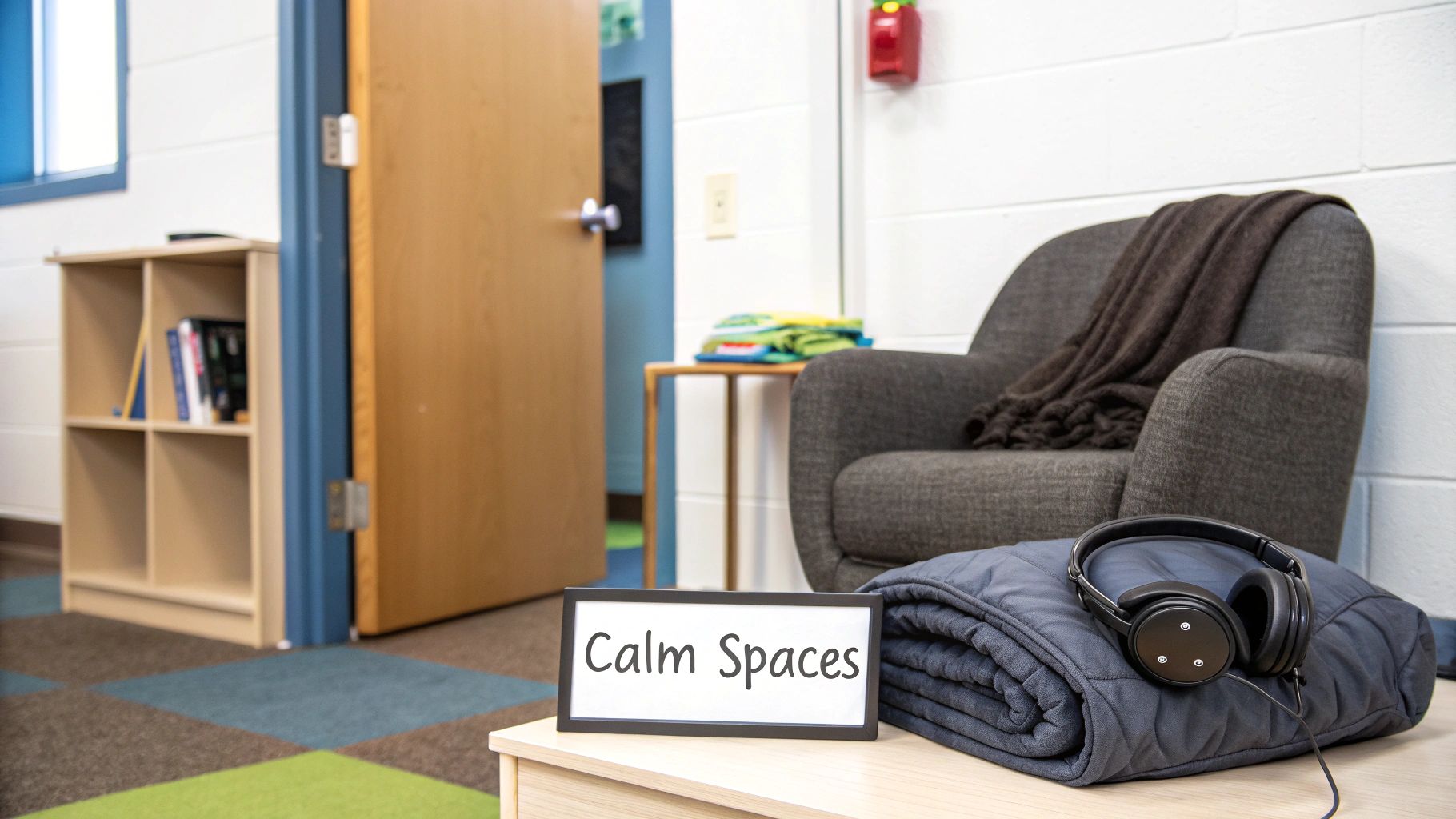
This isn't about bubble-wrapping your child from every experience. It’s about creating a supportive home base and a more accessible learning environment that gives their nervous system a chance to rest, regulate, and feel safe.
Strategies for a Sensory-Friendly Home
Your home should be a sanctuary—a place where your child’s nervous system can finally decompress after a long day. This doesn't mean you need a total renovation; it's about being thoughtful with a few key areas to lower sensory demands and offer regulating input when they need it most.
A wonderful place to start is by creating a dedicated "calm-down corner" or safe space. This isn't a timeout spot, but rather a cozy retreat your child can choose to go to when they feel overwhelmed.
You can furnish this little haven with things that provide calming input:
- Soft lighting like a gentle lava lamp or fairy lights is much better than harsh overhead fixtures.
- Comfortable seating could be a beanbag chair, big floor pillows, or even a small pop-up tent.
- Calming tools like a weighted blanket, a super-soft stuffed animal, or a pair of noise-canceling headphones are perfect additions.
Think of this corner as a charging station for their nervous system. It’s a place they can proactively use to recharge before their battery gets too low, which can head off meltdowns before they even start.
Beyond creating a special space, you can also embed sensory activities right into your daily routines. For children who are sensory seekers, incorporating "heavy work" gives them the intense proprioceptive input their bodies crave. For a closer look at these behaviors, you can learn more about understanding sensory seeking behaviour in our detailed guide.
Simple "heavy work" chores can include:
- Carrying the laundry basket
- Pushing the vacuum cleaner
- Helping bring in groceries from the car
- Watering plants with a full watering can
These tasks provide powerful, organizing feedback to their muscles and joints, which is incredibly grounding and regulating for an active nervous system.
Partnering with Your Child's School
The school environment can often feel like a sensory minefield. It's filled with buzzing fluorescent lights, unpredictable noises, and constant social demands. Working as a team with your child's teacher can transform their school day from one of just surviving to one of truly thriving.
The goal is to implement simple, often discreet, accommodations that support your child without making them feel singled out. You'll find that many of these strategies actually benefit all the students in the classroom, making them an easy "yes" for most teachers.
Simple School Accommodations
Start by scheduling a meeting with the teacher to share a little about your child's specific sensory profile. Explain what helps them feel calm and what helps them focus. Most teachers are very receptive to practical suggestions they can easily put into practice.
Here are a few effective accommodations you could discuss:
- Flexible Seating: Instead of a traditional hard chair, could your child use a wiggle cushion, a wobble stool, or maybe a standing desk? This allows them to get that needed movement input without disrupting the lesson.
- Planned Movement Breaks: Proactively scheduling short breaks for movement can work wonders. This could be as simple as making your child the designated helper to deliver a message to the office or letting them do five wall push-ups before a writing task.
- Discreet Fidget Tools: Provide a small, quiet fidget (like therapy putty or a stress ball) that they can keep in their desk or pocket. This gives their hands something to do, which can free up their brain to focus on listening.
- Noise Management: For a child who is sensitive to sound, ask if they can wear noise-reducing headphones during independent work time or loud assemblies. This one small tool can make a world of difference.
By creating these supportive environments, you build a predictable world where your child feels understood and has the tools they need to regulate their nervous system. This foundation of safety frees up their energy for what truly matters—learning, growing, and connecting with the world around them.
Common Questions Parents Ask About SPD
As you start to connect the dots for your child, it’s only natural for questions to pop up. Feeling uncertain is a completely normal part of this journey. We’ve dedicated this final section to answering some of the most common questions we hear from parents just like you, offering clear, straightforward answers to help you move forward with confidence.
Is Sensory Processing Disorder the Same as Autism?
This is easily one of the first questions parents ask, and it’s a great one. The short answer is no, they are not the same thing. But it’s an understandable point of confusion because they are so closely linked and frequently show up together.
Here’s a helpful way to think about it: SPD is specifically about how the brain takes in, organizes, and responds to sensory information. It's a "wiring" issue. Autism Spectrum Disorder (ASD), on the other hand, is a much broader developmental condition that impacts social communication, interaction, and behavioral patterns.
The overlap is massive—some research suggests that as many as 96% of children with autism also struggle with significant sensory processing challenges. But here's the critical part: a child can absolutely have SPD without having autism. The only way to get a clear picture is through a comprehensive professional evaluation. This ensures your child’s support plan is perfectly matched to their unique needs, whether they stem from one condition or both.
Understanding this distinction is key. It helps ensure that your child's support plan addresses the root of their challenges, whether they stem from sensory wiring, social communication needs, or a combination of both.
Can Children Outgrow Sensory Processing Disorder?
Many families hold onto the hope that their child will simply "outgrow" SPD. While kids don't outgrow the unique way their nervous system is wired—not like they outgrow a pair of shoes—their ability to thrive with that wiring can improve dramatically. With the right strategies and support, the daily challenges can become so much smaller.
Consistent occupational therapy is a game-changer. It helps children build powerful new neural pathways, almost like creating new, more efficient roadways in the brain. They learn to understand their own sensory systems and develop incredibly effective coping strategies. For example, a child who once melted down in a noisy store learns to recognize the signs of overload and ask for noise-canceling headphones before going in.
As they get older, this therapeutic work blends with their own growing self-awareness. They get better at advocating for what they need and using their toolbox of strategies to stay regulated and engaged. So, the goal isn't to erase their sensory differences but to empower kids with sensory processing disorder to navigate their world with confidence.
What Is a Sensory Diet and How Does It Work?
Don't let the name fool you—a "sensory diet" has nothing to do with food! Instead, think of it as a personalized menu of sensory activities, carefully designed by an occupational therapist. The whole point is to give your child’s nervous system the exact kind of input it needs to feel calm, organized, and "just right" throughout the day.
Imagine your child's nervous system is like a car engine. To run well, it can't be revving too high (overwhelmed) or stalling out (under-responsive). A sensory diet provides the specific "fuel" to keep that engine running smoothly.
-
For a sensory seeker—the child whose engine tends to run a bit low and constantly needs more input—the diet might be full of activities that provide strong feedback. Think jumping on a trampoline, pushing a heavy laundry basket, or swinging high at the park.
-
For a sensory avoider—the child whose engine revs too high and gets flooded easily—the diet will focus on calming, organizing activities. This could look like quiet time with a weighted lap pad, getting deep pressure hugs, or listening to slow, rhythmic music.
These aren't random activities. They're strategically woven into your child's daily routine to proactively regulate their nervous system. The goal is to prevent the sensory "crashes" and meltdowns before they even have a chance to start, keeping your child in that ideal state for learning, playing, and just being a kid.
At First Steps Chiropractic, we understand the deep connection between the nervous system and your child’s ability to navigate their world. Our neurologically-focused care is designed to support regulation from the inside out, helping children feel more calm, connected, and resilient. If you're looking for answers and a supportive partner on your journey, we invite you to learn more about our specialized pediatric care at https://firststepschiropractic.com.