
That little flat spot you’ve noticed on your baby's head can feel alarming, but take a deep breath—it's an incredibly common and manageable condition. The key to fixing a baby's flat head usually involves simple, proactive strategies that you can easily work into your daily routine.
Think more tummy time, gently varying your baby's head position when they sleep and play, and giving them plenty of free movement on the floor. For most infants, these gentle adjustments make all the difference.
Understanding Why Baby Flat Head Happens

If you've spotted a flattened area on your little one's head, you are far from alone. This condition, known medically as positional plagiocephaly, is a frequent concern for new parents. Its prevalence has shot up since the "Back to Sleep" campaign was introduced to reduce the risk of SIDS. While this safe sleep practice is non-negotiable, it does mean babies spend a lot of time on their backs, which puts consistent pressure on their soft, pliable skulls.
A baby’s skull isn’t one solid bone. It’s actually made of several soft, flexible plates with gaps between them called sutures. This design is brilliant for two big reasons: it allows the head to mold during birth and accommodates the explosive brain growth that happens in the first year. But that same softness is what makes the skull so susceptible to outside pressure.
Plagiocephaly vs. Brachycephaly
You might hear a couple of different terms for flat spots, and it’s helpful to know what they mean.
- Positional Plagiocephaly: This is the most common type. The head is flattened on one side, which can give it a slightly asymmetrical, parallelogram-like shape. This often happens if a baby has a favorite side to turn their head to while sleeping.
- Brachycephaly: This refers to a flattening across the entire back of the head. It can make the head appear wider than usual and is also caused by prolonged time spent lying flat on the back.
It’s so important to understand that these conditions are almost always cosmetic and do not affect brain development. They are simply the result of external pressure on a soft, growing skull. The good news? Because the skull is still soft, we can guide it back to a rounder shape with some simple interventions.
The sheer number of babies with this condition is surprising to many parents. Research shows just how common it is, which should help ease concerns that you've done something wrong. It's a natural consequence of modern safe sleep guidelines.
This is backed by some serious data. A notable Canadian study from 2010 found that nearly half of all infants—46.6% to be exact—showed some degree of head flattening by the time they were 7 to 12 weeks old. You can read more about the study's findings on infant plagiocephaly here.
Underlying Causes and Contributing Factors
While time spent on their back is the main driver, a few other things can contribute to a flat spot. One of the most common is congenital muscular torticollis, a condition where tight neck muscles make it difficult or uncomfortable for a baby to turn their head in one direction.
Because they can’t turn their head freely, they end up resting on the same spot over and over again, leading to plagiocephaly. Premature babies are also at a higher risk because their skulls are even softer, and they often spend more time lying down in the NICU. Even their position in the womb can sometimes play a role in their head shape at birth.
Recognizing these factors early empowers you to take corrective action, turning that initial anxiety into a confident plan to support your baby's healthy development.
Here’s a quick rundown of the main strategies we’ll be covering.
Quick Guide to Addressing Baby Flat Head
| Strategy | What to Do | Why It Works |
|---|---|---|
| Repositioning | Alternate the direction your baby’s head faces in the crib each night. | This simple trick encourages your baby to turn their head to the other side to look out, varying the pressure points. |
| Increase Tummy Time | Aim for several short, supervised sessions throughout the day, building up to a total of 30-60 minutes daily. | Tummy time takes all pressure off the back of the head while strengthening neck, shoulder, and back muscles. |
| Carry More, Contain Less | Hold your baby upright in your arms or use a baby carrier/sling when they are awake and alert. | This minimizes the time they spend lying flat on their back in containers like bouncers, swings, or car seats. |
| Switch Up Your Routine | Alternate which arm you use for feeding and change the position of engaging toys and mobiles. | Encourages your baby to look in different directions, preventing them from favoring one side. |
By incorporating these small changes into your day, you can make a big impact on your baby's head shape. It's all about providing opportunities for varied movement and positions.
Making Tummy Time a Positive Part of Your Day
Hearing that "tummy time" is the go-to fix for a flat spot can be incredibly frustrating, especially when your little one starts screaming the second their belly hits the floor. If that sounds familiar, trust me, you are not alone. So many parents feel defeated by this advice. The secret isn't to force it; it's to reframe tummy time from a dreaded chore into a playful, positive part of your routine.
The whole point is to build up their strength and get that constant pressure off the back of their head. And here’s the good news: that doesn't have to happen on a playmat right away. We can start with much gentler, more comforting approaches.
Starting Small and Building Stamina
Forget about the clock. In the beginning, think of tummy time in moments, not minutes. The real goal is just to help your baby get comfortable being off their back while they're awake.
- Chest-to-Chest Cuddles: This is my favorite way to start. Lean back on the couch or in a recliner (when you're wide awake, of course!) and lay your baby right on your chest. They get all the benefits of tummy time while feeling secure and connected to you.
- Lap Time: Sit on the floor and lay your baby across your lap, so they're perpendicular to your legs. You can gently rub their back or sing to them. It gives them a new view of the world and still gets the job done.
- The Football Hold: Carrying your baby face-down along your forearm is another fantastic option. It feels secure and gives them a chance to work those little neck muscles as you walk around.
Aim for just one to two minutes at a time, but do it several times a day. Consistency beats duration, hands down, especially at the start. The second your baby gets fussy, pick them up. It's totally fine to stop and try again later. We're trying to build positive connections here, not create stress.
A huge mistake I see parents make is waiting until their baby is already tired or hungry to try tummy time. Instead, aim for a time when your baby is calm, happy, and alert—like right after a diaper change or a good nap. You're setting them up for success.
Making Floor Time More Engaging
Once your baby is a bit more used to the idea of being on their tummy, we can work on making floor sessions more fun. The key is to get down on their level—your presence makes all the difference.
- Use a Prop: Roll up a small receiving blanket or use a nursing pillow under your baby's chest, right below their armpits. That little bit of support makes it so much easier for them to lift their head and look around, which cuts down on frustration.
- Be the Entertainment: Get down on the floor, face-to-face with your baby. Sing, make silly faces, chat with them. You are their absolute favorite toy, and your engagement is what will keep them going.
- Mirrors and Toys: An unbreakable, baby-safe mirror is a game-changer. Babies are fascinated by their own reflection! You can also place some high-contrast toys in a little arc in front of them to encourage them to turn their head from side to side.
Remember, every single minute they spend off the back of their head is a victory. These sessions aren't just about fixing a flat spot; they are laying the essential groundwork for building the neck, shoulder, and core strength they'll need for all their future milestones. You can learn more about how these activities help your child's physical development in our guide to gross motor skills.
This proactive approach is so important. Since the "Back to Sleep" campaign started in 1992, conditions like plagiocephaly and brachycephaly have shot up. In the U.S., about 18% to 19.7% of infants are born with this each year, but an alarming 86% may go untreated because the signs are missed or dismissed early on. By making tummy time a consistent and positive routine, you are taking one of the most powerful steps you can to support your baby's healthy development right from the start.
Using Repositioning Techniques Around the Clock
When you're trying to correct a flat spot, consistency is your best friend. Small, purposeful adjustments to your baby's position all day (and night) long can truly make all the difference. Think of it as a gentle, 24-hour strategy to encourage balanced head movement and take constant pressure off that one area.
This doesn't mean you need to completely upend your life. It’s all about weaving simple positional changes into the things you're already doing—playtime, feedings, naps, and even just carrying your little one around the house.
Awake Time Adjustments
When your baby is awake and taking in the world, that’s your prime opportunity to guide their movement. If you've noticed they favor turning their head to one side, you can use their budding curiosity to your advantage.
- Strategic Toy Placement: During floor play, place engaging, high-contrast toys or a baby-safe mirror on their non-preferred side. This simple trick naturally prompts them to turn their head away from the flattened spot.
- Alternate Your Approach: When you walk up to the crib or play mat, try coming in from their less-favored side. Just the sound of your voice and sight of your face is often enough motivation for them to turn and engage with you.
This visual guide breaks down tummy time—a critical part of awake time—into three manageable steps.
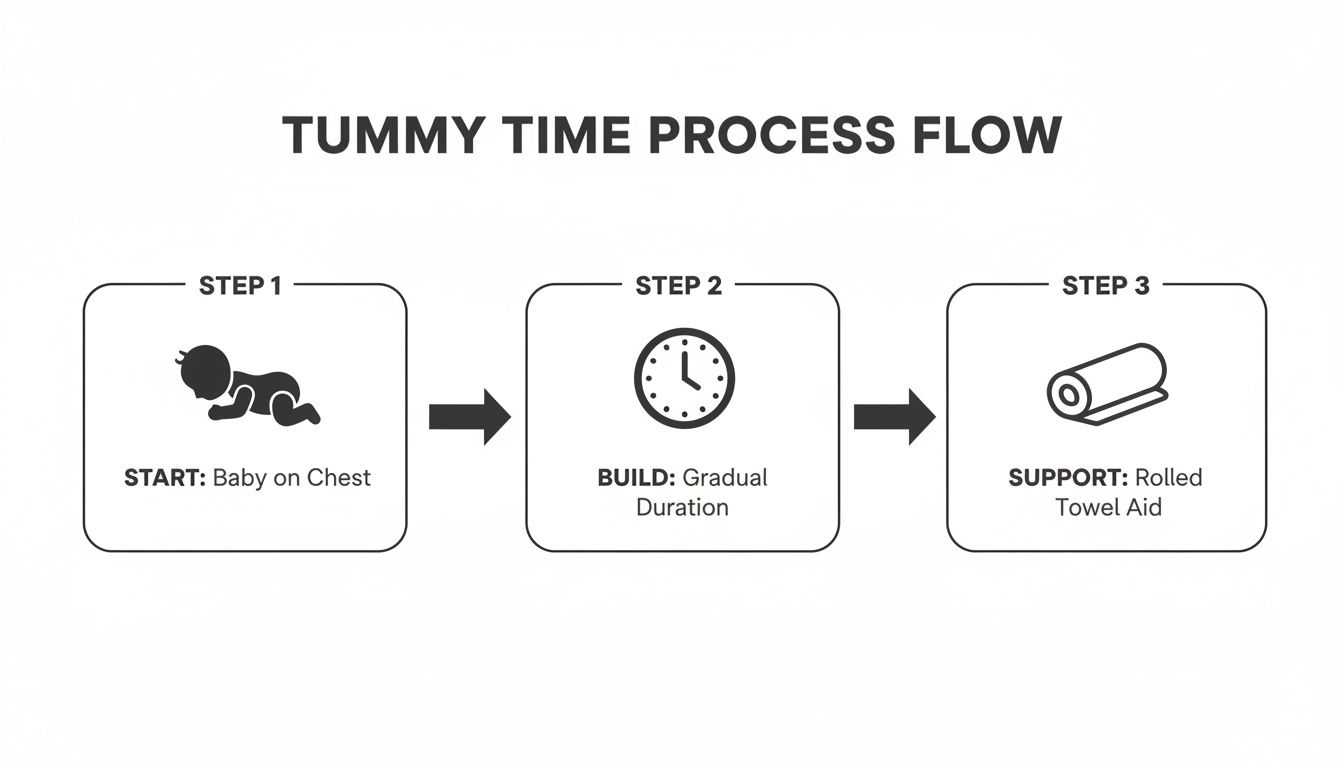
The real takeaway here is that successful tummy time is a journey. It starts with making your baby feel comfortable and connected, then gradually building up how long they can do it, using simple supports to help them succeed.
Varying Your Carrying and Holding Positions
The way you hold your baby has a bigger impact on their positional habits than you might think. Getting creative and moving beyond the standard cradle hold can do wonders for relieving pressure and building up those important neck muscles.
Just think about how much time you spend carrying your baby. Every one of those moments is a chance to make a positive shift.
A common habit I see is parents always holding or feeding their baby in the same arm. It's totally normal, but simply switching which arm you use for feedings encourages them to turn their head in both directions. It’s a tiny change that can have a big impact.
Try working some of these holds into your daily routine:
- The Football Hold: Tuck your baby under your arm, tummy down, with their head resting securely in your hand. This is a fantastic position for strengthening their neck and can be incredibly soothing for a fussy baby.
- Upright Holding: Carry your baby upright against your shoulder or chest. This completely takes the pressure off the back of their head and gives them a great new perspective on the world.
- Babywearing: Using a soft-structured carrier or a sling is a game-changer. It keeps your baby close and content while keeping them off their back. Just be sure the carrier provides proper head and neck support and allows for natural movement.
Smart Positioning During Naps and Sleep
The "Back to Sleep" rule is the gold standard for infant safety, and it is non-negotiable. But you can still make small tweaks to vary your baby's head position while they sleep safely on their back. The idea is to prevent them from resting on that same flattened spot for every single sleep.
One of the easiest and most effective tricks is to simply alternate which end of the crib you place their head at. Babies often turn their heads toward a door, window, or light source. By changing their starting position, you encourage them to look the other way when they stir.
Important Safety Note: You should never use pillows, wedges, or any kind of positioning device in the crib. These items are not safe for sleep and significantly increase the risk of SIDS. The only things that belong in your baby's crib are a firm mattress and a fitted sheet.
Mindful Use of Baby Gear
Things like car seats, swings, bouncers, and rockers can be absolute lifesavers for parents. But because they hold a baby in one position, they can also contribute to flat spots if overused. These devices are often called "containers" for a reason.
The goal is to use them mindfully and only for their intended purpose. A car seat is crucial for travel, but it shouldn't double as a nap spot once you're home.
- Limit Container Time: When you're not on the move, prioritize free-movement playtime on the floor over time spent in a bouncer or swing.
- Take Breaks on the Road: During long car trips, plan to stop every hour or two. Take your baby out of the car seat for a good stretch and a cuddle.
- Provide Smart Support: You can use rolled-up receiving blankets alongside your baby’s body (never their head) in strollers or swings to encourage a more centered head position. Always double-check to ensure their airway is completely clear.
By consistently applying these repositioning techniques throughout the day and night, you create a dynamic environment that promotes healthy, symmetrical growth. It’s the cumulative effect of all these small, loving adjustments that really helps correct a flat spot naturally.
Identifying and Managing Infant Torticollis
While repositioning techniques are a fantastic first step, sometimes a flat spot sticks around because of an underlying issue called congenital muscular torticollis. It sounds complicated, but it's really just tightness in one of the big neck muscles (the sternocleidomastoid). This tightness makes it uncomfortable or tricky for your baby to turn their head freely in both directions.
When a baby has torticollis, they’ll naturally favor looking to one side—it's just easier for them. This constant positioning puts prolonged pressure on the same area of their soft skull, which is a direct cause of a flat spot. It's a classic case of one condition feeding right into the other.
Recognizing the signs early on is the key. When you address the root cause—that tight muscle—you can resolve the head preference, which makes all your repositioning efforts so much more effective.
What to Look For
The signs of torticollis can be subtle at first, but once you know what you’re looking for, they become much clearer. You might notice your baby has:
- A Persistent Head Tilt: They consistently tilt their head to one side, like they're trying to touch their ear to their shoulder.
- A Strong Head-Turning Preference: They almost always turn their head to look in one specific direction and might get fussy if you gently try to turn it the other way.
- Difficulty with Feeding: They might struggle to latch or feed comfortably on one side because turning their head that way is a strain.
- A Small Lump: In some babies, you might feel a small, pea-sized, and harmless lump in the tight neck muscle.
If you spot any of these signs, it's a great reason to chat with your pediatrician. They can give you a proper diagnosis and make sure nothing else is going on.
It's so important to consult with your healthcare provider, like a pediatrician or a pediatric physical therapist, before you start any stretching exercises at home. They can confirm the diagnosis and, more importantly, show you the correct, safe techniques to ensure you're helping, not harming.
Gentle Stretches and Playful Interventions
Once you've gotten professional guidance, you can start weaving gentle movements into your daily routine to help release that muscle tension. The goal here is to make these exercises feel like a natural part of your day, not some clinical procedure.
- Diaper Change Stretches: Diaper changes are the perfect built-in opportunity. While your baby is lying on their back, gently and slowly turn their head to the non-preferred side. Hold for about 10-15 seconds, then release.
- Toy-Motivated Turns: During tummy time or side-lying play, place engaging toys, mirrors, or even just your face on their less-favored side. This encourages them to actively turn their head and work that muscle themselves.
- The Football Hold: This carrying position is fantastic for torticollis. Carry your baby tummy-down along your forearm, with their head turned away from the tight side. It provides a nice, passive stretch while you go about your day.
Remember, consistency is far more important than intensity. A few seconds of stretching repeated many times throughout the day will do so much more than one long, stressful session.
In some cases, specialized care can offer extra support. Exploring options like gentle, neurologically-focused chiropractic care may help address underlying nervous system tension and improve musculoskeletal function. You can learn more about chiropractic care for babies and see how it can complement other therapies.
When to Talk to a Doctor About Helmet Therapy

You’ve been diligently practicing tummy time and using every repositioning trick in the book, but that worry about your baby's head shape just isn't going away. It’s one of the most common concerns I hear from parents: how do you know when at-home efforts are enough and when it’s time to get a professional opinion?
Trust your gut. While most mild cases of plagiocephaly resolve beautifully with these conservative strategies, some situations do warrant a conversation with your pediatrician. If you feel like the flattening is significant or you’re just not seeing any improvement after a few consistent weeks, it’s always best to get it checked out. A professional evaluation can give you peace of mind or get you on the right path for the next steps.
Recognizing When to Make the Call
There are a few key signs that it might be time to schedule that appointment. These go beyond a simple flat spot and may suggest a more moderate to severe case that could benefit from professional intervention.
It helps to go into the appointment with specific observations. Here’s what to look for:
- No Improvement: You have been consistently repositioning your baby and ensuring plenty of tummy time for 4-6 weeks with no noticeable change.
- Significant Asymmetry: Look at your baby from a "bird's-eye view." Does one ear seem pushed forward compared to the other? Does one side of their forehead seem to bulge?
- Facial Asymmetry: Sometimes, the flattening can affect facial features, causing one eye to appear smaller or the cheeks to look uneven.
- Stubborn Torticollis: Despite your best efforts with gentle stretches, your baby still has a very strong preference for turning their head to one side and struggles to look the other way.
A doctor's visit isn't about jumping straight to a helmet. The goal is to get a proper diagnosis, rule out any other underlying conditions, and create a clear, guided plan. This might involve a referral to a pediatric physical therapist or a cranial specialist for a closer look.
Demystifying Helmet Therapy
If your pediatrician determines the flattening is moderate or severe, they may bring up cranial orthosis, which is just the clinical term for helmet therapy. It can sound intimidating, but it's a very safe and effective treatment when used for the right reasons.
A therapeutic helmet doesn't squeeze or force your baby's head into a new shape. Instead, it works by providing gentle, constant contact over the prominent, rounded areas of the skull. This cleverly directs your baby's natural head growth into the flattened spots, allowing them to fill out and round out over time.
Think of it as a guide, not a mold. The helmet essentially creates a perfectly round space for the head to grow into.
The Optimal Window for Treatment
Timing is everything when it comes to the success of helmet therapy. This treatment is most effective when a baby’s skull is still very soft and growing at a rapid pace.
The ideal window for starting helmet therapy is typically between 4 and 6 months of age. While it can still be effective up to 12 months, the skull bones begin to harden after this point, making big changes much harder to achieve. This is why getting an early evaluation is so important—it keeps all your options open.
Parents understandably have a lot of questions about what helmet therapy is really like. Here are some of the most common concerns:
- Is it comfortable? The helmets are custom-made from a 3D scan of your baby’s head. They are surprisingly lightweight with a soft foam lining, and most babies adapt to wearing them within just a day or two.
- How long is the treatment? A baby will typically wear the helmet for 23 hours a day. The total treatment time usually lasts for several months, depending on how old the baby is when they start and the severity of the flattening.
- What about the cost? This is a big concern for many families. Coverage varies widely by insurance plan, so it's essential to check with your provider about your specific benefits.
Some parents also seek out complementary care to support their baby’s progress, whether they are using a helmet or not. For those looking for a non-invasive approach to address any underlying musculoskeletal imbalances, it can be helpful to find a pediatric chiropractor near me who specializes in gentle, neurologically-focused techniques. This can help improve neck mobility and overall function, supporting the body’s natural alignment.
Ultimately, remember that a helmet is a medical tool for specific situations, not a first-line defense for mild flatness. Speaking with your doctor is the best way to determine the right path forward for your baby.
Common Questions About Baby Flat Head
As you start working on these strategies, it's completely normal for a bunch of questions to pop up. You might wonder about timelines, safety, or if you're even doing things "right." Let's walk through some of the most common concerns parents have.
My goal here is to give you clear, direct answers that build on everything we've already covered. Feeling confident in your plan is just as important as the techniques themselves.
How Long Does It Take to See Improvement
This is the number one question on every parent's mind. The honest answer is: it depends. The timeline really hinges on your baby's age, how significant the flattening is, and how consistent you can be with repositioning and tummy time.
Generally, if you catch it early (around 2-4 months of age), you could start to see some subtle improvements within 4 to 8 weeks. For older babies or more noticeable flattening, the process will naturally take a bit longer because their head growth starts to slow down.
Remember, progress is gradual, not dramatic. You’re guiding your baby’s natural growth, so the changes happen slowly over weeks and months. A great tip is to take weekly photos from a "bird's-eye view" above their head. It helps you track the subtle progress you might otherwise miss day-to-day.
Can a Flat Spot Correct Itself Without Intervention
In very mild cases, sometimes a little bit of flattening can round out on its own as your baby becomes more mobile. Once they start rolling, sitting up, and naturally spending less time on their back, the constant pressure is off, giving the skull a chance to reshape.
However, just hoping for the best is a gamble, especially with moderate flattening or if there's an underlying issue like torticollis. Being proactive with tummy time and repositioning is always the most reliable way to guide things toward a positive outcome.
Are Special Pillows or Head-Shaping Products Safe
You've probably seen them online—special pillows, head shapers, and mats all marketed as a quick fix for a baby's flat head. While the promises are tempting, the American Academy of Pediatrics does not recommend these products.
Here’s why they should be avoided:
- Safety Risks: Any soft bedding or positioning device in a crib, bassinet, or play yard increases the risk of suffocation and SIDS. The only safe sleep environment is a firm, flat surface with nothing else in it.
- Limited Effectiveness: These products often restrict a baby’s natural head movement, which is the exact opposite of what you want. Free movement is what strengthens those neck muscles and prevents the flat spot from getting worse.
The safest and most effective tools are the ones that are free: diligent repositioning, plenty of supervised tummy time, and carrying your baby in different positions.
When Is It Too Late to Fix a Flat Head
While it's absolutely true that intervening earlier is more effective, it's rarely "too late" to make at least some improvement. The skull bones start to harden and fuse significantly around 12 months of age, which makes changing the head shape much more difficult after that point.
The "golden window" for making the biggest impact with repositioning—and helmet therapy, if it's needed—is before that first birthday. If your baby is older than a year and you still have concerns, it's always worth discussing them with your pediatrician. They can assess the situation and give you a realistic idea of what to expect.
At First Steps Chiropractic, we understand that every family's journey is unique. If you're looking for gentle, neurologically-focused support to address musculoskeletal imbalances that may contribute to conditions like torticollis and flat head, we're here to help. Discover how our specialized pediatric care can support your child's optimal development by visiting us at https://firststepschiropractic.com.