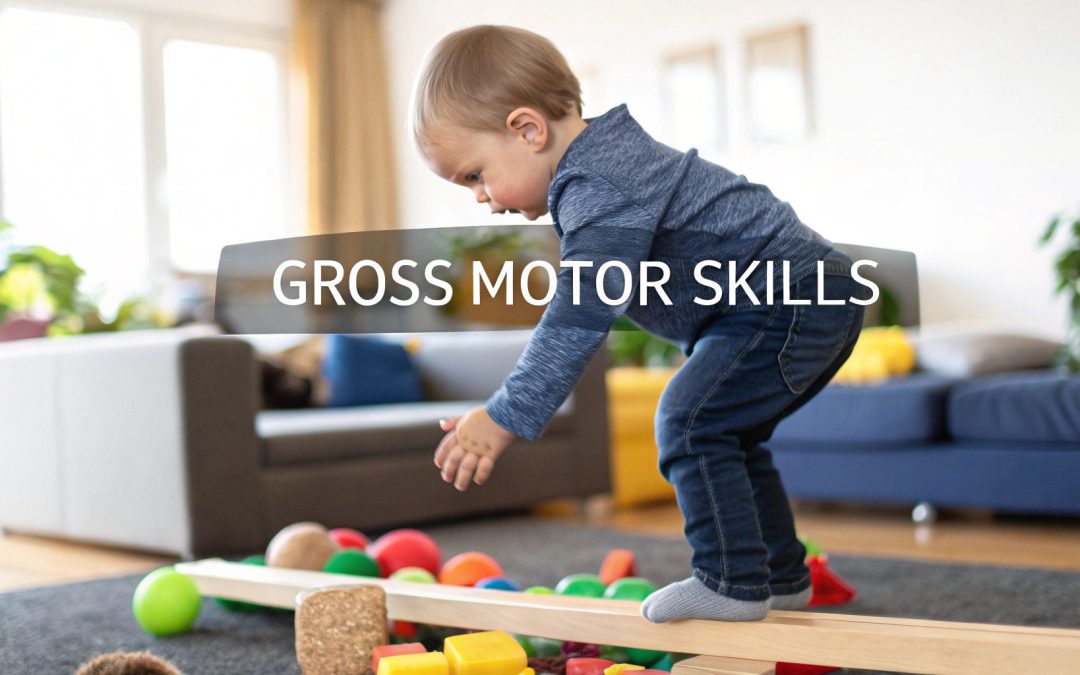
Gross motor development is all about how children learn to use the large muscles in their arms, legs, and torso to move and coordinate their bodies. These are the foundational skills that let kids perform big actions like sitting, crawling, walking, running, and jumping. Think of it like building the sturdy frame of a house—these abilities support everything else a child learns to do physically.
Understanding Your Child's Physical Foundation
At its heart, gross motor development is the incredible journey a child takes to gain mastery over their own body. It’s so much more than just movement; it’s about the brain, nervous system, and muscles learning to communicate and work together in perfect harmony. This intricate network is what allows a baby to go from making random kicks to taking confident, purposeful steps.
You can picture the brain as a conductor leading a grand orchestra. The nervous system acts as the messengers, carrying signals from the conductor to the large muscle groups—the musicians. In the beginning, the music is a bit disjointed and clumsy, but with tons of practice, it becomes a beautiful, coordinated symphony of movement. While this progression is predictable, it’s also entirely unique to each child, and it almost always unfolds from the head downwards.
The Head-to-Toe Progression
You'll notice that development follows a fascinating top-down pattern. A child first gains control over their head and neck, then their core muscles for sitting, and finally their legs and feet for standing and walking. This sequence is precisely why "tummy time" is so vital—it’s the very first workout for those essential neck and upper body muscles.
This journey is typically broken down into three main types of movement that build on one another:
- Locomotor Skills: These are the actions that get your child from one place to another. We're talking about crawling across the living room, running wild in the park, or jumping over a puddle on a rainy day.
- Stationary Skills: These skills involve movement while staying in one spot. This includes things like balancing on one foot, sitting up without toppling over, pushing a heavy toy, or twisting around to grab something just out of reach.
- Manipulation Skills: This category is all about moving objects using those large muscles. The classic examples are throwing a ball, kicking a soccer ball around the yard, or catching a beanbag.
Gross motor skills truly lay the groundwork for almost every other physical ability. As a child develops strength, balance, and coordination, they build the confidence to explore their world, engage fully in play, and interact with everything around them. This physical mastery is deeply tied to their cognitive growth, too, because movement and learning are powerfully intertwined.
When you understand these fundamentals, you can really appreciate every tiny milestone, from that first successful rollover to a brave, confident leap. Each new achievement is a testament to the sophisticated connection firing between your child’s brain and body. For a deeper look into how sensory input fuels this learning process, you can explore the stages of sensorimotor development and see how it all fits together.
Mapping Your Child's Motor Milestones
Trying to understand the typical journey of gross motor development can feel like reading a map without any landmarks. This section is your practical, age-by-age guide, breaking down the incredible progression of skills from the first newborn squirms to confident, school-aged coordination.
Think of these milestones not as a rigid checklist, but as a flexible roadmap. It’s all about celebrating your child’s unique pace while giving you a clear picture of what to expect along the way.
Every new skill—from lifting their head to taking that first unassisted step—is built on the one that came before. It’s a beautiful cascade of developing strength, balance, and neurological connection.
This timeline shows how gross motor skills progress, starting with core strength in the torso, moving to coordinated arm actions, and finally leading to advanced leg movements.
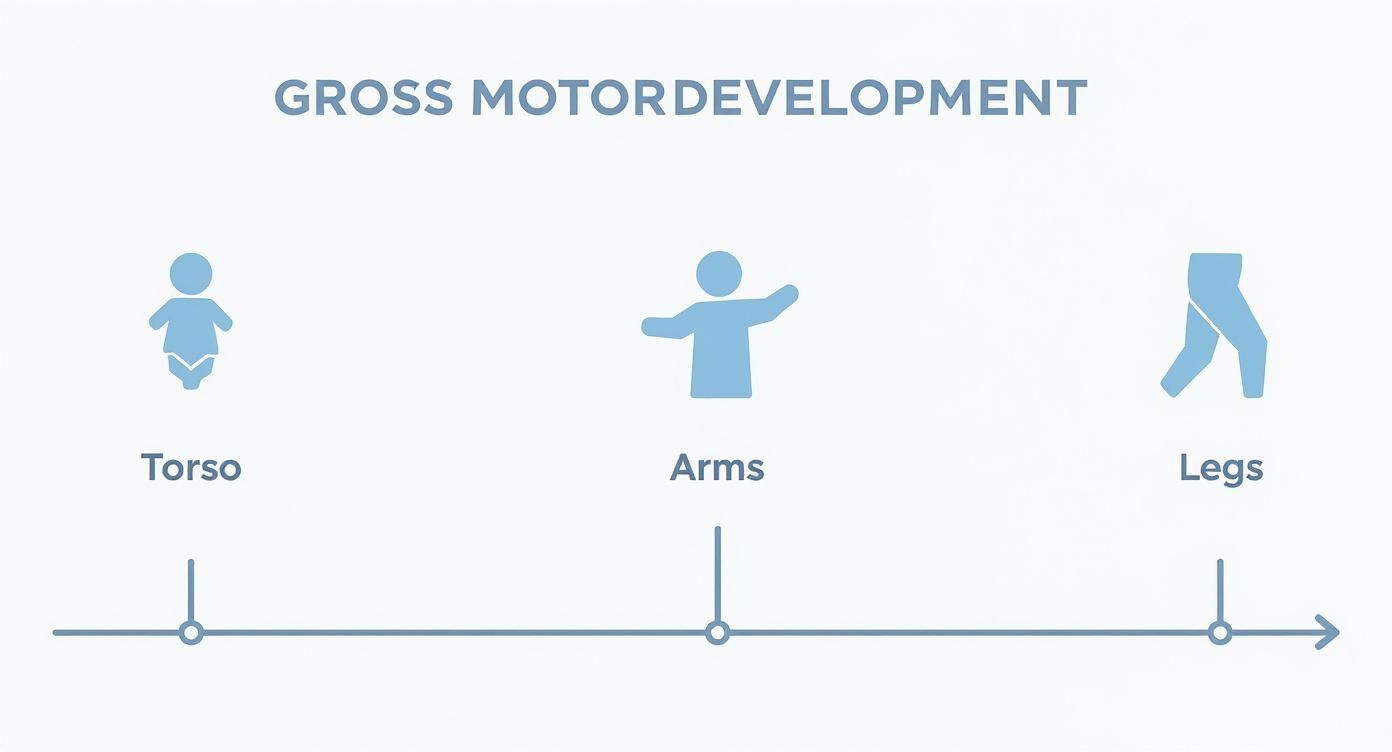
As you can see, foundational skills in the body's core are absolutely essential before more complex control over the arms and legs can be mastered.
The First Six Months: Foundational Movements
The first half-year of life is all about gaining control against gravity. A newborn's movements start out as reflexes, but they quickly begin building the foundational strength needed for purposeful action.
Tummy time is the superstar activity during this stage. It acts as the primary workout for their neck, shoulder, and core muscles, laying the groundwork for everything to come.
Six to Twelve Months: Exploring the World
The second half of the first year is an explosion of mobility! With a stronger core, babies are now ready to explore their environment in exciting new ways. This is the stage where they transform from stationary observers into active participants in their world.
Now, their main goal is to get moving. They want to get to that toy across the room, and they're figuring out just how to do it.
One to Two Years: Becoming a Toddler
Welcome to toddlerhood, where walking takes center stage. This period is defined by newfound independence and a burning desire to test physical limits.
Gross motor development now shifts to refining balance, coordination, and the ability to navigate different surfaces. They are no longer just moving; they are interacting with their world on two feet.
Two to Three Years: Refining Skills
With walking mastered, two-year-olds are focused on adding speed, height, and complexity to their movements. Their play becomes much more dynamic and physically adventurous as they gain confidence in their abilities. You'll notice their movements becoming smoother and more controlled.
Three to Five Years: Advanced Coordination
As children enter the preschool years, their gross motor skills become much more refined and specialized. They can now combine movements to perform the complex actions required for playground games and early sports. This is a period of huge improvement in balance, agility, and overall coordination.
Research shows this period is marked by rapid gains. One study on locomotor skills in children found that the mean score for three-year-olds was 20.5, which jumped to 33.6 by age five—a 63.9% improvement in just two years. This really shows how quickly children refine their abilities through simple practice and play.
To give you a clearer picture, here is a chart that breaks down the key milestones you can expect at each stage.
Gross Motor Development Milestones Chart
| Age Range | Key Milestones |
|---|---|
| 0-6 Months | Lifts head during tummy time, pushes up on arms, rolls from tummy to back (and later, back to tummy), begins to sit with support. |
| 6-12 Months | Sits independently without support, gets into a sitting position alone, crawls or scoots, pulls up to a standing position, "cruises" by walking sideways while holding furniture. |
| 1-2 Years | Walks independently, squats to pick up toys and stands back up, begins to run (stiffly), walks up and down stairs with help, kicks a ball. |
| 2-3 Years | Runs more smoothly, jumps in place with both feet, throws a ball overhand, climbs playground equipment, pedals a tricycle. |
| 3-5 Years | Hops on one foot, stands on one foot for several seconds, walks up and down stairs alternating feet, catches a bounced ball, begins to skip, performs a somersault. |
Remember, these age ranges are just averages. Some children may master a skill a few months earlier or later, and that's perfectly normal. The focus should always be on progress, not perfection.
As you follow your child's journey, remember that each of these steps is a huge victory in their gross motor development. Understanding these distinct stages can also help you recognize the different motor development skills and see how they all connect.
Playful Activities to Boost Motor Skills
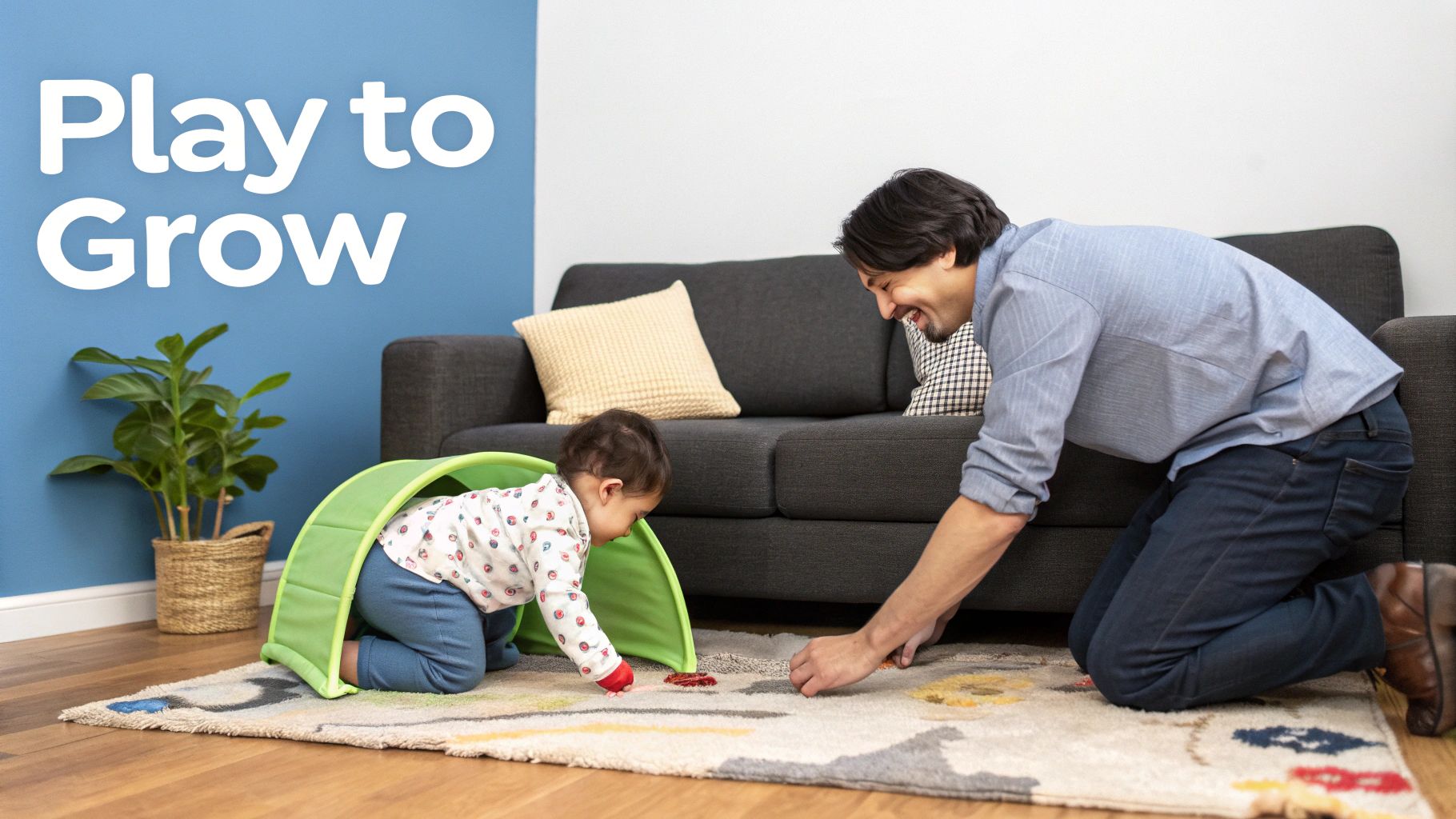
Knowing the stages of gross motor development is one thing, but actually putting that knowledge into practice is where the real magic happens. The best way to encourage these skills is simply through play—making it so fun your child doesn't even realize they're doing important developmental "work."
The goal is to weave movement into your daily life, not create some rigid training schedule. And you don’t need a bunch of expensive toys. Honestly, some of the most effective activities just use simple things you already have at home.
This mindset turns your living room, the backyard, or a trip to the park into the perfect playground for building strength, coordination, and confidence. Let's dig into some creative, skill-building play ideas.
Building Better Balance and Core Strength
Balance is the unsung hero of all gross motor skills. It’s the foundation for everything from sitting up and standing to running and jumping. A strong core is the anchor for all of it. Activities that gently challenge a child’s balance teach their muscles to make constant, tiny adjustments to stay upright.
It's a lot like learning to ride a bike—the body has to figure out how to instinctively shift its weight. These playful exercises help train that internal sense of equilibrium.
- Pillow Obstacle Course: Line up couch cushions, pillows, and blankets on the floor. Encourage your little one to crawl, walk, or "hike" over the wobbly surfaces. This forces their core muscles to fire up to maintain balance.
- Animal Walks: This is always a hit. Have fun imitating different animals! Waddle like a penguin, hop like a frog, or get on all fours and walk like a bear. These silly movements are fantastic for building core strength and body awareness.
- Balancing Beam Fun: Use a line of painter's tape on the floor or a curb outside as your balance beam. Challenge your child to walk the line without stepping off. Make it a game!
The key here is repetition in a low-pressure setting. When a child feels safe enough to wobble and fall, they learn resilience and body control so much faster.
Mastering Movement Through Running and Jumping
Once a kid is steady on their feet, running and jumping become incredible ways to explore what their body can do. These actions are more complex than they look, requiring a mix of strength, timing, and coordination that only comes with practice.
At first, a toddler's run looks more like a frantic waddle, and their jumps barely clear the ground. That’s totally normal! Play gives them the perfect space to practice these skills until they become smooth and powerful.
- Follow the Leader: You can't go wrong with this classic. Change up your pace from a slow walk to a fast run, and throw in fun actions like jumping, skipping, and spinning around.
- Bubble Chase: Blow bubbles and let your child run, jump, and swat to pop them. This is amazing for improving their agility and hand-eye coordination without them even thinking about it.
- Jumping Games: Practice jumping over small things, like a rope laid flat on the ground, or jumping between spots marked by paper plates or chalk circles. This helps them learn to control their take-off and landing.
These games aren't just about burning off energy; they're fundamental for building the cardiovascular endurance and leg strength needed for all the gross motor skills to come.
Developing Throwing, Catching, and Kicking Skills
Interacting with objects—like balls—is a huge step forward in gross motor development. It requires the brain to calculate distance, speed, and trajectory while coordinating the body's movements to make it all happen.
Start with larger, softer objects. This makes learning less intimidating and sets them up for success. A balloon is perfect because it moves slowly, giving a child more time to react and coordinate their hands or feet.
Here are a few simple ways to build these skills:
- Balloon Toss: A lightweight balloon is perfect for practicing hitting and catching. It moves slowly and won't hurt if it bonks them, which builds a ton of confidence.
- Beanbag Target Practice: Set up a laundry basket or a big box as a target. Let your child practice tossing beanbags or other soft toys into it from different distances.
- Indoor Soccer: Use a soft, lightweight ball for a gentle game inside. The "goal" can just be the space between two chair legs. The point is just to practice kicking toward a target.
When you turn skill-building into a game, you create a positive connection with being active. This playful approach not only supports healthy gross motor development but also helps foster a lifelong love for movement.
How to Recognize Potential Motor Delays
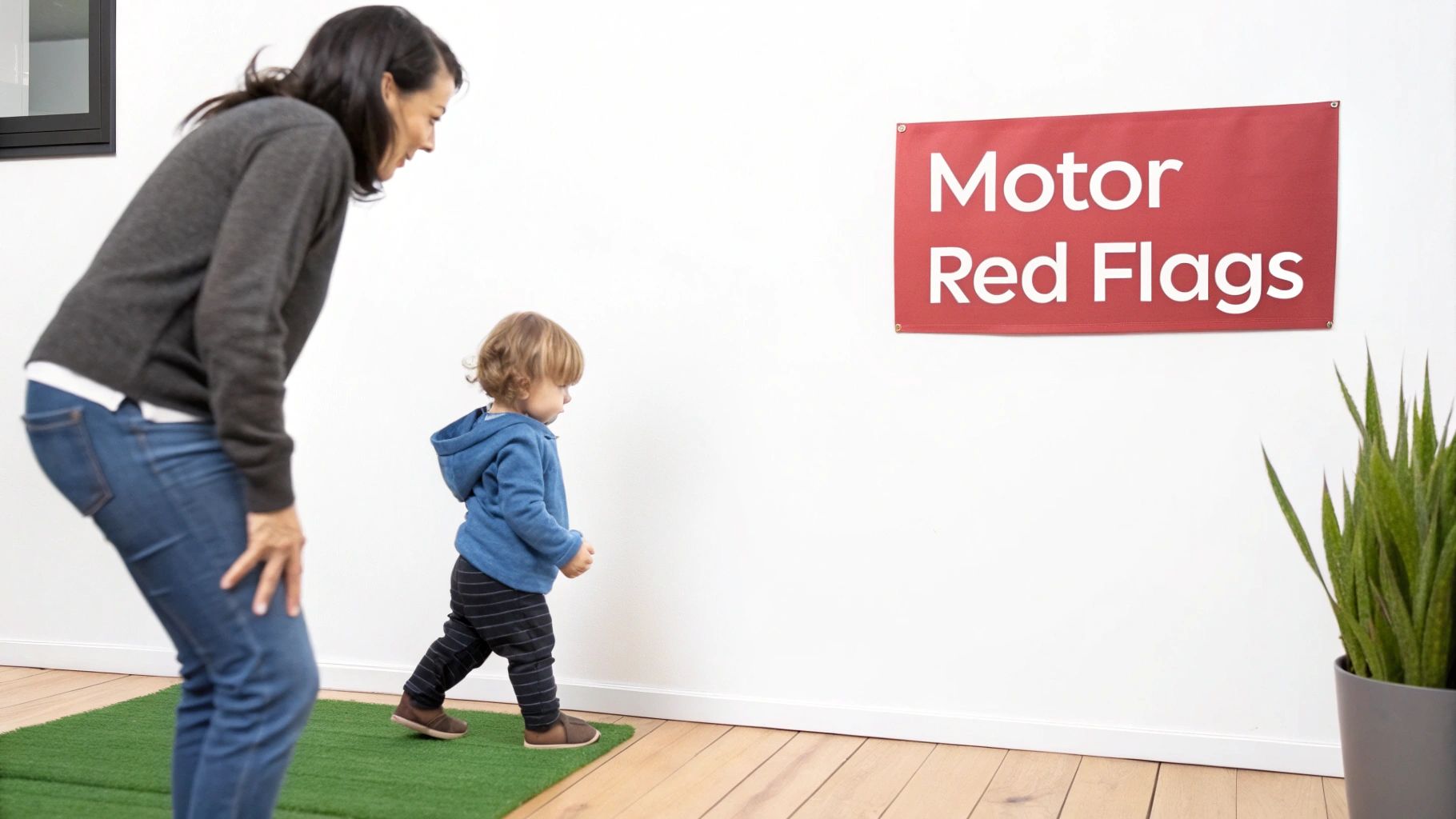
Watching your child grow is one of life’s greatest joys, filled with one exciting milestone after another. But it's also completely natural to wonder if their progress is on track, especially when you see other kids their age doing different things. Learning to spot the difference between your child's unique developmental rhythm and a potential red flag is key to giving them the support they need.
Every child has their own timeline. Some kids walk early but talk late; others are master climbers long before they can stack a few blocks. This individuality is totally normal and expected.
A true developmental delay, however, is a bit different. It’s not just about being a little "late" on one skill. It's more about a consistent pattern of not reaching milestones within the expected age ranges across several areas.
Key Signs That Warrant a Conversation
Sometimes, just watching how your child moves can give you valuable clues. While these signs aren't a reason to panic, they are worth paying attention to and bringing up with a healthcare professional. They can often point to underlying issues with muscle tone, coordination, or the communication pathways in the nervous system.
Take a look at your child's body movements as a whole. Do they move with symmetry and ease, or does something seem off-kilter, stiff, or unusually challenging for them?
Here are a few key physical signs to watch for:
- Abnormal Muscle Tone: Does your child feel unusually stiff and rigid (hypertonia) or, conversely, really floppy like a ragdoll (hypotonia)? This can make it tough for them to hold up their head, sit, or move with control.
- Asymmetrical Movements: Do they heavily favor one side of their body? Maybe they always reach with their right hand or only kick with their left leg. While preferences are normal, a strong, consistent pattern of one-sidedness can be a sign to investigate.
- Difficulty with Foundational Skills: By 6-8 months, are they still having a hard time with head control or unable to sit up even with support?
- Delayed Locomotion: Is your little one not crawling or even attempting to pull up to a standing position by 12 months?
A consistent pattern of missed milestones is more significant than a single skill taking longer to develop. Trust your parental intuition—if you feel something isn’t quite right, it’s always worth exploring.
Environmental and External Factors
A child's motor development isn’t just about what’s happening on the inside. Their environment and daily experiences are huge factors in how they learn to explore and coordinate their bodies. Sometimes, what might seem like a delay is actually connected to these outside influences.
For instance, spending too much time in "containers" like car seats, bouncers, or activity centers can limit a child's opportunity for free movement. This can restrict their chances to practice fundamental skills like rolling over and crawling. Things like nutrition and quality time with caregivers also play a massive role in healthy development.
Gross motor delays in kids under three are relatively uncommon. Research suggests that only about 1.43% of children in this age group experience a delay. A detailed analysis found that factors like age, nutrition (especially supplementary food), and the time spent interacting with caregivers are strongly linked to a child’s motor progress. You can learn more about the factors influencing early motor development.
When to Take the Next Step
Noticing these signs isn't about diagnosing your child—it's about gathering information. Your observations as a parent are incredibly valuable. It can be helpful to keep a simple, dated log of your concerns, jotting down specific examples of what you're seeing.
This empowers you to have a much more productive conversation with your pediatrician or another trusted professional. Instead of just saying, "My child seems clumsy," you can offer concrete examples, like, "For the past two months, he has been falling more than ten times a day and struggles to stand up from a squat."
Remember, early identification and support can make all the difference in the world. Being proactive is the single most important step you can take to make sure your child gets everything they need to thrive.
When to Seek Professional Guidance
If you're worried about your child’s gross motor skills, just knowing what to do next can bring a huge sense of relief. The most important thing you can do is trust your gut. Your observations as a parent are powerful, and if you feel like something is off, starting a conversation with a healthcare professional is always the right move.
Your pediatrician is the best place to start. They’re trained to look at your child’s health as a whole. They’ll listen to your concerns, conduct a developmental screening, and help you figure out if what you’re seeing is within the wide range of normal or if it’s time to see a specialist.
Who Can Help Your Child Thrive
If your pediatrician thinks a closer look is needed, they’ll likely refer you to a team of specialists who live and breathe childhood development and movement. Each one brings something unique to the table to support your child.
- Pediatric Physical Therapists (PTs): Think of PTs as the movement experts. They’ll assess your child’s strength, coordination, and balance, then create fun, play-based therapy plans designed to build those crucial gross motor skills.
- Pediatric Occupational Therapists (OTs): OTs focus on helping kids succeed at their daily "jobs"—playing, learning, and taking care of themselves. They often work on motor planning and sensory processing to help a child interact more confidently with the world around them.
These therapies are often the go-to for addressing motor delays, giving your child targeted support to help them build skills and feel good about what their body can do.
The goal of any therapy isn't to force a child onto a strict timeline. It's about giving them the exact support they need to unlock their own physical potential and thrive.
A Deeper Look at the Nervous System
Alongside these traditional therapies, many parents are also exploring approaches that get to the root of all movement: the nervous system. This is where specialized pediatric chiropractic care comes into the picture.
A neurologically-focused pediatric chiropractor uses gentle and precise techniques to check and improve how the nervous system is functioning. The idea is simple: make sure the brain's messages can get to the body's muscles without any roadblocks. By addressing subtle misalignments or tension that might be getting in the way of those nerve signals, this approach supports the very foundation of gross motor development.
For families in the Hayden area interested in this type of care, you can learn more about finding a pediatric chiropractor near you and see if it feels right for your family's journey.
It's also worth remembering that a child’s environment and culture have a real impact on their development. In fact, cross-cultural studies show that kids around the world hit milestones at different times, which really highlights how a child’s daily experiences shape their physical skills. You can read more about how culture influences motor skills.
Preparing for an Evaluation
Going into an evaluation feeling prepared can make a world of difference in advocating for your child. Before the appointment, take a few minutes to write down what you’ve noticed and any questions you have.
Questions to Consider Asking:
- Based on what you're seeing, what are my child's biggest strengths and challenges?
- What specific goals will we be working on together?
- How can I support this at home in a fun, playful way?
- How will we track progress, and when will we check in?
Taking these small steps helps you become a confident partner in your child’s development, making sure they have the perfect team in place to help them shine.
Got Questions About Gross Motor Skills? We’ve Got Answers.
As you watch your little one grow, it's totally normal to have questions pop up about their physical development. You're not alone! Let's clear up some of the most common things parents wonder about when it comes to gross motor skills.
We'll dive into everything from toddler tumbles to the great screen time debate, giving you the confidence and know-how to support your child's journey.
Is It Normal for My Child to Seem Clumsy?
Yes, a certain amount of clumsiness is a completely normal—and necessary—part of childhood. Think of it like they're learning a brand-new dance. The first few times, their steps are going to be awkward, uncoordinated, and probably lead to a few trips and bumps.
Kids are constantly testing the limits of their growing bodies. Their center of gravity keeps shifting, their legs and arms are getting longer, and their brain is working overtime to coordinate it all. This "trial and error" phase is how they master balance and body awareness. Of course, if the clumsiness is persistent, leads to frequent injuries, or you notice it alongside other developmental concerns, it’s always a good idea to chat with their pediatrician.
What’s the Difference Between Gross and Fine Motor Skills?
This is a fantastic and super common question! The easiest way to remember the difference is to think about the size of the muscles they're using.
- Gross Motor Skills: These skills use the large muscles in the torso, arms, and legs for big, whole-body movements. We're talking running, jumping, climbing, and throwing a ball.
- Fine Motor Skills: These skills use the small muscles in the hands, fingers, and wrists. They're for all the precise little actions like gripping a crayon, buttoning a shirt, or picking up a Cheerio.
Gross motor skills lay the foundation for fine motor skills. A child needs solid core strength and shoulder stability (gross motor) before they can ever master the delicate, controlled movements of their fingers (fine motor).
How Does Screen Time Affect Gross Motor Development?
This is such an important topic for modern parents. While screens can certainly have their place for learning, too much passive screen time can steal valuable hours from the active play that builds strong bodies. When a child is sitting with a tablet or watching TV, they simply aren't practicing running, jumping, balancing, or climbing.
The American Academy of Pediatrics recommends limiting screen time specifically to make room for plenty of unstructured physical play. Movement is the language of childhood—it’s how kids learn to use their bodies, build strength, and develop the coordination that will serve them for a lifetime. Making active, screen-free time a priority is one of the best gifts you can give your child’s gross motor development.
Can a Child Skip a Milestone Like Crawling?
It happens! Some babies do skip crawling and go straight to pulling up, cruising along furniture, and walking. While this can fall within the range of typical development, we know that crawling is a powerhouse of a milestone. It’s an incredible activity that strengthens the entire body, from the hands and wrists all the way up to the shoulders and core.
Crawling also hardwires coordination between the left and right sides of the brain and body, which is a big deal for future skills. If your baby seems to be skipping this stage, you can gently encourage it by placing their favorite toys just out of reach during tummy time. There's no need to panic, but if your little one isn't showing any signs of getting mobile by 12 months, a check-in with a professional is a great next step.
At First Steps Chiropractic, we know that every question about your child's development matters. Our neurologically-focused approach is designed to ensure their nervous system is functioning at its best, giving them a strong foundation to meet every milestone with confidence. If you have concerns or just want to be proactive about your child’s health, we invite you to learn more about our gentle, effective care. Discover our approach at firststepschiropractic.com.