
Navigating the world through your child's eyes can feel like solving a puzzle, especially when their reactions seem bigger or just plain different than you expect. A sensory processing disorder quiz is often a parent's first practical step to organize all those confusing observations and start spotting patterns that might point to underlying sensory challenges. It's a tool that helps translate baffling behaviors into a much clearer picture of what your child's unique nervous system might need.
Understanding Your Child’s Sensory World
It’s completely normal to feel confused or even frustrated when your child has a total meltdown over a shirt tag or seems completely unfazed by a big bump or scrape. These moments are tough. But there's usually a deeper explanation than just "bad behavior." The real key is understanding how their nervous system is taking in and making sense of the world.
Imagine your child's nervous system is like the air traffic control center for a bustling city. Its job is to manage all the incoming sensory flights—sights, sounds, touch, smells, and movement—and guide them to the right runway so the body can respond properly.
For most of us, this system runs pretty smoothly. But for a child with sensory processing challenges, that control center gets overwhelmed. It might misdirect signals or get stuck in a major "traffic jam."
What Do These Sensory Traffic Jams Look Like?
When a child's nervous system struggles to manage all that sensory input, it shows up in a few distinct ways. Learning to recognize these patterns is the first step to truly understanding what your child is experiencing, and it's exactly where a sensory processing disorder quiz becomes so helpful. It guides you to look for specific signs.
These patterns usually fall into three main categories:
- Over-Responsive (Hypersensitivity): This is like having a smoke alarm that's way too sensitive. The child’s nervous system treats everyday sensations as major threats. They might have a huge reaction to loud noises, hate getting their hands messy, or find the texture of certain clothes completely unbearable.
- Under-Responsive (Hyposensitivity): Here, the nervous system's alarm is too quiet. The child needs a ton more sensory input just to notice it. They might not seem to feel pain like other kids, might not respond when you call their name, or can seem lethargic and checked out.
- Sensory-Seeking or Craving: This kid's nervous system is always on the hunt for more intense input to feel organized and calm. This often looks like constant motion—crashing into things, jumping, spinning, and rough play—as they try to "wake up" their system and feel grounded.
The goal is to shift your perspective from viewing these actions as willful defiance to seeing them as a child’s attempt to regulate a nervous system that is wired differently. Identifying the "why" behind the behavior is the most critical step toward providing meaningful support.
By recognizing these patterns, you can move from just managing behaviors to actually addressing the root cause. This compassionate approach validates both your concerns as a parent and your child's internal experience. To dive deeper into the fundamentals, you can learn more about what is sensory processing in our detailed guide. Understanding this framework empowers you to find effective strategies that help your child’s nervous system find balance and calm.
Is It Sensory? Take Our Screening Quiz
You've seen the behaviors. You've felt that nagging concern in your gut. Now, let’s start connecting those dots and bringing the picture into focus.
This isn’t a test your child can pass or fail. Instead, think of it as a practical tool for you, as a parent, to organize your observations and start identifying patterns in your child’s sensory world. It's designed to help you see how individual actions might point to the bigger story of how their nervous system is processing information.
It’s so important to remember that this sensory processing disorder quiz is a screener, not a diagnostic tool. It can’t replace a full, professional evaluation from a trained expert like an OT or a neurologically-focused chiropractor. Consider it a powerful first step—a way to gather your thoughts and head into that professional conversation with clarity and confidence.
Think of this quiz as creating a map of your child's unique sensory landscape. By answering these questions, you’ll start to see where the "traffic jams" in their nervous system might be happening.
How to Use This Screening Quiz
Read through each question and think about your child’s typical behavior over the last few months. Try to answer based on what you see most of the time, not just what happened on one particularly good or bad day.
For each statement, pick the response that feels most accurate: Never, Rarely, Sometimes, Often, or Always.
We’ve broken the quiz into sections that look at different sensory systems. This helps us get more specific, providing a detailed snapshot of where your child might need the most support.
Section 1: Touch and Tactile Processing
This is all about how your child reacts to physical contact and different textures.
- Does your child get really upset by seams in socks, clothing tags, or certain fabrics?
- Does your child actively avoid "messy" play like finger painting, playing in mud, or sand?
- Does your child have a big, negative reaction to being touched lightly or unexpectedly?
- Does your child seem totally unaware of being messy (like having food all over their face)?
- Does your child crave deep pressure, like wanting tight hugs or piling on heavy blankets?
- Does your child touch people and objects constantly, even when it’s not the right time or place?
Section 2: Sound and Auditory Processing
Here, we're exploring how your child responds to the sounds of daily life.
- Does your child cover their ears or get distressed by loud, sudden noises like a vacuum, blender, or public bathroom hand dryer?
- Does your child seem totally overwhelmed or easily distracted in noisy places like the grocery store or a busy classroom?
- Does your child often not respond when you call their name?
- Does your child love making loud noises, like yelling, shrieking, or banging things together?
- Does your child seem to notice quiet sounds that no one else hears?
- Does your child speak with a voice that is consistently very loud or very quiet?
Remember, these questions are all about finding consistent patterns. A single "yes" doesn't mean anything is wrong, but a bunch of "often" or "always" answers in one area can point you toward where you might need to dig deeper.
Section 3: Sight and Visual Processing
This section looks at how your child takes in and makes sense of what they see.
- Is your child bothered by bright lights, direct sunlight, or the fluorescent lights in stores?
- Does your child get easily overwhelmed in visually "busy" places, like a toy store?
- Does your child have a hard time finding a specific toy in a cluttered toy box?
- Does your child stare intensely at things, especially lights or spinning objects?
- Does your child struggle with activities that need good eye-hand coordination, like catching a ball or building with blocks?
- Does your child lose their place a lot when reading a book or copying notes from a whiteboard?
Section 4: Movement and Body Awareness
This part dives into the vestibular (balance) and proprioceptive (body position) senses.
- Does your child seem anxious or fearful of playground equipment like swings or slides?
- Does your child seem clumsy, often bumping into furniture, walls, or people?
- Does your child have a poor sense of personal space, getting right up in other people's faces?
- Does your child seem to be in constant motion—always running, jumping, spinning, and climbing?
- Does your child seek out really intense movement, like spinning until they're dizzy or loving rough-and-tumble play?
- Does your child use way too much or too little force for tasks, like writing so hard the crayon breaks or barely pushing a door closed?
Section 5: Emotional and Social Responses
Finally, let's connect the sensory dots to behavior and emotional regulation.
- Does your child have frequent, intense meltdowns that seem completely out of proportion to what triggered them?
- Does your child have a really hard time with transitions, like leaving the park or stopping one activity to start another?
- Once upset, does your child have extreme difficulty calming back down?
- In new or overstimulating situations, does your child tend to withdraw or completely shut down?
- Does your child struggle to play cooperatively with other kids?
- Does your child seem anxious or very rigid about daily routines?
Once you’ve finished the quiz, take a deep breath and look over your answers. The next section of this guide will walk you through exactly how to interpret these patterns and what they might be telling you about your child's nervous system.
What Your Sensory Quiz Results Really Mean
So you've finished the sensory quiz and now have a page full of notes and observations. This is a huge step. You've just put words to what you've been seeing day in and day out, creating a much clearer picture of your child's world.
Now, let’s dive into what those checks and scores actually tell us about how your child's nervous system is wired. Think of these results less like a final diagnosis and more like the start of a really informed conversation.
The patterns you spotted are clues. They help us figure out if your child’s internal "smoke alarm" is set just right, if it’s way too sensitive, or if it needs a ton of input just to go off. Getting this right is critical, especially when you consider that somewhere between 5% and 16.5% of kids and adults show signs of sensory processing challenges.
This is a map of how our quiz helps organize these observations, sorting them into key areas like touch, sound, and movement.
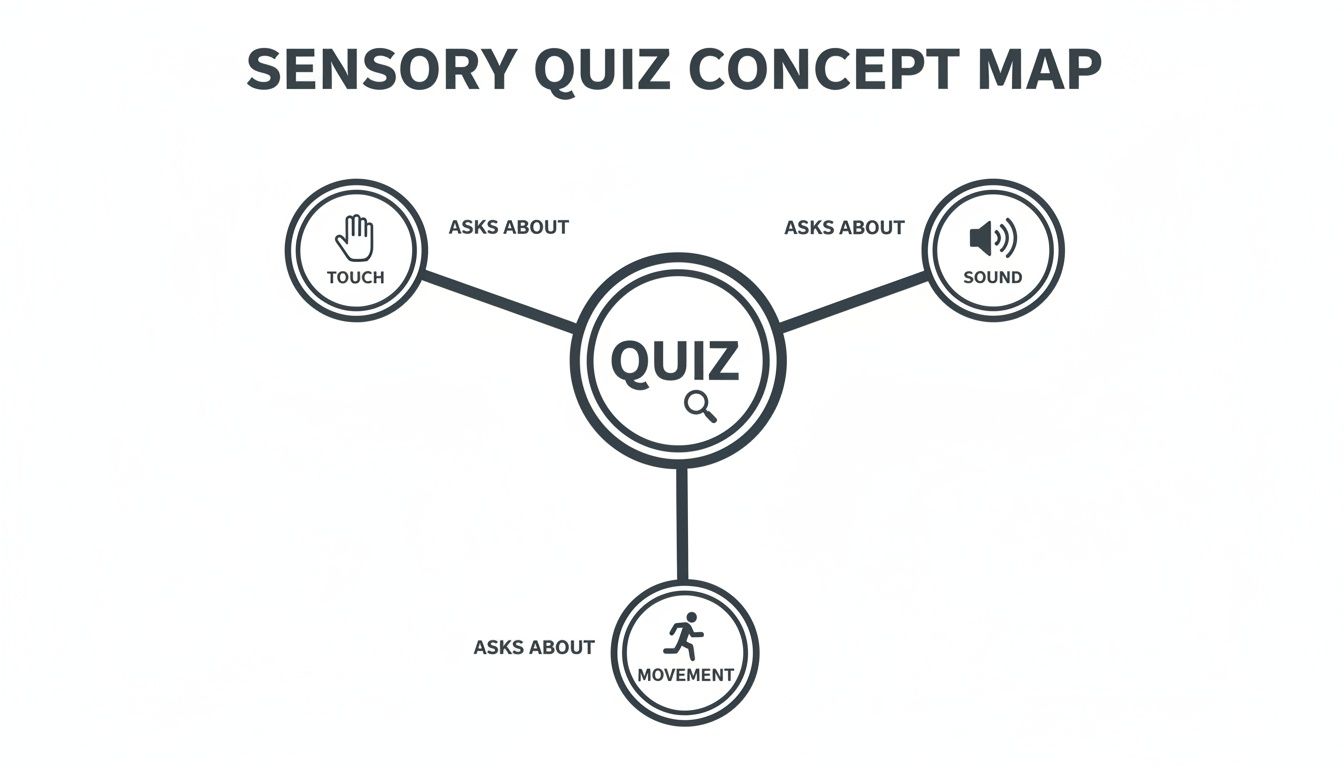
What this shows is that a single quirky behavior isn't the whole story. The real insight comes from seeing the bigger pattern across all their senses.
Interpreting Your Score Patterns
Most kids will have a mix of responses, but the results usually lean toward one of three main patterns. And remember, this sensory processing disorder quiz is just a screening tool—it’s not a formal diagnosis. Its job is to help you see the forest for the trees.
Mostly "Never" or "Rarely": Typical Sensory Processing
If most of your answers landed here, it’s a good sign that your child's nervous system is processing sensory information pretty effectively. They seem to handle the daily flood of sights, sounds, and textures without getting consistently overwhelmed or thrown off balance. Sure, every kid has an off day, but their sensory system is likely a source of stability, not stress.A Mix of "Sometimes" and "Often": Mild Sensory Sensitivities
This blend of answers suggests your child might have some specific sensory quirks or needs. They’re noticeable, but probably not derailing their life on a daily basis. Maybe they can’t stand the seams in their socks or get a little frazzled in a crowded, noisy room, but they’ve figured out ways to cope most of the time. These are definitely things to keep an eye on.
Strong Indicators of Sensory Challenges
If you saw a lot of answers in the "Often" or "Always" columns, especially if they were clustered in one or two sections (like Touch or Sound), that’s a strong signal. It means your child's nervous system is likely working overtime and struggling to keep up.
This isn't a parenting issue. It's about their unique neurological wiring.
Let's break down what those high scores might mean with a simple analogy:
High Over-Responsive Scores (Sensory Avoiders): This is like having a smoke alarm that's way too sensitive—it shrieks every time you make toast. The nervous system misinterprets everyday sensations as threats, triggering a fight-or-flight response over things like a toilet flushing, a gentle hug, or bright lights.
High Under-Responsive Scores (Sensory Sliders): In this case, the smoke alarm barely works. The nervous system needs a massive amount of input just to register that something is happening. This is the child who might not notice food smeared on their face or seems to tune out when you call their name.
High Sensory-Seeking Scores (Sensory Seekers): This child's nervous system is constantly craving more input to feel organized and calm, kind of like how some of us need music to focus. The constant crashing, spinning, and touching is their brain’s way of "turning up the volume" to a level that finally feels right.
To help you see these patterns clearly, here is a quick summary of what to look for.
Sensory Patterns at a Glance
| Sensory Pattern | Common Behavioral Signs | Nervous System Analogy |
|---|---|---|
| Over-Responsive | Avoids touch, covers ears, picky eater, easily overwhelmed by crowds or lights. | The "smoke alarm" is set too high and goes off at the slightest trigger. |
| Under-Responsive | Seems oblivious to pain, doesn't notice messes, slow to respond, appears lethargic. | The "smoke alarm" is faulty and needs a huge amount of smoke to activate. |
| Sensory-Seeking | Constantly moving, crashing, touching everything, loves intense flavors and sounds. | The nervous system is "turning up the volume" to feel just right. |
Seeing your child's behaviors through these patterns can be a game-changer.
These tendencies offer a window into your child's inner world. When you start to understand them, you can see their actions not as defiance, but as a genuine attempt to cope with a world that feels chaotic. To learn more, you can explore our detailed guide on the full range of sensory processing disorder symptoms.
The Connection Between SPD and Other Conditions
If you've noticed sensory challenges in your child, you've probably also seen other behaviors that don't seem to fit neatly under the sensory umbrella. Many parents get a gut feeling that it’s all connected, and you know what? They’re right. Sensory Processing Disorder (SPD) rarely travels alone.
It very often shows up alongside other neurodevelopmental conditions, most commonly Attention-Deficit/Hyperactivity Disorder (ADHD) and Autism Spectrum Disorder (ASD). While each of these are distinct conditions with their own diagnostic criteria, they share a common root: the nervous system. At their core, all of these challenges involve differences in how the brain regulates information, processes the world, and organizes a response.
The Overlap Between SPD and ADHD
Imagine your child's brain is a busy office. In a child with ADHD, the "executive assistant" in charge of focus and prioritizing tasks gets sidetracked easily. Now, let's add SPD to the mix. Not only is the assistant distracted, but the office is also being bombarded with loud noises, flickering lights, and a terribly uncomfortable chair. It’s chaos.
This is the reality for so many kids. The inattentiveness or hyperactivity we see in ADHD can be cranked up to a whole new level when the brain is also fighting to filter out overwhelming sensory input. A child who can’t sit still might actually be seeking movement to help regulate their system, not just being impulsive.
This connection isn't just a theory; it's well-documented. Research consistently shows that when you assess for both sensory and attention challenges, the link is undeniable. One study found that a staggering 41% of participants had both sensory and attention impairments. You can explore the findings on sensory and attention challenges yourself to see just how intertwined these two conditions really are.
How SPD and Autism Are Linked
With Autism, the connection to SPD is even more direct. In fact, unusual sensory responses are now a core part of the diagnostic criteria for ASD. For many autistic individuals, the world is experienced with an incredible sensory intensity, which fundamentally shapes how they interact with their environment and communicate with others.
The behaviors you see—like hand-flapping, avoiding eye contact, or an intense focus on a specific toy—are often powerful self-regulation strategies. They are a way to manage a sensory environment that can feel chaotic, unpredictable, and overwhelming.
Understanding this link changes everything. It helps us shift our perspective from seeing these behaviors as just "symptoms of autism" to recognizing them as meaningful attempts to find calm and order in a confusing sensory world. That compassionate viewpoint is the key to providing the right kind of support.
Why a Holistic View Matters
Because these conditions are so deeply interconnected, looking at just one piece of the puzzle can lead to an incomplete picture and frustrating results. A child’s inability to focus in class might get labeled as just ADHD. But if their discomfort with the buzzing fluorescent lights and the scratchy fabric of their uniform is ignored, standard ADHD strategies are likely to fall short.
This is exactly why a comprehensive, whole-child approach is so critical. When we understand that the root issue is often a dysregulated nervous system, we can build a much more effective and integrated plan for care. Instead of just chasing individual symptoms, we can focus on supporting the entire system to find balance and resilience. This ensures that every piece of your child's puzzle is seen, understood, and addressed.
How Gentle Chiropractic Care Gets to the Root Cause
So, you’ve gone through a sensory processing disorder quiz and are starting to see some patterns. The big question now is, "What can we do about it?" While many traditional therapies are fantastic for managing behaviors and symptoms on the surface, neurologically-focused chiropractic care is all about digging deeper to address the root cause—a nervous system that's stuck in overdrive.

Think of your child’s nervous system as the communication highway that connects their brain and body. Every sight, sound, and touch travels along this highway to be processed and understood. But what if there are constant traffic jams or static on the line? In chiropractic, we call this interference subluxation, and it seriously disrupts that flow of communication.
When signals get lost, scrambled, or amplified, you start to see the over-responsive, under-responsive, or sensory-seeking behaviors you know all too well. Our goal isn't just to give your child coping skills for the traffic jams; it's to actually clear the roads so the messages can get through smoothly.
Pinpointing Nervous System Stress
How do we actually see this static in the nervous system? We use advanced, non-invasive technology called Insight Scans. These scans give us a detailed map of your child's nervous system, showing us exactly where the stress and interference are building up.
It’s like getting a "weather map" for their nervous system. The map highlights the high-pressure zones (stress) that are jamming up the works. This isn't guesswork—it's real, objective data that gives us a clear picture of what's going on inside your child's body.
For many parents, seeing this map for the first time is a huge "aha!" moment. It's validation. It provides a real, physiological reason for the behaviors they've been trying so hard to understand.
Clearing the Static With Gentle Adjustments
Once we've mapped out the specific areas of dysregulation, we can get to work with gentle and precise chiropractic adjustments. Forget the "popping" and "cracking" you might associate with adult chiropractic care. For kids, our adjustments are incredibly gentle, often using just a light, sustained pressure.
The whole point of these adjustments is to reduce that interference and get the brain and body talking to each other properly again. By "clearing the static," we help the nervous system learn how to regulate itself far more effectively.
This process helps reorganize the nervous system, allowing it to better process sensory input. The focus shifts from merely managing the symptoms on the surface to addressing the underlying neurological imbalance that drives them.
This approach is so critical, especially when you consider how common sensory challenges are. Atypical sensory processing was reported in 39.7% of children with various neurodevelopmental diagnoses, which really highlights the need for care that addresses the foundational nervous system.
A Path Forward Focused on Function
When we address the root cause, we empower the body to heal and adapt from the inside out. As the nervous system finds its balance, children become better equipped to handle sensory input, regulate their emotions, and just engage with the world more calmly. Our entire approach to functional neurology chiropractic care is built to support this fundamental shift.
This journey is about improving your child’s overall resilience and function. By restoring balance to the nervous system, we’re not just helping them cope—we’re building a foundation for them to truly thrive.
Your Next Steps for a Calmer Nervous System
Taking a sensory processing disorder quiz and starting to connect the dots is a huge, important first step. You've now got a much clearer picture of what's going on and a real framework for understanding your child's world. The most important thing to know now is this: you are not alone, and there is a clear, supportive path forward from here.

We know that trying to navigate the healthcare world can feel completely overwhelming. That’s why we’ve worked hard to create a straightforward process, designed to make your journey feel manageable and hopeful, right from the very first call. Think of us as partners in your family’s health, here to guide you with clarity and compassion every step of the way.
Our Five-Step Path to Wellness
Our proven approach is all about getting to the root cause of your child’s struggles. To do that, we first have to understand their unique story and their nervous system. Here’s exactly what you can expect when you begin care with us:
- In-Depth Consultation: Everything starts with listening. We sit down with you to truly hear your story, your biggest concerns, and what your goals are for your child. This conversation is the essential foundation for everything that follows.
- Insight Scans: We use gentle, non-invasive technology to get a detailed "weather map" of your child’s nervous system. These scans show us exactly where stress and interference are happening, giving us objective data to guide their care.
- Comprehensive Exam: Next, we conduct a full chiropractic exam to understand the complete picture of your child’s physical and neurological health from top to bottom.
- Personalized Care Plan: Once we have all the information, we create a detailed, custom care plan. This is your family's roadmap, tailored specifically to your child's needs and outlining the steps we’ll take together to bring balance back to their nervous system.
- Gentle Adjustments: Finally, we put that plan into action. Our adjustments for kids are incredibly gentle and precise—nothing like what you might imagine. They are designed to clear the "static" from the nervous system and help it function at its absolute best.
We are committed to making this process accessible and empowering. From your initial free consultation to your child's first gentle adjustment, our team is here to support your family’s journey toward a calmer, more regulated life.
Your Questions About Sensory Processing, Answered
When you're navigating the world of sensory challenges, it's natural to have a lot of questions. We get it. Here are some of the most common ones we hear from parents, answered to give you clarity and confidence on the path ahead.
Can a Child Have Sensory Issues Without Being Autistic?
Yes, absolutely. This is a really common point of confusion. While sensory processing challenges are a well-known part of Autism Spectrum Disorder (ASD), a child can definitely have Sensory Processing Disorder (SPD) all on its own.
The two can exist together, for sure, but one doesn't automatically mean the other is present.
How Is What You Do Different From Occupational Therapy?
That's a great question. We love working alongside occupational therapists! OT is a fantastic resource that primarily focuses on helping kids develop coping skills and adaptive responses to all that sensory input they're dealing with. They do this through specialized, hands-on activities.
Our neurologically-focused care works on a different, foundational level.
We focus on finding and addressing the root cause. By gently adjusting the nervous system, we can reduce interference—what we call subluxation. This helps the brain's ability to process sensory information correctly from the inside out, which often makes the strategies from OT even more effective.
Is Chiropractic Care Actually Safe for Little Kids?
This is probably the most important question we get, and the answer is a resounding yes. Pediatric chiropractic adjustments are incredibly gentle and precise.
We use no more pressure than you would to check if a tomato is ripe. Seriously. Our techniques are specifically designed for the unique needs of a child’s rapidly developing nervous system.
What Should I Expect After My Child's Adjustment?
Every child’s nervous system is unique, so every child responds a little differently. Many parents tell us their child seems calmer, is sleeping more soundly, or has fewer meltdowns—sometimes even after the very first adjustment.
For other kids, the progress is more gradual. The real goal is steady improvement as the nervous system gets more organized and balanced over time. We're building a stronger foundation for their health that will last.
Ready to get to the root of what's going on with your child's nervous system? At First Steps Chiropractic, we're here to provide the clarity and care your family deserves. Schedule your complimentary consultation with us today!