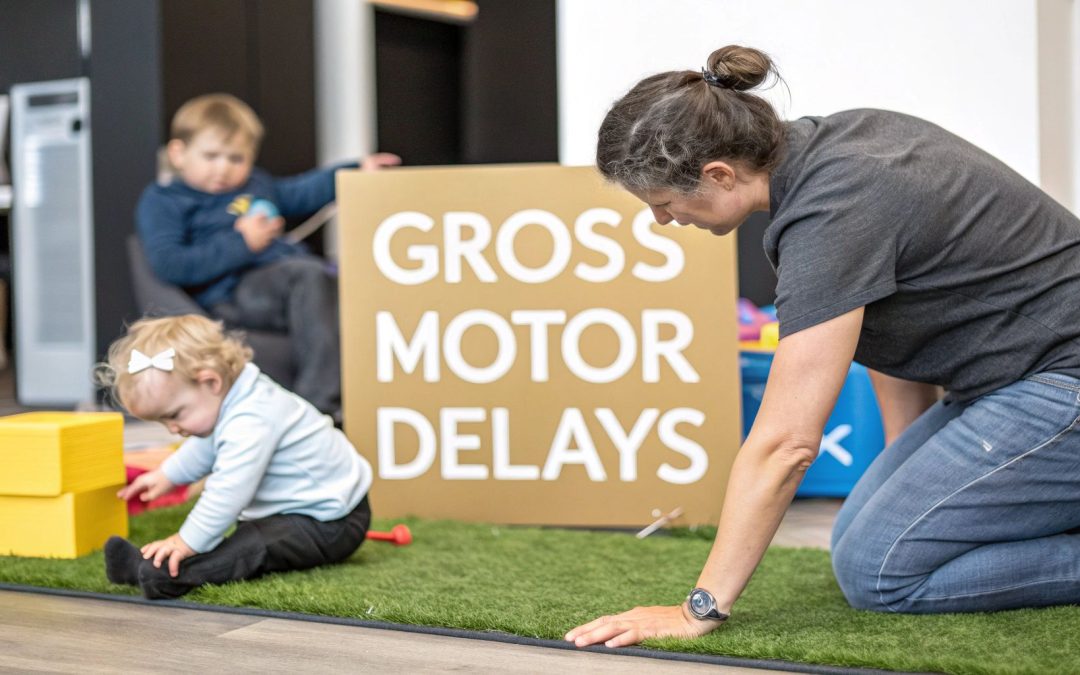
When a child takes longer than expected to hit those big movement milestones—like sitting up, crawling, or taking their first steps—we call it a gross motor delay. But this is so much more than just being a “late bloomer.” These delays can be a sign that something is getting in the way of the brain and body communicating, which can affect how a child learns to explore and engage with the world around them.
What Gross Motor Delays Mean for Your Child's Development
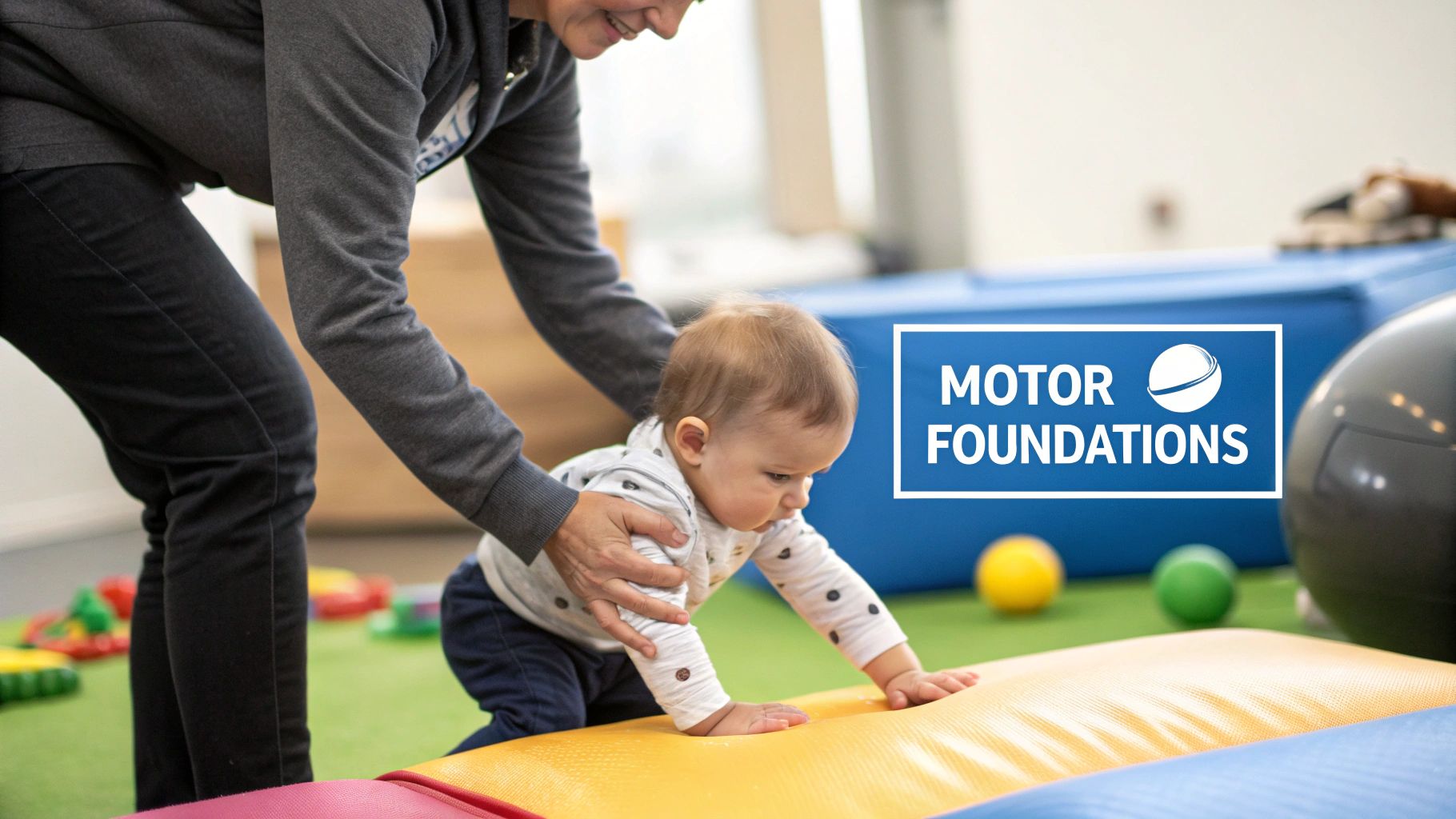
Imagine your child's development is like building a house. Gross motor skills, those large-scale movements using the arms, legs, and torso, form the entire foundation. A child needs this solid, stable base before they can start putting up the intricate walls of fine motor skills (like writing) or adding the complex upper floors of social play on the playground.
If that foundation is a bit shaky because of gross motor delays, everything built on top of it will be less secure. These foundational movements aren't just physical actions; they are the very first tools a child uses to learn, play, and connect with their family.
The Brain-Body Connection
Behind every single movement, from a tiny head lift to a full-on sprint, is the nervous system. It’s the body's command center. The brain sends a signal down the spinal cord, telling the right muscles exactly how and when to move together. For this process to work, that communication pathway has to be clear and efficient.
Often, a delay in motor skills points to a hiccup or traffic jam in this vital brain-body connection. It’s not usually about muscle weakness. More often, it's about disorganized signals. This is precisely why just "waiting it out" isn't always the best or most proactive approach.
Gross motor skills don't develop in a vacuum. They unlock a child's ability to explore their environment, which is what fuels their cognitive and social growth. A baby who can crawl can suddenly chase a ball, reach for a parent, and start discovering the world on their own terms.
Why Early Identification Matters
Catching potential gross motor delays early is so important because development happens in a sequence. Each milestone is a building block for the next one. Think about it this way:
- Head and neck control has to come before a baby can push up on their arms.
- Pushing up builds the shoulder and core strength needed for sitting.
- Sitting independently frees up the hands to reach and explore, paving the way for crawling.
- Crawling is a powerhouse for building the cross-body coordination that's essential for walking and even, down the road, for skills like reading.
When one of these fundamental blocks is delayed, it can create a domino effect, slowing down everything that comes after. You can learn more about how all these abilities are intertwined by reading about the five developmental domains that map out a child's growth.
Spotting a delay early allows us to step in with support that gets to the root neurological cause. The goal is to clear up those communication pathways, allowing the body to get back on track and function the way it was designed to.
As a parent, you're constantly watching your little one grow and change, and it's completely normal to wonder if they're "on track." But instead of getting bogged down by rigid checklists, it’s more helpful to think of developmental milestones as a flexible roadmap. Every child travels this path at their own speed, but knowing the typical signposts can help you feel more confident as you guide them on their journey.
The most obvious signs of progress are usually gross motor skills—those big, whole-body movements using their arms, legs, and core. These skills don't just appear out of nowhere; they build on each other, one after the other. Each new ability, like holding their head up, lays the foundation for the next, like rolling over.
If you’ve ever had concerns about gross motor delays, you're far from alone. A major Norwegian study revealed that the most common suspected delays were in the gross motor area, affecting 2.6% of infants at 4 months and increasing to 3.6% by 12 months. It just goes to show how common these worries are for parents everywhere.
A Look at Key Milestones and What to Watch For
Here’s a breakdown of what you can generally expect to see at different stages. Remember, this is a guide, not a strict timeline. The goal is to understand the progression of skills and spot any patterns that might be worth discussing with a trusted professional.
Gross Motor Milestones and Potential Red Flags
| Age Range | Expected Milestones | Potential Red Flags to Discuss with a Professional |
|---|---|---|
| Birth – 3 Months | Lifts and turns head during tummy time; kicks legs and moves arms with increasing purpose; starts to push up on arms briefly. | Seems overly stiff or floppy; has significant trouble lifting their head by 3 months. |
| 4 – 6 Months | Pushes up on forearms or hands during tummy time; begins to roll from tummy to back, then back to tummy; bears weight on legs when held. | Not pushing up on arms by 6 months; shows no interest or attempts to roll over. |
| 7 – 10 Months | Sits independently without support; gets into a hands-and-knees position; starts crawling, scooting, or shuffling. | Unable to sit without support by 9 months; shows no interest in moving to get a toy. |
| 11 – 18 Months | Pulls to a stand using furniture; "cruises" along furniture; takes independent first steps. | Not attempting to pull to a stand by 12 months; not walking independently by 18 months. |
| 2 – 5 Years | Walks and runs with confidence; jumps with two feet; climbs stairs with alternating feet; kicks and throws a ball. | Trips or falls much more often than peers; cannot jump with two feet by age 3; seems unusually clumsy. |
Birth to 3 Months: Foundational Head Control
Right from the start, your baby is in a battle with gravity. Their movements might look a little jerky and random, but they're busy building crucial strength in their neck and upper body.
During tummy time, you'll see them start to lift their head for a few seconds and turn it side-to-side. When they're on their back, all that arm waving and leg kicking is hard work that's building foundational muscle tone. A potential red flag to keep an eye on is if your baby seems unusually stiff or floppy, or if they really struggle to lift their head at all by the end of this period.
4 to 6 Months: Rolling and Pushing
Get ready for some action! This is when your baby starts gaining more control over their core and limbs, which leads to some very exciting new skills. They're no longer content to stay in one spot.
At this stage, your baby is like a little engineer, figuring out the physics of their own body. They learn that pushing with their arms creates lift and that shifting their weight can lead to a roll, unlocking a whole new perspective on their world.
You'll see them pushing up on their forearms or hands during tummy time, and soon after comes the thrill of rolling over—usually from belly to back first. A sign of a potential gross motor delay might be if they can't push up on their arms or aren't showing any signs of trying to roll by 6 months.
7 to 10 Months: Sitting and Crawling
Core strength takes center stage now. Your baby will likely master sitting up without any help, which is a game-changer because it frees up their hands to reach for and play with toys. This new stability is the perfect launchpad for what's next: crawling.
Whether it’s a classic hands-and-knees crawl, a bum shuffle, or a belly scoot, this movement is so important for building cross-body coordination. It might be time for a chat with your provider if your child can't sit unsupported by 9 months or shows no interest in trying to move forward to get something they want.
For a deeper dive into this topic, check out our guide on gross motor development and why it's so important.
11 to 18 Months: Cruising and First Steps
This is the age of vertical ambition! Your baby will probably start pulling themselves up to stand using furniture, and then "cruising" by shuffling their feet while holding on. This is fantastic practice for building the balance, leg strength, and confidence they need to walk on their own.
Walking can happen anytime in this wide window. Some little ones are off to the races around 12 months, while others take their time until 16 or even 18 months. A key indicator of a potential delay would be a child who isn't trying to pull to a stand by 12 months, or isn't walking by 18 months.
2 to 5 Years: Running, Jumping, and Climbing
Once walking is old news, the real fun begins. Your wobbly toddler will quickly become a confident runner. From there, they'll learn to jump with two feet, balance on one foot, kick a ball, and tackle the playground equipment like a pro.
These more complex skills demand a higher level of coordination, balance, and motor planning. Red flags in this age range can be more subtle. You might notice frequent tripping long after the initial learning phase, an inability to jump by age 3, or difficulty alternating feet when going up and down stairs.
Uncovering the Root Causes of Motor Delays
When a child is struggling with gross motor delays, just looking at the missed milestones isn't enough. We have to dig deeper and ask why it's happening. Think of these delays as symptoms—to offer real, effective support, we first have to understand their origin. It’s a bit like a gardener who checks the soil and roots before trying to fix a struggling plant. We need to look at the foundational factors shaping a child's physical development.
Often, the story begins right at birth. The journey into the world can be incredibly tough on a newborn's tiny body. Interventions like forceps, vacuum extraction, or even the positioning during a C-section can put a surprising amount of physical stress on a baby’s delicate upper neck and spine. This tension can create subtle misalignments that interfere with the vital communication between the brain and the body, sometimes setting the stage for motor control challenges from day one.
The Nervous System: The Body's Control Center
Every single movement a child makes—from a tiny finger wiggle to their first step—is directed by the central nervous system. It's the master controller. The brain sends signals down the spinal cord and out to the muscles, telling them precisely how to coordinate, tense, and relax. But if there’s interference along that pathway, maybe from that early physical stress at birth, the messages can get jumbled.
This can lead to a child who has all the potential in their muscles but struggles with the execution. It's not an issue of strength; it's an issue of disorganized signaling.
Think of it like a radio signal filled with static. The music is playing, but the interference makes it almost impossible to hear it clearly. A neuro-tonal approach works to tune out that static, letting the brain's instructions come through loud and clear to the muscles.
Common Contributors to Gross Motor Delays
While birth trauma is a major piece of the puzzle, several other factors can contribute to gross motor delays. These causes often overlap, creating a complex picture that really needs a careful, personalized approach to fully understand.
A key factor we often see is hypotonia, or low muscle tone. This doesn't mean the muscles are weak, but that they have a "floppy" quality when at rest. This can make it so much harder for them to generate the force needed to push up, sit, or stand against the constant pull of gravity.
Other common causes include:
- Neurological Conditions: Conditions affecting the brain, spinal cord, or nerves can directly impact motor planning and execution.
- Genetic Predispositions: Certain genetic syndromes are linked to developmental delays, including those that affect gross motor skills.
- Environmental Influences: A lack of opportunity for movement, like not getting enough tummy time, can prevent a baby from building that essential foundational strength.
This helpful concept map shows how these foundational skills stack on top of one another, from head control all the way to walking.
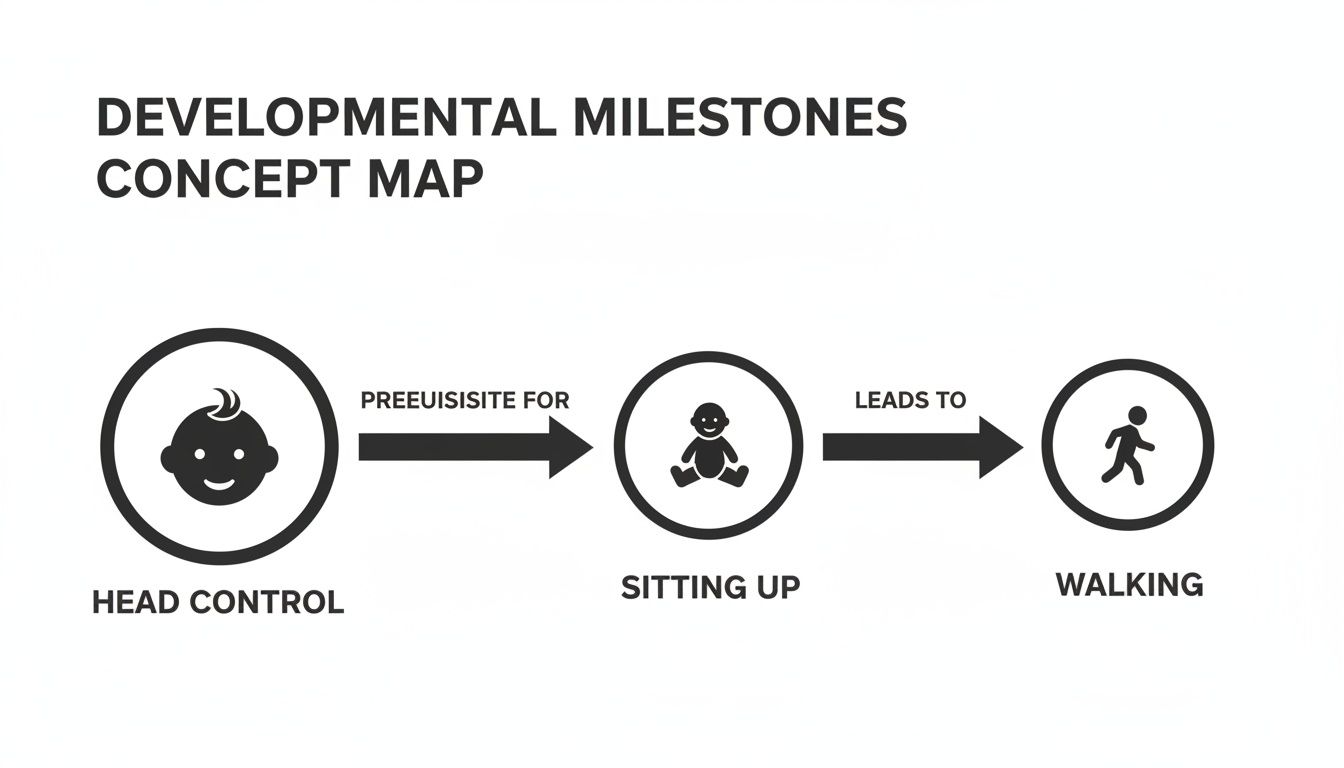
The image makes it crystal clear: without mastering that first step, moving on to the next becomes a much bigger challenge.
A Global Perspective on Early Development
Gross motor delays aren't just a local issue; they're a recognized global health challenge. One eye-opening study in Ethiopia found that nearly 20% of children under five in public health facilities showed signs of delay. The research also highlighted that for every additional month of age, the likelihood of a delay decreased by 4%. This really drives home how critical early identification and support are during infancy and toddlerhood. You can explore the full findings of this study to learn more about global prevalence rates and risk factors.
Understanding the wide range of factors that can lead to these challenges is the first step. For a more detailed breakdown, you might find our article on what causes developmental delays helpful. When we connect these potential causes back to the function of the central nervous system, we can start to see a clear path forward—one that focuses on restoring the body's innate ability to move and thrive.
How Professionals Figure Out What's Going On with Gross Motor Skills
Hearing that your child might need a gross motor assessment can feel pretty heavy. It’s a moment filled with questions and worries. But understanding how the process works can really help bring back a sense of control and give you a clear path forward.
Remember, the goal of any evaluation is simple: to get a true picture of your child's abilities right now so we can figure out the best way to support them. This is a team effort, and you are the most important player on that team.
The first stop is usually your pediatrician's office during a routine check-up. They use standard developmental screenings—which are often just simple questionnaires or checklists they fill out while observing your child play. Think of this as a gentle first filter, designed to catch any potential concerns early on.
Taking a Deeper Look with Specialized Evaluations
If that initial screening brings up some questions, your pediatrician will likely refer you to a few specialists for a closer look. This is where the real detective work begins, with experts who live and breathe childhood movement.
- Physical Therapists (PTs) are the movement mechanics. They’re focused on the "how"—assessing your child’s strength, balance, coordination, and the overall quality of their movements to find any physical roadblocks.
- Occupational Therapists (OTs) look at the bigger picture of how motor skills affect a child's "job," which is to play, learn, and interact with the world. They check out things like motor planning and sensory processing to see if your child can organize their body to get a task done.
These experts use play-based activities and standardized tests to see your child in action in a natural, comfortable way. They aren't just checking boxes on a milestone chart; they’re trying to understand the why behind the delay.
A formal assessment isn't a test your child can pass or fail. It’s a discovery process designed to unlock your child's potential by understanding exactly where they need the most support.
The Neuro-Tonal Approach at First Steps
While traditional PT and OT evaluations are absolutely vital, they mainly focus on the muscles and the resulting function. At First Steps Chiropractic, we add another critical piece to the puzzle by looking at the nervous system—the body's command center that directs every single muscle and movement.
This perspective is so important because gross motor delays are often just one piece of a bigger developmental picture. Research shows these delays are connected to broader issues affecting about 15% of children in the US. Certain factors, like being male or having a low birth weight, have also been linked to a higher risk. This just underscores how crucial it is to get a truly thorough evaluation. You can read more about these statistics and the factors influencing childhood development on KutestKids.com.
Our specialized five-step process is designed to find any hidden neurological stress that other evaluations might miss.
We start with a detailed chat to go over your child's entire health story, from pregnancy and birth right up to today. Then, we move to the heart of our assessment: the Insight Scans. This technology is completely safe and non-invasive. It simply measures how much stress and tension is stored in the nervous system, giving us objective data that shows us exactly where the communication between the brain and body might have static on the line.
This neuro-tonal evaluation gives us a much more complete picture. By finding and addressing the root neurological interference, we can help clear up those communication pathways. When the brain and body can talk to each other clearly, your child’s ability to coordinate movement improves naturally. Our approach doesn’t replace traditional therapies—it builds a stronger foundation for them to succeed.
Supportive Interventions and Therapies That Make a Difference

Realizing your child might need some extra support is the first big step. The great news is there are so many effective, evidence-based ways to help children overcome gross motor delays and feel more confident in their bodies. The real magic happens when you find the right blend of therapies that address both the symptoms and what's causing them in the first place.
This path usually starts with the traditional therapies that have long been the foundation of motor skill development. These are essential for building the functional strength your child needs to navigate their world with more confidence and ease.
Building Strength and Function with PT and OT
Two of the most common and powerful interventions are Physical Therapy (PT) and Occupational Therapy (OT). They often work hand-in-hand, but each has a distinct and vital role. Think of PT as your child’s personal trainer and OT as their life skills coach.
Physical Therapy (PT): A physical therapist zones in on the big muscle groups that control posture, balance, and getting from point A to point B. Through targeted exercises and play, they work on improving strength, coordination, and range of motion. If sitting up, crawling, or walking is a struggle, a PT helps build the crucial mechanics for those foundational skills.
Occupational Therapy (OT): An occupational therapist helps your child succeed at their main "job"—which is playing, learning, and interacting with their world! They focus on translating motor skills into everyday tasks, like putting on a jacket, using a fork, or climbing the playground slide. OT is huge for motor planning, which is the brain's ability to think of and carry out a sequence of actions.
Both PT and OT provide incredible, hands-on value by teaching a child's body how to move correctly and efficiently. They are the experts in improving functional output.
A Neuro-Tonal Approach to Restore Communication
But what if the issue isn't just with the muscles (the "hardware")? What if it's the "operating system" that's running the show? The nervous system is the master controller behind every single movement. If there’s static or interference in the communication lines between the brain and the body, even the strongest muscles won't get the right instructions.
This is exactly where a neuro-tonal chiropractic approach comes into the picture. It gets to the root cause of many motor delays by focusing on improving the function of the nervous system. The goal is to clear those communication pathways so the brain's signals can get through loud and clear.
Think of it like this: Physical therapy trains the dancers (the muscles), while neuro-tonal chiropractic care ensures the choreographer (the brain) has a clear, direct line to give instructions. When both work in sync, you get a beautiful performance.
Here at First Steps Chiropractic, we use incredibly gentle and precise adjustments to reduce tension and restore proper alignment, especially in the upper neck and spine where the brainstem is. This area acts as the "control tower" for motor function and muscle tone. By relieving stress here, we help the entire nervous system regulate itself more effectively, which paves the way for better coordination and control.
Creating a Collaborative Care Team
The most powerful strategy isn't about choosing one therapy over another; it’s about building a supportive, collaborative team that rallies around your child. Neuro-tonal chiropractic care doesn’t replace traditional therapies. Instead, it acts as a foundational partner that can make those other interventions even more effective.
When a child's nervous system is firing on all cylinders, their body is far more receptive to the hard work they do in PT and OT. We often see kids make faster progress in building strength and mastering new skills because their brain and muscles are finally speaking the same language. This team-based approach ensures every aspect of your child’s development is supported, from the inside out.
Partnering with First Steps Chiropractic for Your Child's Health
Trying to figure out gross motor delays on your own can feel overwhelming and isolating. You don't have to walk this path alone. True progress comes from finding a partner who not only understands your child's struggles but also looks deeper to find and address the root neurological causes. Our goal is to empower your family with real answers, meaningful support, and a clear path forward.
As Hayden, Idaho's only PX Certified clinic, we specialize in a neurologically-focused approach that gets to the very heart of developmental challenges. We know from experience that a child's ability to move freely and confidently is directly connected to the health and function of their nervous system.
Your Partnership with Our Team
Your journey with us is built on collaboration and clarity. We believe that knowledgeable parents are empowered parents, which is why we start with a thorough five-step process designed to give you a complete picture of your child's health from the inside out.
- In-Depth Consultation: It all starts with listening. Your insights into your child's history, your observations, and your concerns are the most valuable part of the puzzle.
- Insight Scans: We use safe, non-invasive technology to get an objective look at your child’s nervous system, measuring the amount of stress and interference present.
- Comprehensive Exam: We then conduct a hands-on assessment to understand your child's specific physical and neurological patterns, connecting the dots from the scans to what we can see and feel.
- Personalized Care Plan: With all the information gathered, we create a specific roadmap for your child's care. We'll walk you through our findings and recommendations in detail so you feel confident and clear.
- Gentle Adjustments: Our care is built on safe, gentle techniques specifically tailored to a child's delicate and developing system.
This isn't about chasing symptoms. This process ensures we are focused on restoring the vital brain-body communication that is absolutely essential for overcoming gross motor delays and truly unlocking your child's full potential.
Our commitment is to do more than just provide care; it’s to build a supportive community where families feel seen, heard, and empowered. We partner with you to help your child thrive, not just today, but for a lifetime.
Discover a Different Approach
If you're ready to see how a neuro-tonal approach can complement your child’s existing care and support their development in a foundational way, we invite you to take the next step. Learn more about how we can help your family by booking a consultation at First Steps Chiropractic. Let's work together to unlock your child’s true potential for lasting health and resilience.
Your Questions on Gross Motor Delays, Answered
Navigating your child’s development can bring up a lot of questions. We get it. Here are some clear, straightforward answers to the most common concerns we hear from parents about gross motor delays, designed to help you feel more confident about what to do next.
At What Age Should I Be Concerned?
While it’s true that every child hits milestones on their own timeline, it’s always wise to chat with a professional if you notice your child is consistently behind by several months. The goal isn’t to worry—it’s to be proactive.
Key windows to start a conversation with your provider include if your little one is:
- Not showing good head control by 4 months
- Not sitting up on their own by 9 months
- Not walking independently by 18 months
An early assessment can offer incredible peace of mind. And if support is needed, it ensures you’re getting your child the help that can make a world of difference in their developmental journey.
Is Chiropractic Care Safe for Babies?
Absolutely. When performed by a certified pediatric chiropractor, it is incredibly safe and gentle. Pediatric adjustments look nothing like what you’d expect for an adult; they are specifically tailored to a baby's delicate and growing system.
The amount of pressure used is often no more than you’d use to check if a tomato is ripe. Here at First Steps Chiropractic, our techniques like TRT are designed for the sensitive nervous systems of infants and children, making care not only safe but also comfortable and effective.
How Does a Neuro-Tonal Approach Differ from Physical Therapy?
This is a fantastic question, and it really gets to the heart of why a team-based approach is so powerful. While both therapies are incredibly valuable, they target different pieces of the developmental puzzle.
Physical therapy (PT) primarily focuses on strengthening muscles and improving movement patterns—think of it as addressing the functional "output." A neuro-tonal chiropractic approach, on the other hand, zeroes in on the nervous system—the "operating system" that controls those very muscles.
By making sure the communication pathways between the brain and body are clear and free of interference, we address a potential root cause of poor muscle tone and coordination. The two therapies work beautifully together; chiropractic care helps ensure the body is wired correctly, which can make PT even more effective.
In short, one trains the muscles, while the other makes sure the brain can send clear signals to them in the first place.
At First Steps Chiropractic, we believe in looking at the whole child to understand what’s truly causing a delay. If you’re ready for a neurologically-focused approach that supports your child's development from the inside out, we invite you to book a consultation today.