

That unexplained fussiness, especially when there's little to no spit-up, might be something more than just typical baby behavior. The key silent reflux symptoms baby often shows are things like irritability during or after a feed, a hoarse-sounding cry, and frequent congestion that never seems to clear up.
Is Your Happy Spitter Actually a Silent Sufferer?
Picture this: your baby seems healthy and almost never spits up, but feeding time feels like a battle. Nights are a struggle. They arch their back in discomfort, seem miserable whenever they're laid flat, and have a persistent stuffy nose you just can't shake.
If this sounds familiar, you're not imagining things, and it isn't just "colic." This hidden discomfort often points to a condition called laryngopharyngeal reflux (LPR), better known as silent reflux. Think of it as the sneaky cousin to the more obvious gastroesophageal reflux (GER) that causes all that spit-up.
Understanding the "Silent" Part of Reflux
So, what makes it "silent"? With classic reflux, stomach contents travel up the esophagus and come out of the mouth as spit-up. But with silent reflux, that journey is shorter—and in some ways, more irritating.
Stomach acid and enzymes travel up the esophagus, but instead of being spit out, they're often swallowed right back down.
This means those harsh substances wash over the delicate tissues of the larynx (voice box), pharynx (throat), and even the nasal passages twice. Once on the way up, and again on the way down. Because you don't see the evidence on a burp cloth, the real source of your baby's distress stays hidden.
This diagram offers a simple visual breakdown, connecting the cause (that weak esophageal sphincter) to the main symptoms you're seeing.
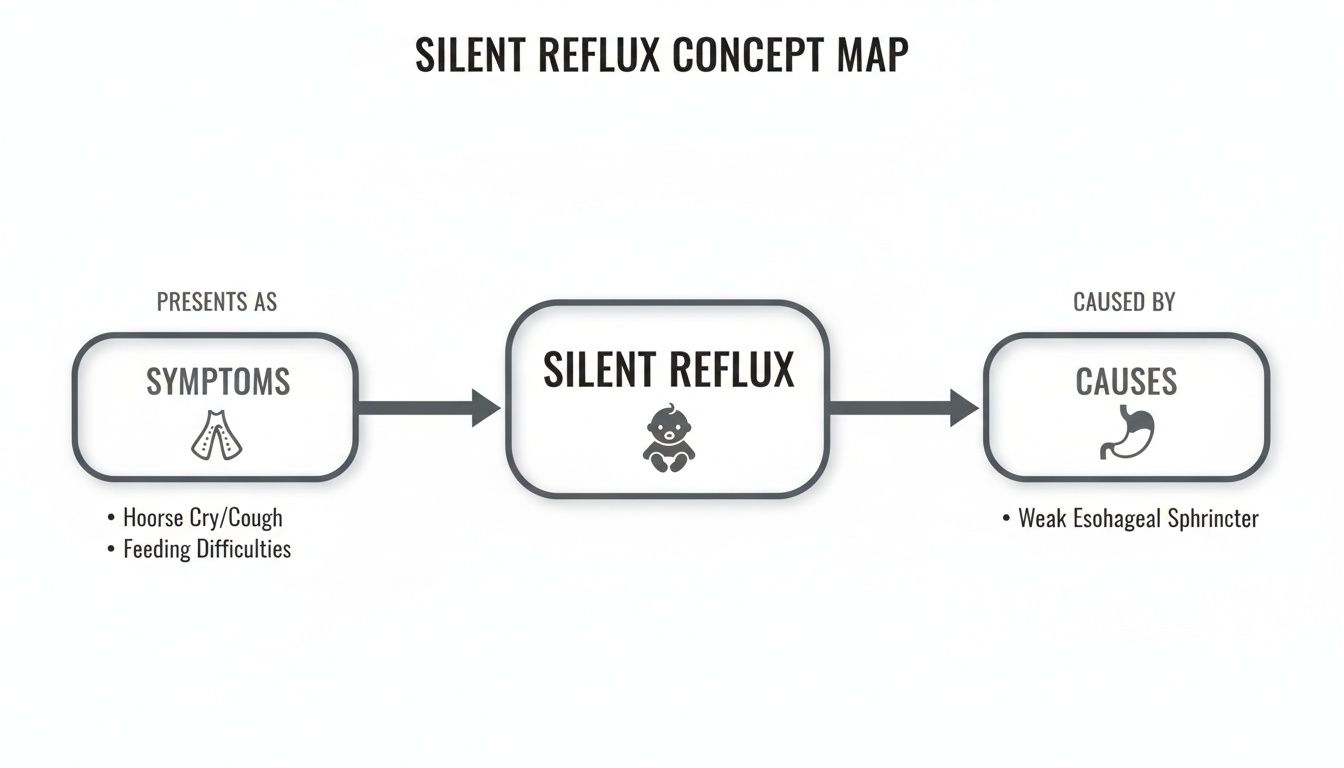
The key takeaway is that the irritation is happening much higher up in the throat and airway. That's exactly why the symptoms often look more respiratory or behavioral, rather than purely digestive.
To help you tell the difference, here's a quick comparison. This table can help you start connecting the dots between what you're seeing at home and whether it might be classic reflux or its more subtle counterpart.
Silent Reflux vs. Classic Reflux at a Glance
| Symptom Area | Classic Reflux (GER) | Silent Reflux (LPR) |
|---|---|---|
| Spitting Up | Frequent, noticeable spit-up or vomiting. | Minimal to no spitting up. |
| Feeding Behavior | May be fussy but often eats well. | Often refuses feeds, pulls away, arches back. |
| Crying/Voice | General fussiness, especially after feeds. | Hoarse, weak, or gurgly-sounding cry. |
| Breathing | Usually unaffected. | Chronic congestion, stuffy nose, coughing. |
| Sleeping | Poor sleep, often wakes uncomfortable. | Very poor sleep, especially when laid flat. |
| Swallowing | May have some difficulty. | Frequent gulping or swallowing sounds. |
This isn't a diagnostic tool, of course, but it highlights how different the two conditions can look. One is obvious and messy; the other is hidden and confusing.
Why Symptoms Are So Easily Missed
The real challenge with silent reflux is that its symptoms masquerade as so many other common baby issues. A hoarse cry gets chalked up to a lot of crying. Congestion is dismissed as a lingering cold. That constant fussiness is labeled a "growth spurt" or "colic."
Because there's no spit-up, many parents—and even some pediatricians—get sent down the wrong path, looking for answers everywhere but the right place.
The critical takeaway is that a lack of vomiting does not rule out reflux. For many infants, the most significant signs of discomfort are behavioral and respiratory, stemming from acid irritation in the throat, not the stomach.
This is why seeing the complete pattern is so important. When you realize the back arching, feeding refusal, and poor sleep could all stem from this hidden irritation, the puzzle pieces finally start to fit together. This ongoing discomfort is a major form of infant stress. You can learn more by decoding newborn stress signs in our detailed guide. Understanding this connection is the first step toward finding real solutions that bring comfort to your baby.
Uncovering the Hidden Signs of Infant Silent Reflux

To really figure out what's going on with your baby, you have to become a bit of a detective. The clues for silent reflux are subtle and easily brushed off as something else. They don’t announce themselves like a huge spit-up; they whisper through your baby’s behavior, breathing, and sleep.
It’s like trying to pick out a single instrument in an orchestra. If you only listen for the obvious—like crying—it’s tough to find the source. But when you start to notice the back arching, the stuffy nose, and the restless sleep all happening together, you begin to hear the full "reflux" melody.
We’ve broken down the most common silent reflux symptoms baby will show into three key areas. Thinking of it this way helps you connect what seem like random issues into one, clear picture.
Feeding Time Troubles
For a baby with silent reflux, feeding isn't comforting—it's often painful. The simple act of swallowing can push stomach acid back up into the delicate tissues of their throat, creating a burning feeling that turns mealtime into a battle.
This discomfort might look like:
- Arching the back during or after feeds: This is a classic pain response. Your baby is trying to stretch out their esophagus to get some relief from the burning pressure of the reflux.
- Popping on and off the breast or bottle: They’re hungry and want to eat, but every swallow hurts. This creates a frustrating cycle: latch, suck, cry in pain, pull off, and then try to latch all over again.
- Refusing to feed or taking very little: Some babies quickly learn to connect feeding with pain and may start to resist meals, which can affect their weight gain.
- Frequent, wet-sounding hiccups or burps: These aren't just cute baby sounds. When they sound gurgly or wet, it often means a little bit of stomach content came up with the air.
A huge clue is the timing of the fussiness. If your baby is happy and calm right up until the bottle or breast is offered, and the crying consistently kicks in during or right after a feed, silent reflux is a very strong suspect.
Breathing and Congestion Clues
One of the sneakiest things about infant silent reflux is how often it masquerades as a respiratory problem. When stomach acid and enzymes travel up the esophagus, the vapor can irritate the larynx, throat, and nasal passages.
This isn’t like a common cold that comes and goes. It's a chronic irritation, and the symptoms can drag on for weeks or even months.
Keep an eye out for these respiratory red flags:
- A perpetually stuffy nose: Does your baby always sound congested, even when they aren't sick? This is a hallmark sign, caused by inflammation in the nasal passages from constant acid exposure.
- A hoarse or raspy cry: Acid can inflame the vocal cords (larynx), changing how your baby’s voice sounds. It might seem weak, strained, or gravelly.
- Wheezing, coughing, or choking sounds: These noises, especially during or after feeds and while lying down, can happen as your baby tries to clear that irritating fluid from their airway.
- Frequent ear infections or sinus issues: The constant inflammation can unfortunately create a perfect environment for secondary infections to take hold.
The symptoms of silent reflux in infants are incredibly varied, which is why it can be so hard for parents and doctors to diagnose. In fact, studies show that respiratory symptoms are a major indicator; chronic cough or hoarseness were present in 62% to 73% of pediatric cases where GERD was detected. This shows just how often silent reflux looks more like a cold than a digestive issue. You can read more about these clinical findings.
Behavioral and Sleep Red Flags
A baby who is in constant, low-grade pain is not going to be a happy, settled baby. This discomfort is most obvious in their general mood and, crucially, their inability to get good, restorative sleep.
Laying a baby flat on their back is the safest position for sleep, but for an infant with silent reflux, it’s the most painful one. Gravity is no longer helping to keep stomach contents down, allowing acid to wash freely up into their throat.
This creates a disruptive pattern of behavior and sleep:
- Extreme fussiness when laid flat: Your baby might be perfectly content in your arms but start screaming the second you put them in the bassinet. They are telling you, in the only way they know how, that lying flat hurts.
- Only sleeping when held upright: So many parents discover their baby will only sleep soundly while on a parent's chest or in a carrier. This upright position provides major relief.
- Fighting sleep and frequent waking: They might finally fall asleep from pure exhaustion, only to jolt awake screaming in pain 20-30 minutes later as the reflux flares up.
- Constant irritability or "colicky" behavior: That unexplained, inconsolable crying is often a direct result of the burning discomfort they simply can't escape.
When you start seeing these signs across all three areas—feeding, breathing, and behavior—it becomes much clearer that you're likely dealing with more than just a "fussy baby." You’re seeing the complete symptom profile of silent reflux.
When Is It More Than Just Normal Baby Behavior?
Every baby gets fussy, and nearly every baby spits up. Those are just universal truths of parenthood, and they can make it incredibly difficult to figure out when something more is going on. How can you tell if your baby's fussiness is a normal part of their development or a sign of a real problem like GERD or silent reflux?
Trusting your parental instincts is huge, but really understanding the difference between normal reflux and a more problematic condition will empower you to advocate for your baby with confidence. It’s all about recognizing when the symptoms cross a line from being an occasional nuisance to a persistent and painful problem.
Think of normal, harmless infant spit-up—often called physiologic reflux—like a glass of water that's just a little too full. When you move the glass around, a small amount might spill over the top. It's a bit messy, but it doesn't actually damage the glass. This is pretty much what happens in many babies; their stomachs are tiny and their digestive systems are still maturing, so a little milk naturally comes back up.
Distinguishing Physiologic Reflux from GERD
Physiologic reflux is incredibly common and usually nothing to worry about. We often call these babies "happy spitters" because, despite the laundry, they are generally comfortable, feeding well, and gaining weight just fine.
On the other hand, Gastroesophageal Reflux Disease (GERD) is more like a persistent, damaging leak. This isn't just an occasional spill; it's a constant backflow of corrosive stomach acid into the esophagus that causes real pain, inflammation, and other complications. When this reflux happens without the spit-up, it becomes silent reflux, making it even trickier to pinpoint.
The crucial difference isn't the presence of spit-up, but the presence of troublesome symptoms. If your baby is consistently showing signs of pain, feeding aversion, poor sleep, or respiratory issues, it's no longer just "normal baby behavior."
The numbers really show how common some form of reflux is. Up to 70% of healthy newborns experience some regurgitation, which is considered normal and usually goes away by 12-14 months. Studies show that daily spit-up happens in about 50% of infants under 3 months old, but only a tiny fraction of these babies—declining to just 2.9% by 6 months—actually meet the criteria for GERD. You can discover more insights about these pediatric reflux statistics from global consensus reports.
Red Flags That Signal a Deeper Issue
So, when should those parental instincts kick into high gear? The line is crossed when the reflux starts to seriously impact your baby's quality of life. While occasional fussiness is normal, persistent and inconsolable crying tied to feeding is a major red flag for a baby with silent reflux.
Here are the key indicators that suggest you're dealing with more than just physiologic reflux:
- Significant Pain and Discomfort: Your baby frequently arches their back, stiffens their body, or cries inconsolably during or right after feeds. They seem to be in genuine pain, not just mildly uncomfortable.
- Feeding Aversion: Instead of enjoying feeding time, your baby consistently refuses the breast or bottle, pulls away screaming, or only takes a tiny amount before stopping. This can sometimes be mistaken for colic. You can learn more about colic versus reflux in our detailed comparison.
- Poor Weight Gain: If the feeding aversion is severe enough, it can lead to your baby not gaining weight at a healthy rate. This is a critical sign that requires immediate medical attention.
- Chronic Respiratory Symptoms: You notice a persistent hoarse cry, a constant stuffy nose, wheezing, or a cough that isn't related to a cold. This can point to acid irritating the throat and airways.
- Severe Sleep Disruption: Your baby absolutely cannot tolerate being laid flat and will only sleep while being held upright. They may wake up screaming in pain shortly after being put down for a nap or for the night.
Ultimately, you are the expert on your baby. If you feel in your gut that their crying is more than just fussiness and their behaviors point to consistent pain, it's time to seek professional advice. While some reflux is a normal part of infancy, suffering is not.
Gentle and Natural Ways to Soothe Your Baby's Reflux

Watching your baby struggle with discomfort is one of the hardest parts of being a parent. It can make you feel completely helpless. When you figure out silent reflux is the likely culprit, you just want to know what you can do right now to bring them some relief.
The good news is, there are plenty of gentle, natural adjustments that can make a huge difference in your baby’s comfort.
These aren't complicated medical interventions. Instead, they focus on working with your baby’s developing digestive system, not against it. By making a few small but powerful changes to how you feed and hold your baby, you can give them the best shot at feeling settled and happy. Think of these as practical tools in your parenting toolkit—ways to ease their symptoms and empower yourself to help.
Master a Gentler Feeding Rhythm
For a baby struggling with silent reflux, how they eat is just as important as what they eat. When a baby gulps down milk too fast, they swallow a lot of air. Those trapped air bubbles act like little buoys in their tummy, helping stomach acid float right back up into the esophagus.
Slowing things down can be a total game-changer.
Research backs this up. A study from Nationwide Children's Hospital found that a slower milk intake and longer feeding times led to fewer reflux episodes in infants. It’s proof that simply adjusting the pace can have a real impact on their comfort. You can discover more about these feeding strategy findings here.
Here are a few simple ways to create a calmer feeding experience:
- Paced Bottle Feeding: Don't let gravity do all the work. Hold the bottle horizontally so your baby has to actively suck for milk, just like they would at the breast. This simple shift prevents them from chugging their milk too quickly.
- Smaller, More Frequent Meals: An overfilled stomach puts more pressure on that little valve at the top. Offering smaller amounts of milk more often keeps their tummy from getting too full, which can seriously cut down on reflux.
- Frequent Burping: Don’t wait until the feed is totally done! Pause to burp your baby every 2-3 ounces if you're bottle-feeding, or when you switch sides if you're breastfeeding. This gets the air out before it can cause problems.
Use Gravity to Your Advantage
After a feed, gravity is your absolute best friend. Laying a baby with silent reflux flat on their back right after eating is like tipping a full bottle on its side—some of the contents are bound to spill back out. It's just simple physics.
The "golden rule" for post-feeding comfort is to hold your baby upright for at least 20-30 minutes after every single meal.
This simple act gives gravity a chance to help the milk settle and allows the stomach to start emptying, making reflux far less likely.
You can walk around with them, let them nap on your chest, or pop them in a baby carrier. Just be careful about anything that puts extra pressure on their little tummy, like a tight waistband or a car seat buckle pulled too snugly right after they’ve eaten.
Support for Breastfeeding Mothers
If you're breastfeeding, what you eat can sometimes influence your baby's reflux symptoms. While that immature valve is usually the main issue, certain foods can pass through your breast milk and irritate your baby’s already sensitive system.
Before you make any big dietary changes, it's always a good idea to talk with your pediatrician or a lactation consultant. That said, many parents find their babies get significant relief when they reduce or eliminate common trigger foods.
Try keeping a food diary for a week or two, tracking what you eat and how your baby is doing. You might start to see a pattern. The most common dietary culprits for babies include:
- Dairy: Cow's milk protein is a very frequent offender.
- Soy: Often goes hand-in-hand with dairy as a common sensitivity.
- Caffeine and Chocolate: These can relax the lower esophageal sphincter, making reflux worse.
- Acidic Foods: Things like citrus fruits and tomatoes can sometimes add to the irritation.
Making these changes isn't always easy, but for so many families, it provides incredible, natural relief. Every one of these strategies, from paced feeding to positional care, is a gentle step you can take to soothe your little one and make feeding time a happy, bonding experience again.
How a Calm Nervous System Can Ease Reflux

When your baby is clearly in pain from silent reflux, it’s completely understandable to focus only on their digestive system. But what if the real root of the problem isn't just in their tummy? From our experience, the answer often lies in the powerful, intricate connection between your baby’s nervous system and their gut.
Think of your baby’s nervous system as the body’s master communication network. The brain is the command center, and the nerves are the wires sending signals to every single part of the body. For digestion to work smoothly, the brain has to send clear, strong signals to the stomach, the esophagus, and that critical little valve that’s supposed to keep acid down.
But this delicate system can get thrown off. The journey into the world—whether it's through the birth canal or a C-section—is a physically intense event. This process can sometimes create subtle physical tension and misalignments in a baby’s spine, especially in the neck and upper back where key nerves for digestion exit.
The Kinked Hose Analogy
I like to use a simple analogy here. Imagine a major nerve that controls digestion, like the vagus nerve, is a garden hose. When the hose is straight and clear, water flows freely and powerfully. This is just like a nervous system in a calm, well-aligned state, sending perfect signals for proper digestion.
But what happens if there’s a kink in that hose? The water flow gets weak, sputters, or might even stop.
This is exactly what can happen when there’s physical tension in a baby’s upper neck and back. This tension essentially creates a "kink" in the nerve pathways, disrupting those vital messages traveling from the brain to the gut.
This disruption means the signals telling the esophageal sphincter to stay tightly closed can become weak or scrambled. The result? That valve gets lazy and inefficient, allowing stomach acid to splash back up and cause the painful silent reflux symptoms baby is experiencing.
The body is designed to be in a "rest and digest" state for things to work right, but this underlying tension can trap it in a state of stress, making the reflux spiral worse.
Restoring the Brain-Gut Connection
This is where gentle, neurologically-focused chiropractic care comes into the picture. Our approach isn't about treating the stomach itself; it’s about addressing the underlying tension that's interfering with the body's ability to regulate itself. The goal is simply to find and release those "kinks" in the system.
We use specific and incredibly gentle adjustments—we’re talking no more pressure than you’d use to check if a tomato is ripe. These adjustments help release tension in the spine, which in turn helps restore proper alignment and allows the nervous system to function without interference.
By calming the nervous system, we help the body shift out of that stressed-out state and back into its crucial "rest and digest" mode. This allows the brain to finally send clear, powerful signals to the digestive system once again. We have a great article that dives deeper into how to improve vagal tone, a key part of this system, which you can read to learn more about calming the nervous system.
What This Means for Your Baby
When the nervous system is calm and the communication lines are clear, amazing things can start to happen for your little one. A calm nervous system often leads to:
- Improved Sphincter Function: The valve at the top of the stomach gets the strong, clear signals it needs to stay properly closed, keeping acid where it belongs.
- Better Gut Motility: The stomach can empty more efficiently, which reduces the internal pressure that contributes to reflux.
- Reduced Overall Stress: A baby who is more physically comfortable is naturally calmer, sleeps better, and is far less fussy.
This approach isn’t about just masking symptoms. It’s about getting to the root cause by helping your baby’s body work the way it was designed to. By addressing the neurological component, we can help provide lasting relief from silent reflux, paving the way for a happier baby and a much more peaceful household.
Your Next Steps Toward a Happier, More Comfortable Baby
Figuring out what's going on with your little one can feel like a huge weight on your shoulders, but now you have a much clearer picture of what silent reflux looks like. The first, and most important, step is knowing the difference between a "happy spitter" and a baby who is genuinely struggling. You've learned how to spot the key silent reflux symptoms baby often displays, from those difficult feedings to the less obvious respiratory signs.
And remember, simple, gentle strategies can make a world of difference. Things like holding your baby upright after meals, pacing feedings, and looking into possible food triggers can bring so much relief—for both of you. Always trust your gut. If you feel like something isn’t right, you are your baby's most important advocate.
Taking Proactive Steps for Your Baby
When those first-line strategies just aren’t cutting it, it might be time to look a little deeper. The physical stress of birth can sometimes create tension that affects the nerves controlling digestion, and getting to the bottom of that can be a real game-changer.
Your next step is to move from awareness to action. Partnering with a professional can help you find the root cause of the discomfort, not just manage the symptoms.
We'd love to help you get the answers you're looking for. We invite you to schedule a consultation with our team. By using advanced tools like our Insight Scans, we can pinpoint any underlying nerve tension that might be contributing to your baby’s distress. Let's work together to create a plan for a happier, more comfortable baby.
Your Top Questions About Silent Reflux
When you’re a new parent trying to figure out what’s causing your baby’s distress, it's easy to feel overwhelmed. If you suspect silent reflux, you’ve probably got a million questions swirling. Let's walk through some of the most common concerns we hear from parents just like you.
How Can I Tell if My Baby Cries From Colic or Silent Reflux?
This is a big one, and it's confusing because both can lead to some intense, heartbreaking crying spells. The key is to look at the timing of the crying.
Colic is often defined by the "rule of threes"—crying for more than three hours a day, more than three days a week, for over three weeks. It often seems to happen for no reason at all, and many parents notice it gets worse in the evening.
Crying from silent reflux, on the other hand, is almost always tied to feeding. You’ll notice the fussiness, squirming, and discomfort kick into high gear either during or right after a feeding. This is when you'll likely see other tell-tale silent reflux symptoms baby might show, like arching their back, having a hoarse-sounding cry, or getting really upset when you lay them down flat. If feeding time consistently turns into a struggle, silent reflux is a very likely culprit.
Is Chiropractic Adjustment Safe for a Newborn or Infant?
Yes, absolutely. When parents hear "chiropractic," their minds often go straight to the kind of forceful adjustments adults receive. Pediatric care is a completely different world.
The amount of pressure we use on an infant is incredibly light—no more than what you'd use to check if a tomato is ripe. Our neurologically-focused approach is designed specifically for a baby’s delicate and developing system. The goal is to gently release physical tension and help restore proper nerve communication without any of the popping or cracking you might expect. Our team has advanced certifications in pediatric care, so you can be confident your little one is in safe, gentle, and expert hands.
When Should I See a Pediatrician for Reflux Symptoms?
You should always touch base with your pediatrician whenever you have concerns about your baby’s health—that's what they're there for! It becomes especially important to see them right away if you notice any "red flag" symptoms.
Red flags that need immediate medical attention include things like poor weight gain, forceful (projectile) vomiting, spit-up that is green or yellow, any blood in their stool, or if they start refusing to eat altogether.
Your pediatrician can do a full workup to make sure nothing more serious is going on. This is a crucial step to get a formal diagnosis and ensure your baby gets the comprehensive care they need to feel better and thrive.
At First Steps Chiropractic, we know just how hard it is to watch your baby struggle with discomfort. Our neurologically-focused approach can help us find and address the underlying tension that may be contributing to their reflux symptoms, helping them find comfort from the inside out. Learn more about what we do and schedule your consultation with First Steps Chiropractic.