
Regressive autism usually shows up when a child is between 15 and 30 months old. Most parents first notice a change—a loss of skills—right around the 18-to-24-month mark. This window is what we often call the primary regressive autism age, simply because it’s when a child who seemed to be right on track might suddenly start losing abilities they had already mastered.
What Is Autism Regression? A Clear Explanation For Parents
For most parents, watching a child grow feels like building a tower of blocks, one new skill at a time. Every new word, wave, or smile is another block you celebrate placing on top. Now, imagine watching that same tower, which you've built with so much joy, suddenly start to tumble down. This is the exact feeling many parents describe when they experience autism regression with their child.
It's not a simple setback, and it has nothing to do with your parenting. It's a recognized developmental path where a child loses skills they once had. One day they might be saying "mama" or waving "bye-bye," and then—either gradually or all at once—those skills seem to fade away. It’s a confusing and heartbreaking experience because the predictable journey of development takes an unexpected detour.
Understanding The Core Of Regression
At its heart, regression is a complex neurological event. It’s so important to understand that this isn’t a child being stubborn or "forgetting" on purpose. Instead, it signals a fundamental shift in how their brain is processing information and managing the tasks of development.
The key difference here is the loss of acquired skills, not just a delay in learning new ones. This specific pattern is a major indicator that it's time to take a closer look at a child’s developmental health. It’s a sign that something has changed internally, and it calls for compassion, careful observation, and proactive support.
Regressive autism, where children develop typically for months or even years before suddenly losing skills like language, social engagement, and eye contact, has been documented in a significant portion of cases, often around 18-24 months of age.
Studies have found that up to 30% of children with autism spectrum disorder (ASD) go through this kind of regression. This shows just how common this experience is for many families. You can learn more about these findings from the CDC and how they help shape early identification efforts.
Early Onset Signs Vs. Regression Characteristics
It can be tough for parents to know if what they're seeing is an early sign of autism that was always there or a true regression. The table below helps clarify the differences between these two paths. While both lead to an autism diagnosis, the journey to get there looks quite different.
| Characteristic | Early-Onset Autism Signs | Regressive Autism Signs |
|---|---|---|
| Initial Development | Delays or differences are often noticeable from early infancy (e.g., not meeting milestones on time). | The child appears to develop typically for the first 12-24 months, meeting expected milestones. |
| Onset of Signs | Signs are consistently present and become more obvious as the child grows. | A sudden or rapid loss of previously learned skills occurs after a period of normal development. |
| Language Skills | Language may be delayed from the start, or babbling might be atypical or absent. | The child was babbling, using words, or even short phrases, but then stops. |
| Social Interaction | May show limited interest in social games, eye contact, or responding to their name from a very young age. | The child was once socially engaged—smiling, playing peek-a-boo—but then withdraws and avoids interaction. |
| Parental Observation | Parents often report a feeling that "something was different" from very early on. | Parents describe a distinct "before and after," remembering a time when their child had skills that are now gone. |
Understanding this distinction helps parents and professionals pinpoint what's happening and tailor the right kind of support. If you recognize the patterns on the right, you're not imagining it—it's a real phenomenon that needs attention.
Key Areas Where Skills May Be Lost
When regression happens, the changes usually pop up in a few critical areas of early development. As a parent, you are almost always the first person to notice these subtle but significant shifts.
-
Communication Skills: This is often the most jarring change. A child might stop using words they once said clearly, go quiet after a period of babbling, or no longer make sounds to get your attention.
-
Social Interaction: A child who was once engaged may suddenly seem to be in their own world. They might stop responding to their name, start avoiding eye contact, or lose interest in simple games like peek-a-boo that they used to love.
-
Play and Motor Skills: Little interactive gestures, like waving or pointing to show you something, might just vanish. A child could also lose interest in toys they previously enjoyed or even seem to struggle with simple motor skills they had already figured out.
Recognizing this pattern is the very first step toward getting the right answers and finding the support your family needs.
The Critical Window for the Regressive Autism Age
The timing of autism regression isn't just a coincidence; it happens right in the middle of one of the most dynamic periods of brain development a child ever goes through. Most parents start to see this loss of skills somewhere between 15 and 30 months of age. This specific timeframe is what experts call the critical window, or the primary regressive autism age, because it’s the exact moment when a toddler's social and communication skills are supposed to be taking off.
Think of a child's brain like a bustling construction site. During these months, the crew is working overtime, rapidly building new neural pathways for language, social cues, and emotional bonds. When regression happens, it’s like construction in specific zones grinds to a halt—or even goes into reverse. This makes the loss of skills feel especially jarring because it stands in such stark contrast to the growth that's expected.
The Peak Period for Skill Loss
While that window stretches over several months, the peak time for regression to kick in is often between 18 and 24 months. This is typically when a child who was babbling, maybe using a few single words, and playing little social games like peek-a-boo, suddenly stops. Those abilities just seem to fade away. The loss feels so abrupt because it throws a wrench into a developmental journey that, up until that point, seemed perfectly on track.
For parents, it’s a bewildering experience. It can feel like the rulebook for their child's development was suddenly tossed out the window. The skills they were celebrating just weeks or months earlier—that first "mama," a wave goodbye, a shared giggle—seem to vanish, leaving a trail of confusion and deep concern.
The timeline below helps visualize the stages leading up to and during this critical regression period.
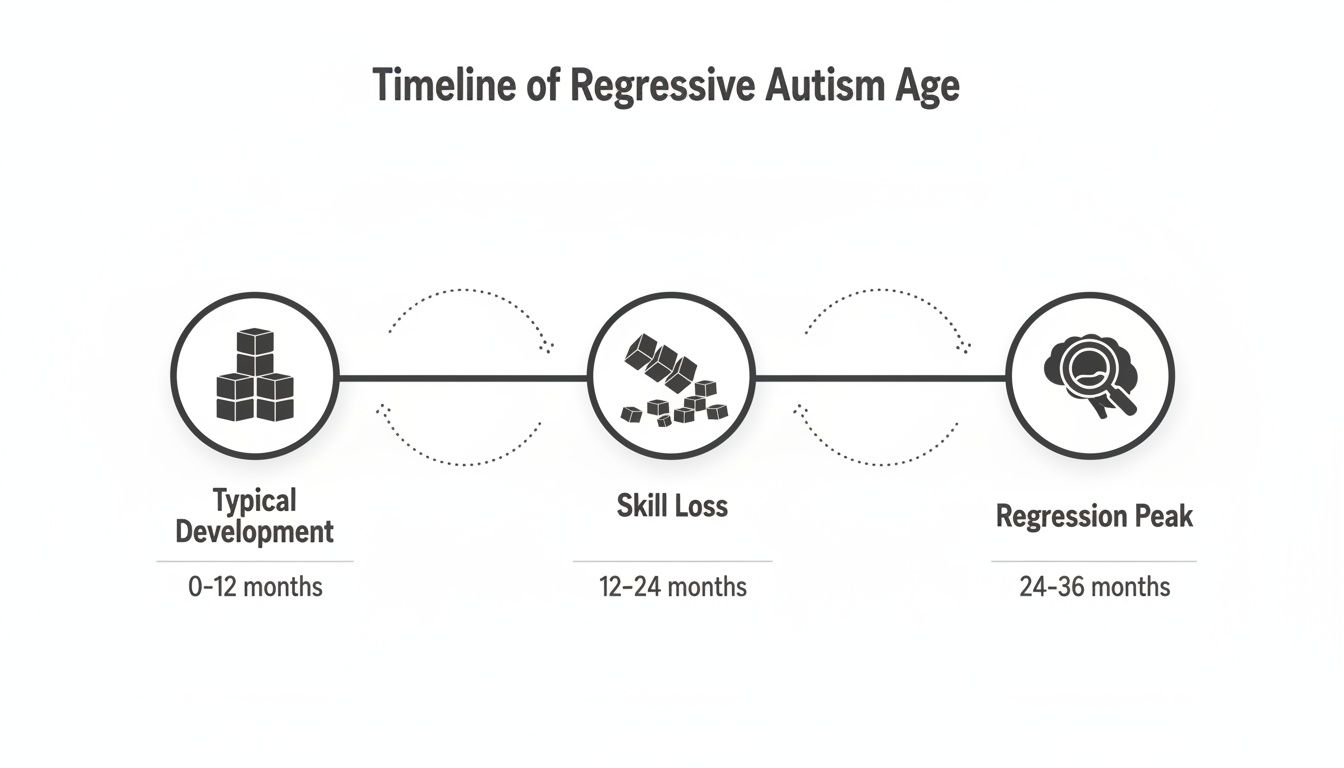
This graphic really brings it to life, showing how a period of typical development can be followed by a distinct phase of skill loss. The most significant regression often peaks right as a child is nearing their second and third birthdays.
Connecting Early Stressors to Development
So why is this particular age range so vulnerable? It helps to think of the nervous system as the body’s master control system. Stressful events early in life—even things that happened during pregnancy or a difficult birth—can create underlying tension within a child’s developing nervous system. You can picture this neurological stress as a kind of constant background static, making it harder for the brain to build and maintain strong developmental connections.
When the brain is already working overtime just to manage this internal static, the intense developmental workload of the 15-to-30-month period can be too much to handle. The system is already strained, and it just may not have the resources to keep up with newly learned, complex skills like talking and socializing. This can lead to those skills being lost. That’s why paying close attention to a child’s development during this critical regressive autism age is so crucial for taking early action.
While the average age of autism diagnosis hovers around 4-5 years globally, for regressive cases, it often spikes post-regression around age 2. Prevalence then peaks sharply in school-aged children as social demands increase.
A massive meta-analysis confirmed this very trend. It found that autism rates were highest at 0.82% (82 per 1,000) for children aged 6-12, which was significantly higher than the rates in younger and older kids. This tells us that the effects of an early regression become much more obvious once children enter more socially complex environments, like school.
You can explore the full findings on ASD prevalence across different age groups to see these patterns for yourself. This data really drives home just how important it is to identify and address developmental regressions as early as humanly possible.
Recognizing The Signs Of Regression: A Parent Checklist
As a parent, your intuition is one of your greatest assets. It's that quiet, nagging feeling you get when something just seems… off. One day you’re celebrating your toddler’s new words and happy waves, and the next, you notice they’re gone. This experience can be incredibly unsettling, and it's a story we hear often from parents witnessing developmental regression.

This checklist is here to help you put words to your observations and pinpoint specific changes. It's crucial to remember that regression isn't just a delay in learning new things—it's a pattern of losing established skills. Documenting these shifts will empower you to speak clearly and confidently with healthcare providers.
Communication And Language Skills
Often, the first and most obvious sign of regression is a loss of communication. It can feel like someone turned the volume down on your child’s world. This is a primary area to watch, especially during the typical regressive autism age of 15 to 30 months.
- Loss of Spoken Words: Did your child once consistently say words like "mama," "dada," or "ball," but now they don't? It’s not that they’re refusing—it’s as if the word has simply vanished.
- Halting of Babbling: Maybe your toddler had a rich vocabulary of babbles and coos that has now fallen silent or become much less frequent. Those playful, conversational sounds they used to make are suddenly gone.
- Reduced Vocalizations: Do they no longer make sounds to get your attention? A child who once grunted for a snack or squealed with excitement might become unusually quiet.
Social Interaction And Connection
A child’s social world is built on tiny, back-and-forth moments. When regression happens, these foundational skills can start to fade, making a child seem more withdrawn or disconnected from the people they love.
- Stops Responding to Their Name: Does your child consistently not turn their head or react when you call their name, even when you're right there? It can sometimes be mistaken for a hearing problem, but it’s often a sign of decreased social awareness.
- Avoids or Reduces Eye Contact: Did your child used to lock eyes with you during feedings or playtime, but now seems to look away or right "through" you?
- Loses Interest in Social Games: Have they stopped enjoying or participating in simple games they once loved, like peek-a-boo or patty-cake? That shared joy might feel like it has disappeared.
Trust Your Gut: A Note to Parents
You know your child better than anyone on this planet. If you feel in your heart that a skill has been lost, please do not dismiss that feeling. Parental concern is one of the most reliable predictors of developmental issues. Your observations are valid, and they matter.
Play And Motor Skills
Play is how children learn about their world and practice new abilities. A regression in play skills can be subtle at first, but it’s a significant sign that something has shifted in their development.
Here are a few specific things to watch for:
- Stops Waving or Pointing: Your child may no longer wave "bye-bye" or point to things they want. These simple gestures are a huge part of nonverbal communication and are often lost during regression.
- Loss of Imitation Skills: Do they no longer copy your simple actions, like clapping your hands or making a silly face? This ability to imitate is fundamental to how they learn from their environment.
- Changes in Toy Interaction: A child might stop playing with toys functionally (like pushing a car) and instead start engaging in repetitive actions, like obsessively spinning the wheels or lining toys up.
- Decline in Imaginative Play: For slightly older toddlers, you might notice a loss of early imaginative skills, like pretending to feed a teddy bear or chat on a toy phone.
Noticing these changes is hard, but creating a log of what you see and when you see it is a powerful first step. This documentation will be invaluable as you seek answers and support for your child. To see how these signs fit into the bigger picture, it can be helpful to explore the common signs of early autism in a toddler.
Milestone Tracker For Spotting Potential Skill Loss
Watching your child’s development can feel overwhelming, especially when you’re worried about regression. This table is designed as a simple tool to help you track previously mastered skills between 12 and 30 months and note any changes you observe.
| Skill Category | Milestone Example (Previously Achieved) | Sign of Regression (What to Watch For) |
|---|---|---|
| Verbal Language | Said 3-5+ clear words (e.g., "mama," "cup") | No longer says words they once used consistently |
| Babbling/Vocalizing | Made conversational babbling sounds | Babbling has stopped or become very infrequent |
| Social Gestures | Waved "bye-bye" or pointed to objects | No longer waves, points, or claps on request |
| Social Games | Enjoyed and participated in peek-a-boo | Shows no interest or stops engaging in the game |
| Name Response | Turned their head when their name was called | Consistently does not respond when called |
| Eye Contact | Made eye contact during play or feeding | Actively avoids eye contact or looks "through" you |
| Imitation | Copied simple actions like clapping or smiling | No longer mimics your facial expressions or actions |
| Functional Play | Pushed a toy car or hugged a doll | Lines up toys or focuses on one part (e.g., a wheel) |
Remember, this tracker is a guide to help you organize your thoughts and observations. It's a tool to support your parental intuition, giving you concrete examples to share when you talk with your pediatrician or a developmental specialist.
Navigating Your Next Steps Toward Assessment And Support
Realizing your child might be regressing is an incredibly difficult and emotional experience. That sense of uncertainty can feel completely overwhelming, but please know you aren't alone, and there is a clear path forward. This is about moving from worry to action, empowering you to find the right answers and support for your child.
The first and most important step is to trust your gut. If you feel that your child has lost skills they once had, your observations are valid and need to be taken seriously. No one knows your child better than you, and your concerns are the most important starting point for getting your family the help you need.
Begin With Your Pediatrician
Your journey for answers should start with a visit to your child's pediatrician. This is a crucial first step for a couple of key reasons. First, it gets your concerns in front of a trusted medical professional who can perform an initial check. Second, they can rule out other potential medical causes for the changes you're seeing, like hearing problems or other underlying conditions.
To make this appointment as productive as possible, do a little prep work.
- List the lost skills: Be specific. For instance, "He used to say 'dada' every day, but he hasn't said it in three weeks."
- Note the timeline: Jot down when you first noticed the changes and how things have progressed since then.
- Bring videos: If you have any videos of your child using a skill they no longer have, they can be incredibly powerful. Showing is often better than telling.
Your pediatrician will likely use a developmental screening tool. Based on what they see and what you share, they can give you a referral for a formal developmental evaluation.
Seek A Formal Developmental Evaluation
A comprehensive developmental evaluation is the next critical piece of the puzzle. This isn't just a single test; it's a deep dive into your child's developmental profile, usually done by a specialist like a developmental pediatrician, child psychologist, or neurologist.
The goal here is to get a full picture of your child's unique strengths and challenges across every area—communication, social skills, motor abilities, and thinking. This detailed assessment is what leads to an accurate diagnosis and, more importantly, gives you a blueprint for a support plan that’s targeted and effective. Don’t get discouraged if there's a waitlist; get your child's name on it as soon as you can.
The rise in regressive autism diagnoses has become more visible over the last two decades. While the prevalence among 5-to-8-year-olds in the US held steady at 30.3 per 1,000 in 2022, a 450% surge in diagnoses among adults aged 26-34 since 2011 highlights how many cases were recognized late.
This trend really drives home how important early, decisive action is when you first spot signs of regression. You can discover more insights about these autism prevalence trends and see why a parent's voice is so vital in this process.
Explore A Complementary Neurological Path
While you're navigating the path toward a formal diagnosis, there are proactive steps you can take to support your child’s underlying health. One powerful, complementary approach is to consult with a neurologically-focused pediatric chiropractor. This type of care looks beyond the symptoms to address the function of the body's master control system—the nervous system.
The process often begins with advanced imaging like Insight Scans. These scans are gentle, completely non-invasive, and create a map of the stress and tension stuck in your child’s nervous system. They provide objective data, showing us exactly where interference might be disrupting the vital brain-body communication that’s so essential for healthy development.
Using these findings, the chiropractor creates a personalized care plan with gentle, specific adjustments. The goal is to release that built-up tension, reduce neurological interference, and restore balance to the entire system. By improving the body’s internal signaling, this care helps create the best possible environment for healing, growth, and development, providing a strong foundation for all other therapies to build upon.
How Neurologically Focused Chiropractic Care Supports Development
When you’re watching your child struggle with developmental regression, it’s natural to search for foundational support that gets to the root of the issue. That's exactly where neurologically-focused chiropractic care comes in. We concentrate on the nervous system—the absolute master control system for the entire body, directing everything from development and communication to emotional regulation.

This approach isn’t about "treating" a diagnosis like autism. It's about restoring the body's incredible, innate ability to adapt and grow by making sure the brain and body are communicating clearly and without interference. It’s about building a strong foundation so that all other therapies and interventions have a better chance to succeed.
Tuning The Nervous System For Optimal Function
I like to think of a child’s nervous system as a finely tuned musical instrument. When every string is in perfect harmony, it plays beautiful music—in this case, healthy development, clear communication, and emotional balance. But physical stressors, sometimes starting from the birth process itself, can create tension that throws the whole instrument out of tune.
This "out-of-tune" state is what we chiropractors call subluxation, or nervous system dysregulation. It’s like static on a phone line, scrambling the critical signals between the brain and the body. Our job is to use gentle, specific chiropractic adjustments to release this tension, effectively "tuning" the nervous system so it can function in harmony again.
The core principle is simple: a nervous system free from interference can better manage the complex tasks of growth and development. By reducing physical tension, we help improve the brain-body connection, creating a more adaptable and resilient internal environment for the child.
This process helps the body shift gears, moving from a state of constant stress (the "fight-or-flight" response) to a state of calm, healing, and development (the "rest-and-digest" response). For a child experiencing regression, making that shift is absolutely crucial.
Mapping Nervous System Stress With Insight Scans
One of the most powerful tools we use is the Insight Scan. These advanced scans are completely safe, gentle, and non-invasive, giving us a visual map of exactly where stress and tension are getting stuck in a child’s nervous system. It’s a way for parents to see exactly what we see, backed by objective data.
These scans measure three key things:
- Neuro-Thermal Scan: This scan identifies areas of inflammation and poor nerve communication along the spine by measuring tiny differences in skin temperature.
- Surface EMG: This measures the amount of tension and energy being used by the muscles supporting the spine, pinpointing areas of stored stress.
- Heart Rate Variability (HRV): This is a critical measurement that assesses the body's ability to adapt to stress, giving us a clear picture of overall nervous system resilience.
The results give us a clear baseline, which allows both parents and our team to track progress objectively over time. You can actually see the nervous system becoming more balanced and organized as the care plan progresses.
Creating A Foundation For Other Therapies
It's really important to understand that neurologically-focused chiropractic care isn't a replacement for behavioral, speech, or occupational therapies. Instead, it acts as a foundational support that can make those other essential therapies more effective. When a child’s nervous system is calmer and more organized, they are often better able to engage in, learn from, and truly benefit from their other therapies.
By addressing the underlying physical and neurological stress, our care helps create a stronger, more adaptable system. This supports the body’s natural ability to heal and develop, giving children a better chance to rebuild pathways and thrive. The connection between chiropractic care and autism support is all about this principle: restoring optimal function from the inside out. This approach empowers the body to do what it’s designed to do—grow, adapt, and reach its full potential.
Exploring Potential Triggers And The Role Of The Vagus Nerve And Nervous System
For any parent watching their child regress, the biggest question is always, "Why is this happening?" It’s a gut-wrenching experience, and the search for one clear-cut answer can be incredibly frustrating. The truth is, current science doesn’t point to a single cause. Instead, it reveals a complex puzzle involving a child's genetic predispositions and various environmental factors that can overload their developing system.
A helpful way to think about it is to picture a child’s developmental capacity as a bucket. While genetics might determine the size of that bucket, it’s the environmental stressors that fill it up. When that bucket overflows, the entire system gets overwhelmed. Key developmental processes, like maintaining language and social skills, can get disrupted. This is often the moment when parents first notice the signs of regression.
The Overloaded Circuit Breaker Analogy
Let's break that down even further. Imagine your child’s nervous system is the main electrical panel for a house. Its job is to manage all the incoming signals and send energy exactly where it's needed. On a good day, everything runs smoothly. But what happens if you plug in too many high-powered appliances at once?
Those appliances represent the physical, chemical, or emotional stressors a child might encounter. Just like in a house, the system can overload.
When that happens, a circuit breaker trips to prevent the whole system from shorting out. A child’s developing body has a similar protective mechanism. An overloaded nervous system might "trip a breaker" on the newest, most energy-intensive skills—which are often speech and social connection—to save resources for the most essential functions.
This is exactly why neurologically-focused care is centered on finding and reducing the stressors that are overloading the system in the first place. The goal is simple: flip that breaker back on and get the communication flowing between the brain and body again.
Physical Stressors and Nervous System Dysregulation
This buildup of stress on the nervous system can start incredibly early, sometimes even before or during birth.
- Birth Trauma: A difficult birth, especially one involving interventions like forceps or vacuum extraction, can create significant physical tension in a newborn's delicate neck and upper spine.
- Early Physical Stress: This tension doesn't just disappear. It can lock a child into a state of chronic nervous system dysregulation, where their body is constantly stuck in a "fight-or-flight" stress response.
Being in this constant state of high alert drains a child’s developmental energy. So when they reach that critical regressive autism age—a time of explosive brain growth—their already overloaded system simply can’t keep up. The result can be a devastating loss of hard-won skills.
The key takeaway is this: an overwhelmed nervous system can directly interfere with normal developmental pathways. It's not about a flaw in the child. It's about a system that has become so overloaded and dysregulated that the essential brain-body connection for growth has been disrupted.
The Connection To Immune Function And Inflammation
This nervous system dysregulation is also deeply tied to immune function. When the body is trapped in a stress response, it can trigger chronic inflammation and throw the immune system out of whack. More and more research is pointing to immune dysregulation as a major factor in some cases of regressive autism.
This creates a vicious cycle. Physical stress contributes to neurological interference, which then leads to immune system problems and inflammation, further overloading the child's system. By going back to the root cause—the physical tension and dysregulation in the nervous system—we can help calm this entire cascade. It shifts the conversation from just managing symptoms to truly restoring balance to the body's master control system. To get a better handle on this, you can learn more about nervous system regulation and its impact on health.
Frequently Asked Questions About Autism Regression
When you're navigating the complexities of developmental regression, it’s completely normal to have a million questions swirling in your mind. We've gathered some of the most common concerns parents bring to us to offer some clarity and peace of mind.
Can My Child Regain Skills Lost During A Regression?
Yes, absolutely. Skill recovery is a real possibility for so many kids, especially when they get timely, comprehensive support. The goal of interventions like neurologically-focused chiropractic care is to help the brain and body reconnect, essentially rebuilding those developmental pathways that went offline.
By improving how the nervous system functions, we're giving your child a stronger foundation to relearn and keep moving forward. Every child’s journey is different, but early action is the most critical factor in seeing positive changes.
The goal is not just to manage symptoms but to restore the body's innate ability to adapt, heal, and grow. A balanced nervous system is the bedrock upon which all other developmental progress is built.
Is This Type Of Chiropractic Care Safe For My Toddler?
Without a doubt. Neurologically-focused pediatric chiropractic care is incredibly gentle and designed to be perfectly safe for young, growing bodies. To give you an idea, the amount of pressure used for an adjustment on a toddler is often no more than what you would use to test the ripeness of a peach.
Our doctors are certified in specialized techniques created specifically for the delicate and developing nervous systems of children. This ensures every visit is a safe, comfortable, and effective experience tailored to their unique needs.
How Soon Should I Act If I Suspect Regression?
Immediately. When it comes to the regressive autism age and any loss of developmental skills, trusting your gut as a parent is one of the most important things you can do. Please don't fall into the "wait and see" trap.
We always recommend scheduling an appointment with your pediatrician right away. They can help you go through your specific observations and rule out any other medical issues. You can also book a consultation with our team to learn how supporting your child's nervous system can be a foundational piece of their overall care plan.
At First Steps Chiropractic, we are dedicated to helping your child thrive by addressing the root cause of developmental challenges. Our neurologically-focused approach supports their nervous system, creating the best possible foundation for growth and healing. Learn how we can support your family's journey at https://firststepschiropractic.com.