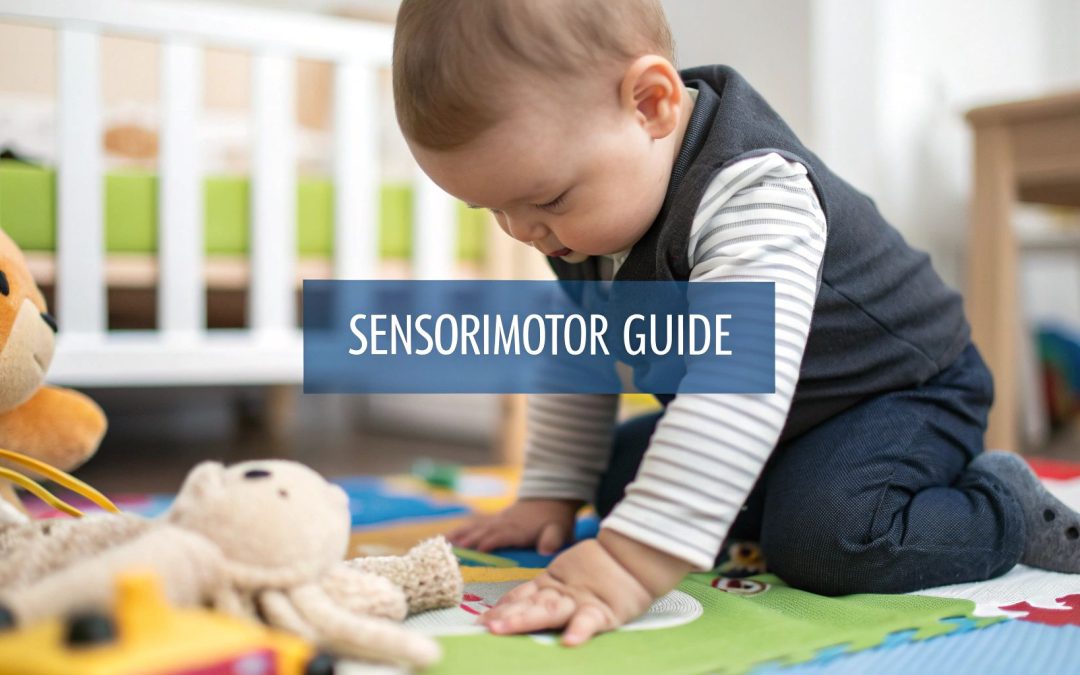
Let's be honest, "sensorimotor" sounds like a complicated, technical term. But when you break it down, it's actually something we see our kids do every single second of the day.
At its core, the definition of sensorimotor is simply the process of taking in information through the senses—like sight, sound, and touch—and then responding with a physical movement. Think of it as a constant, lightning-fast conversation between your child's brain and body that builds the foundation for absolutely everything they will learn to do.
Breaking Down the Definition of Sensorimotor
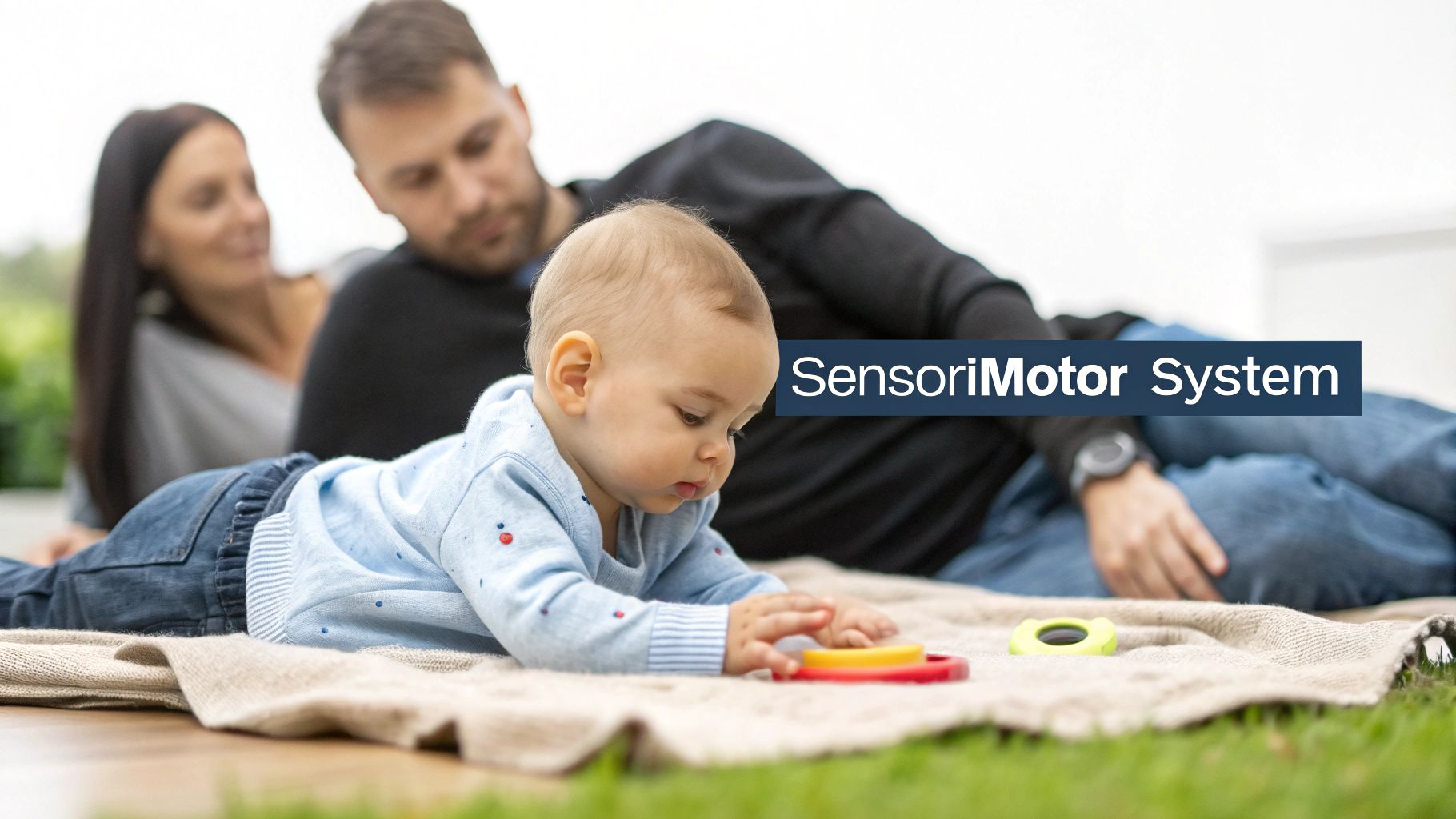
Let's dig a little deeper into what this really means for your child’s development. Imagine their senses are a team of scouts, and the brain is their mission control. The scouts are constantly sending back reports from the field about the world—what they see, hear, and feel. Mission control then has to rapidly process all those reports and send out clear instructions for how the body should move and react.
This continuous, two-way communication is the sensorimotor system in action. It's the essential feedback loop that allows a baby to go from making random, jerky wiggles to purposefully reaching out and wrapping their little fingers around a favorite toy.
The sensorimotor system is the bridge between sensing and doing. It transforms raw sensory data into coordinated, meaningful actions that allow a child to interact with and learn from their environment.
This integrated network is absolutely vital from day one. It’s what connects sensory inputs, like the feeling of a soft blanket or their awareness of where their hands are (proprioception), to motor outputs, like kicking their feet in excitement. In fact, a 2022 study revealed that even the spontaneous kicks and wiggles of newborns show incredibly structured patterns. This suggests the system is busy organizing itself right from birth. You can read the full research on neonatal sensorimotor patterns on pnas.org.
Key Components of the System
To really get it, it helps to look at the two core parts of this system.
Here's a quick breakdown to make it crystal clear:
The Sensorimotor System A Simple Breakdown
| Component | What It Does | Example in Your Child |
|---|---|---|
| Sensory Input | Gathers all the information from the outside world and inside the body. | Feeling the bumpy texture of a teething toy, hearing your voice, or sensing their body position as they try to roll over. |
| Motor Output | The physical action or movement that happens in response to the sensory input. | Reaching for that toy, turning their head toward your voice, or using their muscles to successfully roll from back to tummy. |
This table shows just how intertwined the two sides are—you can't have one without the other. Let’s explore what each component really involves.
-
Sensory Input: This is all the information gathered by the senses. It includes the five we all know (sight, sound, touch, taste, smell) plus two incredibly important "internal" senses: the vestibular sense (balance and movement) and proprioception (body awareness). Our guide on proprioception and sensory processing offers a much deeper look.
-
Motor Output: This is the physical action that results from the brain processing all that sensory information. It can be a big movement like crawling across the room (gross motor skill) or a tiny, precise one like picking up a single Cheerio (fine motor skill).
When this brain-body communication is clear and efficient, your child has a solid foundation for all future learning, coordination, and growth.
How Your Child's Sensorimotor Skills Evolve
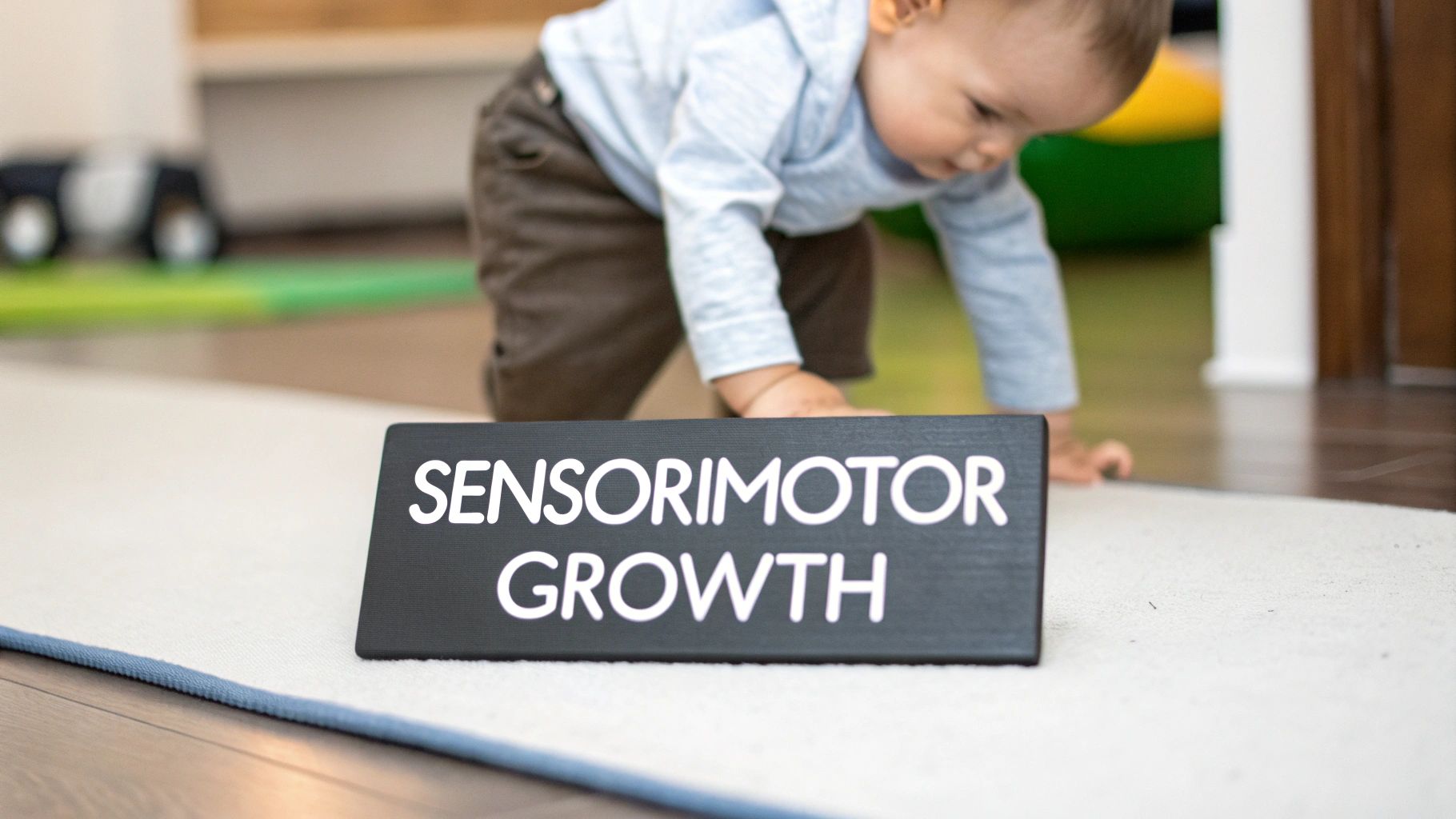
From the moment they’re born, your child is on an incredible sensorimotor journey. This isn’t just a random series of flails and kicks; it's a beautifully designed sequence where the brain and body learn to communicate, building one skill right on top of another. It all begins with the simplest, most instinctual movements.
A newborn’s jerky kicks and tight little grasps are more than just cute reflexes. They’re the brain's very first attempts at figuring out its own body and how it fits into the world. Each wiggle sends a wave of sensory information back to the brain, laying down the first neural pathways for motor control. This early exploration is the literal groundwork for every physical skill that will follow.
Sensorimotor development is not just about moving; it's about the brain learning from movement. Every action, from a simple reflex to a confident step, refines the internal 'map' the brain has of the body and the world.
As this brain-body feedback loop gets stronger and more efficient, those early reflexes start to fade, making way for more purposeful, intentional actions. This is when we start to see the major milestones that every parent loves to celebrate.
From Reflexes to Purposeful Action
The journey from reflexive wiggles to intentional movement is a clear sign of a healthy, developing nervous system. Each new skill builds directly on the one before it, creating a solid foundation for more complex abilities down the road. You can see this evolution happening right before your eyes with each new milestone.
This progression is a fascinating window into how a child’s brain is organizing itself. As kids refine their motor control, their ability to predict the outcome of their movements gets so much better. A study in the Journal of Neurophysiology that tracked children aged 6 to 12 found that the accuracy of their internal "state estimation"—their brain's ability to know where their body is and what it's doing—improved by 35% by age 10. This neurological upgrade dramatically reduced motor errors in reaching tasks from 22% down to just 8%, showing just how incredibly well the brain learns by doing.
This constant improvement gets to the heart of the definition of sensorimotor development—it’s an active, ongoing process of learning and adapting. Key phases include:
- Rolling Over: This is one of the first big wins, requiring coordination between the neck, torso, and limbs.
- Reaching and Grasping: This shows a growing link between what a child sees (visual input) and what their hands do (fine motor output).
- Crawling: A massive leap forward! Crawling integrates both sides of the body, strengthens the core, and hugely expands a child’s world.
- Walking: The ultimate milestone, demanding advanced balance, strength, and sensory integration.
Each of these steps represents a major upgrade in that all-important brain-body connection. You can learn more about the specific timelines and what to look for by reading our guide on the stages of sensorimotor development.
Sensorimotor Skills in Your Child's Everyday Life
Sensorimotor integration isn't some complex clinical term—it's the magic behind how your child plays, learns, and discovers the world. You see it in action all the time, often without even realizing the incredible brain-body teamwork happening right in front of you.
Think about a baby trying to get a spoonful of yogurt into their mouth. It’s messy, but it’s a sensorimotor masterpiece in the making. Their eyes track the spoon (sensory input), their brain figures out where their mouth is, and their arm and hand muscles coordinate to bring it all together (motor output). Every wobbly attempt refines this amazing feedback loop.
From the Playground to Getting Dressed
As kids get older, these skills become much more sophisticated. A toddler tearing it up on a playground is a perfect example of the sensorimotor system working overtime.
- Climbing a Ladder: They’re visually judging the space between rungs, feeling the metal or plastic for a solid grip, and coordinating their arms and legs to pull themselves up.
- Going Down a Slide: Their inner ear (vestibular system) is processing the sensation of movement and speed, helping them adjust their posture to stay balanced all the way down.
- Swinging: That rhythmic pumping of their legs is a surprisingly complex task. It requires timing sensory feedback with a coordinated motor response to build momentum.
Even something as simple (and sometimes frustrating) as a child learning to button their coat is a powerful sensorimotor workout. It demands precise fine motor skills, where their fingers feel for the button and buttonhole and then make tiny, specific movements to get the job done.
Every single time your child plays, they are actively strengthening the neural pathways that connect what they sense with what they do. This "play" is actually crucial developmental work, building the foundation for more advanced learning and coordination.
These everyday moments are absolutely vital for building a strong, efficient nervous system. When we learn to spot them, we can better appreciate the intricate development happening every day. To learn more about how these abilities progress, check out our guide on essential motor development skills.
Recognizing Signs of Sensorimotor Challenges
Every child develops on their own unique timeline, and that’s perfectly normal. But sometimes, you might notice consistent patterns that suggest their sensorimotor system could use a little extra support. The goal here isn’t to self-diagnose, but to help you become a more aware observer of your child’s world. Understanding what to look for is the first step toward getting the right answers and support.
Is your little one unusually clumsy, even for a toddler? We all expect some tumbles, but frequent bumping into furniture, trouble navigating around toys on the floor, or appearing generally uncoordinated during play could be a clue. Pay close attention to how they move and interact with their environment, especially during big-body movements like running, jumping, and climbing.
Difficulties with Daily Tasks
Challenges often show up in the little things, too—those fine motor skills that require a delicate touch. A child might struggle significantly with using a fork and spoon, holding a crayon correctly, or fastening buttons on a jacket long after their friends have figured it out.
Sensory reactions are another huge piece of the puzzle. You might see an over-reaction, like becoming extremely distressed by loud sounds, the seams in their socks, or certain food textures. On the flip side, you could see an under-reaction, where a child doesn't seem to notice scrapes or bumps and has an unusually high tolerance for pain. Both extremes can point to challenges in how their nervous system is processing information.
This timeline gives a great visual of how sensorimotor skills build on each other to support common daily activities as a child grows.
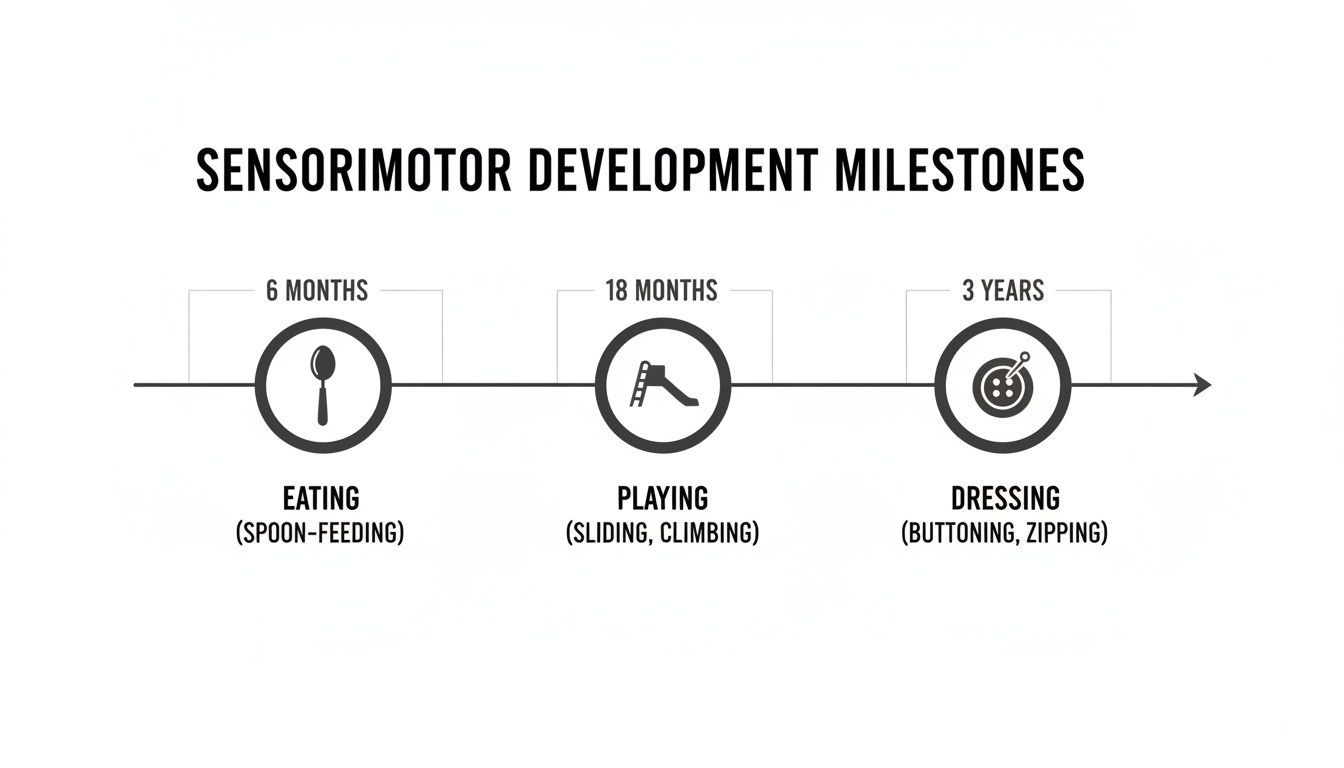
As you can see, simple tasks like learning to eat with a spoon eventually pave the way for more complex skills like dressing, all of which depend on a well-integrated sensorimotor system.
Typical vs Atypical Sensorimotor Development Milestones
To help you get a clearer picture, this table compares typical milestones with some potential red flags. Remember, this isn't a checklist for diagnosis, but rather a guide to help you identify patterns that might be worth discussing with a professional.
| Age Range | Typical Milestone Examples | Potential Red Flags to Discuss |
|---|---|---|
| 0-12 Months | Reaches for toys, brings hands to mouth, sits without support, begins to crawl, responds to sounds and textures. | Floppy or stiff body, difficulty lifting head, not bearing weight on legs, avoids certain textures (food, clothes), doesn't respond to their name. |
| 1-2 Years | Walks independently, scribbles with a crayon, stacks a few blocks, points to objects, begins to use utensils. | Frequent falling, walks only on toes, unable to grasp small objects, avoids messy play, extreme reactions to loud noises. |
| 2-3 Years | Runs and jumps, pedals a tricycle, draws simple shapes, dresses with some help, shows awareness of personal space. | Appears very clumsy or uncoordinated, avoids playground equipment, has significant trouble with utensils, invades others' personal space. |
| 4-5 Years | Hops on one foot, uses scissors, dresses independently, catches a bounced ball, follows multi-step directions. | Difficulty with balance, struggles to learn to ride a bike with training wheels, messy handwriting, constantly crashing or bumping into things. |
If you see a consistent pattern of challenges in the "red flags" column, it may simply mean your child's nervous system needs some help to get better organized. It’s always best to trust your gut and seek a professional opinion if you have concerns.
Observing these patterns can give you valuable insight into how your child's brain and body are communicating. A few more specific things to watch for include:
- Motor Coordination: Actively avoiding playgrounds, seeming fearful or overly cautious with movement, or really struggling with balance activities like riding a tricycle or scooter.
- Sensory Processing: Being an extremely picky eater (often related to texture, not just taste), frequently covering their ears in noisy places, or constantly seeking intense physical input by crashing into furniture or people.
If you recognize these signs in your child, it could mean that the communication loop between their brain and body has some static on the line. Getting a deeper look at their nervous system function is the next step to finding clarity and getting them the support they need to thrive.
Why Sensorimotor Health Is Crucial for Your Child's Well-Being
A healthy sensorimotor system is the bedrock for so much more than just physical milestones like walking or picking up a toy. Think of it as the brain's headquarters for how a child understands, interprets, and ultimately interacts with the world around them. When this system is running smoothly, a child feels secure, can focus, and is ready to learn and grow.
But what happens when the lines of communication get crossed? If a child's nervous system can't properly process all the sensory information coming in, it creates a ton of internal static. This breakdown is often at the very root of common challenges we see in kids, including Sensory Processing Disorder (SPD), ADHD, and frustrating motor delays.
Imagine if your brain misinterpreted the feeling of a shirt tag as a real threat, or the normal sound of a vacuum cleaner as a terrifying danger. This is a daily reality for many kids. Their nervous system gets stuck in a state of high alert—what we call the 'fight-or-flight' response. When a child is constantly living in survival mode, it's nearly impossible for them to focus, learn new things, or regulate their emotions.
Connecting Nerves to Daily Life
This is where we can clearly see the direct link between a child's nervous system and their overall well-being. A dysregulated nervous system shows up in ways that can impact every part of a child's day.
- Behavioral Challenges: What often looks like "bad behavior" is actually a child's best attempt to cope with sensory input that feels completely overwhelming.
- Social Difficulties: Trouble with personal space or reading social cues can easily stem from a brain that isn't integrating sensory information correctly.
- Learning Hurdles: A brain that's preoccupied with managing sensory chaos simply doesn't have the bandwidth left over for schoolwork and learning.
Recent research is even showing how deep this connection goes, revealing that the sensorimotor system influences complex brain functions like our perception of time. One fascinating study found that targeted sensorimotor training successfully reversed cognitive deficits in 70% of cases. Even more, motor exercises improved time-based judgments by a significant 12%. You can learn more about these sensorimotor findings on PMC.
When a child’s nervous system is balanced and regulated, their brain can effectively process sensory information. This allows them to move from a state of just reacting and surviving to one of relaxing, learning, and truly thriving.
This is exactly what neurologically-focused chiropractic care is all about. Our goal isn't just to chase symptoms, but to get to the root cause by helping to calm and regulate the nervous system. Through gentle, specific adjustments, we aim to clear up the communication between the brain and body, giving your child the solid foundation they need for healthy development.
A Clear Path Forward for Your Child
If you’re seeing some of these patterns in your child, or even if you just have that gut feeling that something isn’t quite right, please know you are not alone. Trusting that parental intuition is the most important first step you can take. When we understand what the definition of sensorimotor function truly means—that incredible connection between the brain and the body—we finally have a roadmap to help your child thrive.
At First Steps Chiropractic, our entire process is built to give you clarity and confidence. We want to move past just chasing symptoms and get to the real root cause of your child's struggles. We’re here to be your partners on this journey, every single step of the way.
Your Journey with First Steps
We follow a clear, five-step clinical process to make sure we see the complete picture of what's going on with your child’s health:
- Comprehensive Consultation: It all starts with us listening. This is where you get to share your full story, your worries, and your hopes for your child.
- Insight Scans: We use advanced, non-invasive technology to get a direct look at how your child’s nervous system is working. These scans show us exactly where the stress and miscommunication are happening.
- Chiropractic Exam: A gentle, hands-on assessment helps us connect the dots between the scans and your child's physical movement patterns and spinal health.
- Personalized Care Plan: We bring all the findings together to create a customized, specific plan of action that is unique to your child’s needs.
- Gentle Adjustments: Our care is always safe and gentle. We use precise, neurologically-focused techniques designed to restore balance and improve that essential brain-body communication.
Frequently Asked Questions
We know that navigating your child's development brings up a lot of questions. It's completely normal to want to understand all your options. Here are some of the most common things parents ask us about pediatric chiropractic care and how it connects to sensorimotor function.
Is Chiropractic Care Safe for Infants and Children?
Absolutely. This is the first question on almost every parent’s mind, and we’re glad they ask. Pediatric chiropractic adjustments are nothing like what you might imagine for an adult. They are incredibly gentle, safe, and specifically designed for a child’s delicate, growing body.
We use specialized, neurologically-focused techniques like the Torque Release Technique (TRT), which uses a light, precise force to restore proper function. There is absolutely no "popping" or "cracking." Our doctors are certified in pediatric care, ensuring your child receives the safest, most effective care possible.
How Does the Spine Affect Sensorimotor Development?
Think of the spine as the protective armor for the entire nervous system—it’s the superhighway that carries messages between the brain and the body. When there are misalignments in the spine (often from something as common as birth trauma or a toddler’s tumble), they can create interference, like static on a phone line.
This "static" can disrupt how the brain understands sensory information and coordinates motor responses. That disruption is the very core of a sensorimotor integration challenge. By gently correcting these misalignments, we help clear up that brain-body communication so the messages get through loud and clear.
A well-aligned spine supports a well-regulated nervous system. By reducing interference, we help ensure the 'messages' between the brain and body are sent and received clearly, which is essential for healthy sensorimotor development.
Can Chiropractic Help a Child with Sensory Processing Disorder?
For a child with Sensory Processing Disorder (SPD), the nervous system is often stuck in overdrive—that constant 'fight-or-flight' mode. They're living in a state of high alert, which makes processing the world around them exhausting and overwhelming.
Neurologically-focused chiropractic care helps address this at the source. Our goal is to help regulate the autonomic nervous system, gently guiding it out of that stressed state and into a place of rest, growth, and healing. By improving nervous system function through gentle adjustments, we help the brain get better at processing and integrating all that sensory input. This often leads to calmer behavior, better emotional regulation, and an easier time handling everyday sensory experiences.
If you have more questions or you’re ready to see how neurologically-focused care can support your child, our team at First Steps Chiropractic is here for you. Schedule your complimentary consultation today to get the answers and support your family deserves.