

To really calm down your sympathetic nervous system, you have to intentionally wake up its counterpart—the parasympathetic system. This is done through practical, simple actions like deep, slow breathing, mindful movement, and even just creating a sense of safety in your immediate environment.
This simple shift takes your body out of "fight-or-flight" and into "rest-and-digest," effectively lowering your heart rate and dialing back those stress hormones.
Your Body's Alarm System and How to Turn It Down
Ever feel like your internal engine is constantly revving, even when there's no real danger? That feeling of being perpetually on edge—a racing heart before a minor meeting or a jolt of anxiety from a sudden noise—is your sympathetic nervous system working overtime.
Think of it as your body's "gas pedal," expertly designed to get you ready for immediate, decisive action.
On the flip side, the parasympathetic nervous system is the "brake pedal." Its job is to slow things down, encourage relaxation, and manage all the essential background tasks like digestion and recovery. A healthy, resilient nervous system knows how to smoothly switch between these two. It hits the gas when needed but gently applies the brakes to come back to a calm baseline afterward.
When the Gas Pedal Gets Stuck
The problem with modern life is that it often feels like a non-stop series of small stressors. Traffic jams, an overflowing inbox, and the constant ping of digital notifications—each one subtly presses that gas pedal. But we rarely get the chance to fully hit the brakes.
This creates a state known as sympathetic dominance, where the body gets stuck in a low-grade, constant fight-or-flight mode.
When this internal alarm gets triggered, a whole cascade of physiological changes kicks in:
- Your heart rate and blood pressure shoot up to pump oxygen to your muscles.
- Your breathing becomes shallow and rapid to maximize oxygen intake quickly.
- Your muscles tense up, getting ready for physical exertion.
- Your digestion slows or stops because, in a crisis, it’s not considered a priority.
This response is incredibly useful for escaping a real threat, but it becomes a serious problem when it’s your default setting.
The Long-Term Impact of Chronic Alertness
Living in this state of constant alert creates a persistent imbalance in your autonomic nervous system. When stress becomes chronic, the sympathetic system stays fired up without the normal calming influence from the parasympathetic system. This keeps your adrenaline and noradrenaline levels high while draining acetylcholine, the main neurotransmitter for rest and recovery.
This sustained imbalance can lead to neuroinflammation, mess with your memory, and even suppress your immune function. You can explore the full study on autonomic imbalance to get a deeper look at these effects.
Staying in a high-alert state is like trying to hold a beach ball underwater. You can do it for a little while, but it takes a tremendous amount of energy, and eventually, your system just gets exhausted.
This exhaustion shows up in ways that can impact the whole family. For adults, it might look like anxiety, burnout, or chronic pain. In children, especially those with sensory challenges, a dominant sympathetic state can manifest as hyperactivity, emotional meltdowns, or difficulty focusing.
To help you get a clearer picture, here’s a quick rundown of how these two systems work.
Sympathetic vs Parasympathetic At a Glance
This quick reference table helps you distinguish between your body's 'fight-or-flight' and 'rest-and-digest' responses and understand their core functions.
| Function | Sympathetic System (Fight-or-Flight) | Parasympathetic System (Rest-and-Digest) |
|---|---|---|
| Primary Role | Mobilizes the body for immediate action | Calms the body and conserves energy |
| Heart Rate | Increases | Decreases |
| Breathing | Becomes fast and shallow | Becomes slow and deep |
| Pupils | Dilate (widen) | Constrict (narrow) |
| Digestion | Inhibited or slowed | Stimulated |
| Energy Stores | Releases glucose for quick energy | Stores energy for future use |
By learning to recognize the signs of sympathetic dominance in yourself and your loved ones, you can start to consciously apply the brakes. Understanding this internal alarm system is the very first step toward turning it down and reclaiming a state of genuine, lasting calm.
Immediate Calm Through Breathwork and Vagal Toning
When you feel that familiar wave of stress rising—a tight chest, a racing mind, shallow breathing—you need practical tools that work right now. Waiting for the feeling to pass just isn't an option.
The key is to intentionally activate your body's braking system, the parasympathetic nervous system. One of the most direct ways to do this is by influencing the vagus nerve, a superhighway of information running from your brain to your major organs. When stimulated, it tells your body it’s safe to calm down.
Simple, conscious breathing techniques are your fastest route to sending this signal.
The Power of the Physiological Sigh
Forget the generic advice to just "take a deep breath." A far more effective technique, backed by neuroscience, is the physiological sigh. You already do this instinctively—it's that double-inhale sigh you might release after crying or just before drifting off to sleep.
Here’s why it works so well: Under stress, the tiny air sacs in your lungs, called alveoli, can collapse. This reduces how efficiently you exchange oxygen, which can ramp up feelings of anxiety. A single deep breath often isn't enough to reinflate them all.
To intentionally use this powerful tool:
- Take a full, deep inhale through your nose.
- Before you exhale, sneak in another short, sharp inhale to completely fill your lungs.
- Now, exhale slowly and completely through your mouth. Make the exhale much longer than the two inhales combined.
Just one to three rounds of the physiological sigh can rapidly offload carbon dioxide and signal your brain and heart to slow down. The sense of relief can be almost immediate.
This simple decision tree shows how you can think about your body's response when you're feeling revved up.
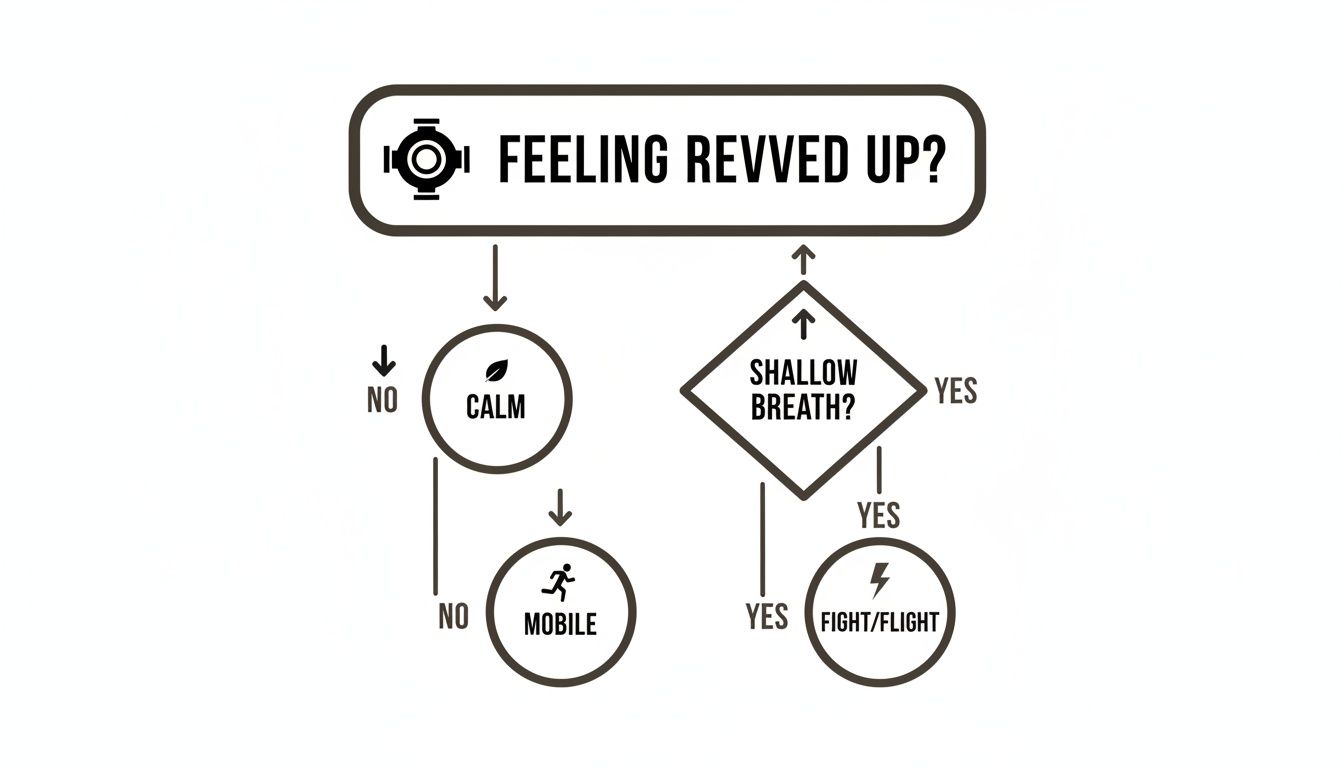
This visual is a great reminder that you have a choice. You can use calming techniques to shift your state or get pulled deeper into a fight-or-flight cycle.
Box Breathing for Sustained Focus and Calm
Another fantastic tool is box breathing, a technique famously used by Navy SEALs to stay calm under intense pressure. It’s incredibly simple to remember and you can practice it anywhere, from a stressful meeting to a chaotic moment with the kids.
Just imagine a square and trace each side with your breath:
- Inhale slowly through your nose for a count of four.
- Hold your breath for a count of four.
- Exhale slowly through your mouth for a count of four.
- Hold your breath at the end of the exhale for a count of four.
Repeating this cycle for just a few minutes helps balance your nervous system, lowers your heart rate, and anchors you in the present moment. Those holds are crucial—they prevent the hyperventilation that often comes with panic.
More Ways to Tone Your Vagus Nerve
Beyond breathwork, you can stimulate your vagus nerve through other simple, physical actions. These techniques, known as vagal toning, strengthen your body's ability to shift into a parasympathetic state more easily over time.
A Practical Takeaway: Think of vagal toning like exercise for your nervous system. The more you practice these small actions, the stronger and more resilient your relaxation response becomes.
Simple activities like humming, chanting, or gargling create vibrations in your throat that directly stimulate the vagus nerve where it passes through your vocal cords. Even gently stretching your neck by slowly tilting your ear toward your shoulder can have a soothing effect.
For a deeper dive into these methods, check out our guide on how to stimulate the vagus nerve naturally.
Making It a Family Affair
These powerful techniques aren’t just for adults. It's easy to adapt them for children, turning nervous system regulation into a fun and accessible family practice.
- Dragon Breaths: Turn deep exhales into a game. Ask your little one to pretend they are a dragon, taking a big breath in and then roaring it all out with a powerful "haaa" sound.
- Humming Contest: Who can hold a single note the longest? This playful challenge is a fantastic way to introduce vagal stimulation.
- Bubble Breathing: Grab a bubble wand. Encourage your child to take a slow, deep breath in through their nose and then blow out a long, steady stream to create the biggest bubble possible. This naturally lengthens their exhale without them even thinking about it.
By weaving these practices into your daily life, you empower yourself and your family with immediate, effective strategies to calm the sympathetic nervous system and find your balance, even in the middle of a storm.
Building a Nervous System Friendly Lifestyle

While things like breathwork are fantastic for hitting the brakes on stress in the moment, true, lasting balance comes from shaping your daily life to support your nervous system. Creating a lifestyle that naturally promotes calm is how you retrain your body to stop defaulting to that high-alert, sympathetic state.
It all comes down to being more intentional about how you move, how you rest, and what you eat. The idea is to build a foundation of safety and predictability. This sends a constant signal to your nervous system that it’s okay to stand down.
These don't have to be massive, overwhelming changes. Small, consistent shifts add up over time, creating profound results for you and your entire family.
Mindful Movement for Nervous System Regulation
Not all exercise is created equal when it comes to your nervous system. High-intensity workouts like sprinting or heavy lifting are supposed to activate the sympathetic “fight-or-flight” response. While they’re great for overall health, if your system is already stuck in overdrive, relying only on intense exercise can keep you there.
To truly calm the sympathetic nervous system, you need to mix in restorative practices. These movements are gentle, rhythmic, and mindful by nature.
- Yoga and Tai Chi: I’m a huge fan of these practices because they pair slow, deliberate movements with deep, conscious breathing. This combination is a direct line to activating the parasympathetic nervous system and toning the vagus nerve.
- Walking in Nature: Just getting outside has been shown to lower cortisol and blood pressure. The simple rhythm of walking provides gentle, bilateral stimulation that is incredibly soothing for the brain.
- Dancing: Put on some music you love and just move. Dancing is a fantastic way to release stored tension and stress hormones in a joyful, unstructured way.
Anything with a rhythmic, bilateral pattern—actions using both sides of the body, like walking, swimming, or even drumming—is especially calming. This helps integrate the left and right hemispheres of the brain, which is incredibly organizing for the nervous system. This is a game-changer for kids, especially those with sensory processing needs.
Creating Predictable Routines and Environments
Your nervous system loves predictability. When your brain knows what’s coming next, it doesn’t have to stay on high alert for potential threats. This allows the sympathetic system to finally take a much-needed break.
Consistent routines are one of the most powerful ways to create this feeling of safety. For families, this could be as simple as having meals around the same time each day or following a predictable bedtime sequence—like bath, story, cuddles, then sleep. This structure is incredibly grounding for children, whose developing nervous systems depend on these external cues to feel regulated.
Think of your environment as a language your nervous system understands. A cluttered, noisy space with harsh lighting sends signals of chaos and stress. A calm, organized space with soft lighting and minimal background noise communicates safety and peace.
Fueling Your Body for Neurological Health
What you eat has a direct line to your neurological function. Certain nutrients are absolutely vital for producing calming neurotransmitters and keeping your nervous system in balance.
Try to focus on bringing more of these into your family's diet:
- Magnesium: Often called the "calming mineral," magnesium is critical for regulating the body's stress response. You can find it in leafy greens, nuts, seeds, and even dark chocolate.
- Omega-3 Fatty Acids: These healthy fats are essential for brain health and have been shown to help reduce anxiety. Fatty fish like salmon, plus flaxseeds and walnuts, are excellent sources.
- Complex Carbohydrates: Foods like oats, brown rice, and sweet potatoes give you a steady supply of energy. This prevents the blood sugar spikes and crashes that can throw your nervous system out of whack.
On the flip side, things like excessive caffeine, sugar, and highly processed foods can push your body into a state of stress, making it that much harder to find your calm. By focusing on whole, nutrient-dense foods, you give your brain and body the building blocks they need to find—and maintain—balance.
Supporting Mothers And Infants Through Key Transitions
Pregnancy and early parenthood are times of incredible change—not just emotionally and physically, but neurologically, too. For an expecting mother, her internal state creates the entire environment for her developing baby. A nervous system that's constantly stuck in high gear (the sympathetic state) can create a physiological backdrop of stress for both mom and child.
This is exactly why learning how to calm the sympathetic nervous system is so crucial during this season of life. The goal is to cultivate a calm, nurturing internal world that supports healthy fetal development and prepares a mother's body for the journey of birth and postpartum life.

Promoting Balance During Pregnancy
Pregnancy itself introduces major physical stressors, from a shifting posture to a whirlwind of hormonal changes, any of which can easily trigger a fight-or-flight response. This is where prenatal chiropractic care can be an absolute game-changer.
Gentle adjustments, especially using the Webster Technique, are designed to improve pelvic alignment and balance. This specialized approach does more than just ease back pain; it dials down the physical stress on the body, which directly helps down-regulate the nervous system. By creating better structural balance, it helps the body adapt more gracefully, promoting a state of calm and ease. For a deeper dive, our article on the vagus nerve and pregnancy is a great resource.
We also know that stress sensitivity can look different for men and women. A 2024 study on autonomic function found that for women, staying in sympathetic dominance after a stressful event was strongly linked to social anxiety. This highlights just how vital it is to be able to shift back into a calm state, a pattern often more pronounced in females.
Soothing A Newborn’s Developing Nervous System
A baby’s nervous system is brand new and incredibly sensitive. Even in the best-case scenario, the birthing process is a huge physical and neurological event for an infant. It’s not uncommon for this to leave them in a heightened sympathetic state right from the start.
Common newborn challenges like colic, constant fussiness, feeding issues, or terrible sleep can often be the outward signs of an overstimulated nervous system. Their tiny bodies are stuck in "fight-or-flight," and they simply don't have the tools to calm themselves down yet.
A fussy or colicky baby isn't being difficult. They're telling you their system is completely overwhelmed. Your calm presence and gentle actions are their best tools for learning how to feel safe and regulated.
Fortunately, there are simple yet powerful things parents can do to soothe their infant and co-regulate their nervous system. These techniques send crucial "safety cues" to their brain and body, signaling that it's okay to relax and shift into a parasympathetic "rest-and-digest" state.
Here are a few gentle, effective methods we recommend to all new parents:
- Skin-to-Skin Contact: Placing your baby (in just a diaper) directly on your bare chest is one of the most powerful regulators there is. Your steady heartbeat, warmth, and rhythmic breathing provide a profoundly calming sensory experience that helps stabilize their heart rate and breathing.
- Swaddling: A snug, secure swaddle recreates the contained feeling of the womb. This deep pressure provides a sense of security and can stop the startle reflex from waking them up, helping them get deeper, more restorative sleep.
- Gentle Rhythmic Motion: Slow, rhythmic rocking or swaying is incredibly soothing. This movement is familiar from their time in the womb and provides organizing input to their developing vestibular system, which is closely tied to nervous system regulation.
By incorporating these gentle practices, you're not just calming your baby in the moment—you are helping to wire their nervous system for health and resilience from their very first days.
The Role of Chiropractic in Restoring Nervous System Balance
While breathing techniques and lifestyle changes are powerful tools for day-to-day management, sometimes they just don't seem to be enough. If you feel like you’re doing all the right things but still feel stuck in a high-alert state, there could be an underlying physical reason. Your body's structure is directly connected to its stress response.
This is where the connection between your spine and nervous system becomes incredibly important. Think of your spine as the protective armor for your nervous system's superhighway. When it's properly aligned, communication flows freely. But when subtle misalignments occur, they can create interference—like static on a radio—messing up those critical communication lines.
These misalignments, which we call vertebral subluxations, can physically irritate the delicate nerves around them. This constant irritation acts as a persistent stress signal, keeping your body locked in that sympathetic, fight-or-flight mode even when there's no real danger.
Beyond Bones and Cracks
Modern, neuro-tonal chiropractic care goes far beyond just addressing back pain or "cracking" bones. Our primary focus is on restoring proper nerve function to help your body self-regulate and find balance from within. The goal is to clear that static so your brain and body can finally communicate effectively.
This approach uses gentle, specific, and precise techniques designed to reduce nerve interference and calm the sympathetic nervous system. It's not about forceful manipulations; it's about giving your body the exact input it needs to hit the reset button. This is why it’s such a powerful approach for getting to the root cause of issues like ADHD, chronic anxiety, and sensory challenges in both kids and adults. You can learn more about how chiropractic care supports the nervous system in our detailed guide.
Seeing Your Nervous System in Action
So, how can we tell if your nervous system is stuck in overdrive? We use advanced tools like Insight Scans to get a clear, objective picture of what’s happening inside. These scans are completely non-invasive and safe for everyone, including pregnant moms and newborns.
The scans give us a window into three key areas of nervous system function:
- Heart Rate Variability (HRV): This tells us how well your body adapts to stress. A low HRV is a classic sign of sympathetic dominance.
- Surface EMG: This measures the electrical activity in the muscles along your spine, revealing exactly where tension and stress are being stored.
- Thermography: This scan shows temperature differences along the spine, which can point to areas of inflammation and nerve irritation.
This data allows us to see exactly how your body is functioning and create a care plan that’s personalized to what you actually need.
By looking directly at nervous system function, we move beyond just managing symptoms. We get to the core of the issue, helping the body heal and regulate itself just as it was designed to.
This is especially critical when we're dealing with stress-related conditions. Research on something as common as test anxiety highlights just how profound the physiological differences can be. One study found that individuals with high test anxiety showed a significant 9% decrease in high-frequency HRV during stress. What's more, a key marker of parasympathetic activity (RMSSD) dropped by about 5%, showing a clear pattern of an amped-up sympathetic drive paired with a reduced ability to calm down. You can discover more about these findings on stress and anxiety on frontiersin.org.
By addressing the physical misalignments that contribute to this heightened state, neuro-tonal chiropractic care helps improve your body’s innate ability to shift back into a calm, parasympathetic state. It’s a foundational piece of the puzzle, removing the physical roadblocks that might be preventing all your other calming efforts from truly working.
Your Questions on Nervous System Regulation Answered
Navigating the world of nervous system health naturally brings up a lot of questions. As you start putting these ideas into practice for your family, you might find yourself wondering about timelines, what’s “normal” for kids, or how different approaches actually fit together.
This section is all about giving you clear, straightforward answers to the most common questions we hear from parents just like you. Our goal is to give you the confidence you need to move forward on your family’s journey toward better regulation and lasting calm.
How Long Does It Take to Calm the Sympathetic Nervous System?
This is easily one of the most frequent questions we get, and the honest answer is layered. The time it takes to see a real change truly varies from person to person.
Some techniques, like the physiological sigh we talked about earlier, can bring a noticeable wave of calm in just a minute or two. These methods are so effective because they directly stimulate the vagus nerve, essentially telling your body to hit the brakes on stress, right now.
But for someone who has been stuck in a state of chronic sympathetic dominance for years, achieving lasting balance is more of a gradual process. It isn't about a single quick fix; it’s about consistently retraining the nervous system over time. Think of it as building a new habit for your body.
With consistent practice of breathing exercises, simple lifestyle adjustments, and professional care like chiropractic adjustments, you're building resilience. Over weeks and months, these efforts compound, making it easier for your body to shift back into that calm, parasympathetic state all on its own.
Can Children Really Have a Dominant Sympathetic Nervous System?
Absolutely. In fact, it's far more common than most people think. A child's nervous system is a work in progress, which makes it highly susceptible to getting stuck in a dysregulated pattern.
A number of things can nudge a child's system into this state, from a stressful birth experience to underlying sensory processing challenges or simply living in a high-stress home environment.
In kids, a dominant sympathetic state often doesn't look like the anxiety we see in adults. Instead, you might see it show up as:
- Hyperactivity and trouble focusing (often mistaken for ADHD)
- Frequent, intense emotional meltdowns over small things
- Difficulty falling or staying asleep through the night
- Chronic digestive issues like constipation or frequent tummy aches
- Persistent feelings of worry or social anxiety
Because their neural pathways are still so pliable, early intervention can be incredibly powerful. Gentle, neurologically-focused chiropractic care can help establish healthier patterns before they become deeply ingrained, setting them up for a more regulated, resilient future.
What Is the Difference Between Anxiety and a Heightened Sympathetic State?
This is a fantastic question that gets right to the heart of the mind-body connection. A heightened sympathetic nervous system is the physiological state of "fight-or-flight." It’s the physical response happening inside your body—the racing heart, tense muscles, and shallow breathing.
Anxiety, on the other hand, is the emotional and cognitive experience that often comes along for the ride. It's the feeling of worry, dread, and fear about the future that bubbles up when your body is on high alert.
You can think of it this way: The sympathetic surge is the fire alarm ringing in your body. Anxiety is the emotional panic you feel when you hear it. By learning to turn off the alarm, you can significantly quiet the panic.
While they are deeply connected, you can have a sympathetic response without feeling anxious—think of the thrill of a rollercoaster or an intense workout. But when that sympathetic activation becomes chronic, it becomes a primary driver of anxiety disorders. By learning how to calm the physical response, you gain a powerful tool for reducing the feelings of anxiety.
Is Chiropractic the Only Way to Regulate My Nervous System?
Not at all, but we see it as a foundational piece of the puzzle. Daily management tools like breathing, meditation, mindful movement, and nutritional support are essential for everyone. We use them in our own lives!
However, if there is underlying physical interference in the nervous system—like a spinal misalignment creating constant nerve irritation—it becomes incredibly difficult for the body to self-regulate effectively. It doesn't matter how much you meditate or deep-breathe; it's like trying to have a clear phone conversation with constant static on the line.
Neurologically-focused chiropractic care is designed to find and address this root physical cause. Our job is to remove the interference, clearing that "static" so your brain and body can communicate properly. When that happens, all the other calming strategies you're using become so much more effective, creating a synergy that leads to deeper and more lasting balance.
At First Steps Chiropractic, we specialize in identifying and addressing the root causes of nervous system dysregulation for the whole family. If you're ready to move beyond managing symptoms and toward genuine healing, schedule your complimentary consultation today.