

Hearing your toddler scream in their sleep is one of the most jarring sounds a parent can experience. But what if I told you that most of the time, this night screaming in toddlers is a completely normal part of their development?
These episodes, known as parasomnias, are usually not a sign that your child is in pain or having a bad dream they'll remember. Think of it as a brief, harmless traffic jam in their brain's transition between deep and light sleep stages. It’s startling for you, but they are perfectly safe.
Why Your Toddler Is Screaming in Their Sleep
When you hear that sudden shriek from your toddler's room, your first instinct is to rush in, assuming the worst. But more often than not, these episodes are just a sign of a developing nervous system learning to navigate the complex highways of sleep. They are far more common than most parents realize.
These events aren't true awakenings. Instead, your child is caught in a confusing middle ground between deep sleep and lighter sleep. Their brain is just awake enough to trigger a physical reaction—like screaming, crying, or thrashing—but not awake enough to be conscious or form any memory of it.
Understanding the Brain's Role
Imagine your toddler’s brain is a pilot trying to land a plane. Most of the time, the descent from the deep, restorative stages of sleep into lighter sleep is a smooth one.
But sometimes, they hit a patch of turbulence. This bumpy transition can cause a sudden, confusing arousal that results in what we call a night terror or confusional arousal.
The most important thing for parents to understand is that your child is not in conscious distress. They are completely unaware of what is happening and will have zero memory of the screaming or thrashing when they wake up in the morning.
These episodes are surprisingly prevalent. In fact, studies show night terrors, a primary cause of night screaming, are a frequent occurrence for little ones. One recent study highlighted that nearly 40% of preschoolers experience at least one of these events. You can learn more from the published findings on toddler sleep episodes.
To figure out what’s going on, it helps to know the common culprits behind night screaming.
- Night Terrors: The most intense form, where a child might scream, thrash, or even have their eyes open but remain completely asleep. These almost always happen in the first third of the night.
- Confusional Arousals: Think of this as a milder version of a night terror. Your child might cry, mumble, or seem disoriented and confused before settling back down.
- Nightmares: These are just scary dreams. They happen in the second half of the night, and unlike night terrors, your child will likely wake up and remember the dream.
Each of these has different signs and requires a different response from you, which we'll explore next.
Quick Guide to Toddler Night Screaming Events
Sorting out what's happening in the middle of the night can be tough. Is it a night terror? A bad dream? This quick guide is designed to help you spot the key differences at a glance.
| Event Type | Key Characteristics | When It Happens | Child's State |
|---|---|---|---|
| Night Terrors | Intense screaming, thrashing, sweating, wide-eyed but unresponsive. | First 1-4 hours of sleep (deep sleep). | Asleep, inconsolable, no memory of the event. |
| Confusional Arousals | Mumbling, crying, looking disoriented or confused. Less intense than a night terror. | First 1-4 hours of sleep (deep sleep). | Asleep, may seem "out of it," no memory afterward. |
| Nightmares | Wakes up crying or scared from a bad dream. | Later in the night or early morning (light/REM sleep). | Awake, can be comforted, often remembers the dream. |
Knowing these distinctions is the first step. It helps you react in the most supportive way, whether that means quietly waiting out a night terror or offering a comforting hug after a nightmare.
Understanding Night Terrors Versus Nightmares
When you hear your toddler screaming in the middle of the night, your first instinct is probably to assume they're having a bad dream. But the two most common reasons for night screaming—night terrors and nightmares—are completely different events. Figuring out which one your child is experiencing is the first step toward giving them the right kind of support.
Think of it like this: a nightmare is a scary movie playing in their head. They’re in a lighter stage of sleep, and when they wake up, they remember what scared them and need you for comfort.
A night terror, on the other hand, is more like a brief system glitch. It’s a sudden, confusing neurological event that happens when their brain is shifting between deep sleep cycles. They aren't actually dreaming at all; they're just stuck in a weird in-between state.
The Anatomy of a Night Terror
A true night terror is a type of parasomnia, which is just a fancy term for an arousal disorder that happens during the deepest stages of non-REM sleep. This is why they almost always pop up in the first third of the night, usually one to four hours after your little one falls asleep.
During one of these episodes, your child might sit bolt upright, thrash around, sweat, or scream with their eyes wide open. The unsettling part for parents is that they are completely asleep and totally unaware you're even in the room.
Trying to wake them up is usually pointless and can even make the episode more intense. They seem inconsolable because, from their perspective, there’s nothing to be consoled about—they aren’t consciously afraid or upset. Afterward, they simply fall back into a peaceful sleep and have absolutely no memory of it the next morning.
A key takeaway for parents is that night terrors are far more distressing for you to witness than they are for your child to experience. Your child is not in pain, not being chased by monsters, and will not remember the screaming.
This concept map helps visualize why these episodes happen—they are a parasomnia, not a bad dream, and are often related to sleep cycle transitions.
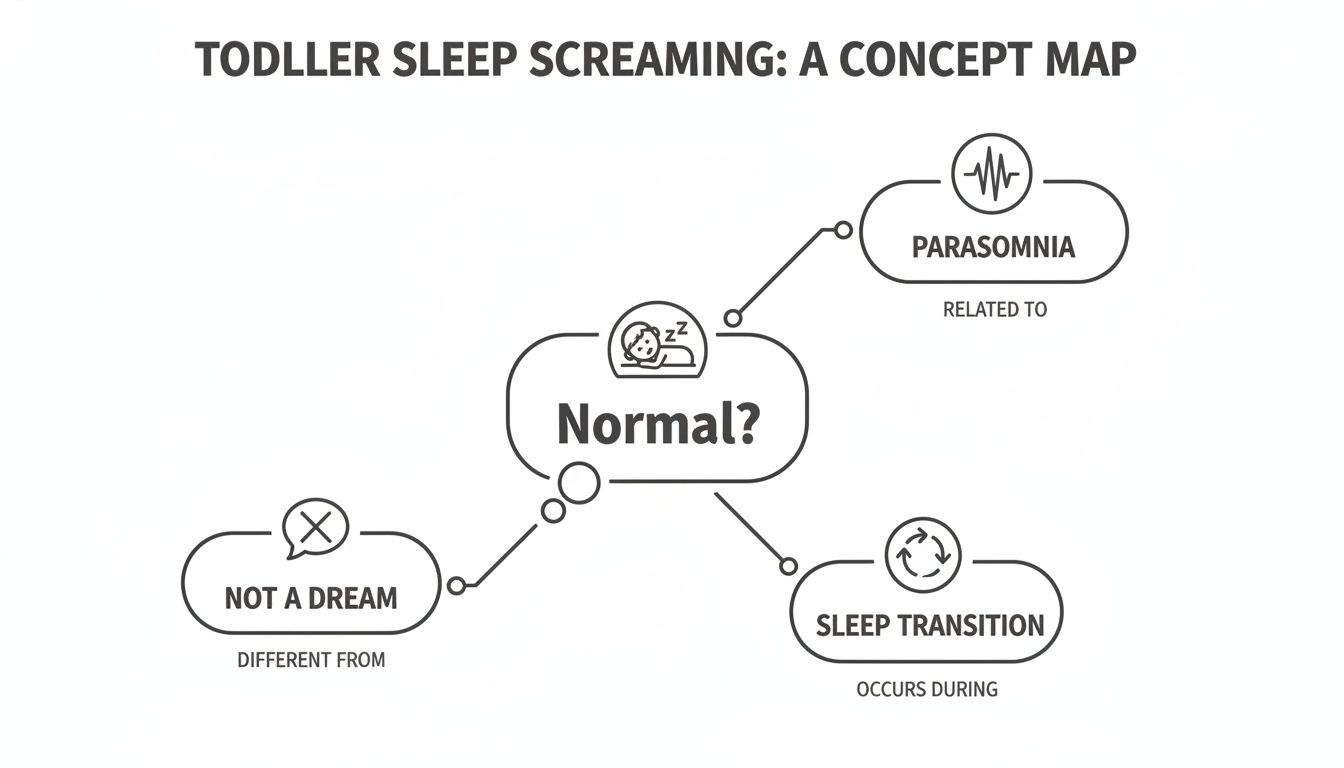
The visual clarifies that these screaming events are rooted in brain activity during sleep transitions, not conscious fear.
Nightmares Explained
Nightmares are much more familiar territory for most of us. They are simply bad dreams that happen during the lighter, REM (Rapid Eye Movement) stage of sleep. This is why they usually occur in the second half of the night or toward the early morning hours.
When your toddler wakes up from a nightmare, they are truly awake and aware of what’s going on. They will be genuinely frightened and will likely remember bits and pieces of the dream. Unlike a night terror, they will respond to your comfort and need your reassurance. A hug, a soothing voice, and knowing you’re there is exactly what they need.
Night Terrors vs. Nightmares: A Detailed Comparison
To make it even clearer, here’s a simple side-by-side look at the key differences between night terrors and nightmares.
| Characteristic | Night Terrors (Parasomnia) | Nightmares (Bad Dreams) |
|---|---|---|
| Timing | First 1-4 hours of sleep | Second half of the night, early morning |
| Sleep Stage | Deep non-REM sleep | Lighter REM sleep |
| Child's State | Asleep, unresponsive, eyes may be open | Wakes up fully, is aware and alert |
| Memory of Event | No memory the next morning | Can often remember the scary dream |
| Response to Comfort | Inconsolable, may not recognize you | Responds well to comfort and reassurance |
| Physical Signs | Thrashing, screaming, sweating, sitting up | Crying, fear, may talk about the dream |
| Returning to Sleep | Falls back asleep quickly after the episode | May have trouble falling back to sleep |
Recognizing these distinctions will help you stay calm and respond in the most supportive way possible for your child.
Statistically, night terrors are surprisingly common in early childhood, impacting 20-40% of children worldwide under the age of three. They tend to peak during the toddler years and usually disappear as the nervous system matures, dropping to just 2% in adults. You can learn more about the prevalence of night terrors in young children and why they are often considered a normal developmental phase.
For some children, especially those on the autism spectrum, these episodes can look a bit different. We explore the connection between night terrors and autism in our detailed guide.
Identifying Common Triggers for Night Screaming
Knowing the difference between a night terror and a nightmare is a huge first step. Now, it's time to put on your detective hat and start spotting the common triggers behind night screaming in toddlers. These episodes almost never happen in a vacuum; they're usually tied to specific disruptions in your little one's day.
Think of your toddler’s brain like a finely tuned instrument. When everything is in balance, sleep comes peacefully. But when something is just a little bit off, it creates enough internal static to mess up those delicate transitions between sleep cycles. The result? A screaming episode that leaves everyone shaken.
Most of these triggers fall into a few key categories that become easy to spot once you know what you’re looking for. By connecting what happens during the day to what happens at night, you can start seeing the patterns and take real, proactive steps toward more peaceful nights for the whole family.
Sleep and Schedule Disruptions
By far, the single biggest trigger for night terrors is being overtired. It's a bit counterintuitive, but when a toddler is sleep-deprived, their brain tries to compensate by spending more time in that super-deep, non-REM sleep. This actually increases the odds of a "glitch" happening when their brain tries to shift out of that deep sleep, making a night terror much more likely.
A messy schedule is usually the main culprit behind an overtired kiddo. This can happen for all sorts of reasons:
- Inconsistent Bedtimes: Even shifting bedtime by 30-60 minutes can throw off their internal body clock.
- Skipped or Short Naps: Missing that essential daytime rest creates a sleep deficit that builds up by nighttime.
- New Environments: Trying to sleep somewhere new, like grandma's house or a hotel on vacation, can be seriously disruptive.
It's helpful to remember that a toddler's nervous system craves predictability. A consistent routine tells their brain what to expect, which helps regulate sleep patterns and dramatically reduces the likelihood of those jarring arousals from deep sleep.
Physical and Environmental Factors
Sometimes, the trigger isn't about their schedule or emotions at all—it’s purely physical. An uncomfortable body or a distracting room can easily throw a wrench in their sleep architecture and spark an episode of night screaming.
Keep an eye out for these potential physical culprits:
- Illness or Fever: A rising temperature can have a major impact on brain activity during sleep.
- Full Bladder: That physical urge to use the bathroom can be just enough of a nudge to trigger an arousal from deep sleep.
- Medications: Certain new medications can interfere with normal sleep cycles, so it's always something to consider.
- Overheating: A room that’s too warm or piling on too many blankets can cause a level of physical discomfort that’s sure to disrupt sleep.
Emotional and Developmental Stress
Your toddler’s emotional world is every bit as important as their physical one. Big feelings, new milestones, and exciting experiences can easily overwhelm their developing nervous system, making it much harder for them to settle into a restful state.
A system that's stuck in "fight or flight" mode is far more prone to sleep disruptions. For a deeper look into this, our guide offers some great insights on nervous system regulation.
Some of the most common emotional triggers include:
- Big Life Changes: Things like starting daycare, welcoming a new baby brother or sister, or moving to a new house are huge stressors for a little person.
- Overstimulation: A jam-packed day full of activities or too much screen time right before bed can leave their brain buzzing for hours.
- Anxiety or Stress: Toddlers are little sponges—they absorb household tension and can struggle with separation anxiety, which often comes out at night.
By learning to spot these triggers, you can finally start connecting the dots. From there, making small, effective tweaks to your child's daily routine can make all the difference.
How to Respond During a Screaming Episode

When an episode of night screaming erupts, every parental instinct you have will scream right back: "Wake them up! Fix it!" But in the strange, upside-down world of night terrors, this is one of the few times your gut is probably wrong. Trying to intervene can actually pour fuel on the fire.
The key to navigating these intense moments is to follow two golden rules: stay calm and keep your child safe. This isn't a behavioral issue or a conscious cry for attention; it's a brief neurological storm that you simply need to ride out. Your presence is for safety, not for active comforting.
Think of it like this: your child's brain is offline for any conscious thought. Trying to reason with them is like talking to a computer that's stuck on a reboot screen—it won't process your words, and the extra stimulation can just ramp up their agitation and make the whole thing last longer.
Your Action Plan: The Dos and Don'ts
Handling an episode of night screaming in toddlers calls for a calm, steady hand. Forcing an interaction will only escalate things. The goal is to create a safe, low-stimulation bubble for the event to pass on its own.
Here’s a clear guide on what to do—and just as importantly, what not to do—when an episode is in full swing.
Essential Dos:
- Stay Present and Calm: Your main job is to be a quiet guardian. Your calm energy helps keep the environment from feeling even more chaotic.
- Ensure Physical Safety: Gently guide them away from the sides of the crib, walls, or any nearby furniture. If they’re out of bed, calmly block them from stairs or other hazards.
- Speak in a Low, Soothing Voice: While they won't understand you, a soft, murmuring tone is far less jarring than panicked shouts. Simple phrases like, "You're safe," can be said for your own benefit as much as theirs.
Critical Don'ts:
- Don't Try to Wake Them: This is the most important rule. Waking a child from a night terror can cause extreme confusion and fear, making them much more agitated.
- Don't Restrain Them Physically: Holding them down can feel threatening and may cause them to thrash even more. Your role is to guide, not to restrain.
- Don't Ask Questions: Shouting "What's wrong?" or "What are you dreaming about?" is futile. They are not conscious and cannot respond.
Remember, these episodes are much more frightening for you than for your toddler. They are completely asleep and will have absolutely no memory of their night screaming in the morning. Your primary goal is to prevent accidental injury until their brain transitions back to a peaceful sleep state.
Most episodes last somewhere between a few minutes and half an hour. Once it's over, they will likely lie back down and fall into a deep sleep as if nothing ever happened. Your best response is to quietly tuck them in, leave the room, and know that you handled it perfectly by doing very little.
Proactive Strategies for More Peaceful Nights

Knowing how to react when an episode hits is important, but the real game-changer is preventing the night screaming in toddlers from happening in the first place. When you shift from a reactive to a proactive mindset, you’re not just putting out fires—you’re building a strong foundation for healthy, restorative sleep. It’s all about creating a predictable environment that signals safety and calm to your child’s developing nervous system.
Think of it as setting the stage for a peaceful performance. Just like an actor needs the right lighting and props, your toddler needs consistent cues to transition smoothly into sleep. By focusing on consistency, you can dramatically reduce the disruptions that often trigger night terrors and other sleep disturbances.
Master the Bedtime Routine
A consistent and calming bedtime routine is your most powerful tool. This sequence of events acts like a countdown for your toddler’s brain, letting it know that sleep is on the way. The key here is predictability. Doing the same steps, in the same order, every single night reinforces this message loud and clear.
Your routine doesn't need to be complicated, but it must be relaxing. Aim for a sequence of quiet activities that help them wind down.
- Warm Bath: A gentle bath is fantastic for soothing tired muscles and signaling a transition away from a busy day.
- Quiet Play: Swap high-energy activities for things like puzzles, soft blocks, or looking at picture books together.
- Bedtime Story: Reading together in a dimly lit room is a classic way to foster connection and bring a sense of calm.
- Soft Music or Cuddles: End the routine with a few minutes of quiet connection right before you place them in their crib or bed.
Consistency helps regulate their internal clock, making it easier for them to fall asleep and stay asleep. For a deeper dive into crafting the perfect wind-down, check out our guide on how to get a toddler to sleep fast.
The Scheduled Awakening Technique
What if the night terrors are happening like clockwork, erupting at almost the exact same time each night? If that’s the case, you might consider a technique called scheduled awakening. This involves gently rousing your child before the episode is expected to happen, which can reset their sleep cycle and break the pattern.
Here’s the simple breakdown:
- Track the Timing: For a few nights, jot down the precise time the night terror kicks off.
- Set an Alarm: Plan to wake your child about 15-30 minutes before the usual episode time.
- Gently Rouse Them: You don’t need to wake them up completely. A soft touch, a quiet murmur, or adjusting their blanket is often enough to just stir them slightly.
- Let Them Resettle: They should drift back to sleep quickly. That brief interruption is often all it takes to disrupt the problematic transition into deep sleep where the terror occurs.
This method acts as a gentle reset button for their sleep architecture. Historical tracking shows that interventions like scheduled awakenings can be highly effective at disrupting the cycle of recurring night terrors.
The good news is that these events tend to decline with age. Rates often drop from 35% at 18 months to around 20% by 30 months. While many cases resolve on their own, this technique offers a proactive solution for those persistent episodes. For more on the numbers behind toddler sleep, you can explore the data behind toddler sleep patterns on urbanhello.com. By taking these proactive steps, you can start paving the way for more peaceful nights for your entire family.
Common Questions About Toddler Night Screaming
Even after you've got a handle on what might be causing those middle-of-the-night screams, a few specific questions always seem to come up. Let's walk through the most common concerns I hear from parents, giving you that final layer of reassurance and practical advice.
When Do Toddlers Usually Outgrow Night Terrors?
Here’s the good news: this is almost always a temporary phase. Most kids grow out of night terrors as their central nervous system matures and gets better at handling the transitions between sleep cycles. It's a developmental pit stop, not a permanent destination.
These episodes tend to peak between ages 2 and 4, but you’ll likely see them drop off significantly by the time your child is school-aged. It's incredibly rare for night terrors to hang around into the teenage years, which really solidifies their status as a normal part of growing up that fixes itself over time.
Should I Talk to My Toddler About It the Next Day?
My advice is to not mention it at all. Your child has absolutely zero memory of a night terror, so bringing it up the next morning can cause a lot of unnecessary confusion or even anxiety about bedtime. It can plant a seed of fear where one didn't exist before.
Unlike a bad dream they might remember and need comfort for, a night terror is a complete non-event in their mind. The best thing you can do is start the morning fresh with your normal, happy routine, as if nothing happened.
The goal is to keep their bed and their room a safe, positive space. Talking about an event they can't remember could accidentally teach them that there's something to be afraid of.
Can Certain Foods or Drinks Trigger Night Screaming?
While diet isn’t a direct cause, some foods and drinks can definitely disrupt sleep enough to make an episode more likely. Think of them as contributors, not the root of the problem.
- Caffeine and Sugar: Things like chocolate or a sugary snack too close to bedtime can rev up a toddler's sensitive system. This makes it much harder for them to settle into that deep, restorative sleep their brain needs.
- A Full Bladder: This is such a simple one, but it's a common physical trigger. That internal discomfort can be just enough to jolt them out of a deep sleep cycle. Try limiting liquids for an hour or two before bed—it's an easy and often effective fix.
When Should I Be Concerned and See a Doctor?
Most of the time, night screaming is harmless. But there are a few red flags that mean it's time to have a chat with your pediatrician. It’s always better to be cautious and rule out any other issues.
You should book a medical evaluation if the episodes:
- Start happening almost every single night.
- Regularly last longer than 30 minutes.
- Involve behaviors that could be unsafe, like trying to get out of the house.
And you should consult a doctor right away if the screaming comes with physical symptoms like excessive drooling, rhythmic jerking motions, or body stiffening. These can be signs of another medical condition, like a seizure, that needs a proper diagnosis.
Understanding the triggers and knowing how to respond can bring so much peace of mind. But if these episodes keep happening, it could be a sign that your child's nervous system is stuck in a state of stress. At First Steps Chiropractic, we focus on finding and addressing these root causes with gentle, neurologically-focused adjustments. A balanced nervous system is the foundation for peaceful sleep. Learn how we can help your family find rest and resilience.
Discover our approach to pediatric care at firststepschiropractic.com