
As a parent, you have an intuition about your child that no one else does. When you notice your toddler is developing a little differently than their peers, it can bring up a mix of confusion, worry, and a whole lot of questions.
Maybe you've noticed small things at first—they don't make much eye contact, they have a really unique way of playing with their toys, or maybe their babbling and first words are a bit delayed. It’s completely natural to feel uncertain. This guide is here to walk you through it, offering a clear, empathetic starting point that goes beyond cold clinical checklists.
The earliest signs of early autism in a toddler usually show up as differences in social interaction, communication, and behavior. It’s almost never a single red flag, but rather a unique pattern of development.
Understanding the First Signs of Early Autism in Toddlers
The most important thing to remember is that autism is a spectrum. That means it looks different in every single child. Think of it less like a list of symptoms to check off and more like a collection of traits that create your child's unique way of experiencing the world.
Our goal here isn't to diagnose your child from an article. It's to help you become a more informed observer of their specific needs, strengths, and challenges. Seeing potential signs of early autism in your toddler is simply the first step toward getting clarity and finding the right support for your family.
The Three Core Areas of Observation
When we talk about autism, we’re looking at persistent differences in two main areas: social communication and restricted, repetitive behaviors. For parents of toddlers, it's easier to break this down into three practical categories to observe in your day-to-day life.
- Social and Emotional Connection: This is all about how your toddler engages with you and others. Do they try to get your attention when they see something cool? Do they share a smile back and forth with you or light up during a game of peek-a-boo?
- Communication Styles: This covers both verbal and non-verbal communication. We're looking at everything from babbling and first words to using gestures like waving "bye-bye" or pointing to show you what they want.
- Behaviors and Interests: This area focuses on how your child plays and interacts with their surroundings. This includes repetitive motions (like hand-flapping), an intense focus on specific objects or parts of toys, and sensitivities to things like loud sounds, bright lights, or certain textures.
This visual gives a simple overview of these three key areas of development.
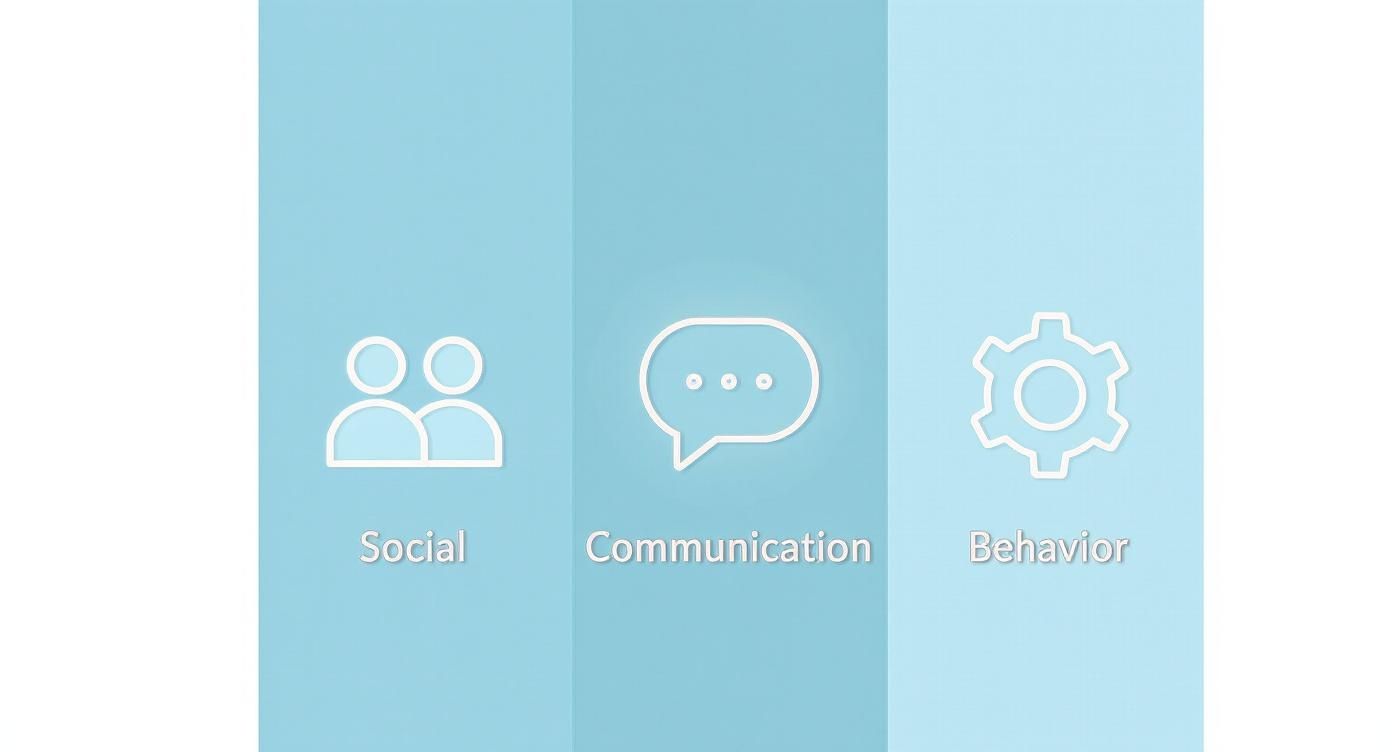
By framing what you see around social skills, communication, and behavior, you can start to build a clearer, more structured picture of your child's development to share with your pediatrician.
Why Early Awareness Matters
Thankfully, awareness of autism has grown so much over the years, leading to better and earlier identification. According to the Centers for Disease Control and Prevention (CDC), recent data shows that autism spectrum disorder (ASD) was identified in approximately one in 36 children aged 8.
Even more importantly, efforts in early identification are working—more children are receiving a diagnosis by age four now than ever before. You can dive deeper into the CDC's latest findings here.
This shift toward earlier identification is so critical. When parents and pediatricians recognize the signs of early autism in a toddler, it opens the door to early intervention services that can make a profound difference during the most formative years of brain development.
How Toddlers with Autism Connect and Communicate Differently
It's easy to get lost in checklists of symptoms, but really understanding the signs of early autism in a toddler means learning to see the world through their eyes. The way they connect and communicate isn't about a lack of wanting to engage; it’s about having a completely different way of processing the social world around them.
Think of it like trying to tune into a specific radio station. You’re both broadcasting, but the signals just aren't syncing up the way you expect. Let's explore what these different "frequencies" of connection and communication might look like in your day-to-day life.
The Nuances of Social Interaction
A different approach to eye contact is one of the most talked-about signs, but it’s rarely as simple as a child who "never" looks at you. The reality is usually much more subtle.
A neurotypical toddler might look you right in the eye when you say their name. A toddler on the spectrum might glance at your mouth instead, or focus on the colorful toy you're holding, or even look just past your shoulder. Their attention is still with you, but their focus is directed differently.
This unique way of processing social cues can also show up in other behaviors:
- Limited Shared Enjoyment: They might not bring you a toy just to show it to you or point at an airplane flying overhead simply to share the moment.
- Difficulty Imitating: They may not try to copy your funny faces, hand gestures like clapping, or the silly sounds you make during play.
- Unusual Responses to Affection: They might seem indifferent to hugs and cuddles or even resist them. On the other hand, they may seek them out, but only on their own terms.
A key concept here is joint attention—that shared moment when you and your toddler are focused on the same thing. It’s when your child looks at what you’re pointing to, then looks back at you as if to say, “Wow, you see that, too?” This back-and-forth social connection is often less developed in toddlers with autism.
Decoding Different Communication Styles
Communication is so much more than just spoken words, especially for toddlers. It's the babbling, the gestures, and the natural give-and-take of interacting. For a child with a different neurotype, this communication roadmap can look quite distinct.
Take, for instance, not responding to their name. Any busy toddler might occasionally tune you out, but a consistent lack of response, even without distractions, can be a flag. It's often not that they're ignoring you, but that their name just doesn't register with the same social importance.
This is a critical area where watching your child's patterns can give you important clues. Some parents also notice that their child's vocalizations are different, which might impact their journey to speaking. If you're looking into how developmental areas are connected, our guide on early intervention for speech delays offers some valuable insights.
Common Communication Red Flags
Beyond not responding to their name, here are some other signs you might notice in your toddler's communication style:
- Delayed Language Skills: This could mean no babbling by 12 months, no single words by 16 months, or not using two-word phrases by 24 months.
- Limited Use of Gestures: They might not use common gestures like pointing, reaching up to be held, or waving "bye-bye" by 12-14 months.
- Echolalia: This is when a child repeats words or phrases they’ve heard. While all toddlers do this as they learn language, in autistic children, it may be more frequent or used in place of creating their own sentences.
Our understanding of these signs has come a long way. Back in 1995, autism prevalence was estimated at about 1 in 500 children. Today, that number is closer to 1 in 31 children—a huge shift that reflects better public awareness and more accurate diagnostic tools. We now know that reliable signs can often be spotted as early as 14 months, which really underscores why early observation is so important.
When you look at these social and communication differences through a lens of understanding instead of judgment, you can start to see your child's world more clearly. This knowledge is power—it helps you ask the right questions and find the best support for your family's journey.
Recognizing Repetitive Behaviors and Sensory Needs
Beyond social cues and communication styles, how a toddler plays and engages with the world offers another huge window into their development. This is where we often see two classic hallmarks of autism: repetitive behaviors and unique sensory needs. These aren’t just random habits; they’re purposeful actions that tell us a lot about how a child is processing information and feeling inside.
It’s incredibly helpful to view these behaviors as a form of communication rather than problems that need to be fixed. For many children, these actions are a way to find comfort, express joy, or create a sense of order in a world that can feel chaotic and overwhelming.
Understanding Repetitive Behaviors
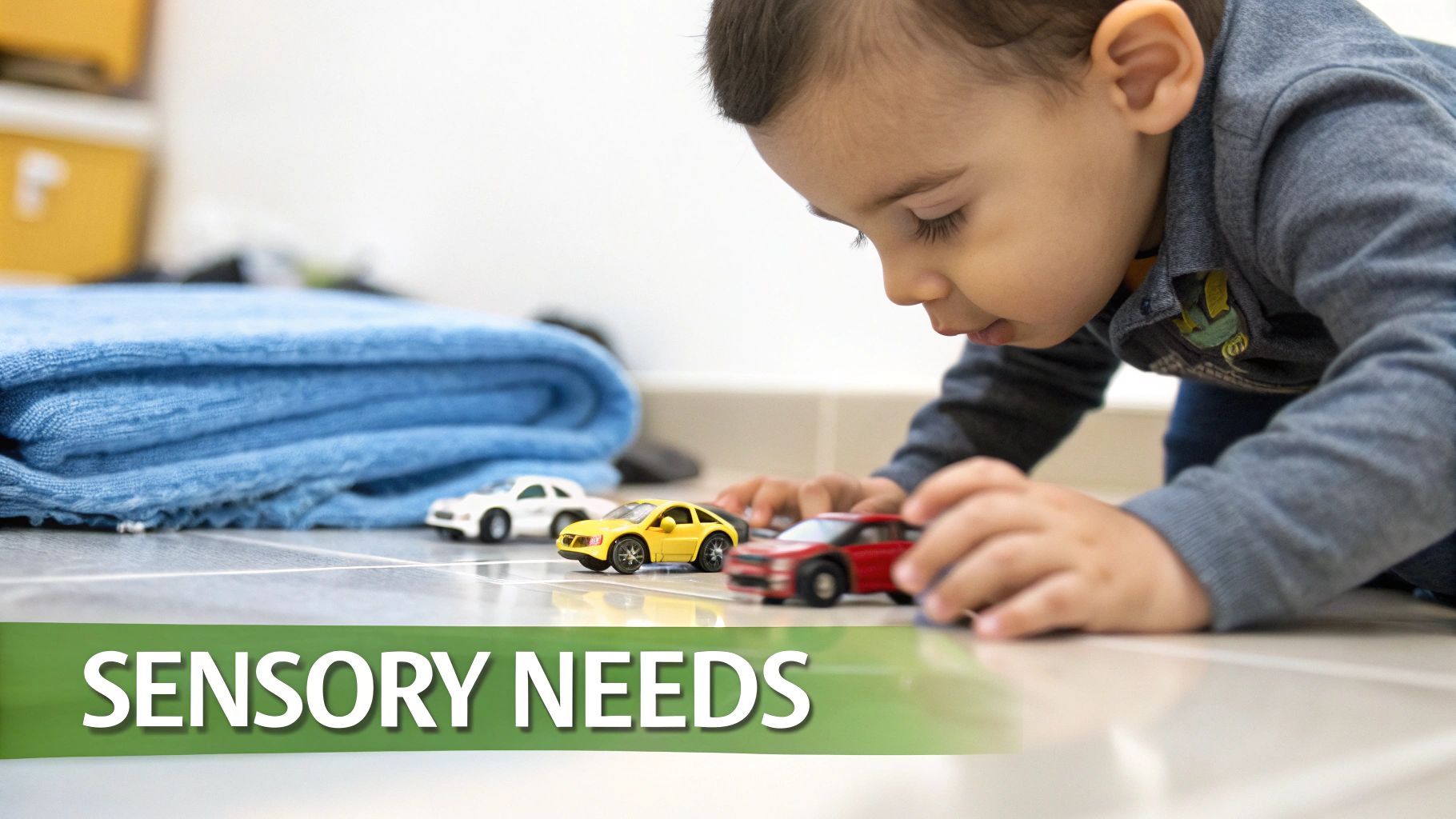
Repetitive behaviors, often called "stimming" (short for self-stimulatory behavior), look different for every child. You might see a toddler who is intensely focused on lining up toy cars in a perfect row, spinning the wheels on a truck over and over, or insisting on watching the exact same clip of a movie on repeat.
These actions serve a real purpose. They can help a child calm themselves down when they feel anxious or organize their thoughts when the world gets too loud or busy. Other common examples include:
- Repetitive Body Movements: This can look like hand-flapping, rocking back and forth, spinning in circles, or frequent toe-walking.
- Repetitive Use of Objects: This often involves playing with toys in a very specific, non-typical way, like flicking a light switch on and off or opening and closing a cabinet door again and again.
- Insistence on Sameness: A toddler might need things to be predictable and get very upset by change. This could mean taking the exact same route to the park every time or needing to eat foods in a specific order.
These patterns are often one of the key signs of early autism in a toddler. Interestingly, some research shows that toddlers diagnosed before 24 months tend to have less severe symptoms, while those identified later (between 25 to 41 months) often show more noticeable restrictive and repetitive behaviors. You can read more about these developmental findings and their impact on screening practices.
Navigating Unique Sensory Needs
We all process the world through our senses, but for many autistic toddlers, that experience is turned way up or way down. Imagine if the gentle hum of the refrigerator sounded like a roaring lawnmower, or the tag on a t-shirt felt like sandpaper scratching your skin. This can be the reality for a child with sensory sensitivities.
A toddler's sensory system can be either hypersensitive (over-responsive) or hyposensitive (under-responsive), and it's common to see a mix of both across different senses. Understanding this helps explain a lot of behaviors that might otherwise seem confusing.
It’s like their internal sensory filter isn’t calibrated the same way as a neurotypical child’s. Some information gets through too strongly, while other information barely registers at all. This is why a child might cover their ears at the sound of a vacuum cleaner but seem to not notice a scraped knee.
Common Sensory-Related Signs
Figuring out how your child processes sensory input is key. You may notice they have really strong reactions to certain things or, on the flip side, actively seek out intense sensations. Here’s what that can look like:
- Hypersensitivity (Over-Responsive):
- Extreme reactions to loud noises (blenders, hair dryers, public bathrooms).
- Distress over certain textures in food or clothing.
- Aversion to being touched unexpectedly or getting messy.
- Discomfort with bright lights or visually busy places.
- Hyposensitivity (Under-Responsive):
- A high tolerance for pain or temperature extremes.
- A constant need to touch everything and everyone.
- A love for intense movement, like spinning, swinging, and crashing into things.
- Fascination with lights, spinning objects, or visually complex patterns.
These sensory needs are deeply tied to a child’s nervous system. If you’re looking for ways to support your child’s sensory processing, our guide on helping kids with sensory issues is a great place to start. By recognizing these behavioral and sensory patterns, you can begin to better understand your toddler’s inner world and find the best ways to support their unique needs.
Your Action Plan When You Have Concerns
That little voice inside your head—your parental intuition—is your most powerful tool. If you’ve been noticing behaviors that make you pause and wonder, it’s easy to get lost in the “what-ifs.” The best thing you can do is turn that worry into confident, proactive steps.
This section is your roadmap for what comes next.
We'll walk you through a clear, manageable process. This isn't about jumping to conclusions. It’s about gathering good information so you can be the very best advocate for your child and have a productive conversation with your pediatrician.
Step 1: Document Your Observations
Before you even pick up the phone to call the doctor, let’s get your concerns out of your head and onto paper. Moving your observations from feelings to facts is incredibly helpful. Start a simple journal or even a note on your phone to track what you’re seeing day-to-day.
Try to be specific and objective. Instead of just writing "he’s not social," jot down the concrete behavior: "Today at the park, he played next to other kids but didn't look at them or try to join in." This factual approach takes the emotion out of it and gives your doctor clear, real-world examples.
For each entry, try to include:
- What happened: Describe the specific action or lack of response.
- When and where: Note the date, time, and setting (e.g., during playtime at home, at mealtime with family).
- How often it happens: Was this a one-time thing, or is it becoming a consistent pattern?
This log becomes an invaluable tool. It gives your pediatrician a much clearer window into your child’s daily life than a brief office visit ever could.
Step 2: Use a Trusted Screening Tool
Once you have some notes, using a standardized developmental screening tool can give your observations structure. These aren't diagnostic tests, but they're brilliant at highlighting which kids might need a closer look.
One of the most common and respected tools for toddlers is the Modified Checklist for Autism in Toddlers, Revised (M-CHAT-R™). It's a straightforward questionnaire you can fill out yourself, with simple yes/no questions about your child's behavior.
Think of the M-CHAT-R as a conversation starter for you and your pediatrician. It helps translate your gut feelings into the specific language of developmental milestones, making your concerns clear and focused.
Completing this screener before your appointment helps you feel more prepared and makes sure you cover all the key developmental areas during your visit. You can often find it online to print and bring with you.
Step 3: Prepare for a Productive Pediatrician Visit
Armed with your notes and screening results, you’re ready for a truly productive conversation. The goal of this initial visit isn't necessarily a diagnosis. The real goal is to get your concerns heard and, if necessary, get a referral for a comprehensive evaluation.
Here’s a quick checklist of what to bring:
- Your Observation Journal: Share those specific, written examples.
- M-CHAT-R Results: Bring a printed copy or have it ready on your phone.
- Your Top Questions: Jot down a few questions so you don’t forget anything in the moment.
- Short Videos: If you can, a few short clips on your phone showing the behaviors you’re concerned about can be incredibly powerful.
It's also important to understand the difference between a screening and a full evaluation. A screening, like the M-CHAT-R, simply flags potential risk. An evaluation is a much more in-depth process done by a specialist—like a developmental pediatrician or child psychologist—to determine if a child meets the criteria for a diagnosis. Your pediatrician is the gateway to that crucial next step.
When your pediatrician confirms your concerns and suggests a full evaluation, it’s completely normal to feel a jumble of emotions—part relief that you’re being heard, part anxiety about what comes next. Take a deep breath. This is the first real step on a path toward clarity, understanding, and getting your child the exact support they need to blossom.
The best news? You don’t have to wait. One of the most important things I tell parents is that you can—and absolutely should—start getting support services in place before you have a formal diagnosis.
What Is a Developmental Assessment?
A developmental assessment goes much deeper than a simple screening. It’s a comprehensive look at your child’s world, led by specialists who are experts in the subtleties of early childhood development. Think of it less as a single test and more as a collaborative process that usually includes:
- Detailed Parent Interviews: You’re the expert on your child. You’ll have a long, detailed conversation about your child’s history, what you see at home, and all your family's concerns.
- Direct Observation: The specialist will spend time playing and interacting with your toddler. This is where they see your child's social, communication, and behavioral skills in a natural, real-world setting.
- Standardized Tools: They’ll use specific, play-based assessment tools to gently measure skills in areas like language, motor abilities, and how your child solves little problems.
The whole process is designed to be as relaxed and low-stress for your little one as possible. The goal is to see them just as they are, which gives the specialists the most accurate picture.
Building Your Child's Care Team
The evaluation is often just the beginning of building a dedicated support team for your child. It’s not about just one professional; it’s about a team of experts, each bringing a unique skill set to help your toddler thrive.
As you start this journey, it’s helpful to know who you might meet along the way and what role they play in putting the puzzle pieces together.
| Your Toddler's Autism Support Team | ||
|---|---|---|
| Specialist | Role in Diagnosis & Support | Examples of What They Do |
| Developmental Pediatrician | A medical doctor specializing in childhood developmental differences. They often lead the diagnostic process and manage any related medical conditions. | Conducts physical exams, orders medical tests if needed, makes referrals to other specialists, and provides a formal diagnosis. |
| Child Psychologist / Neuropsychologist | An expert in child behavior, emotions, and brain development. They are highly qualified to diagnose ASD and identify co-occurring conditions. | Administers cognitive and behavioral tests, observes play, interviews parents, and helps create behavioral support plans. |
| Speech-Language Pathologist (SLP) | Focuses on all aspects of communication—verbal and non-verbal. | Helps with understanding language (receptive), using words and gestures (expressive), and the social back-and-forth of conversation. |
| Occupational Therapist (OT) | Helps with the "occupations" of childhood: playing, learning, and daily living. | Works on fine motor skills (holding a crayon), play skills, self-care (dressing, eating), and managing sensory sensitivities. |
This team approach ensures that your child is supported from every angle, creating a strong and holistic foundation for their future success.
It's also worth knowing that certain biological factors can be part of the conversation. For instance, we know from research that premature birth significantly increases the risk of autism. The prevalence of ASD in infants born very preterm is about 7%, a stark contrast to the general population. Overall, being born preterm can actually triple the odds of an autism diagnosis, a factor your care team may consider. You can learn more about the connection between prematurity and autism from CHOP.
The Power of Early Intervention
If there's one phrase I want you to remember from all of this, it's early intervention. This isn't just a buzzword; it’s the most powerful tool you have. Early intervention refers to specialized therapies for young children that start as early as possible to support their development. And again, you do not need an official autism diagnosis to qualify for many of these services.
The entire idea behind early intervention is to tap into the incredible neuroplasticity of a young child’s brain. By providing targeted, playful support during these critical first few years, you can help build foundational skills that will have a positive ripple effect for the rest of their life.
Some of the most common and effective early intervention therapies include:
- Speech Therapy: This is so much more than just talking. A good SLP can help with non-verbal communication, understanding what others are saying, and learning the social dance of a conversation.
- Occupational Therapy (OT): A fantastic OT can be a game-changer, helping your child learn to manage overwhelming sensory sensitivities, figure out how to play with new toys, and develop self-care skills like feeding and dressing.
- Developmental Therapy or ABA: These approaches use fun, play-based activities to help build positive behaviors and teach new social, communication, and learning skills in a gentle, structured way.
The Role of Chiropractic Care in a Holistic Plan
As you build a support system for your toddler, you’ll likely explore many different avenues to help them feel and function their best. While therapies like speech and occupational therapy are absolute cornerstones of early intervention, some families also find that pediatric chiropractic care fits in perfectly as a complementary part of their child's overall plan.
It’s incredibly important to be clear on this point: chiropractic care is not a treatment for autism. Instead, its entire focus is on supporting the body's nervous system—the master control system for literally everything, from movement and coordination to sensory processing.
Supporting the Nervous System Highway
Imagine your child’s nervous system is a complex communication highway, with messages constantly zipping back and forth between the brain and the body. Sometimes, physical stressors—even from something as natural as birth or minor tumbles—can create tiny interferences or "traffic jams" along this highway. In chiropractic, we refer to this concept as subluxation.
For any child, but especially one who may already have a sensitive system, making sure this highway is as clear as possible can be hugely beneficial. Gentle, specific pediatric adjustments are designed to remove these interferences, which helps support the body’s innate ability to function, heal, and adapt. The goal is simply to improve the overall function of the nervous system, which may in turn help with related challenges.
This approach is all about optimizing how the body works from the inside out. By supporting the nervous system, we aim to help the body better manage things like motor coordination, sleep patterns, or sensory input.
Many of our families report seeing positive changes in these exact areas after starting care. If you're curious and want to take a deeper dive, you can learn more about how chiropractors and autism care can intersect in a supportive, complementary role.
Ultimately, if you decide to explore this path, it's vital to choose a chiropractor with specialized pediatric training and experience. They should be a collaborative member of your child’s care team, ready to work alongside your pediatrician and therapists to provide safe, integrated support for your little one.
A Few Common Questions About Early Autism Signs
When you're trying to understand your child's development, it's natural for specific questions to pop up. Let's walk through some of the most common concerns parents have when they start noticing potential signs of early autism in a toddler. Hopefully, these clear, straightforward answers will help you feel more confident about your next steps.
Can a Toddler Show Signs but Not Be Autistic?
Yes, absolutely. It's so important to remember this. Many individual behaviors that might be flagged as autism signs—things like speech delays, being a very picky eater, or meticulously lining up toys—can also be a completely typical part of development for some kids. Development isn't a race or a straight line; every child moves at their own pace.
What defines autism is a specific pattern of persistent challenges that show up across different areas: social interaction, communication, and behavior. It’s not just about one or two quirks. This is exactly why a comprehensive evaluation from a trained professional is the only way to get a clear picture. They know how to look at everything together to understand your child's unique developmental profile.
Is It Possible for My Toddler to Lose Skills They Already Had?
Yes, and if this happens, it’s a significant red flag that you’ll want to address right away. When a child loses skills they once mastered, it’s called developmental regression. This might look like a toddler who stops using words they used to say, no longer waves "bye-bye," or seems less interested in playing with you than they were before.
If you notice any loss of skills, please contact your pediatrician immediately. It can feel really alarming as a parent, but regression is a key signal that tells professionals a swift, thorough evaluation is needed. Getting that evaluation is what opens the door to vital early support services.
What’s the Difference Between Autism and a Speech Delay?
This is such a common and important question. A speech delay is just that—a delay specifically in a child's ability to use spoken language. They might have a hard time forming words or stringing sentences together, but they often work hard to find other ways to connect with you.
Autism, on the other hand, is a much broader neurodevelopmental condition. While it often includes challenges with both verbal and non-verbal communication, it also involves differences in social interaction and a pattern of restricted or repetitive behaviors.
- Speech Delay Only: A toddler with a speech delay will typically still try to communicate. They'll point, use gestures, and make eye contact to show you what they want or need. They're still engaged in that social back-and-forth.
- Autism: A toddler on the autism spectrum often has challenges in those non-verbal and social areas, too. They might show less interest in the social give-and-take of communication altogether.
At First Steps Chiropractic, we're here to support your family’s entire wellness journey. As you build a comprehensive care team for your child, learn how our neurologically-focused pediatric chiropractic care can play a supportive role. You can schedule a complimentary consultation today by visiting us at https://firststepschiropractic.com.