
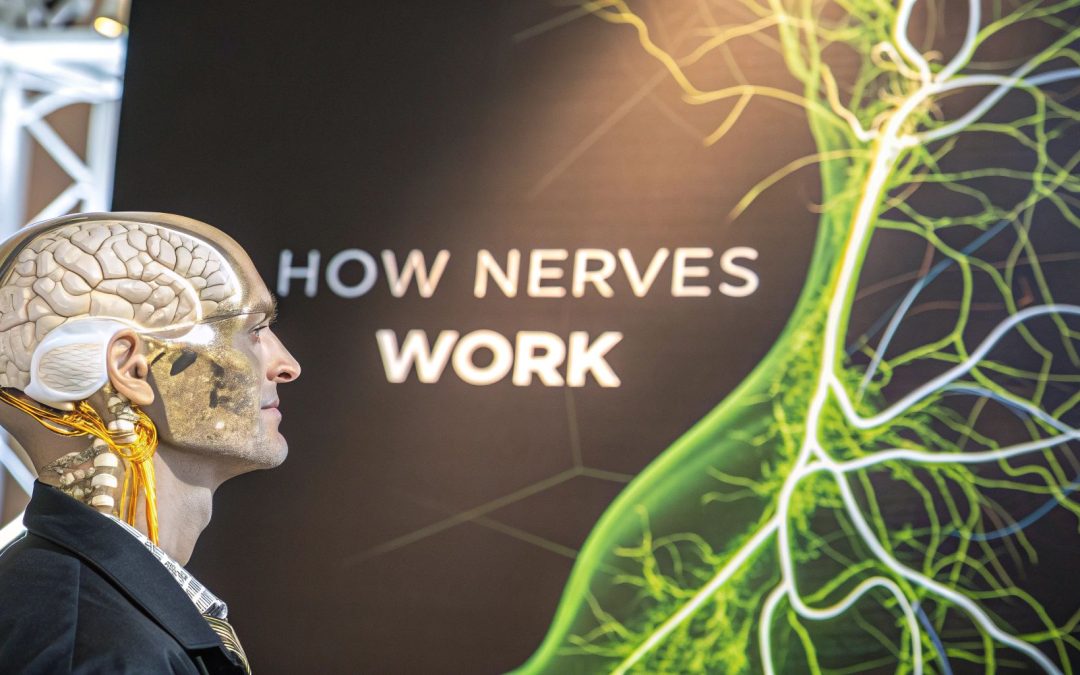
At its heart, the nervous system is a communication network. Its primary job is to transmit signals between different parts of the body, ensuring every cell, tissue, and organ works in harmony.
Think of it as a super-advanced biological computer that controls everything you do, feel, and think. It runs quietly in the background, handling automatic functions like breathing, but it's also responsible for helping you solve complex problems.
Your Body's Intelligent Control System
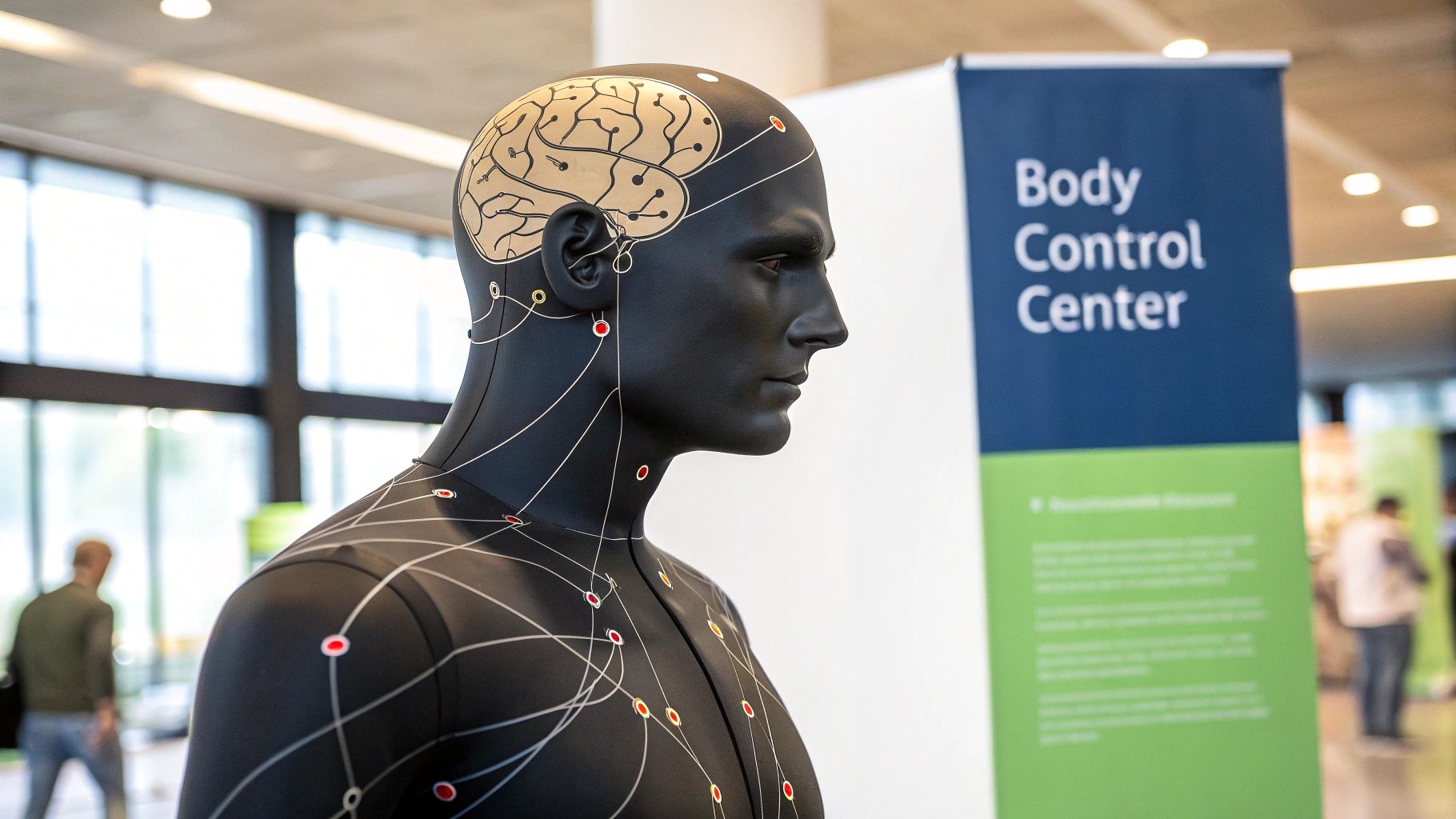
If your body were a bustling, sophisticated city, your nervous system would be the entire infrastructure rolled into one. It’s the central command center, the high-speed communication grid, and the power supply all at once, orchestrating every single process that keeps your personal metropolis running smoothly.
This incredible network is constantly engaged in a three-step cycle that defines our entire existence. It’s not a passive system waiting for instructions; it’s actively interacting with your world every millisecond of the day.
Sensing, Processing, and Responding
First, it gathers sensory input. Nerves in your skin feel the warmth of the sun, your eyes see a red stoplight, and your ears hear a friend’s voice. This is the data collection phase, where information about your internal state and external environment is constantly being gathered.
Next, your brain and spinal cord process this data in an act called integration. They analyze the incoming signals, make sense of them, and decide what—if anything—needs to be done. Is the sun getting too hot? Does the red light mean I need to stop the car? This processing happens so quickly it’s practically instantaneous.
Finally, it generates a motor output, or a response. Your brain sends commands back out through the nerve network, telling your muscles to pull your hand away from a hot stove or your foot to press the brake pedal. This cycle is how the nervous system works at its most fundamental level, ensuring you can interact with and survive in your environment.
To make this easier to understand, let's break down the three primary jobs of the nervous system.
The Nervous System's Core Functions at a Glance
| Core Function | What It Does | Everyday Example |
|---|---|---|
| Sensory Input | Gathers information from your internal and external environment. | Your hand touches a hot surface, and sensory nerves send a pain signal to your brain. |
| Integration | Processes and interprets the sensory information to make a decision. | Your brain receives the pain signal and immediately identifies it as a danger. |
| Motor Output | Activates muscles or glands to produce a response. | Your brain sends a command to the muscles in your arm to quickly pull your hand away. |
This seamless cycle happens constantly, whether you’re consciously aware of it or not, allowing your body to adapt and react to the world around you.
A Network of Billions
The sheer scale of this system is astounding. It operates through specialized cells called neurons, and the human brain alone contains approximately 86 billion of them.
Each neuron can form thousands of connections with others, creating an estimated 100 trillion synapses that allow for lightning-fast communication. This intricate web is the foundation of every thought, memory, and action you will ever experience. To learn more about this biological marvel, you can explore insights into the human brain from the American Brain Foundation.
At its core, the nervous system is a communication network. Its primary job is to transmit signals between different parts of the body, ensuring every cell, tissue, and organ works in harmony. When this communication is clear, the body can function optimally.
The Two Main Divisions of Your Nervous System
To really wrap your head around how the nervous system works, it helps to see it as a whole organization. This massive network is neatly sorted into two main branches, and each one has a very distinct, vital job.
Imagine a giant corporation with a central headquarters that makes all the big decisions, and then a massive field operations team that carries out the orders and reports back. These two divisions are the Central Nervous System (CNS) and the Peripheral Nervous System (PNS). They work together perfectly, but their jobs are completely different.
The Central Nervous System: The Command Center
The Central Nervous System, or CNS, is the ultimate command center for your entire body. It’s made up of just two parts, but they are without a doubt the most critical structures in the whole network: the brain and the spinal cord.
Using our corporation analogy, the brain is the CEO’s office. It’s where all the heavy lifting happens—complex processing, decision-making, and conscious thought. Your brain is what interprets everything you see, hear, and feel. It’s where you form memories, experience emotions, and send out high-level commands.
The spinal cord acts as the main communication superhighway, connecting the brain to every other part of the body. It runs from the brainstem down your back, safely housed inside your vertebral column. This vital pathway relays motor commands from the brain out to your body and carries sensory information from your body back up to the brain. It also handles reflexes—those lightning-fast, automatic responses that happen before your brain even has time to think.
The CNS is where it all comes together. It receives a constant stream of information from your body and the outside world, makes sense of it all, and decides what to do next. Without a healthy CNS, the data your nerves collect would just be noise.
The Peripheral Nervous System: The Messengers
While the CNS is busy making decisions, the Peripheral Nervous System, or PNS, is out in the field handling all the communication and execution. The PNS is made up of all the nerves that branch out from the brain and spinal cord, reaching every last part of you—your organs, your limbs, and even your skin.
Think of these nerves as the couriers and field agents of your nervous system. They create a vast, intricate web that makes sure no message ever gets lost. The PNS has two main pathways that handle different kinds of information.
- Sensory Pathway (Afferent Division): This pathway is all about sending information to the CNS. For example, when you touch a rough surface, the nerves in your fingers detect that texture and send the data up the spinal cord to the brain to be processed.
- Motor Pathway (Efferent Division): This pathway carries commands from the CNS out to your muscles and glands. After your brain decides to pick up a glass of water, it sends signals down this pathway to activate the exact muscles in your arm and hand needed to do the job.
The motor pathway itself is split into two more systems that control different kinds of actions: the somatic system for things you do on purpose (like walking) and the autonomic system for all the automatic functions (like breathing and digesting). The health of this autonomic system is absolutely crucial for managing stress and allowing your body to heal. You can learn more about how to support this vital system in our guide on how to repair your autonomic nervous system.
Together, the CNS and PNS create a seamless, continuous loop of communication. The PNS reports what’s happening, the CNS analyzes the report and gives the orders, and the PNS carries out those orders. This constant, high-speed teamwork is what allows you to perceive, think, feel, and interact with the world every single moment.
How Billions of Neurons Communicate
Now that we’ve looked at the big picture—the central command center and its sprawling network of messengers—let’s zoom in to see how the real work gets done. All of this incredible communication happens thanks to billions of specialized cells called neurons. They are the fundamental building blocks of your body’s entire information highway.
Think of each neuron as a tiny, biological wire designed for high-speed data transmission. While they come in different shapes and sizes, most share a few key parts. They have branch-like extensions called dendrites, which act like antennas, picking up signals from other neurons. The neuron then processes these incoming signals in its main cell body.
From the cell body, a long, slender cable called an axon extends outward. This is the main transmission line that carries the message over a distance. Many axons are wrapped in a fatty layer called the myelin sheath, which acts like insulation on an electrical cord. This coating allows the signal to travel incredibly fast—up to 250 miles per hour in some neurons.
The Action Potential Relay Race
So, how does a message actually zip down a neuron? It all starts with a tiny electrical spark known as an action potential. This isn't like the electricity powering your home; it’s a beautifully controlled wave of charged particles, called ions, that flow across the neuron's outer membrane.
You can picture it like a high-speed relay race. When a neuron receives enough stimulation, the starting pistol fires, and the first "runner" (the action potential) takes off from the beginning of the axon. This electrical impulse sprints down the entire length of the axon, never losing its speed or strength. It’s an all-or-nothing event—the signal either fires at full power or it doesn't fire at all.
This powerful system ensures that the message, whether it’s the feeling of a cool breeze or the command to kick a soccer ball, arrives at its destination just as strong as when it started.
An action potential is the fundamental electrical signal that allows neurons to transmit information rapidly over long distances. Every thought, sensation, and movement is the result of billions of these signals firing throughout your nervous system every second.
Passing the Baton at the Synapse
The real magic happens at the finish line. Neurons don't physically touch each other; there's a microscopic gap between the end of one neuron's axon and the start of the next one's dendrites. This tiny junction is called a synapse.
When the action potential reaches the end of the line, it can’t just jump across this gap. It needs a way to pass the baton. To do this, the electrical signal triggers the release of special chemical messengers called neurotransmitters.
These chemicals flood into the synapse and travel across the gap to the next neuron. There, they fit into specific receptors on the dendrites, much like a key sliding into a lock. This connection can either excite the next neuron, telling it to fire its own action potential, or inhibit it, telling it to stay quiet. It's this elegant process that turns simple electrical pulses into the nuanced instructions that run your body.
This amazing handoff—from electrical signal to chemical message and back again—happens in a fraction of a millisecond. It’s the foundation of everything your nervous system does, allowing for the incredible complexity of human thought, feeling, and action.
The diagram below gives a great high-level view of how information flows from the central decision-making hubs out to the peripheral network that carries out the commands.
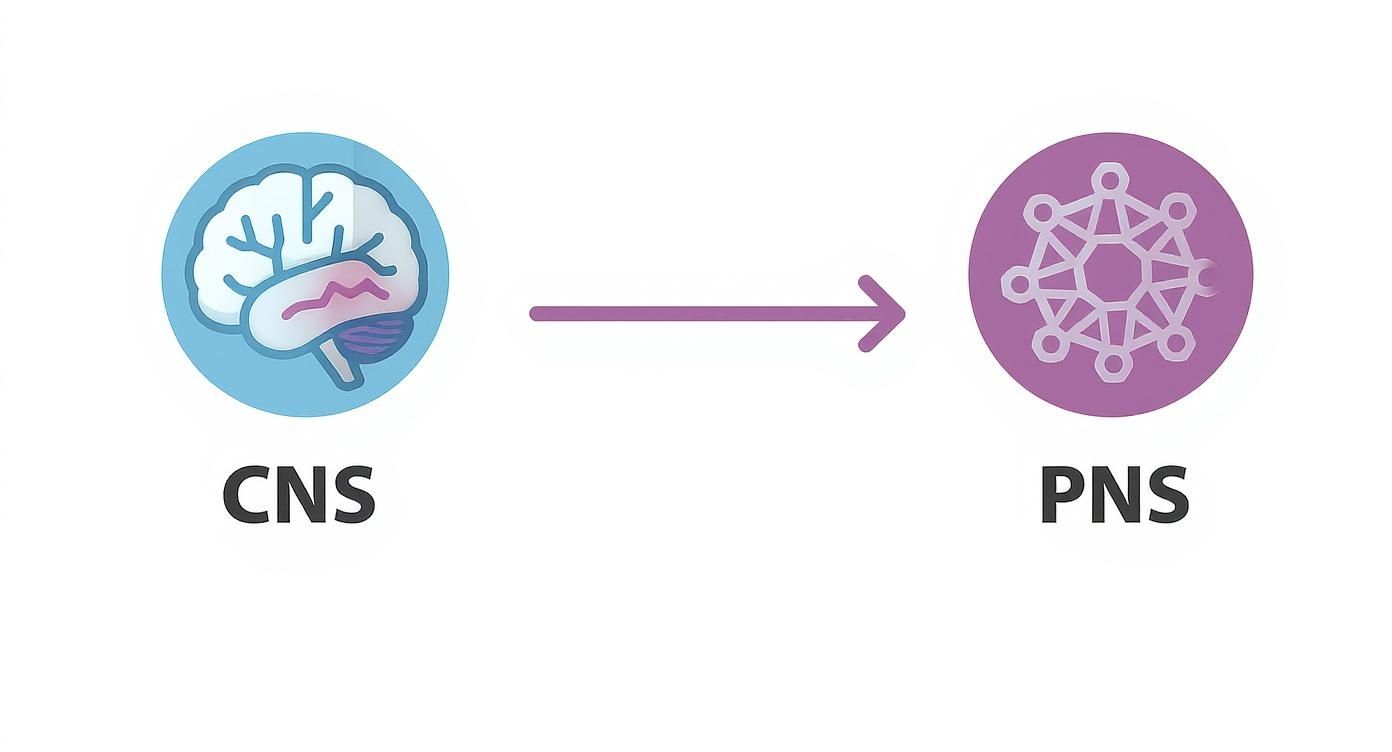
This shows how the Central Nervous System (CNS) acts as mission control, sending out orders that are distributed throughout the entire body by the Peripheral Nervous System (PNS).
When Your Body's Communication System Breaks Down
So far, we’ve painted a picture of the nervous system as a perfectly designed, high-speed communication grid. But what happens when those signals get crossed, delayed, or completely interrupted?
It's a lot like having static on a phone line. When disruptions get in the way, the messages between your brain and body become distorted, leading to a whole host of confusing and frustrating symptoms.
This breakdown in communication is what we often call nerve interference. It’s not one specific disease, but a state where the vital information flowing from your brain to every cell, tissue, and organ just isn't getting through clearly. When this happens, your body starts sending out warning signals that are easy to brush off as just part of a busy life.
Think of it like the wiring in your house. If a circuit gets overloaded or a wire is frayed, you might notice flickering lights or appliances that just don't work right. In the same way, when your nervous system is under stress, the "lights" in your body can start to flicker, too.
Recognizing the Body's Warning Signals
Your body is incredibly smart, and it will always try to tell you when something is off. The real challenge is learning how to listen. So many common issues that people struggle with every day are actually classic signs of a nervous system that's working too hard.
Instead of seeing these symptoms as separate problems, it helps to view them as clues that your body's master control system is under duress. Shifting your perspective this way is the first step toward addressing the root cause instead of just chasing symptoms.
Common warning signs of nervous system dysfunction include:
- Persistent Brain Fog: Feeling mentally sluggish, having a hard time concentrating, or struggling to remember things.
- Chronic Headaches or Migraines: Frequent head pain can be a sign that nerves are irritated or that your system is stuck in a state of stress.
- Unexplained Numbness or Tingling: That "pins and needles" feeling in your hands or feet can mean nerve signals aren't getting through properly.
- Digestive Issues: Problems like bloating, constipation, or irritable bowel syndrome (IBS) are often tied to poor communication between the brain and the gut.
These things pop up because every single function—from thinking clearly to digesting your food—depends on getting precise signals from the brain. When interference gets in the way, the organ or muscle on the receiving end doesn't get the right instructions, and its ability to function suffers. You can learn more about specific nerve-related symptoms like neuropathy in our detailed guide.
The Broader Impact of Nervous System Dysfunction
When nerve interference becomes chronic, its effects can ripple out into every corner of your life, draining your energy levels, affecting your mood, and impacting your overall sense of well-being. A dysregulated nervous system is often stuck in "fight or flight" mode, which means it’s constantly pumping out stress hormones like cortisol.
When the body's communication grid is compromised, it’s not just one system that suffers—it's the entire person. Restoring clear communication is essential for reclaiming health, energy, and vitality.
Living in this constant state of high alert leads to exhaustion, anxiety, poor sleep, and a weakened immune system. It becomes a vicious cycle: stress causes nervous system dysfunction, which in turn makes it even harder for your body to handle stress.
The consequences of widespread neurological issues are massive. Neurological conditions contribute to over 11 million deaths across the globe each year. In the Americas alone, these disorders are responsible for hundreds of thousands of deaths annually, which really highlights how critical it is to maintain a healthy, functional nervous system. To see the full scope of this, you can explore the latest data on neurological care from the World Health Organization.
Recognizing the early signs of dysfunction is key to preventing more serious issues down the road and keeping your body's internal communication network strong and clear.
Supporting Nervous System Health with Chiropractic Care

When you truly grasp how the nervous system works, you see both its incredible importance and its biggest vulnerability. The spinal cord—that information superhighway connecting your brain to every part of your body—is housed inside the 24 moving bones of your spine. While this setup offers fantastic protection, it can also become a major source of disruption.
Think about it: your spine is built to move. But physical traumas, repetitive motions, or even persistent emotional stress can cause spinal segments to get stuck or misaligned. We call these misalignments subluxations, and they can put direct physical stress on the delicate nerves that exit between the vertebrae.
This creates a state known as nerve interference, which is a lot like having static on a crystal-clear phone line. Vital messages between the brain and body get distorted, and the result is a body that simply can't function at its full potential.
Restoring Communication with Neuro-Tonal Techniques
The entire goal of modern chiropractic care is to reduce that interference. It’s not about chasing symptoms; it’s about restoring the body's own innate ability to regulate, coordinate, and heal itself by clearing the lines of communication.
We achieve this with specific, gentle adjustments. Advanced approaches like neuro-tonal techniques are designed to address the precise relationship between the spine and the nervous system. The focus is on correcting misalignments and, just as importantly, easing the tension patterns that keep the body stuck in a state of stress.
Chiropractic care is all about removing the roadblocks in your body's communication network. By restoring proper spinal alignment, we can dial down nerve interference and help the brain and body talk to each other more effectively. This leads to better overall function and health.
A great adjustment helps calm a system that might be locked in a "fight or flight" mode. It sends a signal to the brain that it's safe to shift gears into a "rest and digest" state—and that's the state where true healing, growth, and optimal wellness happen. The link between your spine and nerves is foundational to proactive health, and you can dive deeper into the connection between chiropractic care and the nervous system in our blog.
A Proactive Approach to Neurological Wellness
When you consider the staggering global impact of neurological disorders, taking proactive care of your nervous system is more critical than ever. As of 2021, these conditions affected an estimated 3.4 billion people worldwide—that's roughly 43% of the entire global population.
This isn't just one or two conditions. This massive number covers everything from migraines and diabetic neuropathy to stroke and Alzheimer's disease, showing just how essential clear brain-body communication is for our long-term health.
Chiropractic care offers a powerful, non-invasive way to support this master system. By making sure the spine is aligned correctly and moving freely, we help maintain the integrity of the nerve pathways that control every single aspect of your life. It’s one of the best ways to keep your body’s most important communication lines open and clear.
Frequently Asked Questions
After diving into the incredible world of the nervous system, it’s natural for some practical questions to pop up. Let's tackle a few of the most common ones to help connect the dots between these amazing biological concepts and your everyday life.
What Is the Difference Between the Brain and the Nervous System?
This is a great question. Think of the nervous system as your body's entire communication superhighway, and the brain is the central command center running the whole show. The brain is the main organ of the Central Nervous System (CNS), where all the information is processed and decisions are made.
But the nervous system is the whole network. It includes the brain, the spinal cord (the other half of the CNS), and the massive web of nerves branching out to every corner of your body—the Peripheral Nervous System (PNS).
So, while the brain is the boss, the nervous system is the complete, body-wide organization that makes everything happen.
Can You Actually Feel Your Nervous System Working?
While you can't feel a single neuron fire, you are constantly experiencing the results of your nervous system in action. Every single thing you feel—a gentle breeze, the warmth of the sun, the sight of a loved one—is your nervous system doing its job perfectly.
That conscious choice to lift your arm, the automatic rhythm of your heartbeat, or even that rush of anxiety before a big event are all direct outputs of its activity. And sometimes, you do feel it more directly. Symptoms like tingling, numbness, or sharp, shooting pain are clear signals that a nerve is irritated or struggling somewhere.
So much of its work is silent and automatic, but every conscious action and unconscious process is a testament to your nervous system's constant, vigilant operation. You feel its function in every single moment of your life.
How Does Stress Affect the Nervous System?
Stress is a major player here. It kicks on the "fight or flight" response, which is run by the sympathetic side of your Autonomic Nervous System. This response floods your body with hormones like cortisol and adrenaline, jacking up your heart rate and putting you on high alert to deal with a threat.
But when stress becomes chronic—day in, day out—it keeps that gas pedal floored. This prevents the "rest and digest" (parasympathetic) system from ever taking the wheel. A sustained state of high alert can lead to total nervous system exhaustion, contributing to all sorts of health issues.
Common problems linked to chronic stress include:
- Persistent anxiety or irritability
- Trouble falling asleep or staying asleep
- Ongoing digestive issues
- A weakened immune system
This constant imbalance is exactly why managing stress is so vital for keeping your nervous system healthy, regulated, and resilient.
At First Steps Chiropractic, we specialize in identifying and addressing nerve interference to help your body function at its absolute best. If you're ready to improve your family's health from the inside out, schedule a complimentary consultation with us today.