
Welcome to one of parenting's most challenging—and rewarding—stages. If you're feeling overwhelmed by your 2 year old behavior problems, from the non-stop tantrums to the endless defiance, you are absolutely not alone. These actions are almost always signs of incredible developmental growth, not a toddler intentionally trying to push your buttons.
Understanding Your 2 Year Olds World
Navigating the "terrible twos" feels a lot less terrible once you understand what's really driving the chaos. This isn't just a phase of "bad behavior" to be endured; it's a period of explosive brain development.
Your toddler is a tiny explorer, simultaneously figuring out their independence, their emotions, and the rules of a world that often makes zero sense to them. Their powerful desire to be their own person is rapidly outpacing their ability to communicate clearly or regulate their feelings.
Imagine trying to assemble a complex piece of furniture with only a hammer and a few mismatched screws. That’s your two-year-old trying to handle huge emotions with a brain that’s still very much under construction. This mismatch between their big feelings and their limited toolkit is the true source of most challenging behaviors.
From Defiance to Development
When your toddler screams "NO!" at the top of their lungs or casually flings their dinner onto the floor, they aren't trying to make your life difficult. They are communicating in the only way they currently know how.
Shifting your perspective from managing defiance to guiding development is the first, most powerful step toward more peaceful parenting. This guide will help you understand the why behind their actions, offering real-world strategies grounded in compassion and developmental science.
The key is to see the struggling child, not the misbehaving child. Their actions are a raw form of communication, telling you they need help, connection, or a different approach to meet their needs.
While many of these behaviors are completely normal, it's also true that behavioral disorders are a significant concern for young children. Data from 2022-2023 shows that 8% of children aged 3-17 had a diagnosed behavior disorder. So, while most 2 year old behavior problems are a normal part of growing up, understanding what's typical can help you spot when more support might be needed. You can learn more about the prevalence of these issues from recent studies.
Our goal is to equip you with the knowledge to:
- Distinguish between typical toddler testing and genuine red flags.
- Respond to tantrums and defiance with confidence instead of frustration.
- Recognize how factors like overstimulation can fuel difficult moments. You can check out our guide on understanding what is overstimulation.
- Build a stronger, more connected relationship with your child through it all.
What Normal Behavior Looks Like For a 2 Year Old
Before we can even begin to talk about “problems,” we have to get on the same page about what’s actually normal for a two-year-old. This age is a whirlwind of growth, and frankly, a lot of the behaviors that drive parents crazy are actually positive signs of a developing mind and personality.
When you understand the why behind the defiance, the tantrums, and the constant limit-testing, it can completely shift your perspective from frustration to fascination.
Think of your toddler as a tiny scientist who just got their own lab—your house. Every time they shout "NO!", push a boundary, or insist on doing something “by myseeeeelf,” they’re gathering critical data. They're learning about cause and effect, figuring out their own capabilities, and discovering the social rules of your family. This isn't defiance for the sake of it; it's literally their job right now.
This flowchart really breaks down how a toddler’s developing brain and limited communication tools bubble up into the big, emotional behaviors you see every day.
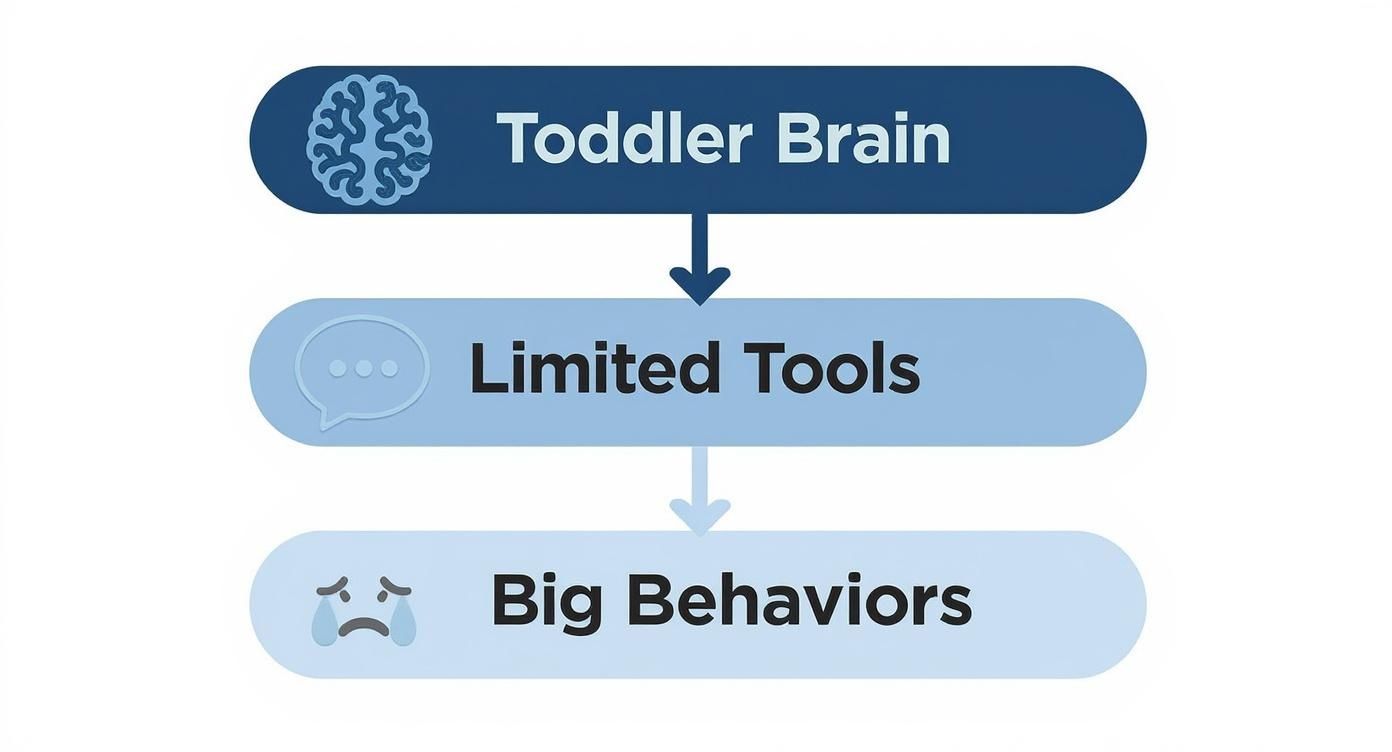
As you can see, their brain is still under major construction. That directly impacts their ability to communicate what they need, which often results in the challenging behaviors that leave parents scratching their heads.
The Brain Science Behind the Behavior
Your two-year-old’s brain is firing on all cylinders, but the part responsible for self-control—the prefrontal cortex—is the least developed. This is the brain's CEO, in charge of impulse control, emotional regulation, and making rational decisions.
In a toddler, that CEO is basically on a coffee break for the next several years.
This means when they get overwhelmed, tired, or frustrated, they simply don’t have the internal wiring to calm themselves down. Their reaction is pure, unfiltered emotion. This biological reality is the engine behind most 2 year old behavior problems.
The classic toddler tantrum isn't a sign of a "bad" child. It's a sign of a brain that's been pushed past its developmental limits. It’s an emotional SOS, not a calculated act of manipulation.
Common (and Perfectly Normal) Behaviors
So, what does this look like in daily life? A few behaviors are practically hallmarks of being two. Recognizing them as normal can seriously lower your own stress levels and help you respond more effectively.
- Intense Emotions and Tantrums: They can't say, "I feel disappointed that we have to leave the park now." Instead, they show you with their whole body—screaming, crying, or throwing themselves on the floor.
- Defiance and Saying "No": This is a huge, powerful sign of their budding independence. They are just now realizing they are a separate person from you with their own thoughts and desires. It’s a milestone!
- Possessiveness ("Mine!"): Two-year-olds are just starting to grasp the concept of ownership and themselves as individuals. Sharing is a complex social skill that is well beyond what their brain can handle right now.
- Testing Boundaries: How do they learn where the limits are? By pushing them. This actually gives them a sense of security, helping them learn that the rules are consistent and predictable.
While these behaviors are typical, it's also true that behavioral and conduct problems are becoming more common. The National Survey of Children's Health found that the prevalence of children diagnosed with these issues rose from 9.2% in 2019 to 10.3% in 2022.
Being aware of these trends can help parents stay informed, and you can discover more insights about child health data from the full research. This awareness empowers you to tell the difference between a developmental phase and something that might need more attention.
Typical Toddler Behaviors vs Potential Red Flags
Knowing where the line is between a typical developmental stage and a potential red flag can help you parent with more confidence and less anxiety. This table offers a clear comparison to help you assess your child's behavior.
| Behavior | What's Typical at Age Two | Potential Red Flag to Monitor |
|---|---|---|
| Tantrums | Intense but short-lived (usually under 15 minutes). Triggered by frustration, fatigue, or hunger. Child can be comforted afterward. | Tantrums that consistently last longer than 25 minutes, are self-injurious (head-banging), or happen multiple times a day. Child remains inconsolable for a very long time after the tantrum ends. |
| Social Interaction | Plays alongside other kids (parallel play) but isn't great at sharing. May be shy or wary around strangers. | Avoids all eye contact, doesn't respond to their name, and shows no interest in other children or caregivers. Seems to exist in their own world and doesn't try to get your attention. |
| Communication | Uses simple two-word phrases ("want juice"). Can follow simple commands. Vocabulary is expanding but communication is still limited. | Significant speech delays (fewer than 50 words by age 2), doesn't use gestures like pointing to communicate needs, or loses language skills they once had. |
| Repetitive Behaviors | Enjoys routines and predictability. May have a favorite toy or repeat certain actions as they learn. | Gets stuck on certain repetitive motor actions (hand-flapping, spinning) that interfere with play. Becomes extremely distressed when a specific routine is altered even slightly. |
| Aggression | Occasional hitting, biting, or pushing, usually out of frustration or an inability to communicate. Doesn't understand the impact on others. | Frequent, unprovoked aggression toward others or themselves. The aggression is intense and the primary way they interact with peers or caregivers, showing little to no remorse. |
This table is just a guide, not a diagnostic tool. Every child develops at their own pace, but if you're consistently seeing behaviors in the "Red Flag" column, it's a good idea to bring it up with a trusted professional.
Uncovering the Root Causes of Toddler Behavior
Challenging behaviors are almost never what they seem on the surface. When your two-year-old lobs a bowl of crackers across the room, it's incredibly easy to label it as defiance. But that action is just the tip of the iceberg; underneath, there’s a whole world of unmet needs, hidden triggers, and overwhelming stressors that are the real reasons for their behavior.
To really guide your toddler effectively, you have to put on your detective hat. Instead of just reacting to what they do, the goal is to get curious and investigate why they do it. This simple shift in perspective can move you from a place of frustration to one of genuine understanding and connection, letting you solve the actual problem instead of just playing whack-a-mole with the symptoms.
The Foundational Needs: Sleep and Nutrition
Before we dive into the deep end of toddler psychology, let's start with the basics. A toddler's ability to manage their big feelings is directly wired to their physical well-being. Think of their self-control like a little bucket of water—when they're tired or hungry, that bucket is practically empty before the day even gets going.
A hungry toddler is running on fumes, making it nearly impossible for them to cope with even the smallest frustration. In the same way, study after study shows that not enough sleep torpedoes a child's mood, attention span, and impulse control. For a two-year-old, a missed nap or a slightly-too-late bedtime can single-handedly cause an entire afternoon of meltdowns.
Just like a car can't run without fuel, a toddler's brain can't regulate emotions without adequate sleep and proper nutrition. Often, the solution to a major meltdown is as simple as a healthy snack or an earlier bedtime.
Sensory Overload in a Big World
Have you ever felt completely frazzled and on edge in a loud, crowded space? For some toddlers, a routine trip to the grocery store can feel like being front row at a chaotic rock concert. Their developing nervous systems are still figuring out how to process all the information the world throws at them—the bright fluorescent lights, the cacophony of sounds, the different textures of clothing and surfaces.
When all this sensory input becomes too much to handle, their system goes into overload, triggering a full-blown sensory meltdown. This isn't a tantrum they're throwing to get something they want; it’s an involuntary, neurological "check out." They aren't giving you a hard time; they are truly having a hard time.
Learning the signs of sensory sensitivity is a game-changer for so many families. Understanding the different ways kids process the world can help you pinpoint their triggers and create a calmer, more supportive environment. To go deeper, you can explore our detailed guide on recognizing sensory processing disorder symptoms and better understand your child’s unique needs.
Recognizing sensory triggers might look like:
- Auditory Sensitivity: Covering their ears when the vacuum, blender, or a public hand dryer turns on.
- Visual Overload: Becoming distressed and irritable in brightly lit stores or rooms filled with visual clutter.
- Tactile Defensiveness: Refusing to wear certain clothes because of the tags or seams, getting upset by messy hands, or shying away from hugs.
Major Life Changes and Emotional Upheaval
Toddlers are creatures of habit. They thrive on predictability and routine because it makes their world feel safe and manageable. When a big life change throws that routine into disarray, their behavior is often the first place you'll see the stress bubbling to the surface.
Events that seem perfectly normal to us can feel like a seismic shift to a two-year-old. These disruptions can easily trigger a regression in behavior—like potty training accidents or sleep issues—or an uptick in clinginess, tantrums, and defiance as they grapple with huge feelings they simply don't have the words for yet.
Common life changes that often impact toddler behavior include:
- Arrival of a New Sibling: Suddenly, your toddler is no longer the center of the universe, and the whole family dynamic has changed.
- Starting Daycare or Preschool: They're navigating a brand-new environment with new faces, new rules, and new expectations. It's exhausting.
- Moving to a New Home: Everything familiar—their room, their yard, their neighborhood—is gone overnight.
- Family Stress: Toddlers are little emotional sponges. They soak up the tension, anxiety, and stress around them, even if they don't understand what's causing it.
By looking beneath the surface of 2 year old behavior problems, you can start to see the unmet needs and hidden stressors driving their actions. This detective work is what allows you to respond with empathy and provide the specific support your child needs to navigate their big, and sometimes overwhelming, world.
Actionable Strategies for Managing Tough Moments
Knowing the "why" behind your two-year-old's behavior is a total game-changer. But now it’s time for the "what to do" part—your practical playbook for those really tough moments. Responding well isn't about memorizing complex discipline theories; it's about having simple, compassionate, and consistent strategies ready to go when emotions are running high.
Here, we'll break down proven techniques for the most common 2 year old behavior problems: tantrums, hitting, and that classic toddler defiance. The goal is to shift from reacting out of pure frustration to responding with real intention. It’s how we turn challenging moments into opportunities to connect and teach.
The Power of Co-Regulation
Before we jump into specific tactics, let's talk about the most powerful tool you have: your own calm. Co-regulation is the process where your settled nervous system actually helps soothe your child's dysregulated one. When your toddler is lost in an emotional storm, you are their safe harbor.
Think of it like this: you can't put out a fire with more fire. Yelling or getting flustered just adds fuel to their emotional blaze. By staying calm, speaking in a low, steady voice, and taking deep breaths yourself, you are literally modeling the emotional control they simply don't have yet. This isn't just about surviving the moment; it's about teaching them a foundational life skill.
Your calm is a tangible gift you give your child during their most chaotic moments. It communicates safety, offers a blueprint for self-soothing, and reinforces that you are their rock, even when they feel out of control.
Taming Toddler Tantrums
Temper tantrums are a hallmark of this age, but how you respond can determine if they last five minutes or twenty-five. The secret is to see it as an emotional SOS, not a deliberate act of defiance.
A Step-by-Step Guide to Tantrums:
- Stay Present and Safe: First things first, make sure they are physically safe. If you need to, gently move them away from anything that could cause harm. Stay close by, but don't try to reason or lecture—their logical brain is completely offline.
- Name the Feeling (Don't Fix It): Give their big emotion a name. Simple validation like, "You are so mad that we have to leave the park," helps them feel seen and understood. You're not agreeing with the behavior; you are just acknowledging the feeling behind it.
- Hold the Boundary with Compassion: This is key. Do not give in to whatever demand triggered the meltdown. Calmly and firmly repeat the limit: "I know you're upset, but we are still going home now." Consistency is your best friend here.
Once the storm passes, that's your moment for connection. A hug, a quiet snuggle, or reading a book together reconnects you both and reassures them that your love is unconditional, even when their feelings are huge.
Addressing Hitting and Aggression
It can be shocking when your sweet toddler suddenly hits, bites, or kicks. But remember, this is almost always a sign of an overwhelmed child who just doesn't have the words to express intense frustration.
How to Respond When Your Toddler Hits:
- Get in Front of It: The best strategy is always prevention. Start noticing their triggers—are they tired, hungry, or overstimulated? A well-timed snack or a bit of quiet time can head off so many aggressive outbursts. Exhaustion is a massive culprit, and knowing how to get a toddler to sleep fast can be a crucial part of your parenting toolkit.
- Intercept with a Clear Script: Gently but firmly block their hand and use a simple, direct phrase like, "I won't let you hit. Hitting hurts." Your tone should be calm and neutral, not angry. The goal is to stop the action and teach, not to shame.
- Offer a Safe Alternative: Their body needs to release that big energy. Give them a "yes" for that feeling. You could say, "You can't hit Mommy, but you can stomp your feet right here, or you can hit this pillow." This teaches them a better way to handle that physical impulse next time.
Navigating Defiance and the Power of "No"
Those constant "no's" and outright defiance are actually signs of their developing independence—a huge milestone! While it's frustrating, this is their way of testing the world and figuring out their own sense of self. The trick is to offer them a sense of control within the boundaries you set.
Strategies for Fostering Cooperation:
- Offer Limited Choices: This is the single most effective tool for this age group. Instead of a command ("Put on your shoes"), offer a choice: "Do you want to wear your red shoes or your blue shoes?" This gives them a feeling of power while making sure the necessary task still gets done.
- Use "First, Then" Language: Toddlers understand sequences way better than abstract commands. Frame your requests in a positive, forward-moving way. "First, we put away the blocks, then we can have a snack."
- Make it a Game: Turn cleanup into a race, make brushing teeth a hunt for "sugar bugs," or pretend you're roaring dinosaurs on the way to the car. A little bit of playfulness can bypass their instinct to resist and make daily routines feel like fun instead of a fight.
By equipping yourself with these actionable, compassionate strategies, you can confidently navigate the tough moments. Each interaction becomes a chance not just to manage behavior, but to build a stronger, more connected relationship with your growing two-year-old.
Knowing When to Seek Professional Support
You have one of the most powerful tools in your arsenal: your parental intuition. While most challenging 2 year old behavior problems are just a normal part of growing up, sometimes that little voice in your head is right—something more might be going on.
Listening to that instinct isn't about looking for problems. It’s about making sure your child has every possible tool to thrive. The goal is never to label a child but to truly understand them. Seeking professional support is a proactive, loving step that opens the door to resources, strategies, and answers, moving you from a place of worry to one of confidence.
Red Flags That Warrant a Conversation
So, how do you tell the difference between a typical toddler moment and a sign that it’s time to call for backup? It’s less about a single behavior and more about its frequency, intensity, and impact on your child and family.
Here are some clear signs that it’s a good idea to chat with a professional:
- Extreme Intensity or Frequency: These aren't just occasional flare-ups. We're talking about tantrums happening multiple times a day or aggression being the immediate response to any frustration.
- Safety Concerns: The behavior consistently puts your child or others in real danger. This could be frequent head-banging, biting that breaks the skin, or a tendency to run into unsafe situations without any sense of boundaries.
- Significant Family Distress: The behaviors are so disruptive they’re seriously impacting your family's well-being. This might mean extreme stress for parents, negative effects on siblings, or finding it nearly impossible to go out in public.
- Lack of Progress: You’ve been using consistent, positive strategies for weeks, but the behavior isn’t getting any better—or it’s actually getting worse.
- Developmental Delays: The challenging behaviors are popping up alongside noticeable delays in speech, motor skills, or social interaction, like avoiding eye contact or not responding to their name.
It’s also helpful to remember that culture plays a role. Research has shown that toddler behaviors can look different across various populations. For instance, American babies often tend to be more social and impulsive than infants from other countries, which may reflect different parenting norms. You can read the full research about these cultural findings for more insight.
Who to Turn To for Help
Knowing you need help is the first step; knowing where to go is the next. The good news is there’s a whole network of professionals trained to support young children and their families, each with a unique role in getting to the root of behavioral challenges.
Trusting your gut is essential. If you feel something is off, it is always worth investigating. You know your child better than anyone, and advocating for their needs is the most important job you have.
Here’s a look at who can help and what they do:
- Your Pediatrician: This is always your best first stop. Your pediatrician can rule out any underlying medical causes, like persistent ear infections or sleep problems, that might be fueling the behavior. They can also conduct developmental screenings and provide referrals to specialists.
- Child Psychologist or Therapist: These professionals are experts in child development and mental health. They can assess for behavioral disorders, offer parent coaching on effective strategies, and use tools like play therapy to help children learn to manage their big emotions.
- Occupational Therapist (OT): If you have a hunch that sensory processing issues are a major trigger for meltdowns, an OT is an incredible resource. They can pinpoint sensory sensitivities and design a "sensory diet"—a plan of activities that helps your child's nervous system stay regulated and calm.
- Neurologically-Focused Pediatric Chiropractor: Professionals like us here at First Steps Chiropractic focus on how the nervous system is functioning. Using gentle, specific techniques, we can help find and address underlying neurological stress that may be contributing to behavioral challenges, sensory issues, and sleep disturbances, helping your child’s system find better balance from the inside out.
Common Questions About 2-Year-Old Behavior
When you’re in the thick of it with a two-year-old, it can feel like you’re trying to read a map where all the roads keep changing. It’s completely normal to have questions about the intense, confusing, and sometimes downright shocking behaviors that seem to pop up overnight.
Here, we’ll tackle some of the most common questions we hear from parents. Think of this as your quick-reference guide for those moments that leave you wondering, "Is this actually normal?" and "What on earth do I do right now?"
Is It Normal For My 2 Year Old to Hit Me?
Yes, it's incredibly common, though that doesn't make it any less upsetting when it happens. Toddlers at this age are all gas, no brakes. They're flooded with big feelings like anger and frustration but don't have the impulse control or the words to express them. Hitting is simply the most direct way for their little bodies to let that overwhelming energy out.
The goal isn't to punish but to teach. Stay as calm as you can, gently but firmly hold their hands, and say, “No hitting. Hitting hurts.” Then, help them name the feeling behind the action: “You are so angry that we have to leave the park.”
Give them a safe alternative. “When you're angry, you can stomp your feet like a dinosaur or hit this pillow.” Consistent boundaries, combined with teaching them a better way to handle that energy, will give them the tools they need over time.
What Should I Do When My Toddler Ignores "No"?
Welcome to the world of boundary testing! This is a healthy, necessary, and often frustrating part of their development. Before you do anything else, take a quick inventory of how often you say the word “no.” If it’s on repeat all day long, it can start to fade into the background and lose its power. Try to save it for the big things, especially safety issues.
When you do have to say it, make it count. Get down on their level, make eye contact, and use a calm but firm voice. The most important part? You must immediately and gently follow through with an action. For example, “No climbing on the table. We keep our feet on the floor.” If they do it again, you gently lift them down.
Consistency is everything. If a toddler learns that 'no' sometimes means 'maybe if I try again,' they are biologically wired to keep trying. A firm, kind, and consistent 'no' teaches them the rule is real, which ultimately makes them feel more secure.
Do Time Outs Work For a 2 Year Old?
The short answer is no, not in the traditional sense. Sending a two-year-old to sit alone is largely ineffective because their brains simply aren't developed enough to reflect on their behavior in isolation. More often than not, it feels like rejection right when their emotions are spiraling out of control.
A much better approach is what we call a "time-in" or a "calm-down corner." This isn't a punishment; it's a chance to co-regulate together. When your child is overwhelmed, you guide them to a cozy, safe spot with you.
You can say something like, “Wow, our bodies are feeling really upset. Let’s sit here together and take some big breaths until we feel calm.” You are modeling how to manage big emotions and reinforcing that you are their safe place—even when they feel out of control. This builds connection while still removing them from the situation.
How Can I Tell a Tantrum From a Sensory Meltdown?
This is a critical distinction to make because how you respond should be completely different. A tantrum is usually about wanting something, while a meltdown is a neurological short-circuit.
Here’s a simple way to think about it:
- A Tantrum: This is often goal-oriented. The child wants a toy, wants to avoid bedtime, or wants that cookie. The outburst is directed at someone and will usually stop if they get what they want or realize it's not going to work.
- A Sensory Meltdown: This is an involuntary nervous system response to being overwhelmed by sensory input—too much noise, crowds, bright lights, or even the tag on their shirt. The child isn't in control and may seem completely unaware of what’s going on around them.
For a tantrum, your job is to hold a firm and loving boundary. For a meltdown, your job is to reduce the sensory noise and provide a safe, quiet space for their overloaded nervous system to recover.
At First Steps Chiropractic, we understand that a well-regulated nervous system is the foundation for balanced behavior. If you're looking for answers that go beyond the surface, our neurologically-focused approach can help. Schedule a complimentary consultation with us today.